When you click on links to various merchants on this site and make a purchase, this can result in this site earning a commission. Affiliate programs and affiliations include, but are not limited to, the eBay Partner Network.
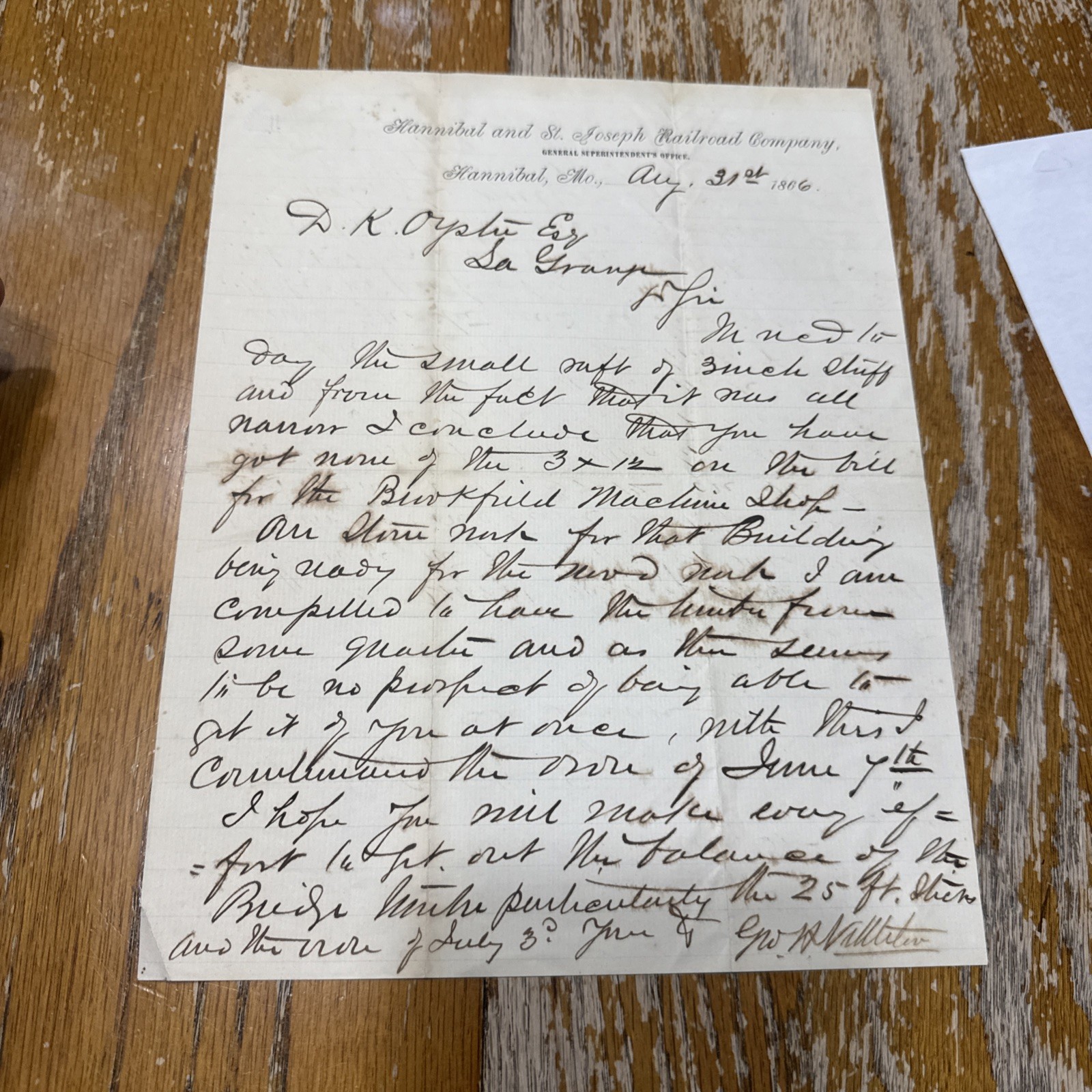
Hannibal and St. Joseph Railroad Company,
General Superintendent’s Office,
Hannibal, Mo., Aug. 31st 1866.
D. K. Owsley Esq.
La Grange
Sir
We rec’d to
day the small raft of 3 inch stuff
and from the fact that it was all
narrow I conclude that you have
got none of the 3 × 12 on the bill
for the Brookfield Machine Shop.
Our stone work for that building
being ready for the wood work I am
compelled to have the timber from
some quarter and as there seems
to be no prospect of being able to
get it of you at once, with this I
countermand the order of June 7th.
I hope you will make every ef-
fort to get out the balance of the
Bridge timber particularly the 25 ft. sticks
and the order of July 3rd.
Yours &c
Geo. H. Nettleton
George H. Nettleton (1831–1896) was a significant railroad engineer and executive, and this 1866 letter captures him early in his career.
Key facts about him
• Born November 13, 1831, in Chicopee Falls, Massachusetts.
• Trained as a civil engineer (briefly attended Rensselaer Polytechnic Institute).
• Worked on early eastern railroads, then moved west.
• By the mid-1860s he was serving as Assistant Superintendent of the Hannibal & St. Joseph Railroad (the role shown on this letter).
• He later served as a civil engineer on the famous Hannibal Bridge (the first permanent railroad bridge across the Missouri River at Kansas City, opened 1869). This bridge was built for the Hannibal & St. Joseph Railroad and was a major engineering achievement of the era.
• In 1872 he became General Superintendent of the Atchison, Topeka & Santa Fe Railroad.
• He moved to Kansas City in 1874 and became a major figure in the city’s growth as a rail and livestock center. He headed the Union Depot Company, helped organize the first Kansas City Stockyards, and later served as president of the Kansas City, Fort Scott & Memphis Railroad (which became part of the Frisco system).
• He died in Kansas City on March 26, 1896.
Significance of the letter
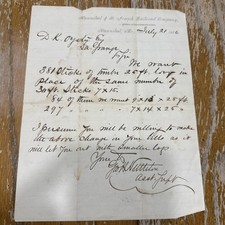
This July 21, 1866 letter is an early example of Nettleton’s work while he was still rising through the ranks on the Hannibal & St. Joseph. At the time he was handling practical operating details such as adjusting timber (likely ties or structural lumber) orders with local suppliers. It shows him already in a position of authority only a year after the Civil War.
Because Nettleton later became a well-known railroad executive and civic leader in Kansas City, letters bearing his signature from this early period have added historical interest for collectors of Missouri railroad material.