When you click on links to various merchants on this site and make a purchase, this can result in this site earning a commission. Affiliate programs and affiliations include, but are not limited to, the eBay Partner Network.
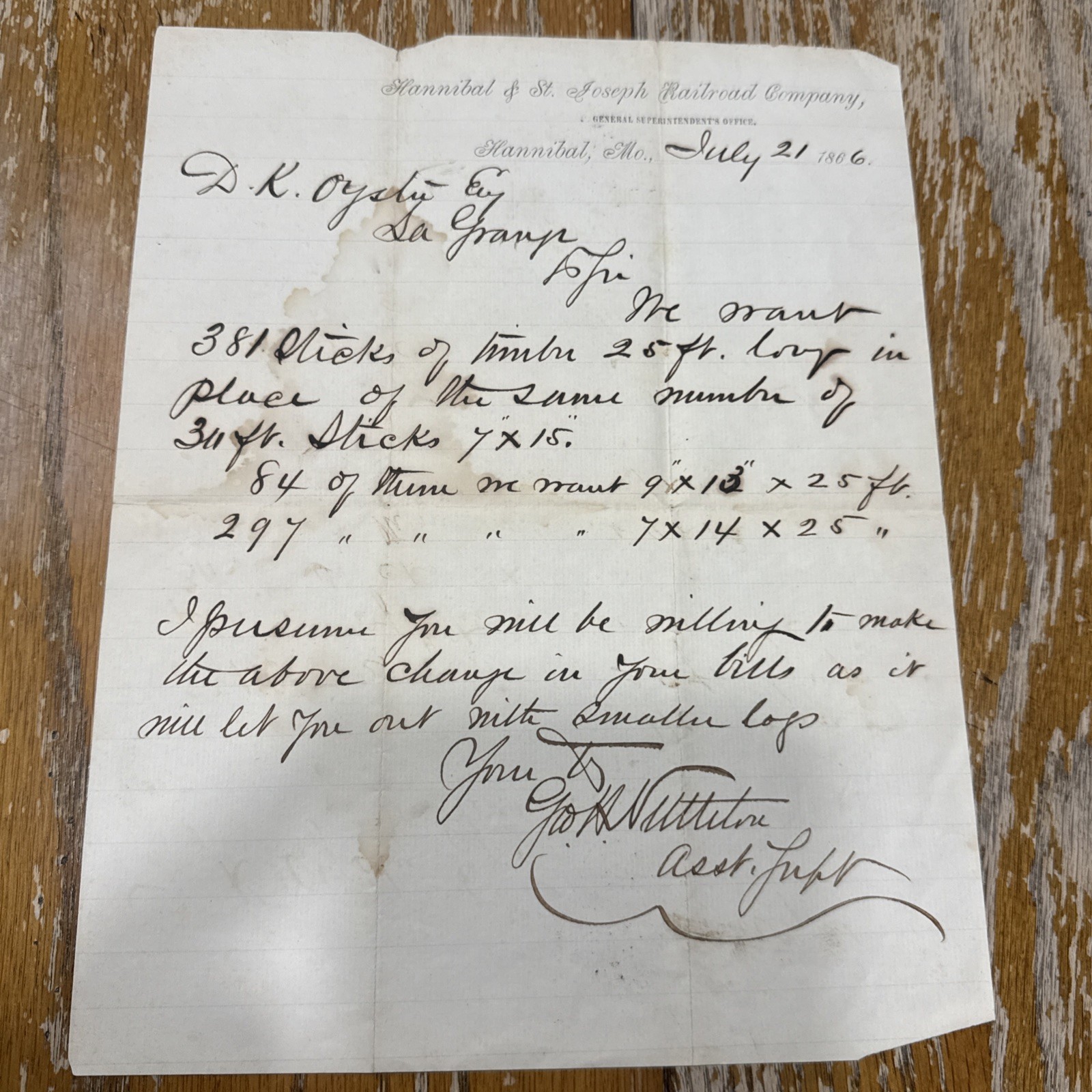
General Superintendent’s Office,
Hannibal, Mo., July 21, 1866.
To
D. K. Owsley Esq.
La Grange
Sir
We want
381 sticks of timber 25 ft. long in
place of the same number of
30 ft. sticks 7 × 15.
84 of them we want 9 × 13 × 25 ft.
297 “ “ “ 7 × 14 × 25 “
I presume you will be willing to make
the above change in your bill as it
will let you out with smaller logs.
Yours &c
Geo. H. Nettleton
Asst. Supt.
What it means
This is a routine but interesting operational letter from the railroad’s Assistant Superintendent, George H. Nettleton, to a timber supplier (D. K. Owsley) in La Grange, Missouri.
The railroad had previously ordered longer 30-foot sticks (likely ties, poles, or structural timber sized 7 × 15 inches). They now want to change the order to shorter 25-foot sticks of two different cross-sections:
• 84 pieces at 9 × 13 inches
• 297 pieces at 7 × 14 inches
Nettleton notes that the change should be easier for the supplier because it allows the use of smaller logs.
Historical context
• Date: July 21, 1866 — just one year after the Civil War ended. The Hannibal & St. Joseph was an important early Missouri railroad (completed 1859) and was still expanding and maintaining its line.
• George H. Nettleton was a known railroad official who later became a prominent figure in the industry (he went on to higher positions with other western railroads).
• La Grange is a small Mississippi River town in Lewis County, Missouri, north of Hannibal — a logical location for a timber supplier serving the railroad.
This is a nice example of day-to-day railroad operations paperwork from the immediate post-Civil War period. It shows how the company adjusted material orders based on practical needs (smaller logs, available timber sizes, etc.).
George H. Nettleton (1831–1896) was a significant railroad engineer and executive, and this 1866 letter captures him early in his career.
Key facts about him
• Born November 13, 1831, in Chicopee Falls, Massachusetts.
• Trained as a civil engineer (briefly attended Rensselaer Polytechnic Institute).
• Worked on early eastern railroads, then moved west.
• By the mid-1860s he was serving as Assistant Superintendent of the Hannibal & St. Joseph Railroad (the role shown on this letter).
• He later served as a civil engineer on the famous Hannibal Bridge (the first permanent railroad bridge across the Missouri River at Kansas City, opened 1869). This bridge was built for the Hannibal & St. Joseph Railroad and was a major engineering achievement of the era.
• In 1872 he became General Superintendent of the Atchison, Topeka & Santa Fe Railroad.
• He moved to Kansas City in 1874 and became a major figure in the city’s growth as a rail and livestock center. He headed the Union Depot Company, helped organize the first Kansas City Stockyards, and later served as president of the Kansas City, Fort Scott & Memphis Railroad (which became part of the Frisco system).
• He died in Kansas City on March 26, 1896.
Significance of the letter
This July 21, 1866 letter is an early example of Nettleton’s work while he was still rising through the ranks on the Hannibal & St. Joseph. At the time he was handling practical operating details such as adjusting timber (likely ties or structural lumber) orders with local suppliers. It shows him already in a position of authority only a year after the Civil War.
Because Nettleton later became a well-known railroad executive and civic leader in Kansas City, letters bearing his signature from this early period have added historical interest for collectors of Missouri railroad material.