When you click on links to various merchants on this site and make a purchase, this can result in this site earning a commission. Affiliate programs and affiliations include, but are not limited to, the eBay Partner Network.
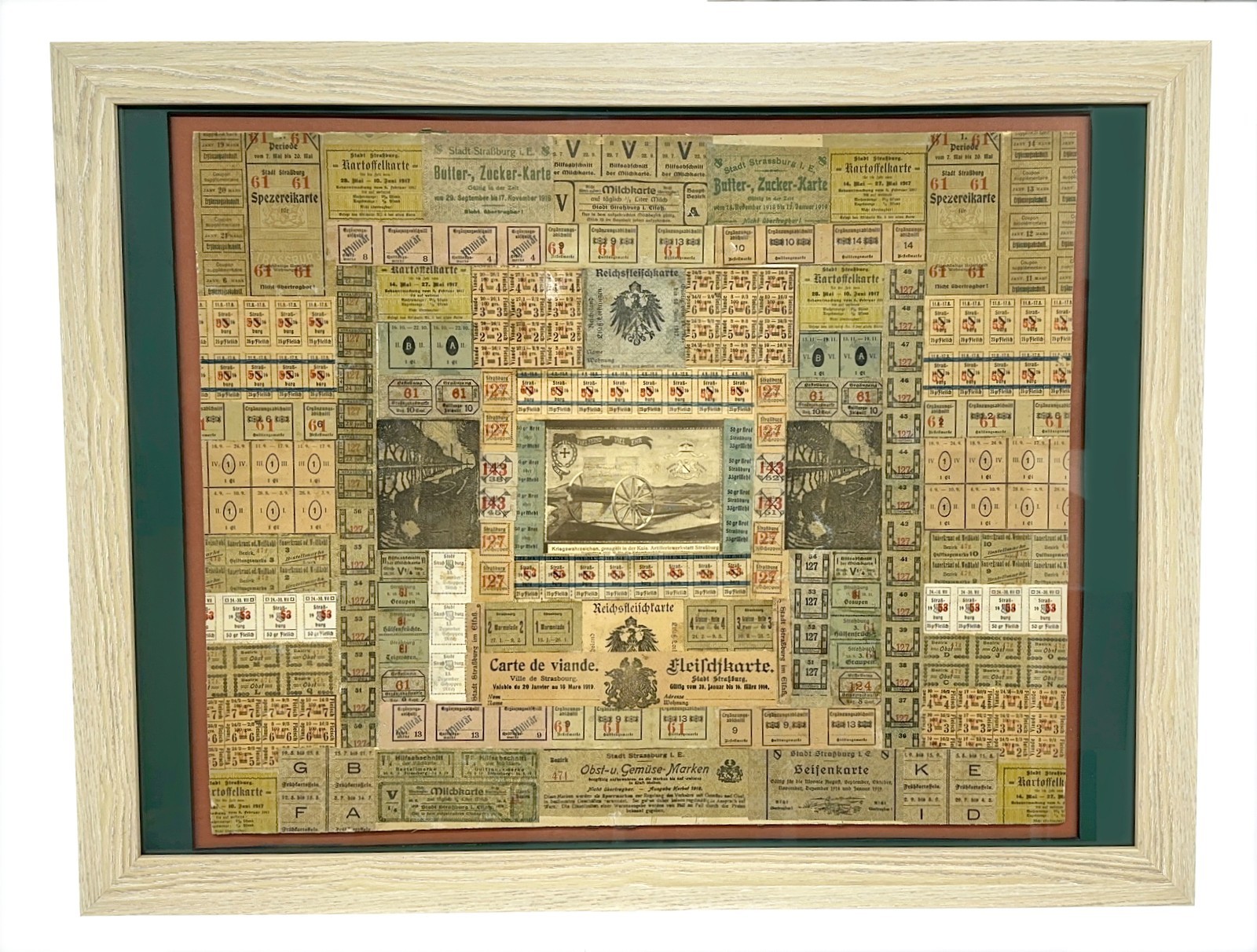
WWI Strasbourg & Alsace Ration Coupon Collage Folk Art 1917-1919
Fascinating piece of early 20th-century folk art ephemera, basically a dense, grid-like collage of WWI-era ration coupons, municipal cards, postal fragments, and printed labels, assembled on a period rigid backer and centered around Strasbourg (Strassburg) in German-controlled Alsace.
This snap of civilian/military life near the end and just after WW1 was made by someone saving and sorting these scraps of daily ration paper and turning them into a piece of art. Remarkably intact and well preserved some 109 years later.
Professionally mounted in full float view with a custom double mat in hunter green and brick, set in a simple wood frame with real glass glazing. Mounted to the mat using archival low-tack transfer tape, so reversible if you are compelled to reframe. Resealed and ready to hang. If curious, further historical details follow at the bottom.
Dimensions
- Overall frame: approximately 26" x 20"
- Visible artwork: approximately 20" x 16"
Condition
- Even, warm toning throughout; no evidence of significant UV exposure or fading.
- Printed text and details remain crisp and legible across the full surface.
- Edges of the artboard show natural irregularity.
- Period backer board shows age-appropriate wear on reverse; structurally sound.
- Remounted in full float view using archival low-tack transfer tape; reversible.
- Real glass glazing; simple wood frame, new.
- New hanging hardware installed; display-ready.
Fulfillment
Ships FedEx Ground in a reinforced frame box with glazing protection, corner and edge guards, and internal cushioning. Typically ships within 1 business day. Rates to Alaska and Hawaii differ from continental US; please message for quote. International shipping available through 's Global Shipping Program.
Content and Historical Context
Strasbourg was basically a fault line at this period in history and straddled French/German ownership transferring back and forth due to the Franco-Prussian war of 1870-71, then WW1, and finally the Armistice where it was returned to France. The materials in this collage date from roughly 1917 to early 1919, spanning the final years of German administration and the immediate transition period, which accounts for the mix of German-language municipal documents alongside French-language cards such as theCarte de viande(meat ration card) issued by the Ville de Strasbourg.
The bulk of the material consists of municipal ration cards covering butter, sugar, meat, bread, and potatoes (Butter-, Zucker-, Fleisch-, Kartoffelkarte), along with divisible coupon strips for measured weekly and daily quantities. Interspersed are military ration supplements markedMilitär, sauerkraut and vegetable order cards, soap ration cards (Seifenkarte), milk cards (Milchkarte), and numbered administrative fragments from Bezirk 471 and 472. Flanking the central image are two woodcut-style vignettes, likely regional Alsatian landscape prints pulled from period printed materials; no attribution is visible. I imagine despite the tough circumstances the landscape was still just incredible as it is now.
At the center of the composition sits a printed image of a nail cannon (Nagelfigur), captioned as theKriegswahrzeichen genagelt in der Kais. Artilleriewerkstatt Straßburg. These nail figures were made at the Imperial Artillery Workshop in Strasbourg. Nagelfigur were a genuine WWI fundraising and morale phenomenon, big iron figures displayed publicly where citizens paid to drive a nail in, proceeds going to war relief funds. If you are unfamiliar with the genre, look it up, neat stuff.