When you click on links to various merchants on this site and make a purchase, this can result in this site earning a commission. Affiliate programs and affiliations include, but are not limited to, the eBay Partner Network.
Remember When a Stuttering "Computer" Almost Saved New Coke? 📺
There was a strange little sliver of the 1980s when a smirking, slicked-back "digital" man in mirrored sunglasses convinced half of America he was a real artificial intelligence — years before anyone had a computer at home, let alone one that could talk back. He glitched. He stuttered. He called everyone "friend" in that jagged electronic warble. And somehow, a soda company still reeling from one of the biggest marketing missteps of the century decided he was the guy to win America back. If the words "C-c-c-catch the wave!" still crackle in your memory from a television speaker, or if you've heard the New Coke story told at a family dinner like a small, beloved national scandal — this poster is the physical proof that it all really happened, and that it was every bit as gloriously odd as everyone remembers.
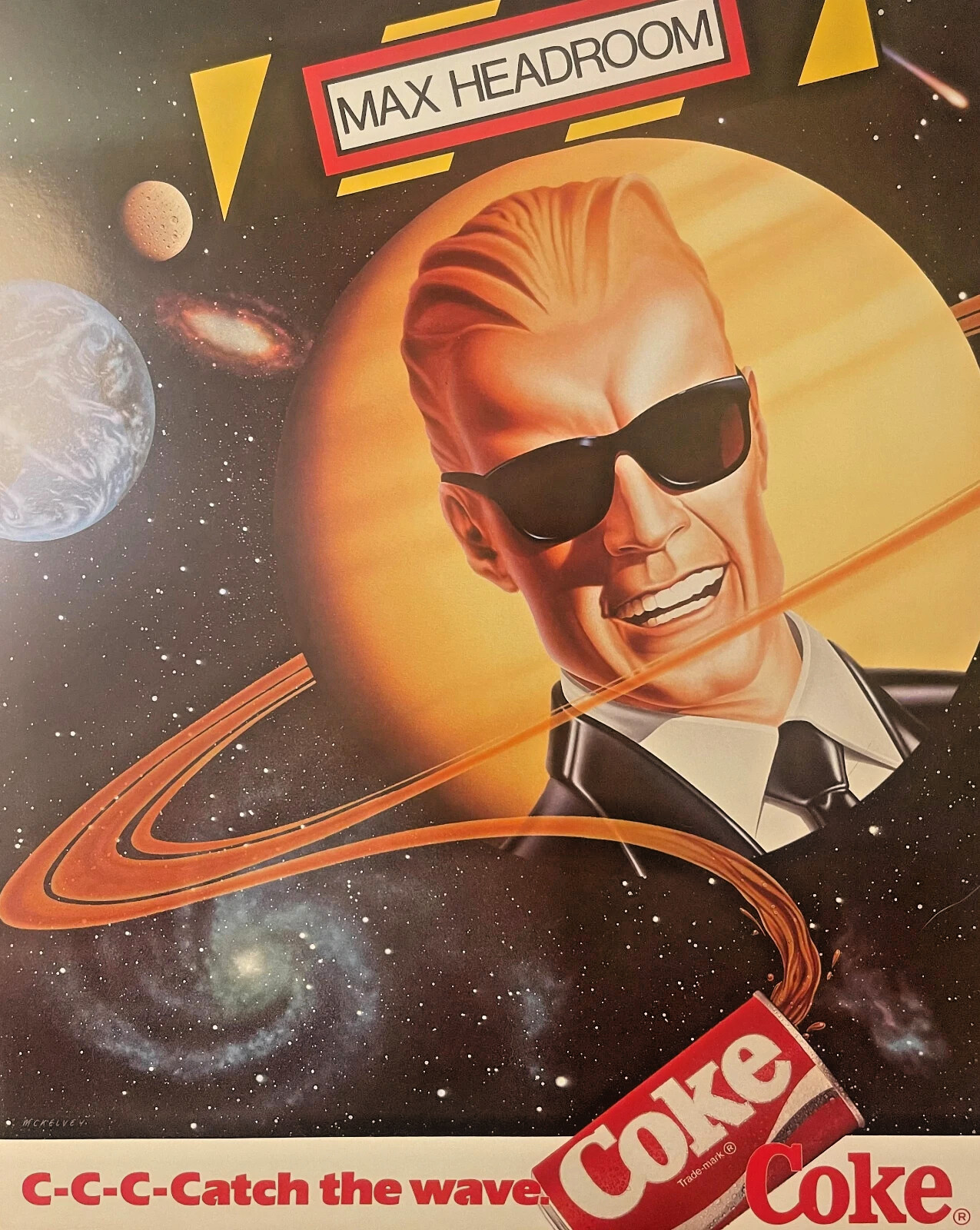
This is a Coca-Cola advertising poster produced by The Coca-Cola Company, built around the licensed character Max Headroom for the "Catch the Wave" campaign. It measures 17 x 14 inches (43 x 35.5 cm) and is an offset lithograph — the workhorse printing process behind so much glossy retail and point-of-sale advertising of its day — rendered in bold black, orange, yellow, red, white, and blue. Max's grinning, slicked-back head floats large against a glowing, ringed planet, with a distant blue Earth and a spiral galaxy scattered in the black field around him, while a Coca-Cola can pours a ribbon of cola that curls and streaks through space, doubling as the planet's own rings. Blocky red-and-yellow lettering across the top spells out "MAX HEADROOM," and across the bottom runs the campaign's signature stutter-slogan, "C-C-C-Catch the wave!" beside the Coca-Cola trademark script. The artwork is signed "McKelvey" in the lower left corner. This example is New Old Stock — a genuine, unused survivor of Coca-Cola's advertising history, never actually put up for retail display.
🥤 The Gamble That Nearly Sank Coca-Cola
To understand why a stuttering television character ended up on a Coca-Cola poster at all, you have to start with the biggest risk in consumer goods history. On April 23, 1985, The Coca-Cola Company announced it was changing the formula of the world's most popular soft drink — the first formula change in 99 years. Behind the scenes, the reformulation had run under a secret internal codename, "Project Kansas," headed by marketing vice president Sergio Zyman and Coca-Cola USA president Brian Dyson. The public backlash was fierce and fast, and on July 11, 1985 — just 79 days later — the company brought back the original formula as "Coca-Cola classic," running it alongside the reformulated drink now known informally as "New Coke." Coca-Cola's own chairman, Roberto Goizueta, would later reflect candidly on the episode in 1995: the company had set out to change the dynamics of sugar colas in America, he said, "and we did exactly that — albeit not in the way we had planned."
With two colas now on shelves needing two distinct identities, Coca-Cola split its advertising: "Red, White & You" carried the emotional, nostalgic pitch for Coca-Cola classic, while "Catch the Wave" was built to sell the new taste of Coke to a younger, more skeptical crowd — the same youth market that had been drifting toward Pepsi. That's the exact gap Max Headroom was hired to fill.
📺 Enter Max Headroom
Max Headroom wasn't a Coca-Cola creation — he was already a British media sensation. The character was dreamed up by video directors and artists George Stone, Annabel Jankel, and Rocky Morton, and brought to life by actor Matt Frewer under prosthetic makeup, contact lenses, and a molded plastic suit, filmed against a blue screen and marketed as "the first computer-generated TV presenter" — a claim audiences largely believed at the time. Max debuted for British viewers on April 4, 1985, in the Channel 4 television movie "Max Headroom: 20 Minutes Into the Future," produced by Chrysalis Visual Programming, with "The Max Headroom Show" following two days later. His arrogant wit, digital stutter, and pitch-shifted warble made him an instant cult figure, and it wasn't long before Madison Avenue came calling.
🌊 C-C-C-Catch the Wave
By early 1986, Coca-Cola's marketing team had settled on Max Headroom as the new face of "new Coke," and the "Catch the Wave" campaign took off from there. It performed beyond anyone's expectations. Newsweek called Max's spots "the most cleverly structured pitches ever aimed at the under-30 viewer" — and two of them were directed by none other than Ridley Scott. Coca-Cola's SVP of marketing, John Reid, reported that 76 percent of teenagers recognized Max after just the first flight of ads, and the company's consumer hotline reportedly fielded more calls about Max than any spokesperson before him — some callers even wanting to know if he had a girlfriend. The campaign was good enough to be named best of 1986 by Video Storyboard of New York, and the Max Headroom Coke spots kept running into 1987.
Even so, all the buzz in the world couldn't undo the public's verdict on the reformulated taste itself, and New Coke was eventually phased out for good, with Max's run as a television personality also wrapping by the late '80s. What survives from that short, strange moment are pieces exactly like this one — the physical, printed record of a soda company betting on a fake robot to save a real product.
🏛️ Atlanta, Georgia: Where It All Began
Every Coca-Cola advertisement, no matter the decade, traces back to a single afternoon in Atlanta, Georgia, on May 8, 1886, when local pharmacist Dr. John Stith Pemberton mixed up a syrup and carried it to Jacobs' Pharmacy, where it sold for five cents a glass. Local legend holds that it was Pemberton's bookkeeper, Frank M. Robinson, who suggested the name Coca-Cola and hand-lettered the flowing script still instantly recognizable on every can today. Pemberton sold off his remaining interest before his death in 1888, and Atlanta businessman Asa Candler bought full control, formally founding The Coca-Cola Company in January 1892 in the same city where the syrup was first stirred. Nearly a century later, when the company needed a bold new spokesman to sell its boldest new idea, it was still that same Atlanta company calling the shots — just with a stuttering "digital man" standing in for a soda fountain clerk.
🎨 The Artist Behind the Artwork
Tucked into the lower left corner of the piece is the signature "McKelvey" — the illustrator credited with this cosmic vision of Max Headroom orbiting a ringed planet with Coca-Cola pouring through the stars like a comet's tail. Advertising illustration of this caliber, especially work strong enough for a company to sign and stand behind, rarely gets the recognition it deserves outside collector circles — which makes a well-preserved, signed example like this one worth holding onto in its own right.
🖼️ Display Ideas
- 🥤 Hang it behind a home soda bar or vintage Coke cooler for an instant conversation piece
- 📺 Pair it with other 1980s pop-culture memorabilia for a dedicated retro media-room wall
- 🛸 Let the space theme anchor a sci-fi or "future that never was" collection
- 🏢 Frame it for an office or man-cave as a nod to one of advertising's boldest gambles
- 🎁 Give it to the New Coke or Max Headroom fan in your life who still remembers the stutter
- 🖼️ Rotate it into a gallery wall of vintage advertising art for eye-catching color and contrast
🎁 Who Collects These
This piece draws in more than one kind of collector at once. Coca-Cola memorabilia hounds chase it for the brand history and the graphic design. Pop-culture and sci-fi collectors want it for Max Headroom himself — a character with a small but devoted cult following decades after his last broadcast. And advertising art collectors are drawn to it simply as a striking, well-composed piece of illustrated commercial art from a genuinely pivotal moment in soft-drink history. It's also a favorite pickup for anyone who lived through the New Coke saga firsthand and wants a piece of it back on their wall.
❓ FAQIs this an original vintage Coca-Cola advertising piece?
Yes — this is a genuine Coca-Cola advertising poster from the "Catch the Wave" campaign, and this example is New Old Stock, meaning it was printed and warehoused rather than ever put up for retail display.
What size is the poster?
It measures 17 x 14 inches (43 x 35.5 cm).
Was Max Headroom created by Coca-Cola?
No — Max Headroom was a licensed British media character created by George Stone, Annabel Jankel, and Rocky Morton, and portrayed by actor Matt Frewer. Coca-Cola licensed him as the spokesperson for its "Catch the Wave" campaign.
Was this for New Coke or Coca-Cola Classic?
"Catch the Wave" and Max Headroom were built specifically to sell the reformulated "new Coke," while Coca-Cola classic ran its own separate "Red, White & You" campaign at the same time.
Who is "McKelvey," the signature on the artwork?
McKelvey is the illustrator credited on the piece itself, signed in the lower left corner of the artwork.
What does "New Old Stock" mean for this poster?
It means the poster was printed decades ago and has remained in storage ever since, rather than being sold, displayed, or handled at retail.
How should I care for or frame a piece like this?
Standard care for paper advertising art applies — keep it out of direct sunlight and framed under UV-protective glass if you plan to display it long-term, which helps preserve the vivid color of the original printing.