When you click on links to various merchants on this site and make a purchase, this can result in this site earning a commission. Affiliate programs and affiliations include, but are not limited to, the eBay Partner Network.
🚂 What Did It Feel Like to Hold a Piece of the Water Level Route?
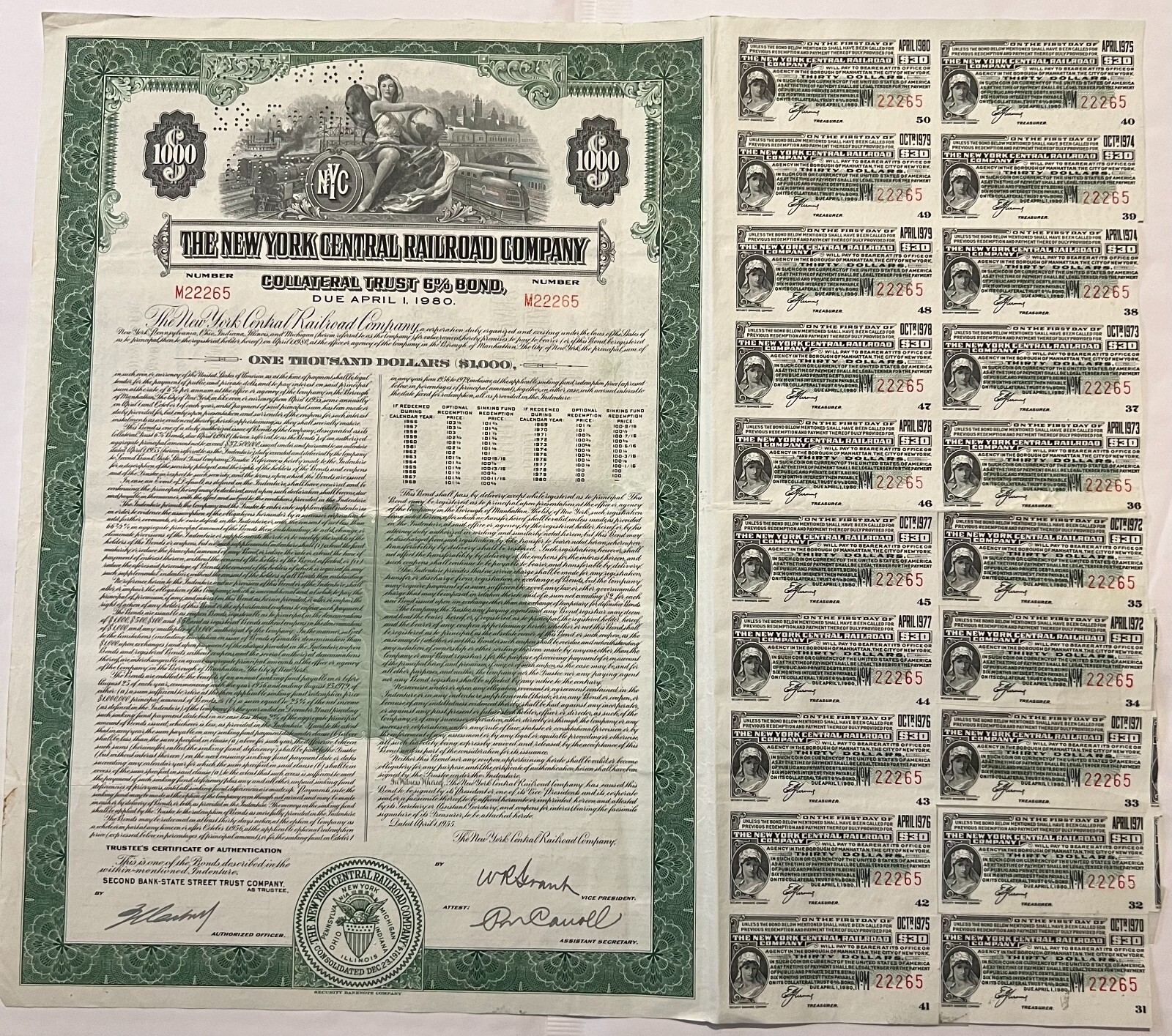
There's a particular kind of green — deep, engraved, almost velvety — that only 1950s security printers seemed to know how to mix. Old-timers who worked around railroad finance offices used to say you could tell a New York Central bond from across the room by that green alone. This one still carries it: a large 1955-dated New York Central Railroad Company Collateral Trust 6% Bond, its sheet of dated interest coupons still attached down the side, exactly the kind of document that once moved real capital up and down the Hudson and now moves collectors instead.
This is genuine issued railroad bond paper from The New York Central Railroad Company, measuring a substantial 15 x 10 inches (about 38 x 25.5 cm), engraved and printed by the Security Banknote Company. The face is dense with the ornate green scrollwork border typical of mid-century American security printing, framed top corners with bold "$1000" denomination medallions. Centered at top is the signature vignette: a seated allegorical female figure — draped, one hand resting on a globe turned to show the Americas — posed against a busy industrial river scene of paddle-wheel steamboat, girder bridge, factory smokestacks, a classic steam locomotive, and a sleek streamlined diesel train, all beneath a distant city skyline. An oval "NYC" monogram anchors the composition at her feet. Below, in bold lettering, reads "THE NEW YORK CENTRAL RAILROAD COMPANY — COLLATERAL TRUST 6% BOND, DUE APRIL 1, 1980." The bond text itself states the company as "duly organized and existing under the laws of the States of New York, Pennsylvania, Ohio, Indiana, Illinois, and Michigan," with a redemption/sinking-fund price table running year by year from 1956 through 1979, and an embossed corporate seal reading "Consolidated Dec 23, 1914." Attached along the side runs a full column of small individual coupons, each promising "$30" in semi-annual interest — the mathematical signature of a 6% annual coupon on a $1,000 bond — dated in pairs across April and October, running toward the April 1, 1980 maturity. Second Bank-State Street Trust Company appears as trustee, with facsimile officer signatures reproduced across the certificate as was standard practice for bearer bond issues of this size.
🛤️ The Railroad Behind the Green Ink
The New York Central traces its lineage to 1853, when ten small parallel railroads running between Albany and Buffalo — tracking the old route of the Erie Canal — were consolidated into one company. The earliest of those roads, the Mohawk and Hudson, was New York State's very first railway, opened in 1831. The man who pushed the 1853 consolidation through was Erastus Corning, four-term mayor of Albany, who had already spent twenty years running the Utica and Schenectady Railroad and who led the newly formed New York Central until 1864. Albany's West Albany shops — 300 acres of repair sheds, classification yards, and livestock pens established under Corning — remained the Central's primary back shops all the way until the end of steam operations in 1957, just two years after this bond was issued.
Cornelius Vanderbilt seized control of the Central in 1867, merging it with his own Hudson River and New York Central lines running down to Manhattan, then folding in the Lake Shore and Michigan Southern in 1873 and the Michigan Central in 1871. Under his son William, the road absorbed the New York, West Shore and Buffalo in 1885, and by the turn of the century, under Chauncey Depew, had leased the Boston & Albany, stretching the system from Boston and Montreal in the north to Chicago and St. Louis in the west — some 10,000 miles of track at its peak, one of the most powerful corporations in the country.
The railroad's home office sat directly above Grand Central Terminal, in the New York Central Building — a Manhattan address now known as the Helmsley Building. From that terminal ran the road's crown jewel, the Twentieth Century Limited, a sixteen-hour first-class run to Chicago's LaSalle Street Station that began in 1902 and became, alongside the Pennsylvania's Broadway Limited, the very definition of luxury American rail travel — red carpet literally rolled out for boarding passengers, an image that stuck in the American imagination for decades. Long before that, in 1893, the Central's Empire State Express, hauled by locomotive No. 999, set a world speed record of 112 miles per hour — at the time, the fastest any human being had ever traveled over land.
👔 1955: The Year the Old Guard Gave Way
A bond dated 1955 lands squarely in one of the New York Central's most consequential years. In 1954, financier Robert R. Young — a Wall Street operator famous for his populist jabs at railroad management, once quipped to have said a hog could cross the country without changing trains but a passenger couldn't, a line that became something close to industry folklore among rail employees of the era — wrested control of the Central away from its old board. Young installed Alfred E. Perlman as president, the last man ever to hold that title at the New York Central. Perlman's relentless cost-cutting through the '50s and '60s left the Central in noticeably better financial shape than its longtime rival, the Pennsylvania Railroad — and it was in this very year, 1955, that merger talk between the two giants first began in earnest, though outside forces (regulatory review, union objections, and the sheer difficulty of combining two sprawling systems) would delay any deal for more than a decade.
🏙️ From Merger to Bankruptcy to Amtrak
Stockholders of both roads finally voted to merge on May 8, 1962, convinced that survival required it — Perlman himself testified that without merging, the Central's "ability to compete... [would] continue to decline to the point of ineffectiveness." The deal closed February 1, 1968, forming Penn Central, which absorbed the bankrupt New York, New Haven and Hartford Railroad the following year. It didn't last: incompatible corporate cultures, duplicated rail assets, industry flight from the Rust Belt, and the added weight of the New Haven's debts sank the new giant with astonishing speed — Penn Central filed for bankruptcy on June 21, 1970, just two and a half years after formation, at the time the largest corporate bankruptcy in American history and, remarkably, the sixth-largest U.S. corporation by size. Out of that wreckage the federal government created Conrail in 1976, which itself was purchased jointly by CSX and Norfolk Southern in 1999. The Central's old Water Level Route between New York and Chicago is still in daily use today, carrying freight and Amtrak's Lake Shore Limited over rails first laid down by Erastus Corning's consolidated companies more than a century and a half ago — a genuinely rare case of a 19th-century rail corridor still doing exactly what it was built to do.
🖼️ Display Ideas
- 🚂 Frame it large and let the engraved allegorical vignette anchor a den or home office wall — the scale at 15 x 10 inches holds its own even from across a room.
- 🏙️ Pair it with a period map of the New York Central system or a photo of Grand Central Terminal for a mini "rise of the American railroad" wall grouping.
- 📜 Display it unfolded so the coupon column reads as its own visual rhythm — dozens of tiny repeating portraits marching down the page.
- 💼 A natural centerpiece for a finance-history or Wall Street-themed office, alongside old stock certificates or ticker tape memorabilia.
- 🛤️ Perfect alongside model train layouts or vintage railroad signage for anyone building a dedicated train room.
- 🎓 A conversation-starting teaching piece for anyone interested in how 20th-century American corporations actually financed themselves.
🎁 Who Collects These
Scripophily collectors seek out New York Central material specifically because the road's decline into Penn Central and eventual bankruptcy makes surviving bond paper genuinely scarce compared to companies that simply kept operating. Railroad historians and Grand Central Terminal enthusiasts prize the engraving for its artwork alone. Finance history buffs are drawn to the mechanics on display here — the sinking fund schedule, the collateral trust structure, the coupon clipping system — as a working illustration of how mid-century American infrastructure was actually funded. And it's a natural gift for anyone with a soft spot for trains, New York history, or the golden age of the engraved American banknote.
❓ FAQ
Is this a real financial document or a reproduction?
It's a genuine New York Central Railroad Collateral Trust 6% Bond certificate from the company's actual 1955 bond issue — long since matured and no longer a live financial obligation, now collected purely for its history and engraving.
Are the coupons still attached?
Yes — the certificate carries its column of individual dated interest coupons, each representing a semi-annual $30 interest payment on the $1,000 principal, running toward the bond's 1980 maturity.
Coupons were made to be clipped away, and most bonds of this age lost theirs one payment at a time until only the certificate was left, so a sheet that came through the decades still attached is the exception rather than the rule. When a road went under, holders commonly taped the last coupon back onto the bond and held on in hope of collecting what they were owed, so a bond that still carries that taped final coupon is the better one to end up with. The coupon count can run a few more or a few fewer than what is pictured.
What size is it exactly?
15 x 10 inches (approximately 38 x 25.5 cm) — large enough to frame as a genuine wall piece, not a small novelty document.
Who printed it?
The Security Banknote Company, whose imprint appears on the certificate — a firm that specialized in the same high-security engraving techniques used for currency and stock certificates of the era.
What does "Collateral Trust" mean on a bond like this?
It indicates the bond was secured by other securities held in trust (in this case administered by Second Bank-State Street Trust Company) rather than by a direct mortgage on physical railroad property — a common structure for large mid-century corporate debt issues.
Why is 1955 a significant date for New York Central history?
It falls right at the start of the Robert R. Young / Alfred Perlman leadership era and the very year serious merger talks with the Pennsylvania Railroad first began — talks that would eventually produce the ill-fated Penn Central merger over a decade later.
Is condition graded?
This is genuine issued vintage railroad bond paper, offered as an excellent example of mid-century American security engraving and corporate history rather than by condition grade.
These are issued instruments rather than blanks. Bonds and debentures of this type were registered to a holder, authenticated by the trustee, and punch- or cut-cancelled when they were finally redeemed. Expect financial writings, markings, stamps, hole punches and staple holes as part of the life of the instrument: endorsements and signatures, trustee and registrar stamps, revenue or documentary tax stamps, cancellation punches, staple holes from being bound into a transfer book, pencil ledger notations. That is the paper trail of a security that actually did its job, and it is what separates a document that lived from a blank that never did. No two are alike: holder details, serial numbers, dates, signatures, stamps and punch patterns vary from example to example, so the photographs show the type rather than the exact sheet that ships. The coupon count can run a few more or a few fewer than pictured.