When you click on links to various merchants on this site and make a purchase, this can result in this site earning a commission. Affiliate programs and affiliations include, but are not limited to, the eBay Partner Network.
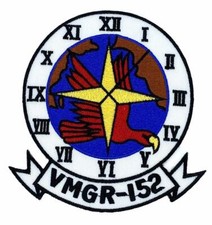
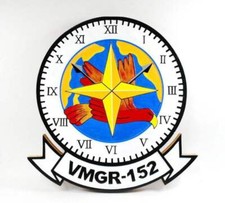
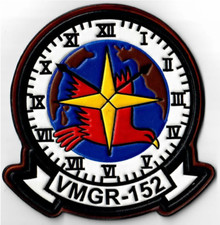
VMGR-152 Sumos Plaque
A handcrafted wood plaque of the VMGR-152 Sumos. Each plaque is carved from Mahogany and handpainted to provide a piece you\'ll love!
- 14 inches
- Made from Mahogany
- US Veteran-Owned Business
- The manufacturer does not intend for children 12 years and younger to use the product.
World War II
The squadron was activated as VMJ-253 in the Western Pacific on March 11, 1942. VMJ-253 pioneered Trans-oceanic transport in the Marine Corps during World War II. It also became the parent squadron for the joint air transport organization dubbed the South Pacific Combat Air Transport Command (SCAT). Lieutenant Colonel Perry K. Smith, USMC, became the first Commanding Officer of SCAT. By November 1942, VMJ-253 had supported operations on Guadalcanal and surrounding islands, logging thousands of flight hours.
While on Guadalcanal, VMJ-253 was the first combat transport squadron to land at Henderson Field, bringing Brigadier General Roy S. Geiger and his staff to take command of the 1st Marine Aircraft Wing. Following the Japanese counterattack that forced the United States Navy to withdraw, VMJ-253 continued to re-supply fuel, ammunition, food, and medical supplies in support of the besieged ground troops. The squadron\'s Douglas R4Ds delivered supplies despite being fired upon by Japanese troops lurking near Henderson Field and marauding A6M Zeros in the skies. Until the end of 1942, it was the Marines of VMJ-253 and other SCAT units that solved the logistical problems of Marines and soldiers on Guadalcanal.
Through 1943, VMJ-253 supported operations on Bougainville, New Georgia, Vella Lavella, and numerous islands throughout the Solomon chain. As the island-hopping campaign moved into the Central Pacific in 1944, so did VMJ-253. Detached from SCAT, VMJ-253 officially became a transport squadron and was redesignated VMR-253. VMR-253 was assigned to the Transport Air Group, popularly called TAG, which was the Central Pacific version of SCAT. Continuing the heavy schedule of lifts from Tarawa, VMR-253 sortied to Kwajalein, Roi-Namur, and Eniwetok. In October 1943, VMR-253 moved to Guam. Working out of Guam, VMR-253 supported actions on Tinian, Saipan, and Peleliu. VMR-253 remained on Guam until the close of the war, and in May 1946, returned to MCAS Miramar.
Post WW II / Korean War
A former VMR-253 Curtiss R5C-1 at the National Museum of Naval Aviation
From Miramar, VMR-253 moved to MCAS El Toro under Marine Aircraft Group 25 where the aging fleet of R4Ds was replaced with Douglas R5Ds. VMR-253 continued its primary mission of moving men and supplies wherever the Marine Corps needed them. After a four-year squadron stand down from 1947 to 1951, VMR-253 reactivated for active duty in the Korean War; with only six Curtiss R5C aircraft, 5 officers and 18 enlisted Marines. By the end of the year it had grown to 58 officers and 184 enlisted men; had received 16 new Fairchild R4Qs; and was ready to go to war once again. From January 1952 through June 1953, the squadron logged over 11,000 flight hours, carried 30,170 passengers, and moved 5,213,383 pounds (2,364,751 kg) of cargo.
1954 - 1965
In 1954, the squadron relocated to Itami Air Force Base, Japan and then to Marine Corps Air Station Iwakuni, Japan. From Japan, VMR-253 conducted the bulk of Marine air transport in the Pacific for nearly ten years. On February 1, 1962, the famous Lockheed KC-130F Hercules joined Marine aviation in the Pacific. With its ability to refuel fighter and attack aircraft, VMR-253 was redesignated Marine Aerial Refueler Transport Squadron 152 (VMGR-152), and the squadron\'s primary mission became aerial refueling.
Less than a year after receiving the Hercules aircraft, the pilots and Marines of VMGR-152 were called upon to support United States Army advisors in the latest hot spot, Indo-China. This deployment gave the squadron valuable experience in the employment of the Battle Herc that would soon pay off. On August 24, 1965, a KC-130F (BuNo 149802) from the squadron veered off runway on take-off from Kai Tak Airport, Hong Kong hit the seawall and crashed into the sea. This was the first Hercules hull loss in Marine Corps service. It was carrying Marine personnel returning to Vietnam after R&R in Hong Kong; of six crew and 65 passengers, 59 were killed.