When you click on links to various merchants on this site and make a purchase, this can result in this site earning a commission. Affiliate programs and affiliations include, but are not limited to, the eBay Partner Network.
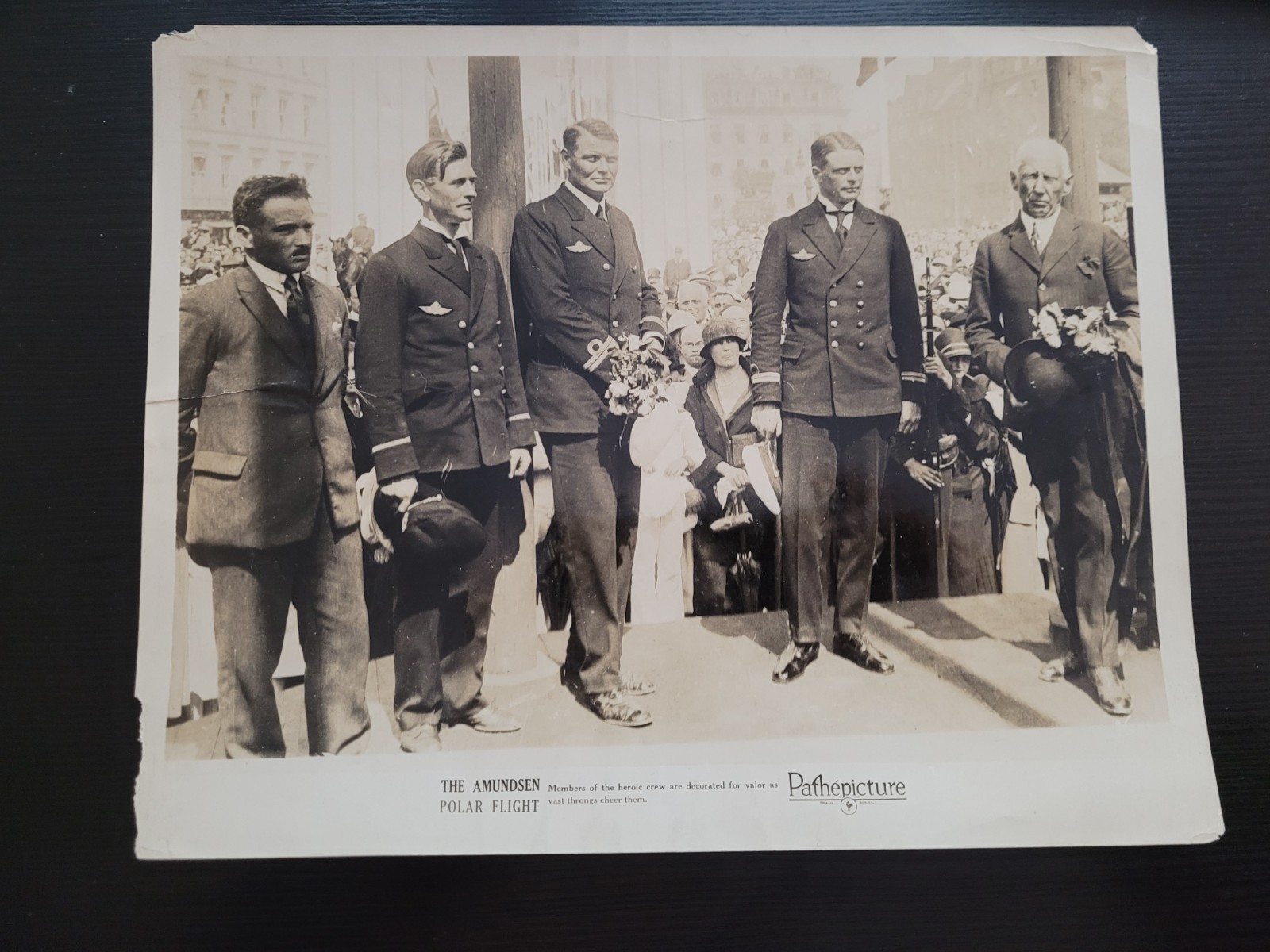
ROALD AMUNDSEN - Norwegian POLAR Explorer POLAR FLIGHT VINTAGE ORIGINAL PHOTO MEASURING 8X10 Engelbregt Gravning Amundsen (UK: /ˈɑːmʊndsən/, US: /-məns-/;[3][4] Norwegian: [ˈrùːɑɫ ˈɑ̂mʉnsən] ⓘ; 16 July 1872 – c. 18 June 1928) was a Norwegian explorer of polar regions. He was a key figure of the period known as the Heroic Age of Antarctic Exploration.
Born in Borge, Østfold, Norway, Amundsen began his career as a polar explorer as first mate on Adrien de Gerlache\'s Belgian Antarctic Expedition of 1897–1899. From 1903 to 1906, he led the first expedition to successfully traverse the Northwest Passage on the sloop Gjøa. In 1909, Amundsen began planning for a South Pole expedition. He left Norway in June 1910 on the ship Fram and reached Antarctica in January 1911. His party established a camp at the Bay of Whales and a series of supply depots on the Barrier (now known as the Ross Ice Shelf) before setting out for the pole in October. The party of five, led by Amundsen, became the first to reach the South Pole on 14 December 1911.
Following a failed attempt in 1918 to reach the North Pole by traversing the Northeast Passage on the ship Maud, Amundsen began planning for an aerial expedition instead. On 12 May 1926, Amundsen and 15 other men in the airship Norge became the first explorers verified to have reached the North Pole.[5][6] Amundsen disappeared in June 1928 while flying on a rescue mission for the airship Italia in the Arctic. The search for his remains, which have not been found, was called off that September.
Early lifeA young Roald Amundsen is depicted in 1875 during his childhood years.Roald Amundsen as a young boy in 1875Amundsen was born into a family of Norwegian shipowners and captains in Borge, between the towns Fredrikstad and Sarpsborg. His parents were Jens Amundsen and Hanna Sahlqvist. Roald was the fourth son in the family. His mother wanted him to avoid the family maritime trade and encouraged him to become a doctor, a promise that Amundsen kept until his mother died when he was aged 21. He promptly quit university for a life at sea.[7]
Amundsen was in the Uranienborg neighbourhood an occasional childhood playmate of the pioneering Antarctica explorer Carsten Borchgrevink.[8][9]
When he was fifteen years old, Amundsen was enthralled by reading Sir John Franklin\'s narratives of his overland Arctic expeditions. Amundsen wrote \"I read them with a fervid fascination which has shaped the whole course of my life\".[10]
Polar treksBelgian Antarctic Expedition
RV Belgica frozen in the ice, 1898Amundsen joined the Belgian Antarctic Expedition as first mate at the age of 25 in 1897. This expedition, led by Adrien de Gerlache using the ship the RV Belgica, became the first expedition to overwinter in Antarctica.[11] The Belgica, whether by mistake or design, became locked in the sea ice at 70°30′S off Alexander Island, west of the Antarctic Peninsula. The crew endured a winter for which they were poorly prepared.
By Amundsen\'s own estimation, the doctor for the expedition, the American Frederick Cook, probably saved the crew from scurvy by hunting for animals and feeding the crew fresh meat. In cases where citrus fruits are lacking, raw meat – particularly offal – from animals often contains enough vitamin C to prevent scurvy.[12]
The Northwest Passage
Amundsen c. 1908In 1903, Amundsen led the first expedition to traverse Canada\'s Northwest Passage between the Atlantic and Pacific oceans. He planned a small expedition of six men in a 45-ton fishing vessel, Gjøa, to have flexibility. His ship had relatively shallow draft. His technique was to use a small ship and hug the coast. Amundsen had the ship outfitted with a small 13 horsepower single-screw paraffin (diesel) engine.[13]
They travelled via Baffin Bay, the Parry Channel and then south through Peel Sound, James Ross Strait, Simpson Strait and Rae Strait. They spent two winters at King William Island, in the harbor of what is today Gjoa Haven.[11][13] During this time, Amundsen and the crew learned from the local Netsilik Inuit about Arctic survival skills, which he found invaluable in his later expedition to the South Pole. For example, he learned to use sled dogs for the transport of goods and to wear animal skins in lieu of heavy, woolen parkas, which could not keep out the cold when wet.
Leaving Gjoa Haven, he sailed west and passed Cambridge Bay, which had been reached from the west by Richard Collinson in 1852. Continuing to the south of Victoria Island, the ship cleared the Canadian Arctic Archipelago on 17 August 1905. It had to stop for the winter before going on to Nome on Alaska\'s Pacific coast. The nearest telegraph station was 500 mi (800 km) away in Eagle. Amundsen travelled there overland to wire a success message on 5 December, then returned to Nome in 1906.[14] While stopped in Alaska, Amundsen had his magnetic instruments (i.e. compasses) adjusted by Don C. Sowers, a physicist from the Carnegie Institution\'s Department of Terrestrial Magnetism.[15] Later that year Amundsen was elected to the American Antiquarian Society.[14]
Amundsen learned of the dissolution of the union between Norway and Sweden, and that he had a new king. The explorer sent the new king, Haakon VII, news that his traversing the Northwest Passage \"was a great achievement for Norway\".[16] He said he hoped to do more and signed it \"Your loyal subject, Roald Amundsen\".[16] The crew returned to Oslo in November 1906, after almost three and a half years abroad. Gjøa was returned to Norway in 1972. After a 45-day trip from San Francisco on a bulk carrier, she was placed on land outside the Fram Museum in Oslo, where she is now situated inside her own building at the museum.[16]
South Pole ExpeditionMain article: Amundsen\'s South Pole expedition
Norwegian flag at the South PolePhotograph of Roald Amundsen, Ernest Shackleton and PearyThe Three Polar Stars: Amundsen, Ernest Shackleton, and Robert Peary, are pictured in Philadelphia in January 1913Amundsen next planned to take an expedition to the North Pole and explore the Arctic Basin. Finding it difficult to raise funds, when he heard in 1909 that the Americans Frederick Cook and Robert Peary had claimed to reach the North Pole as a result of two different expeditions, he decided to reroute to Antarctica.[17] He was not clear about his intentions, and Robert F. Scott and the Norwegian supporters felt misled.[17] Scott was planning his own expedition to the South Pole that year. Using the ship Fram, earlier used by Fridtjof Nansen, Amundsen left Oslo for the south on 3 June 1910.[17][18] At Madeira, Amundsen alerted his men that they would be heading to Antarctica, and sent a telegram to Scott: \"Beg to inform you Fram proceeding Antarctic – Amundsen.\"[17]
Nearly six months later, the expedition arrived at the eastern edge of the Ross Ice Shelf (then known as \"the Great Ice Barrier\"), at a large inlet called the Bay of Whales, on 14 January 1911. Amundsen established his base camp there, calling it Framheim. Amundsen eschewed the heavy wool clothing worn on earlier Antarctic attempts in favour of adopting Inuit-style furred skins.[7]
Using skis and dog sleds for transportation, Amundsen and his men created supply depots at 80°, 81° and 82° South on the Barrier, along a line directly south to the Pole.[7] Amundsen also planned to kill most of his dogs on the way and use them as a source for fresh meat. As he went he butchered some of the dogs and fed them to the remaining dogs, as well as eating some himself.[19] A small group, including Hjalmar Johansen, Kristian Prestrud and Jørgen Stubberud, set out on 8 September, but had to abandon their trek due to extreme temperatures. The painful retreat caused a quarrel within the group, and Amundsen sent Johansen and the other two men to explore King Edward VII Land.
A second attempt, with a team of five made up of Olav Bjaaland, Helmer Hanssen, Sverre Hassel, Oscar Wisting and Amundsen, departed base camp on 19 October. They took four sledges and 52 dogs. Using a route along the previously unknown Axel Heiberg Glacier, they arrived at the edge of the Polar Plateau on 21 November after a four-day climb. The team and 16 dogs arrived at the pole on 14 December, a month before Scott\'s group.[a] Amundsen named their South Pole camp Polheim. Amundsen renamed the Antarctic Plateau as King Haakon VII\'s Plateau. They left a small tent and letter stating their accomplishment, in case they did not return safely to Framheim.
The team arrived at Framheim on 25 January 1912, with 11 surviving dogs. They made their way off the continent and to Hobart, Australia, where Amundsen publicly announced his success on 7 March 1912. He telegraphed news to backers.
Amundsen\'s expedition benefited from his careful preparation, good equipment, appropriate clothing, a simple primary task, an understanding of dogs and their handling, and the effective use of skis. In contrast to the misfortunes of Scott\'s team, Amundsen\'s trek proved relatively smooth and uneventful.
North Polar Expeditions and the Northeast PassageThe Northeast Passage
This section needs additional citations for verification. Please help improve this article by adding citations to reliable sources in this section. Unsourced material may be challenged and removed. (April 2021) (Learn how and when to remove this message)
Maud in June 1918In 1918, an expedition Amundsen began with a new ship, Maud, lasted until 1925. Maud was carefully navigated through the ice west to east through the Northeast Passage. With him on this expedition were Oscar Wisting and Helmer Hanssen, both of whom had been part of the team to reach the South Pole. In addition, Henrik Lindstrøm was included as a cook. He suffered a stroke and was so physically reduced that he could not participate.
The goal of the expedition was to explore the unknown areas of the Arctic Ocean, strongly inspired by Fridtjof Nansen\'s earlier expedition with Fram. The plan was to sail along the coast of Siberia and go into the ice farther to the north and east than Nansen had. In contrast to Amundsen\'s earlier expeditions, this was expected to yield more material for academic research, and he carried the geophysicist Harald Sverdrup on board.
The voyage was to the northeasterly direction over the Kara Sea. Amundsen planned to freeze the Maud into the polar ice cap and drift towards the North Pole – as Nansen had done with the Fram – and he did so off Cape Chelyuskin. But, the ice became so thick that the ship was unable to break free, although it was designed for such a journey in heavy ice. In September 1919, the crew got the ship loose from the ice, but it froze again after eleven days somewhere between the New Siberian Islands and Wrangel Island.
During this time, Amundsen suffered a broken arm and was attacked by a polar bear.[21] As a result, he participated little in the work outdoors, such as sleigh rides and hunting. He, Hanssen, and Wisting, along with two other men, embarked on an expedition by dog sled to Nome, Alaska, more than 1,000 kilometres (620 mi) away. But they found that the ice was not frozen solid in the Bering Strait, and it could not be crossed. They sent a telegram from Anadyr to signal their location.
After two winters frozen in the ice, without having achieved the goal of drifting over the North Pole, Amundsen decided to go to Nome to repair the ship and buy provisions. Several of the crew ashore there, including Hanssen, did not return on time to the ship. Amundsen considered Hanssen to be in breach of contract, and dismissed him from the crew.
During the third winter, Maud was frozen in the western Bering Strait. She finally became free and the expedition sailed south, reaching Seattle, in the American Pacific Northwest in 1921 for repairs. Amundsen returned to Norway, needing to put his finances in order. He took with him two young indigenous girls, a four-year-old he adopted, Kakonita, and her companion Camilla. When Amundsen went bankrupt two years later, however, he sent the girls to be cared for by Camilla\'s father, who lived in eastern Russia.[22]
In June 1922, Amundsen returned to Maud, which had been sailed to Nome.[23] He decided to shift from the planned naval expedition to aerial ones, and arranged to charter a plane. He divided the expedition team in two: one part, led by him, was to winter over and prepare for an attempt to fly over the pole in 1923. The second team on Maud, under the command of Wisting, was to resume the original plan to drift over the North Pole in the ice. The ship drifted in the ice for three years east of the New Siberian Islands, never reaching the North Pole. It was finally seized by Amundsen\'s creditors as collateral for his mounting debt.
Although they were unable to reach the North Pole, the scientific results of the expedition, mainly the work of Sverdrup, have proven to be of considerable value. Much of the carefully collected scientific data was lost during the ill-fated journey of Peter Tessem and Paul Knutsen, two crew members sent on a mission by Amundsen. The scientific materials were later retrieved in 1922 by Russian scientist Nikolay Urvantsev from where they had been abandoned on the shores of the Kara Sea.[24]
Aerial expeditions to the North Pole
Amundsen with his plane in Svalbard (1925)The 1923 attempt to fly over the Pole failed. Amundsen and Oskar Omdal, of the Royal Norwegian Navy, tried to fly from Wainwright, Alaska, to Spitsbergen across the North Pole. When their aircraft was damaged, they abandoned the journey. To raise additional funds, Amundsen travelled around the United States in 1924 on a lecture tour.
In 1925, accompanied by Lincoln Ellsworth, pilot Hjalmar Riiser-Larsen, flight mechanic Karl Feucht and two other team members (pilot Leif Dietrichson and mechanic Oskar Omdal),[25] Amundsen took two Dornier Do J flying boats, the N-24 and N-25, to 87° 44′ north. It was the northernmost latitude reached by plane up to that time. The aircraft landed a few miles apart without radio contact, yet the crews managed to reunite. The N-24 was damaged. Amundsen and his crew worked for more than three weeks to clean up an airstrip to take off from ice.[26] They shovelled 600 tons of ice while consuming only one pound (450 g) of daily food rations. In the end, the six crew members were packed into the N-25. In a remarkable feat, Riiser-Larsen took off, the flying boat barely becoming airborne over the cracking ice. They returned triumphant when everyone thought they had been lost forever.[25]
In 1926, Amundsen and 15 other men (including Ellsworth, Riiser-Larsen, Oscar Wisting, and the Italian air crew led by aeronautical engineer Umberto Nobile) made the first crossing of the Arctic in the airship Norge, designed by Nobile.[27] They left Spitsbergen on 11 May 1926, flew over the North Pole on 12 May,[28] and landed in Alaska the following day.
Controversy over Polar PriorityThe three previous claims to have arrived at the North Pole, by the Americans Frederick Cook in 1908; Robert Peary in 1909; and Richard E. Byrd in 1926 (just a few days before the Norge) are disputed by some, as being either of dubious accuracy or outright fraudulent.[29][30] If these other claims are false, the crew of the Norge would be the first explorers verified to have reached the North Pole, when they floated over it in the Norge in 1926.[5][28]
Disappearance and death
Amundsen\'s Latham 47 flying boatAmundsen disappeared on 18 June 1928 while flying on a rescue mission in the Arctic. His team included Norwegian pilot Leif Dietrichson, French pilot René Guilbaud, and three more Frenchmen. They were seeking missing members of Nobile\'s crew, whose new airship Italia had crashed while returning from the North Pole. Amundsen\'s French Latham 47 flying boat never returned.[31]
Later, a wing-float and bottom gasoline tank from the plane, which had been adapted as a replacement wing-float, were found near the Tromsø coast. It is assumed that the plane crashed in the Barents Sea,[32] and that Amundsen and his crew were killed in the wreck, or died shortly afterward. The search for Amundsen and team was called off in September 1928 by the Norwegian government, and the bodies were never found.[33]
In 2004 and in late August 2009, the Royal Norwegian Navy used the unmanned submarine Hugin 1000 to search for the wreckage of Amundsen\'s plane. The searches focused on a 40-square-mile (100 km2) area of the sea floor, and were documented by the German production company ContextTV.[34][35] They found nothing from the Amundsen flight.
Personal lifeAmundsen was a lifelong bachelor, but he had a long-time relationship with the Norwegian-born Kristine Elisabeth (\'Kiss\') Bennett, the wife of an Englishman, Charles Peto Bennett.[36] He met her in London in 1907 and they remained close for many years; Amundsen kept the relationship a secret from everyone outside his intimate circle. Later, he became engaged to Bess Magids, an American divorcée whom he had met in Alaska.[37] Though there is little evidence, it was said that Amundsen had a brief affair with his landlady in Antwerp—until he came home and found her dead after an apparent suicide.[38] His biographer Tor Bomann-Larsen also suggests a romantic relationship between Amundsen and Sigrid Castberg, wife of the lawyer Leif Castberg from Gjøvik, in the years before the South Pole expedition, a relationship Amundsen broke off after that expedition in favour of Kiss Bennett.[39]
Author Julian Sancton noted that in his younger years, Amundsen was said to have ignored romantic relationships in pursuit of his goals. He \"found little use in activities that didn\'t help him fulfill his polar ambitions\".[40]
Orders and decorationsNorway:Grand Cross of the Royal Norwegian Order of Saint Olav, 20 November 1906[2][41]Commemorative Medal for the 1910–1911 Fram Expedition to the South Pole, 20 August 1912[42]Medal for Outstanding Civic Service, 1st Class (Gold), 1925Austria-Hungary: Grand Cross of the Imperial Austrian Order of Franz Joseph, 1907[43]Belgium: Knight of the Order of Leopold (civil division)[42]Denmark:Medal of Merit, in Gold and with Crown, 1907[42]Hans Egede Medal, 1925[44]France:Grand Officer of the National Order of the Legion of Honour[42]Grand Gold Medal of Exploration and Journeys of Discovery, 1913[45]Kingdom of Italy: Grand Officer of the Order of the Crown of Italy[42]Kingdom of Prussia:[b]Knight of the Royal Order of the Crown, 1st Class[2]1878 Alexander von Humboldt Medal, 1912[47]Russian Empire: Knight of the Imperial Order of Saint Anna, 1st Class[42]Sweden:[42]Commander Grand Cross of the Royal Order of the North Star, 1912[48]Vega Medal, 1913[49]United Kingdom: Livingstone Medal, 1925[50]United States:Hubbard Medal, 1907Charles P. Daly Medal, 1912[51]Congressional Gold Medal, 29 May 1928[52]LegacySee also: List of things named after Roald Amundsen
Amundsen–Scott South Pole StationOwing to Amundsen\'s numerous significant accomplishments in polar exploration, many places in both the Arctic and Antarctic are named after him. The Amundsen–Scott South Pole Station, operated by the United States Antarctic Program, was jointly named in honour of Amundsen and his British rival Robert Falcon Scott.[53] The Amundsen crater on the Moon was named after him; the rim of the crater is being considered by NASA as a potential landing location for their Artemis III lunar lander.[54]
Built in 1929 and opened in 1930, Amundsen High School opened its doors in Chicago\'s Ravenswood neighborhood.[55]
Joachim Calmeyer portrayed Amundsen in the 1968 film Bare et liv – historien om Fridtjof Nansen, which covers events from the life of Fridtjof Nansen.[56]
The 1969 film The Red Tent tells the story of the Nobile expedition and Amundsen\'s disappearance. Sean Connery plays Amundsen.[57]
A book Scott and Amundsen, by Roland Huntford, was adapted into the TV serial The Last Place on Earth. It aired in 1985 and features Sverre Anker Ousdal as Amundsen.[58]
On 15 February 2019, a biographic Norwegian film titled Amundsen, directed by Espen Sandberg, was released.[59]
European-Inuit descendant claimsAt least two Inuit in Gjøa Haven with European ancestry have claimed to be descendants of Amundsen, from the period of their extended winter stay on King William Island from 1903 to 1905.[60] Accounts by members of the expedition told of their relations with Inuit women, and historians have speculated that Amundsen might also have taken a partner,[61] although he wrote a warning against this.[62]
Specifically, half-brothers Bob Konona and Paul Ikuallaq say that their father Luke Ikuallaq told them on his deathbed that he was the son of Amundsen. Konona said that their father Ikuallaq was left out on the ice to die after his birth, as his European ancestry made him illegitimate to the Inuit, threatening their community. His Inuit grandparents saved him.
In 2012, Y-DNA analysis, with the families\' permission, showed that Ikuallaq was not a match to the direct male line of Amundsen.[62] Not all descendants claiming European ancestry have been tested for a match to Amundsen, nor has there been a comparison of Ikuallaq\'s DNA to that of other European members of Amundsen\'s crew.[62]
Works by Amundsen
Norwegians (Norwegian: Nordmenn) are an ethnic group and nation native to Norway, where they form the vast majority of the population. They share a common culture and speak the Norwegian language. Norwegians are descended from the Norse of the Early Middle Ages who formed a unified Kingdom of Norway in the 9th century. During the Viking Age, Norwegians and other Norse peoples conquered, settled and ruled parts of the British Isles, the Faroe Islands, Iceland and Greenland.[22] Norwegians are closely related to other descendants of the Norsemen such as Danes, Swedes, Icelanders and the Faroe Islanders, as well as groups such as the Scots whose nation they significantly settled and left a lasting impact in, particularly the Northern Isles (Orkney and Shetland).[23][24][25]
The Norwegian language, with its two official standard forms, more specifically Bokmål and Nynorsk, is part of the larger Scandinavian dialect continuum of generally mutually intelligible languages in Scandinavia. Norwegian people and their descendants are found in migrant communities worldwide, notably in the United States, Canada, Australia, New Zealand, South Africa and the United Kingdom.[26][27] Norwegians are traditionally Lutheran since the Reformation in Denmark–Norway and Holstein which made Lutheranism the only legal religion in the country, however large portions of the population are now either non-practicing, atheist or agnostic.[28][29]
HistoryMain articles: Germanic peoples, History of Norway, and History of ScandinaviaTowards the end of the 3rd millennium BC, Proto-Indo-European–speaking Battle-Axe peoples migrated to Norway bringing domesticated horses, agriculture, cattle and wheel technology to the region.
During the Viking Age, Harald Fairhair unified the Norse petty kingdoms after being victorious at the Battle of Hafrsfjord in the 880s. Two centuries of Viking expansion tapered off following the decline of Norse paganism with the adoption of Christianity in the 11th century. During The Black Death, approximately 60% of the population died and in 1397 Norway entered a union with Denmark.
In 1814, following Denmark–Norway\'s defeat in the Napoleonic Wars, Norway entered a union with Sweden and adopted a new constitution. Rising nationalism throughout the 19th century led to a 1905 referendum granting Norway independence. Although Norway remained officially neutral in World War I, the country was unofficially allied with the Entente powers. In World War II, Norway proclaimed its neutrality, but was nonetheless occupied for five years by Nazi Germany (1940–45). In 1949, neutrality was abandoned and Norway became a member of NATO. Discovery of oil and gas in adjacent waters in the late 1960s boosted Norway\'s economy but in referendums held in 1972 and 1994, Norway rejected joining the EU. Key domestic issues include integration of a fast-growing immigrant population, maintaining the country\'s generous social safety net with an aging population, and preserving economic competitiveness.[30]
Geographic distributionMain article: Norwegian diasporaViking AgeMain articles: Viking Age, Norsemen, Vikings, Viking expansion, and Norse colonization of North AmericaNorwegian or Norse Vikings[31] raided and settled in Shetland, Orkney, Ireland, Scotland, and northern England. In the United Kingdom, many names for places ending in -kirk, -ness, -thorpe, -toft and -by are likely Norse in origin.[32] In 947, a new wave of Norwegian Vikings appeared in England when Erik Bloodaxe captured York. In the 8th century and onwards, Norwegian and Danish Vikings also settled in Normandy, most famously those led by Rollo; some of their Norman descendants would later expand to England, Sicily, and other Mediterranean islands.
Apart from Britain and Ireland, Norwegian Vikings established settlements in largely uninhabited regions.[citation needed] The first known permanent Norwegian settler in Iceland was Ingólfur Arnarson. In the year 874 he settled in Reykjavík.
After his expulsion from Iceland Erik the Red discovered Greenland, a name he chose in hope of attracting Icelandic settlers.[citation needed] Viking settlements were established in the sheltered fjords of the southern and western coast.[citation needed] Erik\'s relative Leif Eriksson later discovered North America.
NetherlandsDuring the 17th and 18th centuries, many Norwegians emigrated to the Netherlands, particularly Amsterdam.[33] The Netherlands was the second-most popular destination for Norwegian emigrants after Denmark.[34] Loosely estimated, some 10% of the population may have emigrated, in a period when the entire Norwegian population consisted of some 800,000 people.[citation needed]
The Norwegians left with the Dutch trade ships that when in Norway traded for timber, hides, herring, and stockfish (dried codfish). Young women took employment as maids in Amsterdam, while young men took employment as sailors. Large parts of the Dutch merchant fleet and navy came to consist of Norwegians and Danes. Most took Dutch names, leaving no trace of Norwegian names in the later Dutch population.[citation needed]
The emigration to the Netherlands was so devastating to the homelands that the Danish-Norwegian king issued penalties of death for emigration, but repeatedly had to issue amnesties for those willing to return, announced by posters in the streets of Amsterdam. Increasingly, Dutchmen who search their genealogical roots turn to Norway. Many Norwegians who emigrated to the Netherlands, and often were employed in the Dutch merchant fleet, emigrated further to the many Dutch colonies such as New Amsterdam (New York).[citation needed]
North America
A map of North America, with the percentage of Canadians and Americans of Norwegian descent in each province, territory and state in Canada and the U.S.
Norwegian student conducting research at the Massachusetts Institute of Technology in the United StatesUnited StatesMain article: Norwegian AmericanMany Norwegians emigrated to the US between the 1850s and the 1920s. The descendants of these people are known as Norwegian Americans. Many Norwegian settlers traveled to and through Canada and Canadian ports while immigrating to the United States. In 1850, the year after Great Britain repealed its restrictive Navigation Acts in Canada, more emigrating Norwegians sailed the shorter route to the Ville de Québec (Quebec City) in Canada, to make their way to US cities like Chicago, Milwaukee, and Green Bay by steamship. For example, in the 1850s, 28,640 arrived at Quebec, Canada, en route to the US, and 8,351 at New York directly. According to the 2000 U.S. Census, three million Americans consider Norwegian to be their sole or primary ancestry. It is estimated that as many as a further 1.5 million more are of partial Norwegian ancestry. Norwegian Americans represent 2–3% of the non-Hispanic Euro-American population in the U.S. They mostly live in both the Upper Midwest and Pacific Northwest.[citation needed]
CanadaMain article: Norwegian Canadian
This section needs additional citations for verification. Please help improve this article by adding citations to reliable sources in this section. Unsourced material may be challenged and removed.Find sources: \"Norwegians\" – news · newspapers · books · scholar · JSTOR (September 2023) (Learn how and when to remove this message)
Leiv Eirikson Discovering America (1893) by Christian KrohgAs early as 1814, a party of Norwegians was brought to Canada to build a winter road from York Factory on Hudson Bay to the infant Red River settlement at the site of present-day Winnipeg, Manitoba, Canada. Norway House is one of the oldest trading posts and Native-Canadian missions in the Canadian West. Willard Ferdinand Wentzel served the North West Company of Canada in the Athabasca and Mackenzie regions and accompanied Sir John Franklin on his overland expedition in 1819–20 to the Canadian Arctic.
Norwegian immigration to Canada lasted from the mid-1880s until 1930, although Norwegians were already working in Canada as early as 1814. It can be divided into three periods of roughly fifteen years each. In the first, to about 1900, thousands of Norwegians homesteaded on the Canadian prairies. In the second, from 1900 to 1914, there was a further heavy influx of Norwegians immigrating to Canada from the United States because of poor economic conditions in the US, and 18,790 from Norway. In the third, from 1919 to 1930, 21,874 people came directly from Norway, with the peak year in 1927, when 5,103 Norwegians arrived, spurred by severe depression at home. They came with limited means, many leaving dole queues.7% of the population in Saskatoon in Canada is of Norwegian ancestry.From 1825 to 1900 some 500,000 Norwegians landed at Ville du Quebec in Canada (and other Canadian ports) for travelling through Canada was the shortest corridor to the United States\' central states. In spite of efforts by the Government of Canada to retain these immigrants for Canada, very few remained because of Canada\'s somewhat restrictive land policies at that time and negative stories being told about Canada from U.S. land agents deterring Norwegians from going to Canada. Not until the 1880s did Norwegians accept Canada as a land of opportunity. This was also true of the many Americans of Norwegian heritage who immigrated to Canada from the US with \"Canada Fever\" seeking homesteads and new economic opportunities. By 1921 one-third of all Norwegians in Canada had been born in the US.
These new Canadians became British subjects in Canada, and part of the British Empire. Canadian citizenship, as a status distinct from that of a British subject, was created on 1 January 1947, with Canada being the first Commonwealth country to create their own citizenship. Prior to that date, Canadians were British subjects and Canada\'s nationality law closely mirrored that of the United Kingdom. On 1 January 1947, Canadian citizenship was conferred on most British subjects connected with Canada. Unlike the US, Canada was part of the British Empire and most Norwegians would have become Canadians and British subjects at the same time.
According to the 2011 Census, 452,705 Canadians reported Norwegian ancestry article: Norwegian AustralianAs of 2011, there were 3,710 Norwegian-born Australians, and 23,037 Norwegians of Australian descent.
RussiaFurther information: Kola NorwegiansIn the 19th century a community known as the Kola Norwegians settled in the environs of the Russian city of Murmansk. They have suffered persecution under Joseph Stalin and after 1992 were offered a chance to get back to Norway. There are very few of them left there today.
OtherSee also: Norwegian settlement in Iceland, Scandinavian migration to the United Kingdom, Early Scandinavian Dublin, Norwegian South African, and Scandinavian BrazilianGeneticsAccording to recent genetic analysis, both mtDNA (mitochondrial DNA) and Y-chromosome polymorphisms showed a noticeable genetic affinity between the Norwegian population and other ethnic groups in Northern and Central Europe, particularly with the Germans. This is due to a history of at least a thousand years of large-scale migration both in and out of Norway.[36]
Norwegians, like most Europeans, largely descend from three distinct lineages:[37] Mesolithic hunter-gatherers, descended from a Cro-Magnon population that arrived in Europe about 45,000 years ago,[38] Neolithic farmers who migrated from Anatolia during the Neolithic Revolution 9,000 years ago,[39] and Yamnaya steppe pastoralists who expanded into Europe from the Pontic–Caspian steppe in the context of Indo-European migrations 5000 years ago.[37]
The Norwegian population is typical of the Northern European population with Haplogroup I1 being the most common Y-haplogroup, at about 37,3%.[40][41] Norwegians also show the characteristic R1a genes of the paternal ancestorship at 17.9%[42] to 30.8%.[43] Such large frequencies of R1a have been found only in East Europe and India.[44] R1b gene showing paternal descent is also widespread at 25.9%[42] to 30.8%.[43]
Norwegian genetic ancestry also exists in many locations where Norwegians immigrated. In particular, several northern states in the United States (Michigan, Minnesota, North Dakota, South Dakota, and Montana) show Scandinavian (which includes Norwegian) ancestry proportions among European descent (white) persons of 10 to 20%.[45] Similarly, Norwegian ancestry has been found to account for about 25% of ancestry of the population of the Shetland Islands and Danish-Norwegian ancestry has been found to account for about 25% of ancestry of the population of Greenland.[46][47]
Y-chromosome DNAY-Chromosome DNA (Y-DNA) represents the male lineage, The Norwegian Y-chromosome pool may be summarized as follows where haplogroups R1 & I comprise generally more than 85% of the total chromosomes.[48]
I – 55%R1 – 35%NOP ~ 5%Other Haplogroups ~ 5%Mitochondrial DNAMitochondrial DNA (mtDNA) represents the female lineage, Haplogroup H represent about 40% of the Norwegian mitochondrial DNA lineages[49]
H ~ 40%JT ~ 23%UK ~ 22%IWX ~ 5%V ~ 5%Other lineages ~ 5%LanguageMain articles: Norwegian language and North Germanic languagesNorwegian is a North Germanic language with approximately 5 million speakers, of whom most are located in Norway. There are also some speakers of Norwegian in Denmark, Sweden, Germany, Britain, Spain, Canada, and the United States, where the largest community of speakers exists, with 55,311 speakers as of 2000; approximately half of the speakers live in Minnesota (8,060), California (5,865), Washington (5,460), New York (4,200), and Wisconsin (3,520).[50]
As of 2006, in Canada, there are 7,710 Norwegian speakers, of whom 3,420 reside in British Columbia, 1,360 in Alberta, and 1,145 in Ontario.[51]
CultureMain article: Culture of NorwayNorwegian culture is closely linked to the country\'s history and geography. The unique Norwegian farm culture, sustained to this day, has resulted not only from scarce resources and a harsh climate but also from ancient property laws. In the 18th century, it brought about a strong romantic nationalistic movement, which is still visible in the Norwegian language and media. In the 19th century, Norwegian culture blossomed as efforts continued to achieve an independent identity in the areas of literature, art and music.
CuisineMain article: Cuisine of Norway
Reinsdyrsteik (Reindeer steak), a traditional Norwegian dish served with lingonberry jam. It is served from the south to the north of Norway.Norway\'s culinary traditions show the influence of long seafaring and farming traditions with salmon (fresh and cured), herring (pickled or marinated), trout, codfish and other seafood balanced by cheeses, dairy products and excellent breads (predominantly dark/darker). Lefse is a common Norwegian potato flatbread, common around Christmas. For renowned Norwegian dishes, see lutefisk, smalahove, pinnekjøtt, Krotekake and fårikål.
MusicMain article: Music of NorwayAlong with the classical music of romantic composer Edvard Grieg and the modern music of Arne Nordheim, Norwegian black metal has become something of an export article in recent years.
Norway\'s classical performers include Leif Ove Andsnes, one of the world\'s more famous pianists, and Truls Mørk, an outstanding cellist.
The jazz scene in Norway is also thriving. Jan Garbarek, Mari Boine, Arild Andersen, and Bugge Wesseltoft are internationally recognised while Paal Nilssen-Love, Supersilent, Jaga Jazzist and Wibutee are becoming world-class artists of the younger generation.[52]
Norway has a strong folk music tradition which remains popular to this day.[53] Among the most prominent folk musicians are Hardanger fiddlers Andrea Een, Olav Jørgen Hegge, Vidar Lande and Annbjørg Lien, violinist Susanne Lundeng, and vocalists Agnes Buen Garnås, Kirsten Bråten Berg and Odd Constitution Day, 17 MayNorwegians celebrate their national day on 17 May, dedicated to the Constitution of Norway. Many people wear bunad (traditional costumes) and most participate in or watch the Norwegian Constitution Day parade that day, consisting mostly of children, through the cities and towns. The national romanticist author Henrik Wergeland was the founder of the 17 May parade. Common Christian holidays are also celebrated, the most important being Christmas (called Jul in Norway after the pagan and early Viking winter solstice) and Easter (Påske). In Norway, the Santa (called Nissen) comes at Christmas Eve, the 24 December, with the presents, not the morning after as in many English speaking countries. He usually comes late in the evening, after the Christmas dinner many children consider long, boring and unnecessary.
Jonsok (St. John\'s Passing), or St. Hans (St. John\'s Day), i.e. 24 June, is also a commonly revered holiday. It marks midsummer and the beginning of summer vacation, and is often celebrated by lighting bonfires the evening before. In Northern areas of Norway, this day has 24 hours of light, while southern areas have only 17.5 hours.
ReligionSee also: Religion in Norway and Norwegian American § The Norwegian Lutheran Church in the United States
Heddal Stave Church is the largest stave church and one of the oldest preserved churches in Norway.The conversion of Norway to Christianity from Norse paganism began in 1000. By the middle of the 11th century, Christianity had become well-established in Norway and had become dominant by the middle of the 12th century. The Norwegians were Catholics until the Danish king Christian III of Denmark forced them to convert to Lutheranism and established a state-governed church. The church undertook a program to convert the Sámi in the 16th and 17th century, with the program being largely successful.
In the 19th century, emigration from Norway for political and religious motives began and Lutheranism spread to the United States. As a result of this,[citation needed] many of the Norwegians remaining in Norway were religiously moderate; subsequently, church attendance declined throughout the 20th century, as reflected by 78% of the population stating that religion is unimportant in a Gallup poll[55] and low weekly church attendance, at 2%,[56] particularly when compared to that of North Dakota, the state in which Norwegians constitute approximately 30.4% of the population. Of all U.S. states, North Dakota has the lowest percentage of non-religious people and the largest number of churches per capita. It weekly church attendance is at 43%.[57][58]
In Norway the Church of Norway and state are not entirely separated. An act approved in 2016 created the Church of Norway as an independent legal entity, effective from 1 January 2017.[59][60] The Church of Norway was previously the country\'s official religion, and its central administrative functions were carried out by the Royal Ministry of Government Administration, Reform and Church Affairs until 2017.[61] The Lutheran Church is still mentioned in the constitution, for example, the King is still required to profess a Lutheran faith.[62] When baptised, children are registered in the Church of Norway\'s member register, leading to a large membership, although many people do not remain observant as adults. A majority of both ethnic Norwegians and Sámi are nominally Christian, but not necessarily observant. In Norway as of 2018, 70% of the population are members of the Lutheran Church,[63] though only 47.1% answered \"Yes\" to the question \"Do you believe in God?\" in a 2018 European Values Study.[64]
Other terms usedThe Norwegians are and have been referred to by other terms as well.
Some of them include:
Nordmenn: a term used by Scandinavians to denote Norwegians. It translates as \"Northmen\". (Singular: Nordmann)Northmen: old term used by other European peoples to denote the peoples originating in the northern regions of Europe.Norsemen or Norse: Viking Age peoples of Nordic origin.Vikings: used in the Nordic countries to denote people who went raiding, pillaging or slave catching during the Viking Age. Used in a similar way by other peoples but can also mean Scandinavians in general.Minnewegian: colloquial term for a Norwegian Minnesotan.Norski: common name for Northern American Norwegians.Norrbagge: a Swedish (derogatory) term for Norwegians (first attested use in 1257) of uncertain meaning. Some claim that it is based on the root bagge meaning sheep\'s testicles in some Swedish dialects. Another explanation is that \"bagge\" refers to Bagaholm where Bohus Fortress lies, at an ancient border between Norway and Swe
The first expedition to reach the Geographic South Pole was led by the Norwegian explorer Roald Amundsen. He and four other crew members made it to the geographical South Pole on 14 December 1911,[n 1] which was to be five weeks ahead of the British party led by Robert Falcon Scott as part of the Terra Nova Expedition. Amundsen and his team returned safely to their base, and about a year later heard that Scott and his four companions had perished on their return journey.
Amundsen\'s initial plans had focused on the Arctic and the conquest of the North Pole by means of an extended drift in an icebound ship. He obtained the use of Fridtjof Nansen\'s polar exploration ship Fram, and undertook extensive fundraising in a country that had gained its independence only some six years earlier. Preparations for this expedition were disrupted when, in 1909, the rival American explorers Frederick Cook and Robert Peary each claimed to have reached the North Pole - both claims are highly disputed. Amundsen then changed his plan and began to prepare for a conquest of the South Pole; uncertain of the extent to which the public and his backers would support him, he kept this revised objective secret. When he set out in June 1910, he led even his crew to believe they were embarking on an Arctic drift, and revealed their true Antarctic destination only when Fram was leaving their last port of call, Madeira, on 9 September 1910.
Amundsen made his Antarctic base, which he named \"Framheim\" (Home of Fram, after their ship Fram), in the Bay of Whales on the Great Ice Barrier. After months of preparation, depot-laying and a false start that ended in near-disaster, he and his party set out for the pole in October 1911. In the course of their journey they discovered the Axel Heiberg Glacier, which provided their route to the polar plateau and ultimately to the South Pole. The party\'s mastery of the use of skis and their expertise with sled dogs ensured rapid and relatively trouble-free travel. Other achievements of the expedition included the first exploration of King Edward VII Land and an extensive oceanographic cruise.
The expedition\'s success was widely applauded, and was later compared to the Apollo flight to the Moon, in its manner of spending resources and keeping focus on the primary goal of reaching the geographical South Pole.[citation needed] Though the story of Scott\'s so-called heroic failure, meaning the death of his full crew, overshadowed Amundsen\'s achievement in the United Kingdom, Amundsen\'s decision to keep his true plans secret until the last moment was criticised by some. Recent polar historians have more fully recognised the skill and courage of Amundsen\'s party; the permanent scientific base at the pole bears his name, together with that of Scott.
Background
Gjøa, the small sloop in which Amundsen and his crew conquered the Northwest Passage, 1903–06Amundsen was born in Fredrikstad around 80 km from Christiania (now Oslo), Norway, in 1872, the son of a ship-owner.[3] In 1893, the adventurous young man abandoned his medical studies at Christiania University and signed up as a seaman aboard the sealer Magdalena for a voyage to the Arctic. After several further voyages he qualified as a second mate; when not at sea, he developed his skills as a cross-country skier in the harsh environment of Norway\'s Hardangervidda plateau.[4] In 1896, inspired by the polar exploits of his countryman Fridtjof Nansen, Amundsen joined the Belgian Antarctic Expedition as mate, aboard Belgica under Adrien de Gerlache.[5] Early in 1898 the ship became entrapped by pack ice in the Bellinghausen Sea, and was held fast for almost a year. The expedition thus became, involuntarily, the first to spend a complete winter in Antarctic waters, a period marked by depression, near-starvation, insanity, and scurvy among the crew.[6] Amundsen remained dispassionate, recording everything and using the experience as an education in all aspects of polar exploration techniques, particularly aids, clothing and diet.[7]
The Belgica\'s voyage marked the beginning of what would become to be known as the Heroic Age of Antarctic Exploration,[6] and was rapidly followed by expeditions from the United Kingdom, Sweden, Germany and France. However, on his return to Norway in 1899, Amundsen turned his attention northwards. Confident in his abilities to lead an expedition, he planned a traversal of the Northwest Passage, the then-uncharted sea route from the Atlantic to the Pacific through the labyrinth of north Canadian islands. Having earned his master\'s ticket, Amundsen acquired a small sloop, Gjøa, which he adapted for Arctic travel. He secured the patronage of King Oscar of Sweden and Norway, the support of Nansen, and sufficient financial backing to set out in June 1903 with a crew of six.[8] The voyage lasted until 1906 and was wholly successful; the Northwest Passage, which had defeated mariners for centuries, was finally conquered.[9] At the age of 34 Amundsen became a national hero, in the first rank of polar explorers.[8]
In November 1906 the American Robert Peary returned from his latest unsuccessful quest for the North Pole, claiming a new Farthest North of 87° 6′—a record disputed by later historians.[10] He immediately began raising funds for a further attempt.[11] In July 1907 Dr Frederick Cook, a former shipmate of Amundsen\'s from Belgica, set off northwards on what was ostensibly a hunting trip but was rumoured to be an attempt on the North Pole.[12] A month later Ernest Shackleton\'s Nimrod Expedition sailed for Antarctica, while Robert Falcon Scott was preparing a further expedition should Shackleton fail.[13] Amundsen saw no reason to concede priority in the south to the British, and spoke publicly about the prospects of leading an Antarctic expedition—although his preferred goal remained the North Pole.[14]
PreparationNansen and FramFurther information: Nansen\'s Fram expedition
Fridtjof Nansen, whose Arctic drift of 1893–96 inspired AmundsenIn 1893 Nansen had driven his ship Fram into the Arctic pack ice off the northern Siberian coast and allowed it to drift in the ice towards Greenland, hoping that this route would cross the North Pole. In the event, the drift did not approach the pole, and an attempt by Nansen and his companion Hjalmar Johansen to reach it on foot was likewise unsuccessful.[15] Nevertheless, Nansen\'s strategy became the basis of Amundsen\'s own Arctic plans.[16] He reasoned that if he entered the Arctic Ocean via the Bering Strait, well to the east of Nansen\'s starting point, his ship would achieve a more northerly drift and pass near or through the pole.[17]
Amundsen consulted Nansen, who insisted that Fram was the only vessel fit for such an undertaking. Fram had been designed and built in 1891–93 by Colin Archer, Norway\'s leading shipbuilder and naval architect, in accordance with Nansen\'s exacting specifications, as a vessel that would withstand prolonged exposure to the harshest of Arctic conditions.[18] The ship\'s most distinctive feature was its rounded hull which, according to Nansen, enabled the vessel to \"slip like an eel out of the embraces of the ice\".[19] For extra strength the hull was sheathed in South American greenheart, the hardest timber available, and crossbeams and braces were fitted throughout its length.[19] The ship\'s wide beam of 36 feet (11 m) in relation to its overall length of 128 feet (39 m) gave it a markedly stubby appearance. This shape improved its strength in the ice but affected its performance in the open sea, where it moved sluggishly and was inclined to roll most uncomfortably.[20] However, its looks, speed, and sailing qualities were secondary to the provision of a secure and warm shelter for the crew during a voyage that might extend over several years.[21]
Fram had emerged virtually unscathed from Nansen\'s expedition after nearly three years in the polar ice. On its return it had been refitted,[20] before spending four years under the command of Otto Sverdrup, charting and exploring 100,000 square miles (260,000 km2) of uninhabited territory in the northern Canadian islands.[22] After Sverdrup\'s voyage ended in 1902 Fram was laid up in Christiania.[17] Although the ship was technically the property of the state, it was tacitly acknowledged that Nansen had first call on it. After his return from the Arctic in 1896 he had aspired to take Fram on an expedition to Antarctica, but by 1907 such hopes had faded.[17] Late in September of that year, Amundsen was summoned to Nansen\'s home and told he could have the ship.[23]
Initial stepsAmundsen made his plans public on 10 November 1908, at a meeting of the Norwegian Geographical Society. He would take Fram around Cape Horn to the Pacific Ocean; after provisioning in San Francisco the ship would continue northwards, through the Bering Strait to Point Barrow. From here he would set a course directly into the ice to begin a drift that would extend over four or five years. Science would be as important as geographical exploration; continuous observations would, Amundsen hoped, help to explain a number of unresolved problems.[24] The plan was received enthusiastically, and the next day King Haakon VII[n 2] opened a subscription list with a gift of 20,000 kroner. On 6 February 1909 the Norwegian Parliament approved a grant of 75,000 kroner to refit the ship.[26] The general fundraising and business management of the expedition was placed in the hands of Amundsen\'s brother Leon so that the explorer could concentrate on the more practical aspects of organisation.[27]
In March 1909 it was announced that Shackleton had reached a southern latitude of 88° 23′—97 nautical miles (180 km) from the South Pole—before turning back; thus, as Amundsen observed, in the south \"a little corner remained\".[28] He was unreserved in his praise for Shackleton\'s achievement, writing that Shackleton was the south\'s equivalent of Nansen in the north.[29] Following this near miss, Scott immediately confirmed his intention to lead an expedition (what became the Terra Nova Expedition) that would encompass the \"little corner\" and claim the prize for the British Empire.[13]
Personnel
Roald Amundsen, the expedition\'s leaderAmundsen chose three naval lieutenants as his expedition\'s officers: Thorvald Nilsen, a navigator who would be second-in-command; Hjalmar Fredrik Gjertsen, and Kristian Prestrud.[30] Gjertsen, despite lacking a medical background, was made expedition doctor, and was sent on a \"lightning course\" in surgery and dentistry.[31] A naval gunner, Oscar Wisting, was accepted on Prestrud\'s recommendation because he could turn his hand to most tasks. Although he had little previous experience of sledge dogs, Amundsen wrote that Wisting developed \"a way of his own\" with them, and became a useful amateur veterinarian.[32][33]
An early choice for the party was Olav Bjaaland, a champion skier who was also a skilled carpenter and ski-maker.[34] Bjaaland was from Morgedal in the Telemark province of Norway, a region renowned for the prowess of its skiers and as the home of the pioneer of modern techniques, Sondre Norheim.[35] Amundsen shared Nansen\'s belief that skis and sledge dogs provided by far the most efficient method of Arctic transport, and was determined to recruit the most skilful dog drivers. Helmer Hanssen, who had proved his worth on the Gjøa expedition, agreed to travel with Amundsen again.[36] He was joined later by Sverre Hassel, an expert on dogs, and veteran of Sverdrup\'s 1898–1902 Fram voyage, who intended only to travel with Amundsen as far as San Francisco.[37] The carpenter Jørgen Stubberud built a portable building to serve as base for the expedition, which could be dismantled and prepared for shipment with the Fram. Stubberud asked Amundsen for permission to join the expedition, which was granted. Mindful of the value of a competent cook, Amundsen secured the services of Adolf Lindstrøm, another Sverdrup veteran who had been cook aboard Gjøa.[30]
From his experiences on board Belgica and Gjøa, Amundsen had learned the importance of choosing stable and compatible companions,[32] and with these experienced personnel he felt he had the core of his expedition. He continued to recruit through 1909; the Fram party would eventually total 19. All of these except one were Amundsen\'s personal choices; the exception was Hjalmar Johansen, who was taken on at the request of Nansen. Since his epic march with Nansen, Johansen had been unable to settle down. Despite the efforts of Nansen and others to help him, his life became a downward spiral of drunkenness and debt.[38] Nansen wished to give his former comrade a final chance to show that he was still a capable worker in the field; feeling that he could not refuse Nansen\'s wishes, Amundsen reluctantly accepted Johansen.[32] The party contained two foreigners: a young Russian oceanographer Alexander Kuchin (or Kutchin), who was a pupil of Bjorn Helland-Hansen, and a Swedish engineer, Knut Sundbeck.[39][40]
Change of planIn September 1909 newspapers carried reports that Cook and Peary had each reached the North Pole, Cook in April 1908 and Peary a year later. Asked to comment, Amundsen avoided an outright endorsement of either explorer, but surmised that \"probably something will be left to be done\".[41] While he avoided the controversy over the rival claims,[n 3] he saw immediately that his own plans would be seriously affected. Without the allure of capturing the pole, he would struggle to maintain public interest or funding. \"If the expedition was to be saved ... there was nothing left for me but to try and solve the last great problem—the South Pole\". Thus Amundsen decided to go south; the Arctic drift could wait \"for a year or two\" until the South Pole had been conquered.[44]
Amundsen did not publicise his change of plan. As Scott\'s biographer David Crane points out, the expedition\'s public and private funding was earmarked for scientific work in the Arctic; there was no guarantee that the backers would understand or agree to the proposed volte-face.[45] Furthermore, the altered objective might cause Nansen to revoke the use of Fram,[46] or parliament to halt the expedition for fear of undermining Scott and offending the British.[47] Amundsen concealed his intentions from everyone except his brother Leon and his second-in-command, Nilsen.[48] This secrecy led to awkwardness; Scott had sent Amundsen instruments to enable their two expeditions, at opposite ends of the earth, to make comparative readings.[45] When Scott, in Norway to test his motor sledges, telephoned Amundsen at home to discuss cooperation, the Norwegian refused to take the call.[49]
The privately revised expedition schedule required Fram to leave Norway in August 1910 and sail to Madeira in the Atlantic, its only port of call. From there the ship would proceed directly to the Ross Sea in Antarctica, heading for the Bay of Whales, an inlet on the Ross Ice Shelf (then known as the \"Great Ice Barrier\") where Amundsen intended to make his base camp. The Bay of Whales was the southernmost point in the Ross Sea to which a ship could penetrate, 60 nautical miles (110 km) closer to the Pole than Scott\'s intended base at McMurdo Sound.[48] In 1907–09 Shackleton had considered the ice in the Bay of Whales to be unstable, but from his studies of Shackleton\'s records Amundsen decided that the Barrier here was grounded on shoals or skerries, and would support a safe and secure base.[48][n 4] After landing the shore party, Fram was to carry out oceanographic work in the Atlantic before picking up the shore party early in the following year.[48]
Transport, equipment and supplies
Olav Bjaaland dressed for winter travel: \"Not an outfit that cut a dash by its appearance, but it was warm and strong\"[51]Amundsen did not understand the apparent aversion of British explorers to dogs: \"Can it be that the dog has not understood its master? Or is it the master who has not understood the dog?\" he later wrote.[52] Following his decision to go south he ordered 100 North Greenland sledge dogs—the best and strongest available.[53]
The party\'s ski boots, specially designed by Amundsen, were the product of two years\' testing and modification in search of perfection.[54] The party\'s polar clothing included suits of sealskin from Northern Greenland, and clothes fashioned after the traditional garments of the Netsilik Inuit from reindeer skins, wolf skin, Burberry cloth and gabardine.[55][56] The sledges were constructed from Norwegian ash with steel-shod runners made from American hickory. Skis, also fashioned from hickory, were extra long to reduce the likelihood of slipping into crevasses.[57] The tents—\"the strongest and most practical that have ever been used\"[58]—had built-in floors and required a single pole. For cooking on the march, Amundsen chose the Swedish Primus stove rather than the special cooker devised by Nansen, because he felt the latter took up too much space.[59]
From his experiences on Belgica, Amundsen was aware of the dangers of scurvy. Although the true cause of the disease, vitamin C deficiency, was not understood at the time, it was generally known that the disease could be countered by eating fresh raw meat.[60] To neutralise the danger, Amundsen planned to supplement sledging rations with regular helpings of seal meat.[61] He also ordered a special kind of pemmican which included vegetables and oatmeal: \"a more stimulating, nourishing and appetising food it would be impossible to find\".[62] The expedition was well supplied with wines and spirits, for use as medicine and on festive or social occasions. Mindful of the loss of morale on Belgica, Amundsen provided for leisure time with a library of around 3,000 books, a gramophone, a large quantity of records and a range of musical instruments.[63]
Departure
Fram under sailIn the months before departure, funds for the expedition became harder to acquire. Because of limited public interest, newspaper deals were cancelled and parliament refused a request for a further 25,000 kroner. Amundsen mortgaged his house to keep the expedition afloat; heavily in debt, he was now wholly dependent on the expedition\'s success to avoid personal financial ruin.[64]Fram\'s masthead pennant during the expedition[65]After a month\'s trial cruise in the northern Atlantic, Fram sailed to Kristiansand in late July 1910 to take the dogs on board and to make final preparations for departure.[66] While at Kristiansand, Amundsen received an offer of help from Peter \"Don Pedro\" Christophersen, a Norwegian expatriate whose brother was Norway\'s Minister in Buenos Aires. Christophersen would provide fuel and other provisions to Fram at either Montevideo or Buenos Aires, an offer which Amundsen gratefully accepted.[67] Just before Fram sailed on 9 August, Amundsen revealed the expedition\'s true destination to the two junior officers, Prestrud and Gjertsen. On the four-week voyage to Funchal in Madeira, a mood of uncertainty developed among the crew, who could not make sense of some of the preparations and whose questions were met with evasive answers from their officers. This, says Amundsen\'s biographer Roland Huntford, was \"enough to generate suspicion and low spirits\".[68]
Fram reached Funchal on 6 September.[69] Three days later Amundsen informed the crew of the revised plan. He told them he intended to make \"a detour\" to the South Pole on the way to the North Pole, which was still his ultimate destination, but would have to wait for a while.[70] After Amundsen outlined his new proposals, each man was asked whether he was willing to go on, and all responded positively.[69] Amundsen wrote a lengthy letter of explanation to Nansen, stressing how the North Pole claims of Cook and Peary had dealt a \"death blow\" to his original plans. He felt he had been forced into this action by necessity, asked for forgiveness and expressed the hope that his achievements would ultimately atone for any offence.[71]
Before leaving Funchal on 9 September Amundsen sent a cable to Scott, to inform him of the change of plan. Scott\'s ship Terra Nova had left Cardiff amid much publicity on 15 June, and was due to arrive in Australia early in October. It was to Melbourne that Amundsen sent his telegram, containing the bare information that he was proceeding southwards.[72][n 5] No indication was given of the Norwegian\'s plans or his destination in Antarctica; Scott wrote to the Royal Geographical Society (RGS) secretary, John Scott Keltie: \"We shall know in due course I suppose\". News of Amundsen\'s revised plans reached Norway early in October and provoked a generally hostile response. Although Nansen gave his blessing and warm approval,[73] Amundsen\'s actions were with few exceptions condemned by press and public, and funding dried up almost completely.[74] Reactions in Britain were predictably adverse; an initial disbelief expressed by Keltie soon turned to anger and scorn. \"I have sent full details of Amundsen\'s underhand conduct to Scott ... If I was Scott I would not let them land\", wrote Sir Clements Markham, the influential former RGS president.[75] Unaware of the world\'s reactions, Fram sailed south for four months. The first icebergs were sighted on New Year\'s Day 1911; the Barrier itself came into view on 11 January, and on 14 January Fram was in the Bay of Whales.[76]
First season, 1910–11Framheim
The base at Framheim, February 1911After Fram was anchored to ice in an inlet in the south-eastern corner of the Bay, Amundsen selected a site for the expedition\'s main hut, 2.2 nautical miles (4.1 km) from the ship.[77] Six teams of dogs were used to move supplies to the site, as work on erecting the hut began. Bjaaland and Stubberud laid the foundations deep into the ice, levelling the sloping ground. Because the prevailing winds came from the east, the hut was erected on an east–west axis, with the door facing west; in this way the wind caught only the shorter eastern wall.[78] The roof was in place by 21 January, and six days later the hut was complete.[79] By then a large supply of meat—including 200 seals—had been brought to the base, for use by the shore party and to be laid in depots before the journey to the pole.[80] The base was dubbed Framheim, \"the home of Fram\".[81]
Early on the morning of 3 February, Terra Nova arrived unexpectedly in the Bay of Whales. She had sailed from New Zealand on 29 November 1910 and had arrived in McMurdo Sound early in January. After landing Scott and his main party there, Terra Nova had taken a party of six men, led by Victor Campbell, eastward to King Edward VII Land. This group intended to explore this then-unknown territory, but had been prevented by sea ice from approaching the shore. The ship was sailing westward along the Barrier edge in search of a possible landing place when it encountered Fram.[82] Scott had previously speculated that Amundsen might make his base in the Weddell Sea area, on the opposite side of the continent;[83] this proof that the Norwegians would be starting the race for the pole with a 60 nautical mile advantage was an alarming prospect for the British.[84] The two groups behaved civilly towards each other; Campbell and his officers Harry Pennell and George Murray Levick breakfasted aboard Fram, and reciprocated with lunch on the Terra Nova.[85] Amundsen was relieved to learn that Terra Nova had no wireless (radio), since that might have imperilled his strategy to be first with the news of a polar victory.[86] He was worried, however, by a remark of Campbell\'s that implied that Scott\'s motorised sledges were working well.[87] Nevertheless, he offered the British party a site alongside Framheim as a base for the exploration of King Edward VII Land. Campbell turned the offer down, and sailed for McMurdo Sound to inform Scott of Amundsen\'s whereabouts.[88]
Depot journeys
One of the men with a dog team and sledge on the Barrier in early 1911In early February Amundsen began organising the depot-laying journeys across the Barrier, in preparation for the following summer\'s assault on the pole. Supply depots laid in advance at regular intervals on the projected route would limit the amount of food and fuel that the South Pole party would have to carry. The depot journeys would be the first true tests of equipment, dogs and men. For the first journey, to begin on 10 February, Amundsen chose Prestrud, Helmer Hanssen and Johansen to accompany him; 18 dogs would pull three sledges.[89] Before leaving, Amundsen left instructions with Nilsen regarding Fram. The ship was to sail to Buenos Aires for reprovisioning, before undertaking a programme of oceanographic work in the Southern Ocean and then returning to the Barrier as early as possible in 1912.[90][n 6]
When the four men began their journey south, their only knowledge of the Barrier was from books previous explorers had published, and they anticipated difficult travelling conditions. They were surprised to find the Barrier surface was much like that of a conventional glacier; they covered 15 nautical miles (28 km) on the first day.[92] Amundsen noted how well his dogs were performing in these conditions, and wondered at the English aversion to the use of dogs on the Barrier.[93] The party reached 80° S on 14 February, and after laying the depot turned for home, reaching Framheim on 16 February.[94]
The second depot-laying party left Framheim on 22 February, with eight men, seven sledges and forty-two dogs.[95] Conditions on the Barrier had deteriorated sharply; average temperatures had dropped by 9 °C (16 °F),[96] and rough snow had drifted across the previously smooth ice surface. In temperatures sometimes as low as −40 °C (−40 °F), on 3 March the party reached 81° S, where they established a second depot.[97] Amundsen, Helmer Hanssen, Prestrud, Johansen and Wisting then continued with the strongest dogs, hoping to reach 83° S, but in difficult conditions they halted at 82° S on 8 March.[97] Amundsen could see that the dogs were exhausted;[98] the party turned for home, and with light sledges travelled swiftly to reach Framheim on 22 March.[99] Amundsen wanted more supplies taken south before the impending polar night made travel impossible, and on 31 March a party of seven men led by Johansen left Framheim for the 80° S depot with six slaughtered seals—2,400 pounds (1,100 kg) of meat.[100] The party returned on 11 April—three days later than expected—after they strayed into a field of crevasses.[101]
Overall, the depot-laying journeys established three depots containing 7,500 pounds (3,400 kg) of supplies, which included 3,000 pounds (1,400 kg) of seal meat and 40 imperial gallons (180 L) of paraffin oil.[99] Amundsen learned much from the journeys, especially on the second, when the dogs struggled with sledges that were too heavy. He decided to increase the number of dogs for the polar journey, if necessary at the expense of the number of men.[102] The journeys revealed some disunity among the men, particularly between Johansen and Amundsen. During the second depot journey, Johansen openly complained about the unsatisfactory nature of the equipment; Amundsen believed that his authority had been Hassel in the oil store at Framheim during the winter of 1911The sun set over Framheim on 21 April, not to reappear for four months.[105] Amundsen was mindful of the boredom and loss of morale that had blighted the Belgica expedition\'s winter in the ice, and although there was no possibility of sledging he ensured that the shore party kept busy.[106] One urgent task was to improve the sledges, which had not worked well during the depot journeys. In addition to those chosen specifically for the expedition, Amundsen had brought along several sledges from Sverdrup\'s 1898–1902 Fram expedition, which he now thought would be better suited to the task ahead. Bjaaland reduced the weight of these older sledges by almost a third by planing down the timber, and also constructed three sledges of his own from some spare hickory wood. The adapted sledges were to be used to cross the Barrier, while Bjaaland\'s new set would be used in the final stages of the journey, across the polar plateau itself.[107] Johansen prepared the sledging rations (42,000 biscuits, 1,320 tins of pemmican and about 220 pounds (100 kg) of chocolate),[108] while other men worked on improving the boots, cooking equipment, goggles, skis and tents.[109] To combat the dangers of scurvy, twice a day the men ate seal meat that had been collected and frozen in quantities before the onset of winter. The cook, Lindstrøm, supplemented the vitamin C intake with bottled cloudberries and blueberries, and provided wholemeal bread made with fresh yeast, rich in B vitamins.[110][111]
While Amundsen was confident in his men and equipment, he was, Hassel recorded, tormented by thoughts of Scott\'s motor sledges and the fear that these would carry the British party to success.[112] With this in mind Amundsen planned to begin the polar journey as soon as the sun rose in late August, though Johansen warned that it would be too cold on the Barrier so early in the season. Amundsen overruled him, and at sunrise on 24 August seven sledges were made ready.[113] Johansen\'s concerns seemed justified, as harsh conditions for the next two weeks—temperatures as low as −58 °C (−72 °F)—prevented the men from leaving.[114] On 8 September 1911, when the temperature rose to −27 °C (−17 °F), Amundsen decided he could wait no longer, and the party of eight set off; Lindstrøm remained alone at Framheim.[113]
Second season, 1911–12
Amundsen\'s route to the pole, Oct–Dec 1911. The depots marked at 80, 81 and 82° were laid in the first season, Feb–March 1911. Shackleton\'s 1908–09 route, as followed by Scott, is to the right.False startThe party made good initial progress, travelling around 15 nautical miles (28 km) each day. The dogs ran so hard that several from the strongest teams were detached from the traces and secured onto the sledges to act as ballast.[115] In their wolf-skin and reindeer-skin clothing the men could cope with the freezing temperatures while they kept moving, but when they stopped they suffered, and barely slept at night. The dogs\' paws became frostbitten.[113] On 12 September, with temperatures down to −56 °C (−69 °F), the party halted after only 4 nautical miles (7.4 km) and built igloos for shelter.[115] Amundsen now recognised that they had started the march too early in the season, and decided they should return to Framheim. He would not risk the lives of men and dogs for reasons of stubbornness.[116] Johansen, in his diary, wrote of the foolishness of starting prematurely on such a long and historic journey, and of the dangers of an obsession with beating the English.[117]
On 14 September, on their way back to Framheim, they left most of their equipment at the 80° S depot, to lighten the sledges. Next day, in freezing temperatures with a strong headwind, several dogs froze to death while others, too weak to continue, were placed upon the sledges.[118] On 16 September, 40 nautical miles (74 km) from Framheim, Amundsen ordered his men to push for home as quickly as possible. Not having a sledge of his own, he leapt onto Wisting\'s, and with Helmer Hanssen and his team raced away, leaving the rest behind. The three arrived back at Framheim after nine hours, followed by Stubberud and Bjaaland two hours later and Hassel shortly after.[119] Johansen and Prestrud were still out on the ice, without food or fuel; Prestrud\'s dogs had failed, and his heels were badly frostbitten. They reached Framheim after midnight, more than seventeen hours after they had turned for home.[120]
Next day, Amundsen asked Johansen why he and Prestrud had been so late. Johansen answered angrily that he felt they had been abandoned, and castigated the leader for leaving his men behind.[121] Amundsen would later inform Nansen that Johansen had been \"violently insubordinate\"; as a result, he was excluded from the polar party, which Amundsen now reduced to five.[122] Johansen was placed under the command of Prestrud, much his junior as an explorer, in a party that would explore King Edward VII Land. Stubberud was persuaded to join them, leaving Amundsen, Helmer Hanssen, Bjaaland, Hassel and Wisting as the revised South Pole party.[123]
South Pole journeyBarrier and mountains
Men and dogs at the 85° South depot, on the way to the pole, 15 November 1911Despite his excitement to start out again, Amundsen waited until mid-October and the first hints of spring. He was ready to leave on 15 October, but was held up by the weather for a few more days.[124] On 19 October 1911 the five men, with four sledges and fifty-two dogs, began their journey.[125] The weather quickly worsened, and in heavy fog the party strayed into the field of crevasses that Johansen\'s depot party had discovered the previous autumn.[126] Wisting later recalled how his sledge, with Amundsen aboard, nearly disappeared down a crevasse when the snow bridge broke underneath it.[126]
Despite this near mishap they were covering more than 15 nautical miles (28 km) a day, and reached their 82° S depot on 5 November. They marked their route by a line of cairns, built of snow blocks, at three-mile intervals.[127][128] On 17 November they reached the edge of the Barrier and faced the Transantarctic Mountains. Unlike Scott, who would be following the Beardmore Glacier route pioneered by Shackleton, Amundsen had to find his own route through the mountains. After probing the foothills for several days and climbing to around 1,500 feet (460 m), the party found what appeared to be a clear route, a steep glacier 30 nautical miles (56 km) long leading upwards to the plateau. Amundsen named this the Axel Heiberg Glacier, after one of his chief financial backers.[129][n 7] It was a harder ascent than the team had anticipated, made much longer by the need to take detours, and by the deep, soft snow. After three days of difficult climbing the party reached the glacier summit.[129] Amundsen was full of praise for his dogs, and scorned the idea that they could not work in such conditions; on 21 November the party travelled 17 miles (27 km) and climbed 5,000 feet (1,500 m).[130]
March to the poleUpon reaching 10,600 feet (3,200 m) at the summit of the glacier, at 85° 36′ S, Amundsen prepared for the final stage of the journey. Of the 45 dogs who had made the ascent (7 had perished during the Barrier stage), only 18 would go forward; the remainder were to be killed for food. Each of the sledge-drivers killed dogs from his own team, skinned them, and divided the meat between dogs and men. \"We called the place the Butchers\' Shop\", Amundsen recalled. \"[T]here was depression and sadness in the air; we had grown so fond of our dogs\".[131] Regrets did not prevent the team from enjoying the plentiful food; Wisting proved particularly skillful in his preparation and presentation of the meat.[132]
The party loaded up three sledges with supplies for a march of up to 60 days, leaving the remaining provisions and dog carcasses in a depot. Bad weather prevented their departure until 25 November, when they set off cautiously over the unknown ground in persistent fog.[133] They were traveling over an icy surface broken by frequent crevasses, which together with the poor visibility slowed their progress. Amundsen called this area the \"Devil\'s Glacier\". On 4 December they came to an area where the crevasses were concealed under layers of snow and ice with a space between, which gave what Amundsen called an \"unpleasantly hollow\" sound as the party passed over it. He christened this area \"The Devil\'s Ballroom.\" When later that day they emerged on to more solid ground, they had reached 87° S.[134]
On 8 December the Norwegians passed Shackleton\'s Farthest South record of 88° 23′.[135] As they neared the pole, they looked for any break in the landscape that might indicate another expedition had got there ahead of them. While camped on 12 December they were momentarily alarmed by a black object that appeared on the horizon, but this proved to be their own dogs\' droppings off in the distance, magnified by mirage.[136] Next day they camped at 89° 45′ S, 15 nautical miles (28 km) from the pole.[137] On the following day, 14 December 1911, with the concurrence of his comrades Amundsen travelled in front of the sledges, and at around 3 pm the party reached the vicinity of the South Pole.[138] They planted the Norwegian flag and named the polar plateau \"King Haakon VII\'s Plateau\".[139] Amundsen later reflected on the irony of his achievement: \"Never has a man achieved a goal so diametrically opposed to his wishes. The area around the North Pole—devil take it—had fascinated me since childhood, and now here I was at the South Pole. Could anything be more crazy?\"[140]
For the next three days the men worked to fix the exact position of the pole; after the conflicting and disputed claims of Cook and Peary in the north, Amundsen wanted to leave unmistakable markers for Scott.[141] After taking several sextant readings at different times of day, Bjaaland, Wisting and Hassel skied out in different directions to \"box\" the pole; Amundsen reasoned that between them they would bracket the exact point.[142] Finally the party pitched a tent, which they called Polheim, as near as possible to the actual pole as they could calculate by their observations. In the tent Amundsen left equipment for Scott, and a letter addressed to King Haakon which he requested Scott to deliver.[142]
Return to FramheimOn 18 December, the party began the journey back to Framheim.[143] Amundsen was determined to return to civilisation before Scott, and be first with the news.[144] Nevertheless, he limited their daily distances to 15 nautical miles (28 km), to preserve the strength of dogs and men. In the 24-hour daylight the party travelled during the notional night, to keep the sun at their backs and thus reduce the danger of snow-blindness. Guided by the snow cairns built on their outward journey, they reached the Butchers\' Shop on 4 January 1912, and began the descent to the Barrier.[145] The men on skis \"went whizzing down\", but for the sledge drivers—Helmer Hanssen and Wisting—the descent was precarious; the sledges were hard to manoeuvre, and brakes were added to the runners to enable rapid stops when crevasses were encountered.[146]
On 7 January, the party reached the first of their depots on the Barrier.[147] Amundsen now felt their pace could be increased, and the men adopted a routine of travelling 15 nautical miles (28 km), stopping for six hours, then resuming the march.[148] Under this regime they covered around 30 nautical miles (56 km) a day, and on 25 January, at 4 am, they reached Framheim. Of the 52 dogs that had started in October, 11 had survived, pulling 2 sledges. The journey to the pole and back had taken 99 days—10 fewer than scheduled—and they had covered about 1,860 nautical miles (3,440 km).[149]
Informing the worldOn his return to Framheim, Amundsen lost no time in winding up the expedition. After a farewell dinner in the hut, the party loaded the surviving dogs and the more valuable equipment aboard Fram, which departed the Bay of Whales late on 30 January 1912. The destination was Hobart in Tasmania. During the five-week voyage Amundsen prepared his telegrams and drafted the first report that he would give to the press.[150] On 7 March, Fram reached Hobart, where Amundsen quickly learned there was as yet no news from Scott. He immediately sent telegrams to his brother Leon, to Nansen and to King Haakon, briefly informing them of his success. The next day he cabled the first full account of the story to London\'s Daily Chronicle, to which he had sold exclusive rights.[151] Fram remained in Hobart for two weeks; while there she was joined by Douglas Mawson\'s ship Aurora, which was in service with the Australasian Antarctic Expedition. Amundsen presented them with a gift of his 11 surviving dogs.[152]
Other expedition achievements
The Japanese Antarctic Expedition\'s ship Kainan Maru in the Bay of Whales, January 1912Eastern partyOn 8 November 1911, Prestrud, Stubberud and Johansen had departed for King Edward VII Land.[153] The search for the point at which the solid ice of the Barrier became ice-covered land proved difficult. On 1 December the party had their first sighting of what was indubitably dry land, a nunatak which had been recorded by Scott during the Discovery expedition in 1902.[154] After reaching this point they collected geological specimens and samples of mosses, and briefly explored their surroundings before returning to Framheim on 16 December.[155] They were the first men to set foot on King Edward VII Land.[156]
Fram and Kainan MaruAfter leaving the Bay of Whales on 15 February 1911, Fram sailed for Buenos Aires where she arrived on 17 April.[157] Here, Nilsen learned that the expedition\'s funds were exhausted; a sum supposedly set aside for the ship\'s needs had not materialised. Fortunately, Amundsen\'s friend Don Pedro Christopherson was at hand to fulfil his earlier promises to provide supplies and fuel.[158] Fram departed in June for an oceanographic cruise between South America and Africa, which occupied the next three months.[159] The ship returned to Buenos Aires in September for final refitting and re-provisioning, before sailing south on 5 October. Strong winds and stormy seas prolonged the voyage, but the ship arrived at the Bay of Whales on 9 January 1912.[160] On 17 January the men in Framheim were surprised by the appearance of a second ship; it was the Kainan Maru, carrying the Japanese Antarctic Expedition led by Nobu Shirase.[161] Communication between the two expeditions was limited by language difficulties, though the Norwegians gathered that the Japanese were heading for King Edward VII Land.[162] Kainan Maru departed the next day, and on 26 January she landed a party on King Edward VII Land. This was the first landing on this shore from the sea; attempts by Discovery (1902), Nimrod (1908) and Terra Nova (1911) had all failed.[163]
AftermathContemporary reactions
Clements Markham, the distinguished British geographer, was a harsh critic of Amundsen\'s change of plan and expressed private doubts about his success.In Hobart, Amundsen received congratulatory telegrams from, among others, former U.S. President Theodore Roosevelt and King George V of the United Kingdom. The King expressed particular pleasure that Amundsen\'s first port of call on his return had been on soil of the British Empire. In Norway, which only six years earlier had become an independent country after 500 years of Danish and Swedish supremacy, the news was proclaimed in banner headlines, and the national flag was flown throughout the country. All the expedition\'s participants received the Norwegian South Pole Medal (Sydpolsmedaljen), established by King Haakon to commemorate the expedition.[164] However, Amundsen\'s biographer Roland Huntford refers to \"the chill underneath the cheers\"; there remained a residue of unease over Amundsen\'s tactics. One Norwegian newspaper expressed relief that Amundsen had found a new route, and had not intruded on Scott\'s path from McMurdo Sound.[165]
In Britain, press reaction to Amundsen\'s victory was restrained but generally positive. Apart from the enthusiastic reports in the Daily Chronicle and The Illustrated London News—which each had a financial stake in Amundsen\'s success—the Manchester Guardian remarked that any cause for reproach was wiped out by the Norwegians\' courage and determination. Readers of Young England were exhorted not to grudge \"the brave Norseman\" the honour he had earned, and The Boy\'s Own Paper suggested that every British boy should read Amundsen\'s expedition account.[166] The Times correspondent offered a mild rebuke to Amundsen for his failure to inform Scott until it was too late for the latter to respond, \"all the more unnecessary, for no one would have welcomed co-operation in the work of South Polar exploration more than Captain Scott ... Still, no one who knows Captain Amundsen can have any doubt of his integrity, and since he states he has reached the Pole we are bound to believe him\".[167]
Senior figures at the RGS expressed more hostile sentiments, at least privately. To them, Amundsen\'s feat was the result of \"a dirty trick\". Markham hinted that Amundsen\'s claim might be fraudulent: \"We must wait for the truth until the return of the Terra Nova\".[165] When later in 1912 Amundsen addressed the RGS he felt slighted after Lord Curzon, the Society\'s president, jocularly called for \"three cheers for the dogs\".[168] Shackleton did not join in denigrating Amundsen\'s victory, and called him \"perhaps the greatest polar explorer of today\".[169] Before she heard the news of her husband\'s death, Kathleen Scott conceded that Amundsen\'s journey \"was a very fine feat ... in spite of one\'s irritation one has to admire it\".[169]
Scott tragedy
Map showing the polar journeys of the Scott\'s Terra Nova expedition (green) and Amundsen\'s expedition (red) to reach the South PoleAmundsen left Hobart to undertake a lecture tour of Australia and New Zealand. He then went to Buenos Aires where he finished writing his expedition account. Back in Norway he supervised the publication of the book, then visited Britain before embarking on a long lecture tour of the United States.[170] In February 1913, while in Madison, Wisconsin, he received the news that Scott and four comrades had reached the pole on 17 January 1912, but had all perished by 29 March, during their return journey. The bodies of Scott, Wilson and Bowers had been discovered in November 1912, after the end of the Antarctic winter. In his initial response, Amundsen called the news \"Horrible, horrible\".[171] His more formal tribute followed: \"Captain Scott left a record, for honesty, for sincerity, for bravery, for everything that makes a man\".[172]
According to Huntford, the news of Scott\'s death meant that \"Amundsen the victor was eclipsed ... by Scott the martyr\".[173] In the United Kingdom a myth quickly developed in which Scott was portrayed as one who had behaved nobly and played the game fairly. He had been defeated because, by contrast, Amundsen was a mere glory-seeker who had concealed his true intentions, had used dogs rather than relying on honest man-hauling and had slaughtered these same dogs for food. Furthermore, he was considered a \"professional\" which, in the mindset of upper-class Britain of that time, diminished anything he might have accomplished.[174] This narrative was heavily reinforced with the publication of Scott\'s journals and his \"Message to the Public\". Huntford points out that \"[Scott\'s] literary talent was his trump. It was as if he had reached out from his buried tent and taken revenge.\"[173] Even so, among explorers Amundsen\'s name continued to be respected. In his account of the Terra Nova expedition written a few years later, Scott\'s comrade Apsley Cherry-Garrard wrote that the primary reason for Amundsen\'s success was \"the very remarkable qualities of the man\", specifically his courage in choosing to discover a new route rather than follow the known path.[175]
Historical perspectiveFurther information: Comparison of the Amundsen and Scott expeditions
Remains of Amundsen\'s last ship, Maud, in Cambridge Bay, Nunavut, CanadaThe outbreak of the First World War in 1914 delayed the start of Amundsen\'s northern polar drift—to which the South Pole expedition had been intended as a preliminary—until July 1918. He then set off in a specially constructed vessel, Maud, which remained in Arctic waters for the next seven years. The ship did not drift over the North Pole, although in the course of the expedition it became the fourth ship to traverse the North-East Passage, after Nordenskiöld\'s Vega and the Russian icebreakers Taymyr and Vaygach.[176] Amundsen left the expedition in 1923; the remaining years of his life were largely devoted to polar exploration by air. On 12 May 1926, aboard the airship Norge with Lincoln Ellsworth and Umberto Nobile, Amundsen flew over the North Pole. He and Wisting, also on the airship, were the first men to see both poles.[177] In 1928, while attempting to rescue a later Nobile expedition, Amundsen disappeared with his aircraft in the seas between Norway and Spitsbergen.[178]
The four men who had stood at the pole with Amundsen were all asked to accompany their leader on the Maud drift. Bjaaland and Hassel declined; neither participated in any further polar ventures.[179][180] Helmer Hanssen and Wisting both joined Maud; the latter took over the leadership when Amundsen left the expedition. In 1936 Wisting captained Fram on the ship\'s final voyage to Oslo, where it became a museum.[181] Johansen, who had been unable to settle back into normal life on his return from Antarctica, became withdrawn and uncommunicative. He refused to discuss his experiences or his dispute with Amundsen, and retreated into a life of depression and poverty. On 4 January 1913 he shot himself in his Oslo lodgings.[182]
The Scott myth lasted until the final quarter of the 20th century, when it was replaced by one that characterised him as a \"heroic bungler\" whose failure was largely the result of his own mistakes. This portrayal, the cultural historian Stephanie Barczewski asserts, is as fallacious as the earlier one in which he was considered beyond criticism.[174] In the early 21st century, writers have suggested more reasoned explanations for the Scott tragedy than his incompetence, and his reputation has to some extent been rescued.[183][184] The renewed spotlight on Scott has also highlighted Amundsen\'s achievements: Barczewski writes that \"Amundsen and his men reached the pole due to a combination of superb planning, long experience with sledge-dogs and skis and impressive physical stamina\".[174] In her account of Scott\'s expedition, Diana Preston is equally specific in identifying the basis of Amundsen\'s success. He was focused on the single goal of reaching the pole, whereas Scott had to reconcile the competing claims of geographical exploration and scientific knowledge. \"A practical and experienced professional, [Amundsen] planned carefully and applied all the lessons he had learned in the Arctic ... [H]e relied exclusively on the well-tried means of transport and unsentimentally exploited their food potential. He was similarly efficient and unsentimental in his management of his men\".[185] The United States\' scientific base at the South Pole, founded in 1957, is named the Amundsen–Scott South Pole Station, to honour the memories of both polar pioneers.[186]
Modern researchIn a paper published 100 years after the Amundsen expedition, researchers claimed that the tent and flags are buried under 17 m (56 ft) of ice and about a minute of latitude north of the South Pole,[187] or about one nautical mile.