When you click on links to various merchants on this site and make a purchase, this can result in this site earning a commission. Affiliate programs and affiliations include, but are not limited to, the eBay Partner Network.
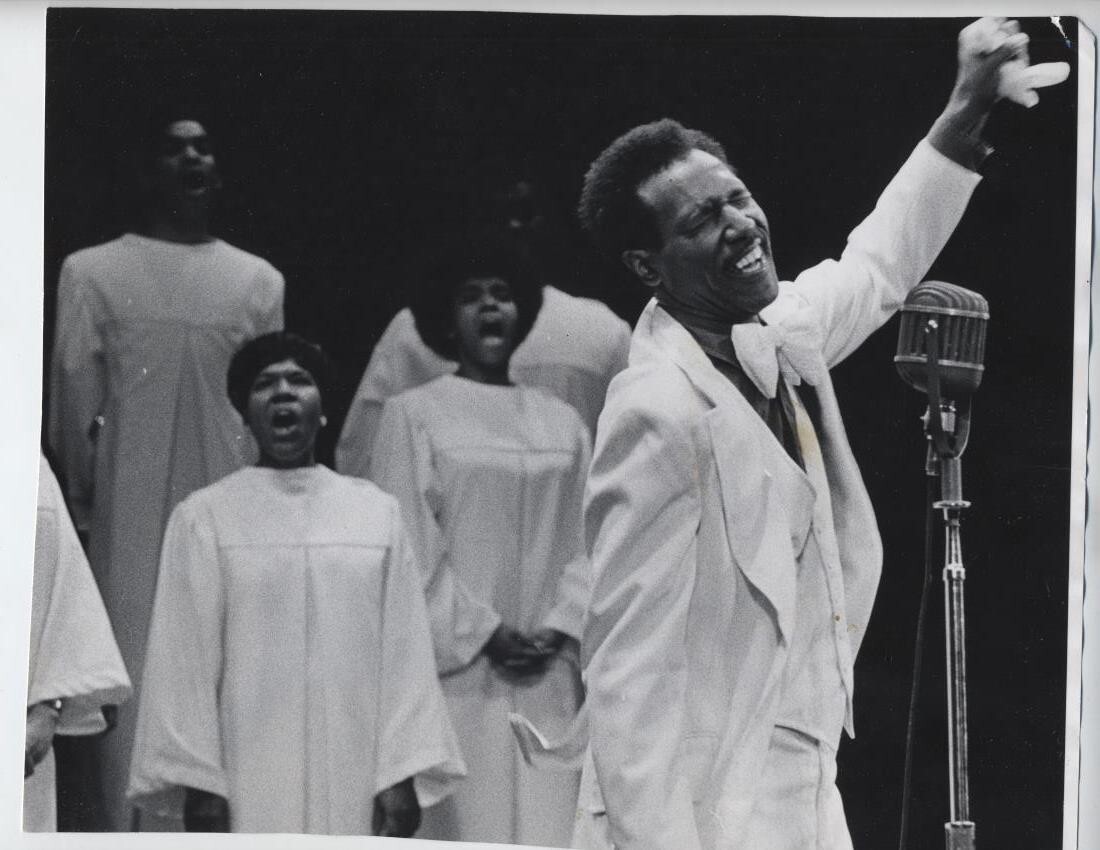
APPROXIMATELY 8 1/4 X10 1/2 INCH PHOTO BY LEGENDARY AFRICAN AMERICAN PHOTOGRAPHERBOBBLACK1974 REV STANLEY KEEBLE CHICAGO MUSICIAN & PASTOR
Photographer Bob Black was born in Chicago, Illinois, on June 4, 1939. Black was one of five children, and attended Chicago public schools. After briefly attending Woodrow Wilson Junior College, Black began working.Bob Black, the first African-American photographer at the Chicago Sun-Times
Black started his career as a professional photographer in 1965, working at the Chicago Defender as a staff photographer. By the time Black joined the Defender, it had already established itself as the largest African American-owned newspaper in the nation, and had been fighting for full equality for African Americans since its inception in 1905. In 1968, Black left the Defender for the Chicago Sun-Times where he remains today as a photographer.
As a member of the National Association of Black Journalists (NABJ), Black was one of the founders of the Visual Task Force, an organization of still and video photographers within the NABJ. He is also a founding member of the Chicago Alliance of African American Photographers (CAAAP), established in 1999 to bring together local African American photographers to promote their work and educate future generations.
Black has been the recipient of numerous awards, including collecting first place at the World Press Photo Competition. He also actively pursues projects outside his work for the newspaper, including a series of photographs of life in the Dominican Republic and a series of photographs displayed along with other CAAAP members at the Chicago Museum of Contemporary Art.
IMAGES BY BOB BLACK STORY BY ALEXY IRVING - Bob Black is a Chicago native and nationally recognized photojournalist with deep roots in the development of what Chicago’s professional photography world is today.
Blacks recent induction into the National Association of Black Journalist Hall of fame, serves as a reflection of how building with a community can come full circle. As a founding member of CAAAP and the National Association of Black Journalist’s Visual Task Force, his hands have been crafting what generations after him can utilize as a vehicle to thrive in the professional photography and photojournalism industry.
CAAAP and NABJ are both safe spaces for the black story teller in all of us. Your community can be found if you lean into your gifts and each of these organizations can be labeled as a starting point towards taking your gifts professional and moving forward with a community, simultaneously.
CAAAP is an organization of black photographers that was ignited following a conversation between Bob Black and CAAAP’s founding member Milbert Brown.
“He [Milbert] was a Tribune photographer and we were covering the White Sox game together. This was coming into the 21st century.”
“Its important for us to document our people. Our story deserves to be seen as part of a whole and only we can get in deep.” - Bob Black
Milbert asked, “ Bob, what I would like to do is pull together a bunch of photographers and we just go through the city and document the black community. To see how far we’ve come and how much further we’ve got to go.“ think I done anything great. I was just trying to get the job done.“ Black has since began archiving his work for future generations to come and has brought students through NABJ under his mentorship. This convention hosts industry professionals, numerous panels, workshops and keynote speakers. The organizations mission is to provide career development and education opportunities to its members.
This pivotal moment in history would later on allow Bob Black to be inducted into the National Association of Black Journalists’ Hall of Fame for being a instrumental member of the community that built him.
Black recalls learning of his honor and that he was nominated through Milbert Brown and NABJ’s current president Dorothy.
“It was very humbling because I always felt that people who got that honor were people that have done great things. I didn’t expect it to happen with me because I didn’t “While I was a member of NABJ, it was a source of strength for me. When I first went to the conventions, I got to see people who were managing editors and partner heads. In Chicago, I didn’t see any of that, they didn’t have it. That’s when I found out, Black folks can be the director of photography. Because I ran into a bunch of them.”
NABJ is the National Association of Black Journalist founded in Washington, DC. Every year they host a convention to bring black professionals together to pursue their professional goals. “Theres a lot of great things happening in the Black community. People doing great things. Young people, old people, everybody, doing great things. We need to find those and document them.”
One common responsibility of all photojournalist should be to tell the truth with your photography.
“Its a lot of good things going on in the community, so we should try to find those things and bring that to the forefront because the media is always going to spread the negative. That’s expected. But we have to show the counterpoint to that.”
As Sun-Times photographer Bob Black photographed this policeman skirmished with demonstrator at Division and Wells Monday night, two other policemen attacked Bob Black with clubs. Aug 26 1968
Lou Della Evans Reid served as Minister of Music at the Fellowship Missionary Baptist for fifty years. Here Evans is conducting the choir during a service to celebrate her retirement.
Photo of Bob Black by Matt Gibson IV“Look for the essence of the folks that live in the community so people can know we’re folks like everybody else who are trying to make life as comfortable for ourselves and our children.” - Bob Black
Federal Bldg Plaza. Renisha James,9, lights a candle in memory of Dantrell Davis who was shot to death while on his way home from school, during a rally in the Federal Building Plaza sponsored by ‘HOPE’, which is headed up by her father, Minister Michael James, B.A. Theology Liberty Baptist Church opened their doors to the community on the night Dr. Martin Luther King was assassinated so people could have a place to mourn and comfort each other. It was April 1968.(Sun-Times)
Black, Bob. (b. Chicago, IL, 1939; active Chicago, IL, 2005)Bibliography and ExhibitionsMONOGRAPHS AND SOLO EXHIBITIONS:
GENERAL BOOKS AND GROUP EXHIBITIONS:
ATLANTA (GA). Atlanta College of Art Gallery.Songs of My People: African Americans: A Self-Portrait.June 26-August 9, 1991; Boston: Little, Brown and Co., 1992.xiii, 209 pp. exhibit. cat. of 150 works by over 50 African American photographers; intro. by Gordon Parks. Eric Easter, D. Michael Cheers, and Dudley M. Brooks, eds. This was a photographic project initiated by the editors, not the usual historical compilation. Included: Jules Allen, Howard Bingham, Bob Black, D. Michael Cheers, Michel DuCille, James V. Evers, Roland L. Freeman, Ronald L. Griemans, C.W. Griffin, Keith Hadley, Durell Hall, Jr., Chester Higgins, Jason Miccolo Johnson, David C. Lee, Matthew Lewis, Kirk McKoy, Jeanne Moutoussamy-Ashe, Ozier Muhammad, Marilyn Nance, Eli Reed, Morris Richardson II, Jeffery Allan Salter, Coreen Simpson Lester Sloan, D. Stevens, Bruce Talamon, Dixie D. Vereen, John H. White, Keith Williams, et al. [Traveled to Corcoran Gallery of Art, 1992; Afro-American Historical and Cultural Museum, Philadelphia, April-May 1992; California Afro-American Museum, May 1992 -- at which eight photographs by D Stevens and others related to the Los Angeles riots of 1992 were added. A second small tour of 60 photographs traveled to: Museum of the City of New York; the DuSable Museum, Chicago; the Uffizi, Florence, Italy, and other international venues.] [Reviews: Renee Lucas Wayne, \"An African-American Self-Portrait in Photos,\" Philadelphia Daily News, April 17, 1992; Shauna Snow, \"Redressing the Balance - Photography: \'Songs of My People\' is Designed to Contribute Toward Understanding ... and Healing the City.\" Los Angeles Times, May 30, 1992; Charles Hagen. \"Review/Photography: \'Songs of My People,\' A Black Self-Portrait.\" NYT, October 9, 1992; \"Unfinished Songs: Three Exhibitions at Philadelphia\'s Afro-American Museum\" The Crisis, October, 1992; long description, but with many names of photographers misspelled.] Note: the photographs from the exhibition were donated to the Museum of Art and Archaeology, University of Missouri. 4to (30.5 x 25.4 cm.; 12 x 10.2 in.), black pictorial boards, pictorial dust jacket. First ed.
CHICAGO (IL). Museum of Contemporary Art (MCA).The Journey: The Next 100 Years.February 12-April 4, 2001.Group exhibition of work by 50 photographers. [Although the number of participants seems to have grown with each subsequent exhibition.] Organized by the Chicago Alliance of African-American Photographers (CAAAP), this exhibition presents 100 photographs by 60 photographers, encompassing all aspects of daily life of the African American communities of the Chicago area including the arts, business, religious life, politics, and social issues such as unemployment and homelessness. Founded in March 1999, the CAAAP was established to encourage aesthetic awareness of photography featuring the African-American community. [Traveling exhibition.]
CHICAGO (IL). South Side Community Art Center.Through the Eyes of Blackness.1973.Group photo exhibition by four Chicago photojournalists. Featured Howard Simmons, John H. White (Daily News), Ovie Carter (Chicago Tribune), and Bob Black (Sun-Times.) Organized by Howard Simmons.
EASTER, ERIC, D. MICHAEL CHEERS and DUDLEY M. BROOKS, eds.Songs of My People: African Americans: A Self-Portrait.New York: Little, Brown & Co., 1992.208 pp., 152 photographic illus. Introduction by Gordon Parks. Essays by Sylvester Monroe, Paula Giddings, Nelson George and Joyce Ladner. Includes photographs by Michelle Agins, Jules Allen, Anthony Barboza, Conrad Barclay, Howard Bingham, Bob Black, Geary G. Broadnax, Dudley Brooks, Ron Caesar, D. Michael Cheers, George Chinsee, Jacques Chinet, Roland L. Freeman, Vince Frye, Mark Gail, T. Ortega Gaines, C.W. Griffin, Keith Hadley, Durell Hall, Jr., Craig Herndon, Chester Higgins, Fred Hutcherson, Jason Miccolo Johnson, David Lee, Matthew Lewis, Roy Lewis, Kirk McKoy, Odell Mitchell, Jeanne Moutoussamy-Ashe, Ozier Muhammad, Marilyn Nance, Eli Reed, Jeffery Allan Salter, Coreen Simpson, Lester Sloan, D. Stevens, Bruce Talamon, Dixie D. Vereen, Kenneth Walker, Riccardo Watson, John H. White, Keith Williams, Pat West, and other leading Black photojournalists. [The exhibition traveled to 23 U.S. cities and 7 countries in Europe. 4to, cloth, d.j. First ed.
FRYE, DANIEL J.African American Visual Artists: an annotated bibliography of educational resource materials.Lanham, MD: Scarecrow Press, 2001.xvi, 378 pp. Many misspellings of artists\' names and a handful of white artists included. 8vo (23 cm.), cloth.
SAN FRANCISCO (CA). Fine Arts Gallery, San Francisco State University.Black Power, Black Art...and the struggle continues: political imagery from the Black Arts Movement of the 1960s and 1970s.September 19-October 21, 1994.6 color thumbnail illus., b&w raised fist logo on cover, list of artists with biog notes, prograam schedule, brief bibliog. introduction, essay. Project Director: Joe Louis Moore. Curated by Samella Lewis and Mary Jane Hewitt. Artists included: Benny Andrews, Kofi Bailey, Richmond Barthé, Romare Bearden, John Biggers, Bob Black, David Bradford, Elizabeth Catlett, Dana Chandler, Floyd Coleman, Dewey Crumpler, Murray DePillars, Emory Douglas, Melvin Edwards, Malaika Favorite, Hal Franklin, Claude Fiddler, Reginald Gammon, Ron Griffin, David Hammons, Ben Hazard, Mike Henderson, Barbara Hogu-Jones, Lois Mailou Jones, Artis Lane, Jacob Lawrence, Samella Lewis, Philip Mason, Joe Moore, Howardena Pindell, Faith Ringgold, Betye Saar, Raymond Saunders, Clarissa Sligh, Ruth Waddy, William Walker, Charles White. [Review: Bruce Nixon, \"Aftershock. Black Power/Black Art at San Francisco State University,\" Artweek 25 (Oct. 20, 1994):16.] 10-panel folded brochure, 12.25 x 3.75 in., wraps.
TAHA, HALIMA.Collecting African American Art: Works on Paper and Canvas.New York: Crown, 1998.xvi, 270 pp., approx. 150 color plates, brief bibliog., index, appendices of art and photo dealers, museums and other resources. Intro. by Ntozake Shange. Forewords by Dierdre Bibby and Samella Lewis. Text consists of a few sentences at best on most of the hundreds of listed artists. Numerous typos and other errors and misinformation throughout. 4to (29 cm.), laminated papered boards, d.j.
WILLIS, DEBORAH, ed.Black Photographers: 1940-1988, An Illustrated Bio-Bibliography.New York: Garland, 1989.483 pp., over 350 illus. The most comprehensive list of Black photographers to date, with brief biographical entries on many artists and a few bibliographical entries on approximately half of the hundreds of names. Photographers included in Willis\'s earlier book, Black Photographers 1840-1940, receive only a brief notation here. An indispensable reference work. Artists discussed include: Salimah Ali, Omobowale Ayorinde, J. Edward Bailey, III, Anthony Barboza, Donnamarie Barnes, Vanessa Barnes Hillian, Fay D. Bellamy, Lisa Bellamy, Dawoud Bey, Hart Leroy Bibbs, Bonnie Brisset, Barbara Brown, Lisa Brown, Millie Burns, Muriel Agatha Fortune Bush, Cynthia D. Cole, Juanita Cole, Cary Beth Cryor, Tere L. Cuesta, Fikisha Cumbo, Phyllis Cunningham, Pat Davis, Carmen DeJesus, Lydia Ann Douglas, Barbara Dumetz, Joan Eda, Sharon Farmer, Phoebe Farris, Valeria \"Mikki\" Ferrill, Collette V. Fournier, Roland L. Freeman, Rennie George, Bernadette F. B. Gibson, Anthony Gleaton, Dorothy Gloster, Lydia Hale-Hammond, Gail Adelle Hansberry, Inge Hardison, Teenie Harris, Madeleine Hill, Zebonia Hood, Vera Jackson, Louise Jefferson, Michelle M. Jeffries, Brent Jones, Brian V. Jones, Julia Jones, Kenneth G. Jones, Marvin T. Jones, Leah Jaynes Karp, Irene C. Kellogg, Lucius King, Romulo Lachatanere, Allie Sharon Larkin, George Larkins, Archy La Salle, Abe C. Lavalais, Joyce Lee, Sa\'Longo J.R. Lee, Carl E. Lewis, Harvey James Lewis, Matthew Lewis, Roy Lewis, Fern Logan, Edie Lynch, Peter Magubane, Jimmie Mannas, Louise Martin, Mickey Mathis, Carroll T. Maynard, Rhashidah Elaine McNeill, Marlene Montoute, Michelle Morgan, Jeanne Moutoussamy-Ashe, Marilyn Nance, Yvonne Payne, Patricia Phipps, Ellen Queen, Phillda Ragland, Arkili-Casundria Ramsess, Odetta Rogers, Veronica Saddler, Lloyd Saunders, Cheryl Shackelton, Victoria Simmons, Coreen Simpson, Lorna Simpson, Clarissa T. Sligh, Ming Smith, Toni Smith, Charlynn Spencer Pyne, Jo Moore Stewart, Celeste P. Stokes, Elisabeth Sunday, Elaine Tomlin, Sandra Turner-Bond, Jacqueline La Vetta Van Sertima, Dixie Vereen, William Onikwa Wallace, Sharon Watson-Mauro, Carrie Mae Weems, Dolores West, Judith C. White, Elizabeth \"Tex\" Williams, Lucy Williams, Pat Ward Williams, Deborah Willis, Carol R. Wilson, Jonni Mae Wingard, Ernest Withers, and many, many others. Not all listed in this description, but all individual photographers are cross-listed. Large stout 4to, pictorial boards, no d.j. (as issued). First ed.
Photographer Bob Black was born in Chicago, Illinois, on June 4, 1939. Black was one of five children, and attended Chicago public schools. After briefly attending Woodrow Wilson Junior College, Black began working.
Black started his career as a professional photographer in 1965, working at the Chicago Defender as a staff photographer. By the time Black joined the Defender, it had already established itself as the largest African American-owned newspaper in the nation, and had been fighting for full equality for African Americans since its inception in 1905. In 1968, Black left the Defender for the Chicago Sun-Times where he remains today as a photographer.
As a member of the National Association of Black Journalists (NABJ), Black was one of the founders of the Visual Task Force, an organization of still and video photographers within the NABJ. He is also a founding member of the Chicago Alliance of African American Photographers (CAAAP), established in 1999 to bring together local African American photographers to promote their work and educate future generations.
Black has been the recipient of numerous awards, including collecting first place at the World Press Photo Competition. He also actively pursues projects outside his work for the newspaper, including a series of photographs of life in the Dominican Republic and a series of photographs displayed along with other CAAAP members at the Chicago Museum of Contemporary Art.
Retired Chicago Sun-Times photographer Bob Black was inducted Friday into the National Association of Black Journalists’ Hall of Fame.
Black, who worked for the Sun-Times for 38 years after starting at the Chicago Defender, was honored in Aventura, Florida, at the NABJ’s yearly convention, along with others including Tom Joyner, the longtime Chicago radio host known as “The Fly Jock” for the years he commuted between Chicago and Dallas to host daily shows in both cities at the same time.
All were cited for “significant contributions to not only their respective fields within the journalism community but also in the black community worldwide,” according to Sarah Glover, president of the organization. “They have blazed trails and opened doors that have helped black journalists who have come after them to thrive and survive in the industry.”
The NABJ singled out Black for his photos “capturing key historical moments such as the aftermath of Martin Luther King Jr.’s assassination” and also pointed to his work as “a mentor to many NABJ college students.”
Bob Black’s Pink Slip: A Color Thing?
Years ago we used to ride into the night with Bob Black. He was the photographer and wheelman, we carried the notepad, and as the two of us hurtled toward whatever mayhem the Sun-Times’s night desk had sicced us on, that happy warrior enlightened this young newcomer to Chicago on the ways of the city and the ways of the world.
Bob Black is 53 now and almost half his lifetime has been given to the Sun-Times. But last week Black was fired for a “gross breach of trust.” He was dismissed without severance for what the Sun-Times Company described in a statement as “dozens of unauthorized uses of the company’s Federal Express account and outside photo lab,” going back more than three years and costing the company “more than $1,400.”
According to the newspaper, Black was warned last November when two supervisors noticed “a $175 messenger charge for personal business.” But “our records show Mr. Black continued to use the company’s Federal Express account for personal business on at least a dozen additional occasions.”
Black called us the day after he was fired. He said, “Over the years I’ve been using the Fed Ex number at work to send out various things, one of them a project, ‘Songs of My People,’ a photo documentation of the African American experience. Or when people feature my work or ask me to speak, as one of the few African Americans doing my work, they’d ask for biographical information. I thought, well, it’s OK to use the Sun-Times’s Fed Ex number. They always wanted it yesterday.
Best of Chicago voting is live now. Vote for your favorites >>
“The company is using the number ’78 times’ over a period of three years. I counted 17 situations that were actually purely personal, but there was no serious gain to me in money. . . . The company takes the position I stole services from the Sun-Times. The [Chicago Newspaper] Guild takes the position it was a case of bad judgment, which I have admitted to. I also offered to pay back the money involved. That didn’t seem to work. Yesterday I gave them $500.”
Normally the Sun-Times refuses to comment on personnel matters. It changed its policy with Bob Black because “unfortunately”–management’s word–Black’s dismissal “has become something of a public issue.”
Stories on Bob Black have appeared twice on the front page of the Chicago Defender. Last Saturday Operation PUSH called for a Sun-Times boycott. The Chicago Association of Black Journalists wrote editor Dennis Britton asserting that Black had not been treated fairly and asking for his reinstatement. African American colleagues at the Sun-Times submitted a letter urging management to reconsider.
Was this racial? we asked the Chicago Newspaper Guild’s executive director, Gerald Minkkinen. The guild is grieving to save Black’s job, and short of that to get him dismissal pay. “If you’re asking me if I think the dismissal was racially motivated, I don’t see any evidence of it,” Minkkinen replied. “I have to be honest. Would they have dismissed a white employee for having done the same things? Probably.”
Black isn’t so sure. Put yourself in his shoes. You do a good job for 25 years, and then you’re drummed out in disgrace. You’d fight back too, any way you could. To Black, race was both an explanation and the weapon at hand. He started making calls.
“The Sun-Times doesn’t understand where they get their basic readership from. It’s the black community. They don’t seem to understand that,” Black told us. “They’re always going after the suburbs.”
Is this a racial issue? we asked him.
“Well, you know, to say it’s cut and dried would be hard, but in my experience I’ve never known them to do this to any of the white staffers. . . . I’m senior man in the photo department. I happen to be African American. It’s not something that has to be resolved in this way. They could have asked for reimbursement, and that should have been the end of it. But they want to make me out to be a common thief, and I’m not.”
Was this racial? we asked a black colleague of Black’s who signed the letter protesting his dismissal.
The colleague said it wasn’t but went on, “Bob is one of our own. It is incumbent upon us to weigh in when we feel one of our own has been wronged. We are a minority, and if we don’t stand up for ourselves no one will.”
Does anyone else there feel as strongly as the blacks do?
“I don’t know. We haven’t talked to anyone else. I do know some of my white colleagues have said that they feel Bob has been wronged. They’ve expressed basically the same idea that the punishment was too harsh for an employee of his background.”
Will they act on that conviction? we wondered.
“I don’t know. I don’t know. I hope so.”
But you doubt it?
“I do doubt it. They will leave it to the union leadership to handle. As is correct procedure.”
And that disappoints you, we said.
“No. I’m not disappointed. I’m the type of person who never expects anyone to stick their neck out.”
Pundits on the Plan
Nothing’s more dreadful than a lockstep press. We know that. Disagreement should reign and up out of the froth will eventually bob the truth.
And yet we were sort of hoping the pundits of America would speak with one voice in hailing the new economic program of President Clinton. We liked his reforms philosophically without having any idea whether they’d actually work. We think it’s pretty crucial that they do, and that’s what we wanted to hear.
The speech itself was reverently reported on front pages everywhere. The Tribune was especially grand: “Seeking to reshape the economic and social destiny of the nation at the end of the Cold War, Bill Clinton risked his young presidency Wednesday night by challenging a nation at peace to sacrifice for domestic renewal.”
But the president’s credibility was already under attack. “Not Leveling Gave Clinton Uphill Job,” said the headline to a Jeff Greenfield column in the Sun-Times the day before Clinton’s speech. “What’s upsetting about Clinton’s economic proposals isn’t so much the content as the dishonesty of it all,” said the same paper’s Dennis Byrne the morning after. “Clinton operated on the principle that you should say whatever you must to get yourself elected.” George Will concluded that Clinton’s presidential campaign had been “the most disingenuous since at least 1964.”
But then came a volley of headlines that rang like fanfares! Tribune: “Greenspan says Clinton’s budget plan is ‘credible.\'” Sun-Times editorial: “Industrial Policy Is Right for America.” Sun-Times: “Economic Allies Back Clinton’s Program.” Tribune: “Builders warm to Clinton’s plan.” New York Times: “Clinton Blueprint Wins New Respect–Emphasis on Shared Sacrifice Pleases Business Leaders.” New York Times: “Bentsen Sits Tall at Group of 7 Talks–Clinton’s plans gave the U.S. new credibility with its trading partners.” New York Times: “Cheers From States for Clinton’s Plan.”
Herbert Stein, a former chairman of the President’s Council of Economic Advisers, said in the New York Times: “Bill Clinton’s economic program is probably the most far-reaching effort ever made by a President to control the Federal budget deficit.” Robert Eisner, past president of the American Economic Association, wrote in the Tribune: “President Clinton’s economic plan is generally a winner. It charts a basically new direction.”
So we dared hope. But there were other voices. Consider these three headlines from the same page of the Tribune: Over a Joan Beck column, “Clinton’s Rx for ‘change’ may be just a placebo”; over a Stephen Chapman column, “Clinton stands for thrift, except when he wants to spend”; over a David Broder column, “Clinton plan is in danger of causing another deficit: Public trust.”
A Boston Globe columnist appearing in the naysaying Tribune asserted: “It is possible to agree with every measure President Clinton set out in his talk last week and still consider the speech a smug disaster. . . . Aside from abandoning nearly every campaign promise it made to get elected, the Clinton administration is notable so far mainly for its determination to put Democrats everywhere and its willingness to use politics anywhere.”
Eugene Kennedy wrote in the Tribune: “It is . . . extremely dangerous for President Clinton to excuse himself for immediately breaking his campaign promise of not increasing taxes on the middle class by saying that the voters did not expect him to keep his pre-election pledges and that it wasn’t as if he had ‘made a read-my-lips promise’ to the American people. . . . This statement, whether intended or not, telegraphs a disdain for the dignity of the American people on a par with that of the infomercial host who varnishes heads to cure baldness.”
So we despaired. But an occasional pundit tried to square the circle. Commented the Tribune’s John McCarron: “Nobody’s telling it like it is, beginning with Bill Clinton. From the start, the selling of his economic program has been fogged with white lies and petty deceptions. . . . But he’s being a lot more honest than those who pine for the ’12 fat years’ of Reagan-Bush.”
“The public seems far ahead of the politicians in wanting change,” observed the Tribune’s William Neikirk. “It doesn’t even seem to matter that Clinton broke a slew of campaign promises or gave a distorted picture of his plan in his speech to Congress, or failed to mention that the final cost of the savings and loan bailout are not included in his plan. All is forgiven by a populace eager to be led.”
The press’s emergent position seems to be this: the patent medicine might actually do some good, but don’t trust the confidence man peddling it. We’re not comforted. We advise Clinton to pay attention to his clipping service.
The images are in black and white, and in color. They capture decades of Chicago history. Some are joyous. Others sad. They\'re now all in one book.
Morning Insider Jim Williams tells us the book\'s editors dug deep into the Chicago Sun-Times photo archive to depict Chicago history captured by extraordinary photojournalists.
Bob Black was in his car when a bulletin came over the radio.
\"My heart just jumped. I said \'oh, Lord,\' and so I had to pull over to side of the curb to digest what I had just heard,\" he said.
Dr. Martin Luther King Jr. had just been assassinated. Black, in his late 20s, himself grieving, went to a South Side church with his camera in hand.
\"You didn\'t want to become intrusive. You didn\'t want people to notice you,\" he said.
Only one month into his job as a Chicago Sun-Times photographer he photographed one of the people mourning King\'s murder.
\"It said to me this person was grieving from the depths of their soul. And that\'s the way I was feeling,\" Black said.
Bob Black\'s work is among the photos in the new book \"Chicago Exposed,\" all from the Chicago Sun-Times photo archive.
From the euphoria of World War II\'s end to Mamie Till Bradley\'s agony when her the body of her murdered son, Emmett Till, arrived back in Chicago from Mississippi.
From the unrest outside the 1968 Democratic National Convention to the unrest after the killing of George Floyd.
Richard Cahan is the book\'s co editor, and for many years he was the picture editor at the Sun-Times.
\"When you think back in your life, if you grew in Chicago, you think about these events, and you oftentimes associate them with visual pictures,\" he said.
We had the ideal location for our interviews: the Chicago History Museum.
In 2018, the Chicago History Museum acquired the Sun-Times photo archive. Five million images; a treasure trove of Chicago history. Some of these photos are in \"Chicago Exposed,\" accompanied by essays; some penned by people in the photos, or historians, or those who took the pictures.
WILLIAMS: \"This is what you wrote: \'The photo helped me cope. I grew up in this community and was connected to the church.\'
BLACK: \"Yes, yes.\"
\"Chicago Exposed\" is a visual chronicle of the city\'s history, and a tribute to the men and women whose work fills these pages.
\"I loved it. I love it. It was my dream job,\" Black said.
Bob Black retired from the Sun-Times in 2006, but said he still takes photos. You can get \"Chicago Exposed\" online or at bookstores.
It was a historic event. An education, really.
Four of Chicago’s most-esteemed photographers — Bob Black, Ovie Carter, John White and Howard Simmons — gathered for a once-in-a-lifetime event during the National Association of Black Journalists Chicago Chapter’s Oct. 23 forum celebrating photojournalism, held at Bar Louie in the South Loop.
The trailblazers, among the first black staff photographers to work at major Chicago daily newspapers, discussed their careers, friendship and techniques used to capture some of their best work.
“It’s humbling for me to be in the company of these guys because they’re superb photographers and they’re true gentlemen,” said Simmons, 76, who worked as a staff photographer for Ebony magazine and the Chicago Sun-Times.
Simmons said he started working at the Sun-Times after White, who already worked there, made the suggestion. White’s looking out for Simmons is another testament to the respect the men always had for each other.
“We’re competitors. There’s a harmony that bonds us and binds us. They’re my colleagues but they’re my brothers,” said White, 74, who won the 1982 Pulitzer Prize for feature photography while at the Sun-Times.
No other photo captures this bond more than a selfie the men took in 1973. Simmons, White, Carter and Black positioned a camera on the sidewalk and used a timer to take a photo of themselves on the front steps of the South Side Community Arts Center to promote their exhibit, “Through the Eyes of Blackness.”
More than 40 years later, the men re-created that shot in a poignant, much lauded, time-warp photo. “We wanted to have a signature photograph,” Simmons explained. As photojournalists, the men were often the first ones on the scene, capturing tragedies, celebrations and everyday life for many around Chicagoland. They also turned their lens on key historical moments such as Black’s documenting the aftermath of Martin Luther King Jr.’s assassination.
Nicknamed “Legend” by the other men, Black, 80, began his career in 1965 at the Chicago Daily Defender, and in 1968, became the first black photographer hired at the Sun-Times. A co-founder of the Chicago Alliance of African American Photographers and the NABJ Visual Task Force, Black was inducted into the 2019 NABJ Hall of Fame.
White isn’t the only Pulitzer Prize winner among these photojournalists.
Carter, 73, who began his career as a photographer at the Chicago Tribune in 1969, won the Pulitzer Prize in international reporting with fellow reporter William Mullen for their coverage of famine in parts of Africa and India. Carter also was a member of the Tribune team that won the 2001 Pulitzer Prize for explanatory reporting.
“I had some vision about the kind of photography that I wanted to do. [I had] on-the-job-training and got off to a good start,” Carter said about getting himself hired by the Tribune.
Today, as the widely respected elders in the field, the men continue to mentor, shoot captivating images, and are even contemplating exhibiting their work together again.
”They call us old-timers. I love it now. Didn’t like it at first,” White said.
bout
Our Goal Is To Support And Promote The Art And Science Of Photography In All Styles And Formats, As Individuals, As An Organization, And As Part Of The Community So That All May Enjoy And Benefit From The Images Of Our Lives.
Historic shoot for Black Artists at SSCAC Painters, sculptors, photographers, and numerous other visual artists gathered for a historic photo shoot May 28, 05 on the steps of the South Side Community Art Center.
OUR MISSION
The mission of the Chicago Alliance of African-American Photographers is:
To photographically document the culture, society, and history of African-Americans, its communities, residents and their ethnic exchange in the Greater Chicago area and throughout the world.
To promote the work of professional and amateur photographers through sponsored exhibitions, publications, lectures and education in the field of photography, and its related genre.
To Use our photographic images and expertise to inform the public and our community about the importance of photography as an informative and creative medium of expression.
CAAAP is open to all commercial, fine art, freelance,
and newspaper photographers interested in supporting these efforts.
OUR BEGINNINGS
The Chicago Alliance of African-American Photographers (CAAAP) founded on March 8, 1999, by seven photographers; Leslie Adkins, Bob Black, Martha Brock, Milbert O. Brown Jr., Terry Harris, Brent Jones and Lee Landry. Their initial goal was to document Chicago\'s African-American communities at the turn of the 21st Century. The primary objectives of the organization grew to unify Chicago based professional African-American photographers, and promote the art of photography through exhibitions, lectures and educational programs.
The membership of the Chicago Alliance of African-American Photographers is composed of commercial, fine art, freelance, documentary, newspaper photojournalists, and amateur photographers. Their talents cover the full spectrum of photography from street artists and news, to studio photography. Although many of our members are established professionals, some are hobbyists. However, all of our members share a passion for the art of photography, and it\'s power to inform, educate and record history. Our membership has included three Pulitzer Prize-winning photojournalists, and a former Chicago Tribune photojournalist named Ovie Carter, who won the 1975 Pulitzer for International Reporting. Milbert O. Brown Jr. and Ovie Carter were members of the Chicago Tribune\'s 2001 Pulitzer Prize-winning team for Explanatory Reporting. The Chicago Sun-Times\' John H. White, won the 1982 Pulitzer Prize for Feature Photography. The original project, \"The Journey: The Next 100 Years\", was a photographic project documenting the culture and lifestyles of Greater Chicago\'s African-American communities at the beginning of a new millennium. Over 50 African-American photographers from Chicago produced compelling black and white images of the first year of the \'new\' century. In 2001, The Journey: The Next 100 Years; was a featured photographic exhibition that opened concurrently at Chicago\'s Museum of Contemporary Art, and the \'legendary,\' community-based institution: The South Side Community Art Center in the Bronzeville neighborhood of Chicago. Over the next twenty-four months, the exhibit traveled throughout the Chicago metropolitan area where these powerful images exhibited at public libraries, art galleries, universities, and museums.
Over the ensuing years, CAAAP members and their photographs were featured in local, national, and international publications, including the Chicago Defender, Chicago Tribune, Chicago Sun-Times, The New York Times, Black Enterprise Magazine, and Ebony/Jet Magazines. Members have participated in educational lectures and exhibits at Loyola University, Northwestern University, University of Illinois – Chicago and Roosevelt University. Our members have also made appearances on local media, radio, and television, and interviewed in Vibe Magazine, and The New York Times. In 2006, CAAAP produced and published a book of the project \"The Journey: The Next 100 Years\"; featuring over 300 images by 70 CAAAP members from 2000 through 2005.
In 2006, with funding provided from the Chicago Tribune Foundation, assistance from Roosevelt University, and the Chicago History Museum, CAAAP produced and published a book of the project “The Journey: The Next 100 Years”; featuring over 300 images, produced by 70 CAAAP members from 2000 through 2005.
ob Black’s photojournalism career started with the Chicago Daily Defender in 1965. He later joined the Chicago Sun-Times in 1968 where he worked for 38 years until retirement.
Bob Black was honored with a first place award from the World Press Foundation of Amsterdam, The Netherlands. In 1990 Black was one of 50 photographers contributing to the land mark project, “Songs of My People,” resulting in a book and a traveling exhibit.
He is one of the founders of the Chicago Alliance of African American Photographers. (CAAAP) as well a co-founder of the National Association of Black Journalists (NABJ) VisualTask Force (VTF).
utOur Goal Is To Support And Promote The Art And Science Of Photography In All Styles And Formats, As Individuals, As An Organization, And As Part Of The Community So That All May Enjoy And Benefit From The Images Of Our Lives.Historic shoot for Black Artists at SSCAC Painters, sculptors, photographers, and numerous other visual artists gathered for a historic photo shoot May 28, 05 on the steps of the South Side Community Art Center.OUR MISSIONThe mission of the Chicago Alliance of African-American Photographers is:
To photographically document the culture, society, and history of African-Americans, its communities, residents and their ethnic exchange in the Greater Chicago area and throughout the world.To promote the work of professional and amateur photographers through sponsored exhibitions, publications, lectures and education in the field of photography, and its related genre.To Use our photographic images and expertise to inform the public and our community about the importance of photography as an informative and creative medium of expression.CAAAP is open to all commercial, fine art, freelance,and newspaper photographers interested in supporting these efforts.
OUR BEGINNINGSThe Chicago Alliance of African-American Photographers (CAAAP) founded on March 8, 1999, by seven photographers; Leslie Adkins, Bob Black, Martha Brock, Milbert O. Brown Jr., Terry Harris, Brent Jones and Lee Landry. Their initial goal was to document Chicago\'s African-American communities at the turn of the 21st Century. The primary objectives of the organization grew to unify Chicago based professional African-American photographers, and promote the art of photography through exhibitions, lectures and educational programs.
The membership of the Chicago Alliance of African-American Photographers is composed of commercial, fine art, freelance, documentary, newspaper photojournalists, and amateur photographers. Their talents cover the full spectrum of photography from street artists and news, to studio photography. Although many of our members are established professionals, some are hobbyists. However, all of our members share a passion for the art of photography, and it\'s power to inform, educate and record history. Our membership has included three Pulitzer Prize-winning photojournalists, and a former Chicago Tribune photojournalist named Ovie Carter, who won the 1975 Pulitzer for International Reporting. Milbert O. Brown Jr. and Ovie Carter were members of the Chicago Tribune\'s 2001 Pulitzer Prize-winning team for Explanatory Reporting. The Chicago Sun-Times\' John H. White, won the 1982 Pulitzer Prize for Feature Photography. The original project, \"The Journey: The Next 100 Years\", was a photographic project documenting the culture and lifestyles of Greater Chicago\'s African-American communities at the beginning of a new millennium. Over 50 African-American photographers from Chicago produced compelling black and white images of the first year of the \'new\' century. In 2001, The Journey: The Next 100 Years; was a featured photographic exhibition that opened concurrently at Chicago\'s Museum of Contemporary Art, and the \'legendary,\' community-based institution: The South Side Community Art Center in the Bronzeville neighborhood of Chicago. Over the next twenty-four months, the exhibit traveled throughout the Chicago metropolitan area where these powerful images exhibited at public libraries, art galleries, universities, and museums.
Over the ensuing years, CAAAP members and their photographs were featured in local, national, and international publications, including the Chicago Defender, Chicago Tribune, Chicago Sun-Times, The New York Times, Black Enterprise Magazine, and Ebony/Jet Magazines. Members have participated in educational lectures and exhibits at Loyola University, Northwestern University, University of Illinois – Chicago and Roosevelt University. Our members have also made appearances on local media, radio, and television, and interviewed in Vibe Magazine, and The New York Times. In 2006, CAAAP produced and published a book of the project \"The Journey: The Next 100 Years\"; featuring over 300 images by 70 CAAAP members from 2000 through 2005.
In 2006, with funding provided from the Chicago Tribune Foundation, assistance from Roosevelt University, and the Chicago History Museum, CAAAP produced and published a book of the project “The Journey: The Next 100 Years”; featuring over 300 images, produced by 70 CAAAP members from 2000 through 2005.
Bob A. Black started his career as a professional photographer in 1965, working at the Chicago Defender as a staff photographer. By the time Black joined the Defender, it had already established itself as the largest African American-owned newspaper in the nation, and had been fighting for full equality for African Americans since its inception in 1905. In 1968, Black left the Defender for the Chicago Sun-Times where he remains today as a photographer.As a member of the National Association of Black Journalists (NABJ), Black was one of the founders of the Visual Task Force, an organization of still and video photographers within the NABJ. He is also a founding member of the Chicago Alliance of African American Photographers (CAAAP), established in 1999 to bring together local African American photographers to promote their work and educate future generations.Bob has been the recipient of numerous awards, including collecting first place at the World Press Photo Competition. He also actively pursues projects outside his work for the newspaper, including a series of photographs of life in the Dominican Republic and a series of photographs displayed along with other CAAAP members at the Chicago Museum of Contemporary Art.
CHICAGO ALLIANCE OF AFRICAN AMERICAN PHOTOGRAPHERSWE MATTERWe Matter documents the local protests set off by the death of George Floyd in 2020. United in solidarity, demonstrators throughout Chicago and the U.S. took to the streets to denounce the failures of systemic racism and colonialism and to fight against racial oppression and police brutality. The members of CAAAP and other Chicago photographers have captured these protests that have inspired demands for social policy change and economic accountability.
The exhibition, We Matter, validates that We are intolerant of infrastructures that support racism in America. The word WE in the title represents the collective voices of protest.A Brief History of the Chicago Alliance of African American PhotographersThe Chicago Alliance of African American Photographers began 21 years ago when seven of Chicago’s best photographers created a place for black photographers within the Chicagoland area to cultivate and celebrate black culture and curate diasporic photographic arts. The founding members include: Leslie Adkins, Bob Black, Martha Brock, Milbert O. Brown Jr., Terry Harris, Brent Jones and Lee Landry. CAAAP continues to increase its membership and create educational photography programs for the African-American Community.
Series I: Original Interview FootageVideo Oral History Interview with Bob Black, Section A2003_010_001_001, TRT: 0:29:102003/01/17Bob Black was born on June 4, 1939 to Elaine Curry Black (later Martin) andClarence Henry Black, Jr. His mother was born around 1919 to Janie Curry andRobert Curry, in Chicago, Illinois and worked as a hair stylist. His father wasborn around 1918 to Marie Black and Clarence Black, Sr. and was a postalworker. Black’s parents met while attending Berean Baptist Church in Chicago,Finding Aid to The HistoryMakers [6/7/22, 9:29:44 PM]Illinois. During World War II, his father fought in the Philippines. His motherwas a musician and a pillar in the church, and later remarried to Herbert Martin.Black grew up in the Washington Park neighborhood of Chicago, where heattended William W. Carter Elementary School and Englewood High School. Hewas active in his school’s safety patrol and in the Boy Scouts, where he was astaff member at Camp Blackhawk on the Owasippe Scout Reservation in TwinLake, Michigan and a member of the Order of the Arrow. Black’s three brothers,Arnold, Clarence, and David were also Boy Scouts.Video Oral History Interview with Bob Black, Section A2003_010_001_002, TRT: 0:29:412003/01/17Bob Black and his brothers were members of the Boy Scouts and the drum andbugle corps of the American Legion Post. They were also mentored by twoteachers who lived in the area: Emma Stacker and Mrs. Trotter. At EnglewoodHigh School, Black was a member of the choir and ROTC as well as friendswith HistoryMaker George Carruthers. At this time, he also started learningabout photography from the members of the Berean Baptist Church camera club,including Reverend William Vance, Bobby Orr, and Billy Lites. These men letBlack use their equipment and mentored him. Black graduated from high schoolin 1957 and began freelancing for the Chicago Defender, where he metphotojournalists Cleo Lyles and Tony Rhoden. In the early 1960s, Black joinedthe Illinois National Guard to avoid fighting in the Vietnam War. He wasinitially an Infantryman in the 8th Regiment, but joined the Signal Corps afterintegration and was placed in the photography unit.Video Oral History Interview with Bob Black, Section A2003_010_001_003, TRT: 0:29:102003/01/17Bob Black began working at the Chicago Defender shortly after his high schoolgraduation in 1957 as a contributor to its “Teen Page.” He continued to work asa freelancer, learning from photojournalists Cleo Lyle and Tony Rhoden andinspired by HistoryMaker Gordon Parks’ photos in Life Magazine. In the early1960s, Black became a photographer for the Illinois National Guard. In 1965,Black was hired by HistoryMaker Robert Sengstacke as a full-time photographerfor the Chicago Defender, where he worked with reporters including Dave Potterand Betty Washington and covered Father James Groppi and the Milwaukeeopen housing marches. In 1968, Black used his position in the Illinois NationalGuard to take photographs of the riots in Chicago, Illinois after the assassinationof Reverend Dr. Martin Luther King, Jr. After the riots, Bob Langer hired Blackat the Chicago Sun-Times. Black was the second African Americanphotojournalist to work for a white Chicago newspaper, following his friend andmentor John Tweedle.Video Oral History Interview with Bob Black, Section A2003_010_001_004, TRT: 0:28:002003/01/17Bob Black continued to work for the Chicago Sun-Times, where his dailyschedule took him to crime scenes, political functions, accidents, and societygatherings. He reflects upon the changes caused by digital cameras and phones,as well as the dangers of being a first responder. Black describes the conditionshe has put himself in for stories, including the police brutality he faced whilecovering the 1968 Democratic National Convention, houses on fire, and horrificcrime scenes. He describes two events that he covered, the 1968 North CentralAirlines crash at O’Hare International Airport and the 1972 Illinois Central Gulftrain crash in Chicago, Illinois, and reflects upon the ethical question of whetherhe would save someone’s life or take a picture first if forced to choose. Henames some of the remarkable people he met and photographed, includingFinding Aid to The HistoryMakersReverend Dr. Martin Luther King, Jr. and Chicago Mayor Harold Washington.Video Oral History Interview with Bob Black, Section A2003_010_002_005, TRT: 0:31:122003/01/27Bob Black narrates his photographs.Video Oral History Interview with Bob Black, Section A2003_010_002_006, TRT: 0:13:042003/01/27Bob Black continues to narrate his photographs
Black, Bob. (b. Chicago, IL, 1939; active Chicago, IL, 2005)Bibliography and ExhibitionsMONOGRAPHS AND SOLO EXHIBITIONS:
GENERAL BOOKS AND GROUP EXHIBITIONS:
ATLANTA (GA). Atlanta College of Art Gallery.Songs of My People: African Americans: A Self-Portrait.June 26-August 9, 1991; Boston: Little, Brown and Co., 1992.xiii, 209 pp. exhibit. cat. of 150 works by over 50 African American photographers; intro. by Gordon Parks. Eric Easter, D. Michael Cheers, and Dudley M. Brooks, eds. This was a photographic project initiated by the editors, not the usual historical compilation. Included: Jules Allen, Howard Bingham, Bob Black, D. Michael Cheers, Michel DuCille, James V. Evers, Roland L. Freeman, Ronald L. Griemans, C.W. Griffin, Keith Hadley, Durell Hall, Jr., Chester Higgins, Jason Miccolo Johnson, David C. Lee, Matthew Lewis, Kirk McKoy, Jeanne Moutoussamy-Ashe, Ozier Muhammad, Marilyn Nance, Eli Reed, Morris Richardson II, Jeffery Allan Salter, Coreen Simpson Lester Sloan, D. Stevens, Bruce Talamon, Dixie D. Vereen, John H. White, Keith Williams, et al. [Traveled to Corcoran Gallery of Art, 1992; Afro-American Historical and Cultural Museum, Philadelphia, April-May 1992; California Afro-American Museum, May 1992 -- at which eight photographs by D Stevens and others related to the Los Angeles riots of 1992 were added. A second small tour of 60 photographs traveled to: Museum of the City of New York; the DuSable Museum, Chicago; the Uffizi, Florence, Italy, and other international venues.] [Reviews: Renee Lucas Wayne, \"An African-American Self-Portrait in Photos,\" Philadelphia Daily News, April 17, 1992; Shauna Snow, \"Redressing the Balance - Photography: \'Songs of My People\' is Designed to Contribute Toward Understanding ... and Healing the City.\" Los Angeles Times, May 30, 1992; Charles Hagen. \"Review/Photography: \'Songs of My People,\' A Black Self-Portrait.\" NYT, October 9, 1992; \"Unfinished Songs: Three Exhibitions at Philadelphia\'s Afro-American Museum\" The Crisis, October, 1992; long description, but with many names of photographers misspelled.] Note: the photographs from the exhibition were donated to the Museum of Art and Archaeology, University of Missouri. 4to (30.5 x 25.4 cm.; 12 x 10.2 in.), black pictorial boards, pictorial dust jacket. First ed.
CHICAGO (IL). Museum of Contemporary Art (MCA).The Journey: The Next 100 Years.February 12-April 4, 2001.Group exhibition of work by 50 photographers. [Although the number of participants seems to have grown with each subsequent exhibition.] Organized by the Chicago Alliance of African-American Photographers (CAAAP), this exhibition presents 100 photographs by 60 photographers, encompassing all aspects of daily life of the African American communities of the Chicago area including the arts, business, religious life, politics, and social issues such as unemployment and homelessness. Founded in March 1999, the CAAAP was established to encourage aesthetic awareness of photography featuring the African-American community. [Traveling exhibition.]
CHICAGO (IL). South Side Community Art Center.Through the Eyes of Blackness.1973.Group photo exhibition by four Chicago photojournalists. Featured Howard Simmons, John H. White (Daily News), Ovie Carter (Chicago Tribune), and Bob Black (Sun-Times.) Organized by Howard Simmons.
EASTER, ERIC, D. MICHAEL CHEERS and DUDLEY M. BROOKS, eds.Songs of My People: African Americans: A Self-Portrait.New York: Little, Brown & Co., 1992.208 pp., 152 photographic illus. Introduction by Gordon Parks. Essays by Sylvester Monroe, Paula Giddings, Nelson George and Joyce Ladner. Includes photographs by Michelle Agins, Jules Allen, Anthony Barboza, Conrad Barclay, Howard Bingham, Bob Black, Geary G. Broadnax, Dudley Brooks, Ron Caesar, D. Michael Cheers, George Chinsee, Jacques Chinet, Roland L. Freeman, Vince Frye, Mark Gail, T. Ortega Gaines, C.W. Griffin, Keith Hadley, Durell Hall, Jr., Craig Herndon, Chester Higgins, Fred Hutcherson, Jason Miccolo Johnson, David Lee, Matthew Lewis, Roy Lewis, Kirk McKoy, Odell Mitchell, Jeanne Moutoussamy-Ashe, Ozier Muhammad, Marilyn Nance, Eli Reed, Jeffery Allan Salter, Coreen Simpson, Lester Sloan, D. Stevens, Bruce Talamon, Dixie D. Vereen, Kenneth Walker, Riccardo Watson, John H. White, Keith Williams, Pat West, and other leading Black photojournalists. [The exhibition traveled to 23 U.S. cities and 7 countries in Europe. 4to, cloth, d.j. First ed.
FRYE, DANIEL J.African American Visual Artists: an annotated bibliography of educational resource materials.Lanham, MD: Scarecrow Press, 2001.xvi, 378 pp. Many misspellings of artists\' names and a handful of white artists included. 8vo (23 cm.), cloth.
SAN FRANCISCO (CA). Fine Arts Gallery, San Francisco State University.Black Power, Black Art...and the struggle continues: political imagery from the Black Arts Movement of the 1960s and 1970s.September 19-October 21, 1994.6 color thumbnail illus., b&w raised fist logo on cover, list of artists with biog notes, prograam schedule, brief bibliog. introduction, essay. Project Director: Joe Louis Moore. Curated by Samella Lewis and Mary Jane Hewitt. Artists included: Benny Andrews, Kofi Bailey, Richmond Barthé, Romare Bearden, John Biggers, Bob Black, David Bradford, Elizabeth Catlett, Dana Chandler, Floyd Coleman, Dewey Crumpler, Murray DePillars, Emory Douglas, Melvin Edwards, Malaika Favorite, Hal Franklin, Claude Fiddler, Reginald Gammon, Ron Griffin, David Hammons, Ben Hazard, Mike Henderson, Barbara Hogu-Jones, Lois Mailou Jones, Artis Lane, Jacob Lawrence, Samella Lewis, Philip Mason, Joe Moore, Howardena Pindell, Faith Ringgold, Betye Saar, Raymond Saunders, Clarissa Sligh, Ruth Waddy, William Walker, Charles White. [Review: Bruce Nixon, \"Aftershock. Black Power/Black Art at San Francisco State University,\" Artweek 25 (Oct. 20, 1994):16.] 10-panel folded brochure, 12.25 x 3.75 in., wraps.
TAHA, HALIMA.Collecting African American Art: Works on Paper and Canvas.New York: Crown, 1998.xvi, 270 pp., approx. 150 color plates, brief bibliog., index, appendices of art and photo dealers, museums and other resources. Intro. by Ntozake Shange. Forewords by Dierdre Bibby and Samella Lewis. Text consists of a few sentences at best on most of the hundreds of listed artists. Numerous typos and other errors and misinformation throughout. 4to (29 cm.), laminated papered boards, d.j.
WILLIS, DEBORAH, ed.Black Photographers: 1940-1988, An Illustrated Bio-Bibliography.New York: Garland, 1989.483 pp., over 350 illus. The most comprehensive list of Black photographers to date, with brief biographical entries on many artists and a few bibliographical entries on approximately half of the hundreds of names. Photographers included in Willis\'s earlier book, Black Photographers 1840-1940, receive only a brief notation here. An indispensable reference work. Artists discussed include: Salimah Ali, Omobowale Ayorinde, J. Edward Bailey, III, Anthony Barboza, Donnamarie Barnes, Vanessa Barnes Hillian, Fay D. Bellamy, Lisa Bellamy, Dawoud Bey, Hart Leroy Bibbs, Bonnie Brisset, Barbara Brown, Lisa Brown, Millie Burns, Muriel Agatha Fortune Bush, Cynthia D. Cole, Juanita Cole, Cary Beth Cryor, Tere L. Cuesta, Fikisha Cumbo, Phyllis Cunningham, Pat Davis, Carmen DeJesus, Lydia Ann Douglas, Barbara Dumetz, Joan Eda, Sharon Farmer, Phoebe Farris, Valeria \"Mikki\" Ferrill, Collette V. Fournier, Roland L. Freeman, Rennie George, Bernadette F. B. Gibson, Anthony Gleaton, Dorothy Gloster, Lydia Hale-Hammond, Gail Adelle Hansberry, Inge Hardison, Teenie Harris, Madeleine Hill, Zebonia Hood, Vera Jackson, Louise Jefferson, Michelle M. Jeffries, Brent Jones, Brian V. Jones, Julia Jones, Kenneth G. Jones, Marvin T. Jones, Leah Jaynes Karp, Irene C. Kellogg, Lucius King, Romulo Lachatanere, Allie Sharon Larkin, George Larkins, Archy La Salle, Abe C. Lavalais, Joyce Lee, Sa\'Longo J.R. Lee, Carl E. Lewis, Harvey James Lewis, Matthew Lewis, Roy Lewis, Fern Logan, Edie Lynch, Peter Magubane, Jimmie Mannas, Louise Martin, Mickey Mathis, Carroll T. Maynard, Rhashidah Elaine McNeill, Marlene Montoute, Michelle Morgan, Jeanne Moutoussamy-Ashe, Marilyn Nance, Yvonne Payne, Patricia Phipps, Ellen Queen, Phillda Ragland, Arkili-Casundria Ramsess, Odetta Rogers, Veronica Saddler, Lloyd Saunders, Cheryl Shackelton, Victoria Simmons, Coreen Simpson, Lorna Simpson, Clarissa T. Sligh, Ming Smith, Toni Smith, Charlynn Spencer Pyne, Jo Moore Stewart, Celeste P. Stokes, Elisabeth Sunday, Elaine Tomlin, Sandra Turner-Bond, Jacqueline La Vetta Van Sertima, Dixie Vereen, William Onikwa Wallace, Sharon Watson-Mauro, Carrie Mae Weems, Dolores West, Judith C. White, Elizabeth \"Tex\" Williams, Lucy Williams, Pat Ward Williams, Deborah Willis, Carol R. Wilson, Jonni Mae Wingard, Ernest Withers, and many, many others. Not all listed in this description, but all individual photographers are cross-listed. Large stout 4to, pictorial boards, no d.j. (as issued). First ed.
GIVE US YOUR SUGGESTIONS & response ABOUT THE SITE Comment suggestWe will send you an E-mail every time there is a newarticle in your favorite section. Sign-Up For ALERTS.RSS TGP Choice
View Slide Show | Print Article | E-mail ArticleInterview with Hal Buell, Former Head of the Associated Press Photography Service <br><br>by Wayne Yang Interview with Hal Buell, Former Head of the Associated Press Photography Service
by Wayne Yang
Recently, TakeGreatPictures.com contributor Wayne E. Yang sat down with Hal Buell, former Head of the Associated Press Photography Service, to discuss the future of photography, journalism as a medium, and Buell\'s book, Moments:The Pulitzer Prize Winning Photographs.
Published: July 3, 2006
Article rating: 10.00
Wayne Yang:In Moments, you separate the great Pulitzer photos into technological eras. You were key to digitalization at the Associated Press, both on the archival side and in the way the service’s photography is distributed. Can you talk a little more about the importance of digitalization in photography these days? What’s your opinion on whether it has made photography better or worse?
Hal Buell:Digital is just another tool. The essence of photography and the essence of picture journalism has not changed much since the camera and film were invented. What’s changed is the technology of making and distributing a picture. The impact of photojournalism has increased as more people see the pictures that photographers produce, and that was largely a technical issue, not a journalistic issue. [Civil War photographer Matthew] Brady faced the sheer problems of long exposures and having to process on dusty battlefields and so on. Compare that to the digital photographer who in a war situation can flash his pictures. Brady’s photos were never seen, in fact, except in his gallery, whereas now a photographer, thanks to digital, can make a picture in a battlefield and have it everywhere in the world before the battle is over—or shortly thereafter. What technology allows picture journalism to do is to deliver pictures in the timeframe that is unique to journalism. All journalism is really [about] speed of delivery, being au courant, being ‘today’s story today,’ and not ‘today’s story next week.’ What digital has allowed the photographer to do is to deliver those photos with faster and faster capability.
Even in Vietnam, pictures were lagging a day, or two days, or three days because the communications out of Vietnam were not very good, even though the journalists in Vietnam had greater access to the war and to journalistic activity than any photographers before or since have had. The journalism was incredible, but the technology for delivering those pictures was shaky at best. And as much as we had wonderful pictures and wonderful stories, how much different it would have been if we had had the digital capabilities we have now in the Vietnam era. But digital is nothing more than a tool.
Hal Buell pulitzer prize photographs
Yang:You have seen a lot of evolution in picture taking during your time, but with all the different changes in technology that we have seen—you talked also about photography’s evolution since Matthew Bradydo you think the quality of images has suffered with this greater immediacy? It seems like people like Brady, or even more recently, the Vietnam era photographers, had more time to think about their picture taking, at least in terms of the distribution anyway.
Buell:No, the editorial quality hasn’t suffered. What has suffered, since Vietnam, is access to the stories. In Vietnam, photographers had utter, complete access. A photographer could go out to the airport, and call his [own] shots. All he needed was the pilot of a helicopter to say “yeah, hop aboard, we’re going to Da Nang or we’re going to Cu Chi,” or wherever they were going, and the photographer went along. There was absolutely no restriction of any kindofficial or unofficial restriction on their coverage. Then in the Gulf War, which was the next big one, there was virtually no access to the story. And there is something in between in the current Iraq War, so the pictures from Iraq are better than the pictures from the Gulf. But they still don’t capture the essence of the war in the way that the pictures did from Vietnam. The time to make pictures is the same. I mean, things happen, and you have to make the picture, so the act of making the specific picture doesn’t change much. What changes is the ability to be where the action is and to be where the story is.
Yang:Along those lines, it seems that information gatekeepers have become savvier about the power of a lot of the image making…
Buell:Yes, I think that an appreciation for picture journalism has grown spectacularly because of the Vietnam coverageand also because the pictures are more relevant because they are more timely. You cannot take the time of delivery out of anything that has to with, certainly with daily picture journalism, and generally speaking with journalism. That’s why television has this immediacy, and newspapers have immediacy minus a couple of clicks, and magazines minus a couple of clicks, and books minus a couple of clicks. Today’s picture seen today, as I said earlier, is better than seeing today’s picture a week from now. At the time it took that much time to deliver a picture—the pictures were still very important, it’s just they have so much more impact when you have a picture in the same timeframe.
Yang:In terms of that immediacy, there are some people that argue that those who capture still imagery need to be better at capturing other kinds of media, like audio and video. Where do you fall on that?
Buell:Well, I believe that picture journalism in the still world is different than picture journalism in the video world. If you take the time to carefully analyze what you see on the screen of a news program, or even a documentary, what you actually see are still pictures. Yes, they move, but they have the essence of still pictures that are stitched together. So when a video photographer shoots a story, say, if you and I are in the same room, and he’s doing a story on this conversation we’re havinghe shoots a picture of you, which is a mug shot, talking. And he shoots a picture of me, which is a mug shot, talking. And maybe he inserts a picture that we’re talking about. And he takes bits and pieces of that picture. But when he puts it all together, it’s a series of pictures. A still photographer really looks for the essence of the story in one, or two, or three pictures, unless he has a luxury of doing a book or extensive photo essay. But basically a still photographer shooting our conversation would have both of us in the picture with maybe a picture on the wall or on the table, so it would all be in one frame as opposed to separate shots. And I believe that the discipline, what I would call the mechanical discipline, to put all that material together, is different in stills as it is in video, and it’s very hard to do both.
Yang:Have they moved closer in any way? In terms of the mindset, one of the things that digital allows the photographer to do is to shoot a little more loose. Obviously, when you go back to the time when photojournalists were using plates—in your book, you talk about the Iwo Jima photos, for instance, and during that era how you literally had maybe half a dozen plates at most during certain assignments. You obviously had to be incredibly disciplined about waiting for those perfect moments. Do you think the mindset has changed, then, in that way, where the still photographer is becoming a little bit more like the video photographer?
Buell:I don’t think so. I think the digital era, and even 36-exposure rolls of film, and the Life magazine era, and the early days of 35mm photography, and daily picture journalism, the freedom of getting out of the 4x5 mentality has allowed the still photographer to experiment more. He still is looking for that one great picture, but because he has more shots available, he can do it this way and that way, and he can experiment. He can use a wide lens, he can use a long lens, he can use a medium lens. He can do the closeup. He can work up, down, sideways. So he has an opportunity to be a little, it’s like if you were writing, you would write stream of conscious, if you just write it out, but then you go back and you edit it down. What did Mark Twain say, “sorry my remarks are so long tonight, I didn’t have time to prepare?” So it is now with the still photographers [too]. He can now shoot 20 pictures, but there’s still the essence of one or two that tells the story. But he has an opportunity to make those one of two much better than in the days when he was limited to four or five plates. It is a freer kind of an atmosphere, which leads in the end to better pictures. Sometimes experiments work. So if you have the chance to experiment, you should.
Yang:I guess in many ways the professional mindset hasn’t changed, but one of the issues that seems to be troubling a lot of—at least younger photographersis the idea that all of a sudden more people are in the game.
Buell:That’s a different issue.
Yang:Along those lines, you were talking about war photography, for instance. Obviously, soldiers have been taking pictures since they’ve had access to cameras, but it seems like in this particular war, and maybe I’m wrong about it being new, but there’s a lot more immediacy to their sharing of images, and they’re self-publishing in ways that they haven’t in the past.
Buell:The trouble with participatory journalism, and this is where you get into some pretty fierce arguments, you’re right, is that—I have to speak from what I believe to be the way journalists should operate, which may not be in favor right now. I do not believe that journalism gives anyone the right to express a point of view, that is the journalist’s point of view. That’s not the purpose of journalism. The purpose of journalism is to relate factually what happened, or to show factually and as honestly and as fairly as possible what happened, and let the reader make up his mind. I do not believe the ethic or the professional training is available to people in participatory journalism. Those who practice participatory journalism on a regular basis tend to tell the story they want to tell, as opposed to the story that is there to tell. Those can be two very different things.
Now, that does not rule out the occasion when someone is on the scene and has a camera and something happens that makes for a great picture. That’s the serendipity factor, and I exclude that from this conversation. I’m talking about the participatory journalist who does it on a regular basis. That’s someone who has a lot of spin, in my mind, and I think that I would rather go with the trained, ethical journalistalthough there are many cases where a trained, ethical journalist can go put spin on a story also. That’s why the idea of what a journalist is is so very, very important.
Yang:What do you think of embedded journalists?
Buell:I don’t have any heavy quarrel with the embedded journalists if the embedded journalist is the kind of journalist I just described. There is a fear, a belief in some quarters that if a journalist is embedded with a certain unit in the military, that somehow he or she develops some kind of affection or some kind of loyalty to the people that they are covering. Well, you could say that about a writer who covers a beat, who covers city hall, who covers a police beat. They develop friendships and contacts also. The journalist that I’m speaking about, this ideal journalist is one who is able, because of his training, to seek out the essence of the story and photograph it, whether it is supportive or detrimental to the people that he is covering. And I think there are examples of that out of Iraq. There are a lot of photographers who were embedded and who did marvelous jobs of what I call very good journalism. On the other hand, photographers who were not embedded, who were racing from place to place and point to point, spending a lot of time racing up and down the highway, sometimes clicking and getting wonderful and meaningful pictures but sometimes not also putting themselves in considerable dangerthat’s not the way to go either. You’ve got to come out with a story. The idea is not to get killed; the idea is to get a story.
Yang:One of the things your book tackles well is the myth of serendipity. A lot of people seem to have the fallacy in their minds that a lot of the great photos are mostly about serendipity. You happen to be in a particular location, so that enabled you to make a great photo.
Buell:The wise guys say, “yeah, f16 at 200 and be there.” You know, that’s a smartass, meaningless remark. And I won’t say that some pictures aren’t made that way. But you also come to realize when you look at the pictures that are made, that over and over again you see the same photographers making the really wonderful pictures. And there’s more than “f16 at 200 and being there.” It can be very risky, and it can be very time consuming, and it can be very unproductive. So the photographer has a lot to worry about besides just being there. He has to know what to do once he’s there. We talked about that earlier, the difference between video, and how that’s done, and how stills are done. The photographer has to bring together his experience and his knowledge of the story, the risks that are involved. He has to put all that into the equation, so there’s a lot more than being there. I mean, if that’s all you had to do, a lot more people would be doing it.
Yang:What would you say to those journalists who— I think, in this era of 24/7 (in terms of clips like we saw from CNN in North Korea, the photographs from Abu Ghraib, and so on), there’s a feeling among some younger photojournalists that they can’t be everywhere. To compete against this kind of mass-grouping of people throughout the world waiting with their cell phones to capture an image, that are devaluing the picture-taking that they do.
Buell:That’s sour grapes. When you look at the pictures that have been made by the so-called amateursyou know of all the Pulitzers, the only one that was made by a true amateur was the Virginia Schau picture of the truck hanging off the bridge. All the other “amateurs” were really people who were advanced amateurs and skilled photographers who chose to work at something else, but they still enjoyed making pictures. So it wasn’t that they weren’t photographers. They were photographers. They just didn’t spend their life working at it. That’s different. Never at any time in history was there anyone who could be everywhere. “I can’t be everywhere.” Of course, you can’t. No one can be everywhere. You’ve got to pick and choose, pal. That’s what life’s about.
Yang:You’ve said thatto shift gears a little bit, you’ve said that pairing a good photographer with a good writer is like putting hand in hand, and I’m guessing you’re talking at least partially about your experience in the book Moments as well. You explained that this was because photographers and writers see things differently. Why do you think it’s so difficult to be good at both kinds of seeing?
Buell:Well, I don’t know that it’s so difficult. It’s just that people don’t choose to do it. And in my experience, I have found that, generally speaking, it’s easier to find a photographer who is a fairly decent writer, than a writer who is a fairly decent photographer. Now I can come right back at you and give you 10 examples of writers who are pretty good photographers: Mal Browne, who made the Burning Monk [photo], Peter Arnett, who made marvelous pictures in Vietnam, who’s a great reporter, and I mean there are many reporters who are able to use cameras very effectively. But when you look across the spectrum of journalists, I mean when you take the whole batch, as opposed to those singular exceptions, it is my experience that photographers who can write are easier to find than writers who can photograph. Now, having said that, I suppose the emails will flood in, and I’ll be criticized, but nevertheless, that’s true in my experience.
Yang:Is there any reason why you think that happens to be the case?
Buell:Well, because a writer sees something happen, and then creates the way to tell it, so he has to master the vocabulary and the grammar. Now photography has a grammar also, but the photographer has a lot less control over the way the picture looks than the writer has over the way the story reads. So a really talented writer can take a nothing story and make it sing, because he knows how to use the language. It’s a lot harder to make a mundane situation and make it into a sparkling picture, though good photographers will make it a better picture than mundane photographers or poor photographers. It’s a case of level, not of brilliance. A good photographer can make an ordinary scene a little more interesting. A writer can take an ordinary story and make it a lot more interesting, because he has control over the expression, as opposed to the photographer who has some control, but nevertheless is still stuck with what’s there.
Yang:So in some senses too, it’s almost commercial demand in the sense, writers more often have something to say, even when there isn’t something to say, whereas…
Buell:Well, no, I don’t think writers have more to say than photographers. I think writers have the ability to say more; there’s a difference there. Not that the writer is so insightful and brilliant, it’s just that because he uses words, he can choose between five words to say what he wants to say. The photographer has to deal with what’s in front of him. And the writer can stitch those words together in a more entertaining, exciting, elaborate, meaningful way sometimes than a photographer, that’s all.
Yang:You mentioned Mal Browne and Peter Arnett as two people who think have talent in both. Are there any other names that come to mind?
Buell:Well, Eddie Adams could write pretty well. Horst Faas could write pretty well. Just off the top of my head, there was a guy named John Wheeler who worked for the AP, who was a writer, who was a pretty fair photographer.
Yang:Was there something about the fact that they were such excellent photojournalists that enabled them to be so good on the writing front as well?
Buell:No, I don’t think so. I think that some people have an innate visual insight that others don’t have, and given a little practice tend to exploit it a little better than people who don’t have it. They don’t work at it professionally, and they don’t examine all lenses and films and digital and zooms, and all the little specificities that photographers use, but they nevertheless have a basic insight into what makes a picture. It’s just a gift. That’s true of photographers, but photographers, like the writer who learns to use the words, the photographer who has basic instinct and instinctive talent learns to use the tools of the photographer to make his pictures better.
Yang:Dirk Halstead talks about how the rise of photo services like Corbis are viewed as a threat by a lot of photojournalists these days. In the whole, I don’t want to use the word ‘scandal,’ but the fuss about Corbis and SygmaCorbis itself said there was much less demand for hard news than soft news, it’s all about lifestyle and celebrities, pictures that have much more of a global interest: this is in their words. And some younger photojournalists have talked about how they have to finance more “worthy projects” on their own. Where do you think photojournalists should be turning for venues…?
Buell:First of all, it’s not that the demand for celebrity, which is what you’re talking about, has put down other kinds of news photography. It’s that the demand for celebrity photography has increased. It hasn’t reduced the other demand. People are celebrity nuts these days, and I don’t know if that’s a fad or a trend, but there it is, and there’s the truth of it. And it’s easier for a photographer to make a living shooting celebrities, although it’s very competitive, than it is for a photographer to make a living getting news assignments. And the reason is that most news assignments now are covered by newspapers and wire services who can have wide areas of distribution and who can defray the costs. It’s very difficult for a photographer to go out to Iraq on his or her own, although many have done it, by making arrangements with different publications—they manage to do it, but it’s extremely difficult to do it. There’s no question about that. It’s costly to equip yourself now, it’s very costly.
Yang:Along those lines, some people argue that some photojournalists have tried to compensate by trying to make their photographs more commercial, not necessarily focusing on the news orientation. One of the examples that was thrown out were the photographs taken of the most recent Tour de France of Lance Armstrong. There were people that argued that some of the photographs were more appropriate for posters than they were for their photojournalistic value.
Buell:I would have to see the specific example that drew that observation, but I will tell you that one of the aspects of what makes a good picture is a poster quality, which I would describe, rather than as a poster quality, the need for simplicity and composition and image, so that the picture communicates very quickly and very easily. Now, I don’t know how that relates to the specific image that you are talking about. Can you describe the picture?
Yang:There’s one in particular where Armstrong is in a very steep lean, and he’s out in front with a couple other cyclists right behind him. And there’s emphasis on color. Personally, I don’t think I saw a difference from other historical cycling photos.
Buell:Sounds like to me it was a picture of Armstrong winning the race.
Yang:So you don’t think of it as any kind of trend?
Buell:No, no, I don’t think so. If a picture is made and has a poster quality and someone sells it as a poster, well, god bless him, he made an extra buck. And there are people who will shoot pictures, particularly of celebrities, that are meant to be posters. That’s part of the celebrity world, I mean the celebrity world is phony, come on. Everybody’s got their own agenda including the actors and actresses, the producers and all the rest of them, to put these things together. And a lot of the media, celebrity publications, certain newspapers, particularly the tabloids, buy into that, and play into that. Okay, that’s what they do. And then look at all the entertainment programs, the celebrity programs on TV now. It’s a new market.
Yang:You’ve just touched upon, I guess, simplicity is one factor that can make more photos memorable. One thing you talk a lot about in Moments is the iconic power of some of the great photographs. If I’m quoting you correctly from the book, you say a still photograph captures a moment in time. You’ve also talked about the way that photographs elevate moments into historical importance. A couple of the photographs you seem to like to point out are the Eddie Adams photo of the Vietnamese officer and the Joe Rosenthal photo of Iwo Jima, and there are a lot of people who feel that those two images changed sentiment surrounding their particular wars. Can you talk about what it is about still photography, especially as audio and video have become more competitive, what is it about still photography that seems to retain that kind of power?
Buell:The problem with video, it’s fleeting, it goes by very quickly. I like to say “it goes in one eye and out the other.” It just goes by quickly. Whereas a still photo, even when it’s used on television, it’s there for X amount of time, whether it be five seconds or ten seconds, it’s a lot longer than the video image that is there, the video image is 1/24 of a second, and it’s on to the next thing. While video has an impact of its own, for reasons I’ll try to describe, it does not last in the mind. Now having said that, there’s nothing more dramatic than having a plane fly into the Twin Towers. But some of those still pictures are pretty good too.
Historically speaking, the still photo stops the event, and it gives the individual viewer the time to look at it and study it and see not only the scene, but the pictures within the picture. You take Eddie Adams’ picture, and when you look at the footage, a man comes up, shoots a man, falls, and it is gone. If you look at Eddie’s picture, you see the pistol, the expression on the man’s face, you see the expression on the face of the shooter, you see the wince of the guards in the background, you see the straight line of the pistol being held out, which is almost bullet-like in its impact, so that, because you see and have the time to see all the elements, you see more than you see in the video image. Now, if the video image is played over and over and over, sometimes you get to see it in some better detail. Even then, it doesn’t have that frozen power that the still image has. And your memory works in still pictures if you think about it, rather than a motion picture.
I have a theory, and I have tried it out on neurologists…sometimes they agree and sometimes they say, “Maybe you’re right,” so I can’t say this 100 per cent. But…when you read a story in a paper or a magazine or a book, you read one word at a time, and the word delivers its message along with the other words one at a time. Your brain may be doing other things, too, simultaneously…enjoying a breeze perhaps, a perfume of flowers…whatever. The brain can handle this…especially the one word at a time. But when you look at a still picture you see it all at once. The brain has to work harder to capture all that information and pass it all into your being. The breeze and the perfume get less attention…the brain focuses on the image. The picture for that reason sticks longer in your mind. There is more focus of the intelligence on the picture. The still picture lasts longer.
The great icons also tend to be on stories of memorable impact, so that in addition to the inherent power of the picture, you have the inherent power of the event. The reason Joe Rosenthal’s picture was so great was, yes, incredible photography, but also because it came at a time when people were thinking other thoughts about the war. Despite what we say about the Greatest Generation and that wonderful time in World War II, people were getting a little fed up with the war by the Winter of 1945. People understood what was going on in Europe, because we were talking of datelines in Rome and Paris and London, and even Berlin and cities and locations that were part of our own history. In Asia, we talked about Saipan and Eniwetok and Bougainville, places that you couldn’t find on a map, and along comes Iwoand the casualties were staggering, and along comes Iwo Jima, another place on the ocean, you can’t find it on the map, and all these people are being killed, and people are saying stop already. Stop. And along comes this picture that says victory; it says American boys doing the job; it’s working together, all those ideals. It’s the way Americans see themselves. Think about how much that picture had going for it. Think of all that, and of course—and plus it was beautiful photography. You couldn’t make it any better. So, you put all that together, and Eddie’s picture and so did Nick Ut, and Malcolm Browne and “the Burning Monk,” the sheer horror of it, brought the Vietnam War on the front pages. Up until that time, it wasn’t exactly a back alley war, but it wasn’t a major thing. That picture put it on the front pages: it stayed there for ten years. So this is a very visceral impact that photography has, that still photography, that other forms of photography, and other forms of communication do not have.
Yang:You’ve mentioned some of the photos that, I guess, you would rank in that category of having that iconic power. Any other ones that stand out? Would you include the Abu Ghraib ones in that category?
Buell:Yes, Abu Ghraib has an impact for a different reason, but it has the same impact. It is not good photography, it’s bad photography. Remember when I was talking about the Iwo Jima picture? Its meaning, its impact, its translation, was of American ideals that American believed in themselves. It was a reinforcement of that time and attitudes. Abu Ghraib was just the opposite. It was exactly what Americans do not see in themselves. They don’t see Americans as doing things like that, but it’s the complete flip side, which means it has just as much impact, because it’s a negative picture as opposed to a positive picture. It doesn’t reduce the impact, because it challenges your basic ideals of yourself. And I think that accounts for its, frankly, what I think will be a lasting value. The My Lai pictures from Vietnam were the same thing. We don’t see ourselves that way. And all of a sudden there it is. It has a very jolting, jerking of the reins kind of an impact on the viewer.
Yang:Your book collects a lot of the great Pulitzer Prize winners. You just mentioned the photo of, the name of the photographer escapes my name right now, the little girl running from…
Buell:Yeah, Nick Ut [Huynh Cong Út].
Yang:Yes, the Nick Ut photo. Any other photographs you would put in that category of “turning points?” And why would you include them?
Buell:Of course, the photos of the Trade Towers being struck. There’s a case there of the classic combination of event in graphic, spectacular, indelible photography, that always will be iconic. An icon is more than a picture of a specific event. An icon sums up what went on before and after. On that same story was Tom Franklin’s photo of the fireman raising the flag. There’s an interesting concept there. The flag was raised and this takes nothing away from an incredible photograph, but there was an instant comparison to Iwo Jima, and all the strengths of the Iwo Jima picture came to support the same idea that Tom Franklin’s picture had: we will rise, we will prevail, we will overcome, you’re not going to put us down, we’re going to get this flag up, we’re going to be Americans… So across the generations, one picture supports another picture, and a lot of icons have that kind of power, they relate back.
Or in the case of the Hindenburg explodingthere were several pictures in that period, Jesse Owens winning the four medals at the Olympics, Joe Louis knocking out Max Schmeling , and the Hindenburg, which was the most dramatic of the pictures. They were all spectacular photos, they were also all anti-Nazi, and they combined together to fortify the anti-Nazi feelings that were on the build in the United States at the time, and therefore became icons themselves, particularly Jesse Owens and particularly the Hindenburg.
Yang:You talk a lot about your admiration for the Hindenburg photos. It seems like even if [Murray Becker] had had a digital camera, I’m not sure if he could have captured the moment or moments betterwith the technology he had, and to get off all those photos…
Buell:Oh, yeah, remarkable. Murray Becker did a remarkable job. He made four pictures in 46 seconds on a Speed Graphic. Really incredible, professional. That’s a mastery of mechanics. It’s just like an artist who knows exactly how to mix his paints, which is a mechanical thing. But he uses that mechanical thing to create a beautiful painting. Murray used his mastery of the mechanics to get these pictures, it was just stupendous. Yang:You use this wonderful poetic phrase to talk about what makes photos iconic. You said, in many ways they capture what came before, and what will come after. Otherwise, you’ve said in your book Moments that there are no hard and fast rules on what makes a photograph a Pulitzer, or I guess, by extension an iconic photo, except that they capture a universal moment. Besides this concept of capturing the before and after, can you talk about what makes a photograph universal in your eyes?
Buell:Well, I think the essence of it is simplicity. Most of the iconic pictures are extremely simple photographs. They’re not complicated, they communicate their message instantly, even though, as I had said before there are pictures within the picture, the overall image is communicated instantly. What the still image allows is for someone to see more than that first blast of image, the first impact of image, than the cold water in the face effect that a really strong picture has, and allows you to see more, if you look at it you see more. If you look at the Hindenburg, there are people hanging on the roof, people falling down, the boiling fire of the explosion, and tilted angle. There are all sorts of things that communicate to the first blast, and then the details of it. But the icons, generally speaking, have this very strong overall power. Now that’s not true of the Abu Ghraib thing, and I don’t know if we dignify those as being icons. They’re certainly lasting. And they certainly have a before and after effect. “Icon” tends to be very positive, and those pictures are not positive.
Yang:Yet at the same time, very obviously, a lot of the photographs that we remember seem to be borne of violence, and, paraphrasing you, I think you said that, unfortunately, it seems history is written more in blood than in moments of beauty. And looking through the photographs, some of the photographs have this quality where you can’t turn away, even though they’re so horrific, what’s depicted in them is so horrific.
Buell:It’s a voyeuristic kind of a thing.
Yang:Right. Why do you think so many of the, and I guess you’re somewhat loathe to use the word “iconic” for those kinds of photos, but let’s say “memorable” photos, why is it that so many of them are borne of violence?
Buell:Well, because violence is very dramatic. I like to tell the story, people say, well, why does news seem too often to have this kind of a negative, violent, harsh, whatever you want to call it. Well, let me tell you a story.
It takes me three minutes to get to the train. I leave for work in the morning, and I walk to the train station. And I come home at night, and my wife says, “Well, what kind of a day did you have?” “Well, I went down and I went to the train station, bought my Times, and I went up on the track, and I saw Joe, and I said, ‘hi, how are the wife and kids,’ then I walked down and got on the platform, and the train came in, and a guy fell down between the train tracks, he run over and cut in two, and he got boxed up, and a couple of us went and got into a taxi and they took us down.” That’s not how you tell that story. “What kind of a day did you have?” “Damn! It was great ! A guy got killed on the platform this morning when I was getting to work this morning!” That’s because it’s different, it’s unusual, it rises out of the routine. And all too often, it’s the violence that rises up out of the routine.
Sometimes something will happen in which you will say, “you know I went down to the train station this morning, there was the cutest little girl, she had nice long curls, and she carried a dolly, and she smiled, and it was a pleasant moment.” That happens, and that’s what we call a feature picture, don’t we? That kind of a thing, like the [Bill Beal photo of a] cop talking to the boy that won the Pulitzer Prize? A marvelous vignette. You just don’t see so many of those. You just don’t. And I can’t explain it to you. Let me say this to you, when I was running the AP photo service, I think many times people would bring an issue to me, I used to kid the staff and myself too, “you think I go into my pocket and I have a little book and go to page 23 and it tells me what to do in this set of circumstances?” And the marvelous part of all this is that it is unpredictable, sometimes it’s not describable, sometimes it’s just interesting, because you look at it and say, “wow.” “That’s really interesting.” Well, why is it interesting? You begin to intellectualize it, like you and are doing now. And that’s fine and dandy, and it’s helpful, and it’s useful. But there’s this visceral thing about photography. There’s an electric excitement to photography that you don’t get in many other things.
Yang:Do you think it’s because it’s difficult to recognize those kinds of vignettes, that otherwise seem like everyday moments? When you’re photographing violence the importance of the story in many ways seems obvious.
Buell:Do you know John White in Chicago? John White is a Pulitzer Prize winner. He won the Pulitzer Prize for his collection of vignettes. And he just has an eye for that kind of thing. Some photographers have that, and some don’t. Many don’t. It’s a much more difficult kind of journalism to practice on a day to day basis, a lot of times you just stumble into it. Talk about serendipity, that’s where serendipity becomes the governing factor as just one of several factors. But John has a great feel for that, he’s a marvelous photographer. And a very sensitive fellow, and just a beautiful human being. And it shows in his photography, his personality comes through in his photography. There’s no way you can tell people how to do that, that’s something that’s in their heart and soul. It’s something that comes out in their pictures. Those are things that, you can’t define them, you can’t write them down. If you could, we’d all be doing them.
Yang:You noted that Eddie Adams wasn’t particularly happy about the fact, maybe this is exaggerating his sentiment, but he didn’t like the fact that he was known mostly for that one photo of the execution in Vietnam. Dorothea Lange likewise complained that she hated the fact that she was known solely, or largely, for Migrant Mother. Why do you think it is, maybe the answer is too obvious, but why is it that we often remember just one single image from even a lot of the great photographers?
Buell:Well, it’s because they are icons, because they have captured attention. Eddie is most proud of his pictures that he calls “Boat of No Smiles,” in which he did a photo story on Vietnamese who were at sea. They couldn’t land their boat anywhere and become citizens of another country; they were trying to escape Vietnam some time after the war. And actually those pictures changed the immigration laws. The Vietnamese were allowed to come into the U.S. in larger numbers.
The pictures are marvelous. Eddie was a great photographer. But the pictures had all the talent that Eddie brought to the scene, plus he felt that they did good. He did stories on a little boy who lived in a bubble, he did stories on kids who suffered from different diseases that were very compelling and made very compelling pictures, and he felt, he would rather have been known for that than for the execution photo, simply because he felt the execution photo didn’t tell the whole story.
That morning the deputy of Nguyen Ngoc Loan, the police chief who did the executingwas killed along with his wife and children by the Viet Cong, and the police chief was just not in the mood to think of the niceties. He caught the Viet Cong, and he executed him on the spot. As he walked away, he looked at Eddie and said, “these people killed many of my people and your people too,” and he just kept walking, with the guy dead on the street. Loan was highly respected, by both the Americans and the Vietnamese, he was a man of some intellectual abilities, and a reasonably fair guy, and Eddie felt that he had been unduly persecuted, because he took that picture. One of the problems with photography is that you can’t get all of that into a picture. I don’t know that if you had written a story that day that you would have gotten all that into a story either. Anyway, that’s why Eddie felt the way he did about that photograph.
“Take pictures with the camera of your heart.”
“I’m faithful to my purpose, my mission, my assignment, my work, my dreams. I stay focused on what I’m doing and what’s important. And I keep in flight—I spread my wings and do it.”
Chicago is a city of hard work and hard working people, blue and white collar. Chicago artists are known for their hard work, prolific output, and search for excellence. The list of legendary artists is long. Many are long dead. Some, like Paul Natkin, Shelley Howard, Victor Skrebneski, and Linda Matlow are still producing work.
From June through October 1973 and briefly during the spring of 1974, John H. White, a 28-year-old photographer with the Chicago Daily News, worked for the federal government photographing Chicago, especially the city`s African American community. White took his photographs for the Environmental Protection Agency`s (EPA) DOCUMERICA project. As White reflected recently, he saw his assignment as \"an opportunity to capture a slice of life, to capture history.\" His photographs portray the difficult circumstances faced by many of Chicago`s African American residents in the early 1970s, but they also catch the \"spirit, love, zeal, pride, and hopes of the community.\"
Today, John White is a staff photographer with the Chicago Sun-Times. He has won hundreds of awards, and his work has been exhibited and published widely. In 1982 he received the Pulitzer Prize for Feature Photography.
John White: Portrait of Black Chicago
Part One
The captions are John White`s own, written some time after he took his photographs. In some cases White used virtually the same caption for several images.
\"Sunrise on Lake Michigan with Chicago shown in the background. The city has provided a climate for developing black resources and is considered the black business capital of the United States. There were 8,747 black owned businesses which grossed more than $332 million in 1970 according to the Census. In 1972 black owned financial institutions in Chicago had assets of $254.9 million.\"
\"Black sidewalk salesmen arranging their fresh fruits and vegetables on Chicago`s South Side. Many of the city`s black businessmen started small and grew by working hard. Today Chicago is believed to be the black business capital of the United States. Black Enterprise Magazine reported in 1973 that the city had 14 of the top 100 black owned businesses in the country, one more than New York City.\"
\"Black products was one of the themes at the annual Black Expo held in Chicago. Also present were black education, talent, a voter registration drive and other aspects of black consciousness. The aim is to make blacks aware of their heritage and capabilities and help them towards a better life.\"
\"Empty housing in the ghetto on Chicago`s South Side. Structures such as this have been systematically vacated as a result of fires, vandalism, or failure by owners to provide basic tenant services. Then the vacated buildings, often substantially salvageable, are razed and replaced with high-rise apartments which appeal to few members of the black community and almost none of the area`s previous residents.\"
Chicago ghetto on the South Side. Although the percentage of Chicago blacks making $7,000 or more jumped from 26% to 58% between 1960 and 1970, a large percentage still remained unemployed. The black unemployment rate is generally assumed to be twice that of the national unemployment rate published by the Bureau of Labor Statistics.\"
John White: Portrait of Black Chicago
John White: Portrait of Black Chicago
Part Two
The captions are John White`s own, written some time after he took his photographs. In some cases White used virtually the same caption for several images.
\"Black youths play basketball at Stateway Gardens` high-rise housing project on Chicago`s South Side. The complex has eight buildings with 1,633 two and three bedroom apartments housing 6,825 persons. They were built under the U.S. Housing Acts of 1949 and 1968. They are managed by the Chicago Housing Authority which is responsible for 41,500 public housing dwellings.\" May 1973 (NWDNS-412-DA-13710)\"Black youngsters cool off with fire hydrant water on Chicago`s South Side in the Woodlawn community. The kids don`t go to the city beaches and use the fire hydrants to cool off instead. It`s a tradition in the community, comprised of very low income people. The area has high crime and fire records. From 1960 to 1970 the percentage of Chicago blacks with income of $7,000 or more jumped from 26% to 58%.\" June 1973 (NWDNS-412-DA-13684)
\"Young woman soliciting funds for a Chicago organization in a shopping center parking lot. She is one of the nearly 1.2 million black people who make up over a third of the population of Chicago. It is one of the many black faces in this project that portray life in all its seasons. The photos are portraits that reflect pride, love, beauty, hope, struggle, joy, hate, frustration, discontent, worship, and faith. She is a member of her race who is proud of her heritage.\" August 1973 (NWDNS-412-DA-13682)
\"Minority youngsters who have gathered to have their picture taken on Chicago`s South Side during a talent show. Blacks make up over one third of the 3.6 million population in the city. Chicago census figures for 1970 show a significant gap in economic security between blacks and whites. Only 35% of black families earned $10,000 to $25,000 compared to 60% of white families. Of families earning less than $8,000 a total of 50% were black compared to 21% white.\" August 1973 (NWDNS-412-DA-13683)
\"A student at the Westinghouse Industrial Vocation School on Chicago`s West Side. She is one of the nearly 1.2 million black people who make up over a third of the population of Chicago. It is one of the many black faces in this project that portray life in all its seasons. The photos are portraits that reflect pride, love, beauty, hope, struggle, joy, hate, frustration, discontent, worship, and faith. She is a member of her race who is proud of her heritage.\" May 1973 (NWDNS-412-DA-13691)
\"A black man. One of the nearly 1.2 million black people who make up over a third of Chicago`s population. It is one of the many black faces in this project that portray life in all its seasons. The photos are portraits that reflect pride, love, beauty, hope, struggle, joy, hate, frustration, discontent, worship, and faith. In short, portraits of individual human beings who are proud of their heritage.\" June 1973 (NWDNS-412-DA-13697)
\"A black man painting a store front on South Wabash Street. One of the nearly 1.2 million people of his race who make up over a third of Chicago`s population. It is one of the many black faces in this project that portray life in all its seasons. In short, they are portraits of human beings who feel they are individuals and are proud of their heritage. Their faces mirror pride, love, beauty, hope, struggle, joy, hate, frustration, discontent, worship, and faith.\" July 1973 (NWDNS-412-DA-13702)
Part Three
The captions are John White`s own, written some time after he took his photographs. In some cases White used virtually the same caption for several images.
\"Religious fervor is mirrored on the face of a Black Muslim woman, one of some 10,000 listening to Elijah Muhammad deliver his annual Savior`s Day message in Chicago. The city is headquarters for the Black Muslims. Their $75 million dollar empire includes a mosque, newspaper, university, restaurants, real estate, bank, and variety of retail stores. Muhammad died February 25, 1975.\" March 1974 (NWDNS-412-DA-13792)\" `The Fruit of Islam,` a special group of bodyguards for Muslim leader Elijah Muhammad, sits at the bottom of the platform while he delivers his annual Savior`s Day message in Chicago. The city is headquarters for the Black Muslims. Their $75 million dollar empire includes a mosque, newspaper, university, restaurants, real estate, bank, and variety of retail stores. Muhammad died February 25, 1975.\" March 1974 (NWDNS-412-DA-13794)\"The Rev. Jesse Jackson speaks on a radio broadcast from the headquarters of Operation PUSH, [People United to Save Humanity] at its annual convention. One of the aims of the organization is to open the world of business to small black owned businesses. Rev. Jackson is credited for helping to make Chicago the black banking capital in the country. He helped persuade white companies to stop taking profits they earned from black consumers to the white suburbs.\" July 1973 (NWDNS-412-DA-13800)
\"Artist Ron Blackburn painting an outdoor wall mural at the corner of 33rd and Giles Streets in Chicago. He is one of many black artists painting such art. They feel it is a means of sharing art with the people of the ghetto who don`t go to the city`s museums.\" October 1973 (NWDNS-412-DA-13776)
\"Artist who was helping with a wall painting on 33rd and Giles Street in South Side Chicago. He is one of many black artists painting outdoor murals in Chicago. They feel it is a means of sharing art with ghetto people who don`t go to the established museums.\" October 1973 (NWDNS-412-DA-13695)
\"Black bongo player performs at the International Amphitheater in Chicago as part of the annual PUSH [People United to Save Humanity] `Black Expo` in the fall of 1973. The annual event showcases black talent, educational opportunities, stars, art, and products to provide blacks with an awareness of their heritage and capabilities, and help them towards a better life.\" October 1973 (NWDNS-412-DA-13860)
\"Black soul singer Isaac Hayes performs at the International Amphitheater in Chicago as part of the annual PUSH [People United to Save Humanity] `Black Expo` in the fall of 1973. The annual event showcases black talent, educational opportunities, stars, art, and products to provide blacks with an awareness of their heritage and capabilities, and help them towards a better life.\" October 1973 (NWDNS-412-DA-13855)
IT IS WINTER IN NEW ORLEANS, and my mother is dying. As I sit at her bedside, on the verge of being overcome with grief, I try to distract myself with work. I’ve been asked to write about the great Pulitzer Prize-winning photographer John H. White: his pictures, his legacy, and his famously unique spirit.
My mother has dementia. She and I are alone, except for her cat curled up asleep at her side. But thinking about John White makes me feel like I have company. In this dark moment, my memories of him, like the images he captured with his camera, feel like a gift.
I remember the night he touched my life. The Eddie Adams Workshop is an institution in the world of photojournalism: four days for professionals and students to meet, learn, and bond. John White, with his perfect Afro framing his ageless face and smiling eyes, has always been involved, or at least in my fading memory he always has been.
I was first invited to the workshop in the 1990s, when images were made on film and digital cameras were slightly smaller than a Smart car. At the time, I was an eager 20-something photo intern at the Los Angeles Times. John White was there, as was Gordon Parks, the legendary black photographer and filmmaker, both in the role of professional instructors. I was one of 100 young photographers hoping to learn from them.
Williams-Ali.jpgA crowd of 10,000 cheers Elijah Muhammad at his annual Savior’s Day Message in Chicago, 1974.
I recall other young photographers of color, but as far as I can remember, I was the only black participant apart from faculty members like White and Parks. Even then, this was becoming a familiar experience. I’d find myself thinking: I must do more. I must be the best.
Sign up for CJR\'s daily emailEmail addressWhite, of course, came up in an even less diverse era. A preacher’s son from Lexington, North Carolina, he was born in 1945, when the idea of a black photojournalist barely existed. A teacher once told him he’d grow up to be a garbage man. As the story goes, White’s father told him it was fine to be a garbage man “as long as he was the one driving the truck.” He was taught to work hard and take pride in that work, whatever it was.There was such violence, fear, and crime, but the exposure of images became a light that only photography could create.”I’d heard of White before the Eddie Adams workshop. I knew he worked for the Chicago Sun-Times, where he’d won the Pulitzer for feature photography in 1982. I also knew he’d won his Prize for a collection of pictures taken over the course of a year, a rarity among photographers, who are usually honored for a single image or a photo essay or story, which involve a collection of related images. Indeed, John White is the only photojournalist in the last 100 years who has won a Pulitzer in either of the photography categories with a portfolio of one year’s work. He is also one of only six black photojournalists who have won individual Prizes.
White’s winning portfolio captures his powerful and consistent vision: simple, straightforward images; beautiful use of light; muscular composition; and subversive, meaningful moments. It contains images of daily life in Chicago, from the whimsical—a dinosaur skeleton having its teeth brushed and a penguin frolicking—to a touching and sweet image of two little girls playing a single violin. Young ballerinas leap and float. A National Guard citizen-soldier trains hard. A child plays in a dilapidated hallway at the notorious Cabrini-Green public housing complex.
Williams-fountain.jpgGirls play in the flow of a fire hydrant in the Woodlawn Community on Chicago’s South Side, 1973.
One cold autumn night, on a bus back to the Eddie Adams farm after a trip to town, I spied an empty seat next to White and grabbed it. We quickly fell into a hushed, intimate conversation, and he asked me a question I’ll never forget: “Are you a black photographer or a photographer who happens to be black?”
I remember tears welling in my eyes, and hoping that he couldn’t tell. Even back then, it was a question I asked myself often, an exercise in the emotional complexity of being black in America. I don’t recall what I said, or whether I said anything at all.
White’s question reminded me of the “double-consciousness” that W. E. B. Du Bois describes in The Souls of Black Folk. Being black in America, Du Bois writes, means living with a “sense of always looking at one’s self through the eyes of others, of measuring one’s soul by the tape of a world that looks on in amused contempt and pity. One ever feels his two-ness—an American, a Negro; two souls, two thoughts, two unreconciled strivings; two warring ideals in one dark body, whose dogged strength alone keeps it from being torn asunder.”
When I was an intern at the Times, there was only one black photographer on staff and a few photo editors of color. I sometimes felt that my race was more important than my skills. Shortly after I started there, a white reporter asked me to work with her on a story involving black teenagers in south LA. I gladly agreed and shared some of my ideas, but she told me she wasn’t looking for ideas. I want you to come with me because I know you’ll be able to calm these kids down, she said, more or less. So I went along and calmed the kids down so that she could talk to them. I made a couple decent frames, but on that story, my dreadlocks and persona were what mattered.
Williams-tall.jpgAbandoned housing pockmarks Chicago’s South Side; buildings are left vacant after fires, vandalism, or owners’ failure to provide basic services, 1973.
Is John White a black photographer or a photographer who happens to be black? The answer is complicated. I can only imagine looking at a newspaper today and experiencing as powerful a body of work as White’s, with an earnest visual stream of consciousness that is tightly edited and that explores a city and its people through various moods that span what it means to be alive. As then-Sun-Times Executive Vice President and Editor Ralph Otwell wrote in his 1982 letter accompanying White’s Pulitzer portfolio, his work was “as big as life itself.”
In one of White’s pictures, we travel beneath Chicago and walk the line with a worker in a subway tunnel, in awe at what men and women have created to move us to and fro. His photograph of a preemie struggling to live forces me to stare, silently offer a prayer of thanks, and then smile as I think about my little Papi at day care.
We go to jail and watch a nun minister to a captive flock. I think and feel. Those of us who believe in a higher power sense the presence of God within the picture of a baptism in the churning waters of Lake Michigan. I continue to feel.
This is life. John White reminds us that we are alive.
But there’s something else in these pictures, too, something troubling. We take a journey through the gritty, graffiti-covered world of Cabrini-Green. We feel the pressure of poverty; the history of redlining in Chicago is evident, the plight of black folk clear. Though we don’t see gangs, we feel their presence. We walk the beat with cops, and feel the intensity of their assignment, as well as concern for the young people they arrest. Yet even here, the strength of the spirit cannot be denied. Amid the poverty, there is pride—even joy.
“Photography took the handcuffs off of that place,” White told me recently. “The children could smile again, play again because of the power of journalism. There was such violence, fear, and crime, but the exposure of images became a light that only photography could create.”
One of these photos has become iconic. It captures children smiling and playing in front of a monolithic tower at Cabrini-Green. Though the building looms over him, the boy at the center of the frame is larger than life. His joy is infectious, impossible to ignore. Young black men are often viewed as threats, but this boy is palpably innocent. White chose to celebrate a black child. I believe this was an artistic decision, not a political one, but it carries a deeper social meaning.
Williams-housing.jpgI imagine White must have felt an added responsibility as a black photographer in Cabrini. Not to right a wrong, but to do right by the people he was photographing, as opposed to just making a good picture. In my own life, it’s moments like these when I’ve felt like a black photographer, rather than a photographer who happens to be black. You look at this world with a historical perspective, and try to give a voice to the voiceless. It’s not just an assignment or a job. It’s a sacred responsibility.
It hurts to admit that John White’s Pulitzer is much larger than the pictures for which he won. It cannot be separated from the social implications of his being black, in a field where concerns about the lack of diversity are as pressing now as ever. Take the city I call home, New Orleans, which is more than 60 percent black, with a growing Latino community and a substantial Asian population. Yet the photo staffs of our mainstream newspapers and wire services do not begin to reflect the community’s diversity.
John White didn’t dwell on the negative. When the Sun-Times laid him off in 2013, along with the rest of its photo staff, he responded with grace. “I light candles, I don’t curse the darkness,” he told The New York Times. “Even now, my colleagues are cursing the darkness. I’m lighting the candles. And I give wings to dreams, I ain’t breaking no wings. I’m not clipping any wings. Make a difference in the world. One light. One day. One image.”
My mother died on a Saturday in January. It was automatic to think of White as I mourned her. He is a deeply spiritual man, and something I read recently has taken me deeper into my meditation on his importance in my life.
“I believe in God, who made of one blood all nations that on earth do dwell,” Du Bois wrote in his essay “Credo.” “I believe that all men, black and brown and white, are brothers, varying through time and opportunity, in form and gift and feature, but differing in no essential particular, and alike in soul and the possibility of infinite development.”
Am I a black photographer or a photographer who happens to be black? I can answer White’s question now. Within my double-consciousness, I am both.Williams-sidebar.jpgIN 1997, the Los Angeles Times assigned photographer Clarence Williams to document the lives of children growing up with drug-addicted parents. Williams spent days and nights with addicts and their kids, capturing images of a mother shooting up heroin near her 3-year-old daughter and the son of a speed addict digging through a dumpster for clothes.
Williams-pulitzer.jpgAn image from Williams’s Pulitzer-winning series.
One afternoon, Williams was hanging out with a female speed addict. She liked to get high and clean frenetically, “like a crazy person,” Williams recalls. In a drug-induced fugue, she deposited her infant daughter on a blanket on the floor and started vacuuming. Through his camera lens, Williams saw the baby grab for the vacuum cleaner cord and bring it to her mouth. “I had no desire to take a picture of a child electrocuting herself,” he says. He put down his camera and picked up the baby. “I believe there are times when we’re in the world and we have a journalist’s hat on, and there are times when you have to take the journalist’s hat off and put on your human hat. That was a time when I had to put on my human hat.”
ohn H. White (*1945) is a renowned American photojournalist. His photography documents everyday lives and political events in American cities, particularly Chicago. He was a staff photographer on the Chicago Sun-Times for 35 years, and won a Pulitzer prize in 1982. Our exhibition concentrates on photographs depicting life for families living in Chicago housing projects in the 1980s.The controversial dissolution of the Sun-Times photography department earlier this year stirred up much debate regarding the significance of photojournalism. We are therefore particularly pleased to present this exhibition of works by one of the world’s most influential photojournalists as a testament to the enduring importance of this occupation.
A couple months back, Donald Winslow, the editor of the National Press Photographers Association\'s News Photographer magazine, emailed me asking if I would be able to photograph a \"renowned\" Chicago photographer for the April 2012 issue.
My first thought was, \"I hope he means John H. White.\"
Several weeks later, he confirmed, that indeed, he was looking for me to hang out with John a bit for a cover story honoring John on the 30th anniversary of his Pulitzer Prize.
After running the idea past my photo chief, I was given the green light.
Before I go on about my time with John, I want to first give some context.
Back in 1986, shortly after graduating from Ripon College, I was trying to break into the world of newspaper photography.
At the time, I had absolutely no experience and not a soul was responding to the resumes that I had sent out to almost every newspaper in the Midwest.
Then one day, Erv Gebhard of the Milwaukee Journal called and asked if I would like to come up to Wisconsin and show him my work.
I tightened up my portfolio of ill-composed sports photos shot from the stands, artsy silhouettes and reflections and a photo story on public sculpture in Chicago that didn\'t have one human in it and headed north.
After looking at my work, Gebhard kindly said that I had a good eye, but, that I needed to get some experience. He said that I should either get a job at a small paper or go back to school and take some photo classes.
As I headed out the door, he told me to give John H. White a call. He said John taught a photojournalism class at Chicago\'s Columbia College and his tutelage might be exactly what I needed to get on the right track.
The next morning, I called John to inquire about how I would go about taking his class. After discussing my photo background or lack thereof, John told me that I would first have to take Photo I and Darkroom I before I could enroll in his class.
Halfway through those introductory classes at Columbia, I was offered a part time job at The Daily Calumet, a community newspaper that covered Chicago\'s southeast side and south suburbs.
I promptly stopped going to school and began learning my craft on the job.
In hindsight, I wonder what trajectory my career would have taken if I had hung around Columbia long enough to be taught my John.
But when I really think about it, I have been taught by John everday of the past 26 years.
Working in the same city as John, seeing his images in the Sun-Times and occasionally shooting side by side with him has improved my skills as a photographer, however, more importantly, watching his work ethic, the way he treats his fellow man and his uplifting presence has shown me a golden example of how to live life.
The photos that I am sharing here are from three visits with John right before and on Easter.
The whole time was magical, although, photographing John at the Sun-Times\' office was extremely awkward.
The high point of the assignment, and maybe of my entire career, was Easter morning.
I arrived at John\'s South side residence before dawn.
I was awestruck and humbled as I entered his home and witnessed his life\'s work covering the walls.
John is a private man and I felt extremely honored to be allowed into his world.
As John finished getting ready, I walked around, mouth agape, soaking in the experience.
In short time we were off to the lakefront where John tries to begin each day at sunrise, where in his words he \"recharges his batteries\" and spends a \"moment with God\".
After documenting John\'s ritual of half prayer half photography, I took a break to stand with John, arm around his shoulder and his around mine, facing the rising sun, soaking in this glorious scene.
John then took time to pray for me, my family and to thank God for letting us share this time together.
I didn\'t want that moment to end.
John likes to say that he sometimes is given \"assignments from God\". Well, I can honestly say that my time spent with John H. White was a gift.
I can never give back to John everything that he has given me, but, I definitely can pay it forward and try to live my life like John lives his.
God bless you John H. White.
Keep in flight!
Whether you know it or not, there\'s a good chance you\'ve admired the work of John White. He\'s a Pulitzer Prize-winning photo-journalist who\'s captured iconic images of Nelson Mandela and Muhammad Ali, just to name a few.
He spent decades with the Chicago Sun-Times – until the paper laid off all of its photography staff in 2013.
White is set to talk about his work at Middlebury College on Tuesday at 4:30 p.m., and he joined VPR by phone from Chicago to talk about his career.
On getting into photography
\"I actually was chewing bubblegum in school, which you don\'t do. And it was Bazooka bubble gum and in the bubblegum wrapper said for 50 cents and ten wrappers, you can get a camera. So, my grandmother gave me 50 cents. I ordered that camera, and it was my first camera, when I was 13 years old.
\"My father is a minister, and so everywhere we would go, people would take photographs of the preacher family and things like that, and I always had this sense of what people were looking at, and watching people ... This thing of observing people. It was simpler for me to click a shutter and capture a moment.
At this point, John White holds a camera up to the microphone and snaps a picture, creating that unmistakable sound of a lens shutter.
\"Oh yes, I have my Nikon, and then I have the camera of my heart. The absence of a camera would be ... I mean, it\'s an extension and it\'s an extension of my ... I have to have the camera because I look at myself as a visual John H. White / Courtesy Middlebury CollegeMuhammad Ali, 1978, Deer Lake, Pennsylvania.On being a \"visual servant to God\"
\"The camera is sort of a conduit between the heart beat of humanity. I know that when I capture a moment, that every individual on earth can read that, can understand the language of that. And so I can communicate with everybody.
\"I remember an interview President Obama did last year, and a student asked, \'Mr. President, if you had any power in the world, what would that power be?\' And he said, \'To speak all the languages of the world.\' And I can\'t wait to have a conversation with the president and say, \'Mr. President, I do that every day.\' ... And somebody young, old rich, poor, educated, uneducated, can read the language of John H. White / Courtesy Middlebury CollegeAim of Fame.On choosing a favorite photograph
\"I just love photographs. And they change. There are some that mean much to me because of what it meant to the people. And in my Pulitzer Prize portfolio, there\'s a picture of a dinosaur, at the museum, being maintained. And I attended a kindergarten graduation. And this little boy was the top speaker there and I was so proud of him and I went up to him I said, \'I\'m very proud of you, and you\'re going to do great. So what you want to be when you grow up?\' And he said, \'Mister, I want to be like the man and take pictures of dinosaurs.\'
\"And so that touched me, because he saw my photograph and did a study on my work and he wanted to be like John White, so to speak. So that, to me, is just as important as covering the pope, or any major event. It\'s the one-on-one, heart-to-heart, eye-to-eye, with ordinary people.\"
\"I\'m the conduit\"
\"The pictures take themselves ... I\'m just sort of the mirror. I\'m the the conduit. I remember, one meaningful moment for instance is [Nelson] Mandela being in this house for the first time after being released from prison in Soweto. And I saw him, you know, I\'m in the kitchen and he\'s coming out of the bedroom, with his jacket, putting it on, and I just saw that smile, this gentle giant, this kindness, and I took the John H. White / Courtesy Middlebury CollegeNelson Mandela returns home to Soweto, February 15, 1990.\"I captured that moment. But, in moments like that, it\'s not me. You know, I\'m there, I sense the spirit of connectedness. And so, I don\'t take the picture, the spirit takes it, so to speak.\"
On the role of photojournalists in a world awash with smartphones
\"You know, I think it\'s true that there are a lot of photographers. But quality photographs, quality moments – a lot of photographs out there, but not a lot of moments. Not a lot of intimate John H. White / Courtesy Middlebury CollegePure Joy.\"I mean, you when I was coming to the studio, I saw two people standing, getting ready to take a selfie. And I said, \'May I take the picture for you?\' And they were going to take it against this wall that, the window that was overpowering the light, which wouldn\'t work. Anyway, I took two images with their phone, and they just really loved it.
\"So I think that people are clickers. You know, they click. And there\'s no soul to it, there\'s no feeling to it. It\'s content, which is cool. You look at the magazines and newspapers that are doing great things, and there\'s moments there. There\'s moments there, and those will always be. And you can\'t do that with a clicker.\"
” Photo: Scott Strazzante/Chicago Tribune
John H. White is a Chicago legend. He started work at the former Chicago Daily News and moved to the Chicago Sun Times in 1978. In 1973-74 the Environmental Protection Agency asked Mr. White to photograph Chicago’s African American life for its DOCUMERICA project.
Mr. White was selected as one of fifty African American photographers for the book, “Songs of My People”, documenting African American life. Mr. White taught at Northwestern and Columbia College. John H. White received the Pulitzer Prize for Photojournalism in 1982 for consistent excellence in a wide range of topics. He also won three National Headliner Awards, was awarded the Chicago Press Photographer Association Photographer of the Year five times, and was the first photographer inducted into the Chicago Journalism Hall of Fame. He also received the Chicago Medal of Merit.
Mr. White is an artist, teacher, mentor, deeply spiritual man, and one of the nicest people in the news business you will ever meet. I had the opportunity to meet Mr. White at a photography seminar held at Calumet Photo. We discussed the reportage of violence in Chicago for a few minutes. His lecture was informative, but you could feel there was an element of love in what he was saying. He is a man who truly loves his craft.
The Chicago Sun Times saw fit to reward John H. White’s long career with them by laying him off with all their other photographers. John H. White will not disappear, whine, or complain. Mr. White has something missing in too many people, artists and non-artists alike. Mr. White has a work ethic. It is part and parcel of his moral code. Mr. White will continue to produce excellence. We will continue to benefit from his work.
Another great photographer, Gordon Parks, described freedom as, “Not allowing anyone to set boundaries, cutting loose the imagination, and then making the new horizons.” John H. White is now free to pursue an even higher plane of artistic creation.
John H. White: DriverHere\'s what we learned from John H. White:
That although great photography is the result of skill and circumstance, strength of character plays a part, too. \"When I was nine years old, a teacher told us what we would probably grow up to be,\" John H. White says, \"and because I was slow in math, she said I\'d end up working on a garbage truck. All the other kids laughed. I went home crying, and my dad asked me what was wrong. When I told him, he got all six of us kids together and said, \'I\'ll never tell you what to be in life, but I will tell you to be your best and look for the best in others.\' Then he said to me, \'And Johnny, if you work on a garbage truck, fine...just be sure you\'re the one driving the truck.\' I may have been very young, but it was a turning point.\"
That he\'s been a photojournalist for over 30 years, and is currently a staff photographer at the Chicago Sun-Times, the paper he joined in 1978. In 1982, he received the Pulitzer Prize for feature photography and has won three first place National Headliner Awards. He was the first photographer inducted into the Chicago Journalism Hall of Fame and has been the Chicago Press Photographer Association\'s Photographer of the Year a record five times. In 1999, he received the city\'s highest honor, the Chicago Medal of Merit.
That after all his years as a photojournalist, he still strives to have \"the rookie\'s spirit and the pro\'s eye.\" The spirit comes naturally: \"I believe in embracing each gift we get, and I get one each day.\" The eye is guided by a sense of responsibility: \"The camera is this great tool, this wonderful passport, that allows me to go out there and be the eyes for others.\"
That he got his first camera at 13 and his first assignment at fourteen. \"Our church had burned down,\" John has said, \"and my father had me take pictures after that and during the whole construction stage. Maybe that\'s why I do picture stories now, because I started that way.\"
That for the entire year of 2001, John pursued a long dreamed-of self-assignment: to take one photo each day of a moment that meant something special to him. For the project, he used the Lite-Touch camera he always carries with him. \"I\'m never without that little camera. It\'s been my third eye. I use it as a visual notebook, and I\'ve always wanted to do that every day for a year—to take out that notebook and record a special moment.\"
That the project was challenging, but not really difficult. Challenging because \"my favorite thing to do is stories, I love stories, and to capture only one moment each day was a challenge. Yet it was simple because it was a moment that captured me.\" He ended up with 365 slices of life; one year and all those precious memories captured in a total of less than five seconds. Some were images of things he saw on the job, but most were taken during private and personal moments. (The last four photos you see here are from the self-assignment.)
That the project, which John calls \"Glimpses of My Journey,\" was inspired by and dedicated to his mother, Ruby Mae Leverett White, and it was made all the more poignant by her death in March of 2001. \"For one month, in October of 2000, I practiced for the assignment, and the very first frame, on October 1st, was of my mother, and it was taken at her birthplace. When I showed her the proof sheet from that month of practice, she saw a photo of a tree I\'d made, which to me just showed off some fall color, but she said that it was a picture of how nature represents aging. Then she saw a picture of children at Halloween, and she talked about what that picture would mean to the children years from now and what it would mean to generations to come.\"
That practicing for a month was a good idea. \"I made a couple of mistakes that I couldn\'t make on the project. One of the mistakes was on the third or fourth day of the month\'s practice. I was on the 50th floor of a high rise in Chicago taking photographs on a balcony, and a tiny bird landed on the balcony. I took pictures of the people there and then I realized I couldn\'t do that. I\'d taken two frames of them, trying to make them feel good, using the camera devoted to the project. Making that mistake was good for me because I learned that if you\'re limited to one frame a day, you\'ve got to have discipline.\"
That his assignments for the newspaper range from sports to spot news. \"I cover everything,\" John says. \"As in life: birth to death and all the things in between. And I like that. I don\'t want to be limited to doing just one thing.\"
That he\'s not without ambition. \"When I\'m out shooting and people ask me where the pictures are going to be, I say, ’I shoot for page one.\' \"
That he lives by three words: faith, focus, flight. \"I\'m faithful to my purpose, my mission, my assignment, my work, my dreams. I stay focused on what I\'m doing and what\'s important. And I keep in flight—I spread my wings and do it.\"
And that when John says good-bye to you, his parting words are \"Keep in flight.\"
In the BagFor John\'s news photography the camera is the D1. For his projects away from the paper it\'s an F5, F100 or his treasured F4. And, of course, his constant companion and visual notebook is a Lite-Touch point and shoot.
\"The lens I use every day is the 35-70mm Zoom-Nikkor,\" John says. His 70-210mm zoom, the 105mm and the 300mm also get a share of the work, but if he were to be limited to one lens it would be a 35mm—\"it\'s the one most comfortable to my eye.\"
John H. White (born 1945 in Lexington, North Carolina) is an American photojournalist, recipient of a Pulitzer Prize in 1982.Contents1 Early life2 Photo career3 Notes4 External linksEarly lifeWhen John H. White was nine years old, a teacher told him that he would grow up to work on a garbage truck because he was slow in math. At home, his father told him to grow up to be his best, to look for the best in others, and if he were to work on a garbage truck, fine—just be sure he\'s the driver. White has said that this was a turning point in his life.[2]
Photo careerWhite\'s father also played a pivotal role in his photography. At age 14, White\'s church burned down and his father asked him to take photos of the destruction and reconstruction. White now credits this first assignment with his focus on photo stories.
After working for the Chicago Daily News, White joined the staff of the Chicago Sun Times in 1978 and worked there until May 2013.[3] White also teaches photojournalism at Columbia College Chicago, and formerly taught at Northwestern University. In 1973 and 1974 White worked for the Environmental Protection Agency\'s DOCUMERICA project photographing Chicago and its African American community. White\'s photographs show the difficulties facing residents as well as their spirit and pride.Street scene on 47th StreetWhite was awarded the Pulitzer Prize for Photojournalism in 1982 for his \"consistently excellent work on a variety of subjects.\" He was selected as a photographer for the 1990 project Songs of My People.[4] White has also won three National Headliner Awards, was the first photographer inducted into the Chicago Journalism Hall of Fame, was awarded the Chicago Press Photographer Association\'s Photographer of the Year award five times, and, in 1999, received the Chicago Medal of Merit.
Hal Buell, the former head of the Associated Press Photography Service, noted that White is one of the best photographers at capturing the everyday vignette.[5] White has published a book about Cardinal Bernardin, but he has yet to publish a book of his work outside the religious realm.
White has said that he lives by three words: faith, focus, flight. \"I\'m faithful to my purpose, my mission, my assignment, my work, my dreams. I stay focused on what I\'m doing and what\'s important. And I keep in flight—I spread my wings and do it.\"[6]
The Pulitzer Prize for Feature Photography is one of the American Pulitzer Prizes annually awarded for journalism. It recognizes a distinguished example of feature photography in black and white or color, which may consist of a photograph or photographs, a sequence or an album.
The Feature Photography prize was inaugurated in 1968 when the single Pulitzer Prize for Photography was replaced by the Feature prize and \"Pulitzer Prize for Spot News Photography\", renamed for \"Pulitzer Prize for Breaking News Photography\" in 2000.
Winners and citationsOne Feature Photography Pulitzer has been awarded annually from 1968 without exception.[1]
1968: Toshio Sakai, United Press International, \"for his Vietnam War combat photograph, \'Dreams of Better Times\'.\"1969: Moneta Sleet Jr. of Ebony, \"for his photograph of Martin Luther King Jr.\'s widow and child, taken at Dr. King\'s funeral.\"1970: Dallas Kinney, Palm Beach Post (Florida), \"for his portfolio of pictures of Florida migrant workers, \'Migration to Misery\'.\"1971: Jack Dykinga, Chicago Sun-Times, \"for his dramatic and sensitive photographs at the Lincoln and Dixon State Schools for the Retarded in Illinois.\"1972: David Hume Kennerly, United Press International, \"for his dramatic photographs of the Vietnam War in 1971.\"1973: Brian Lanker, Topeka Capital-Journal, \"for his sequence on child birth, as exemplified by his photograph, \'Moment of Life\'.\"1974: Slava Veder, Associated Press, \"for his picture Burst of Joy, which illustrated the return of an American prisoner of war from captivity in North Vietnam.\"1975: Matthew Lewis, Washington Post, \"for his photographs in color and black and white.\"1976: Photographic staff of the Louisville Courier-Journal and Times, \"for a comprehensive pictorial report on busing in Louisville\'s schools.\"1977: Robin Hood, Chattanooga News-Free Press, \"for his photograph of a disabled veteran and his child at an Armed Forces Day parade.\"1978: J. Ross Baughman, Associated Press, \"for three photographs from guerrilla areas in Rhodesia.\"1979: Staff photographers of the Boston Herald American, \"for photographic coverage of the blizzard of 1978.\"1980: Erwin H. Hagler, Dallas Times Herald, \"for a series on the Western cowboy.\"1981: Taro Yamasaki, Detroit Free Press, \"for his photographs of Jackson State Prison, Michigan.\"1982: John H. White, Chicago Sun-Times, \"for consistently excellent work on a variety of subjects.\"1983: James B. Dickman, Dallas Times Herald, \"for his telling photographs of life and death in El Salvador.\"1984: Anthony Suau, The Denver Post, \"for a series of photographs which depict the tragic effects of starvation in Ethiopia and for a single photograph of a woman at her husband\'s gravesite on Memorial Day.\"1985: Stan Grossfeld, Boston Globe, \"for his series of photographs of the famine in Ethiopia and for his pictures of illegal aliens on the U.S.-Mexico border.\"1986: Tom Gralish, The Philadelphia Inquirer, \"for his series of photographs of Philadelphia\'s homeless.\"1987: David C. Peterson, Des Moines Register, \"for his photographs depicting the shattered dreams of American farmers.\"1988: Michel du Cille, Miami Herald, \"for photographs portraying the decay and subsequent rehabilitation of a housing project overrun by the drug crack.\"1989: Manny Crisostomo, Detroit Free Press, \"for his series of photographs depicting student life at Southwestern High School in Detroit.\"1990: David C. Turnley, Detroit Free Press, \"for photographs of the political uprisings in China and Eastern Europe.\"1991: William Snyder, The Dallas Morning News, \"for his photographs of ill and orphaned children living in subhuman conditions in Romania.\"1992: John Kaplan, Block Newspapers, Toledo, Ohio, \"for his photographs depicting the diverse lifestyles of seven 21-year-olds across the United States.\"1993: Staff of Associated Press, \"for its portfolio of images drawn from the 1992 presidential campaign.\"1994: Kevin Carter, a free-lance photographer, \"for a picture first published in The New York Times of a starving Sudanese girl who collapsed on her way to a feeding center while a vulture waited nearby.\"1995: Staff of Associated Press, \"for its portfolio of photographs chronicling the horror and devastation in Rwanda.\"[2]1996: Stephanie Welsh, \"a free-lancer, for her shocking sequence of photos, published by Newhouse News Service, of a female genital cutting rite in Kenya.\"[3]1997: Alexander Zemlianichenko, Associated Press, \"for his photograph of Russian President Boris Yeltsin dancing at a rock concert during his campaign for re-election. This was originally nominated in the Spot News Photography section, but was moved by the board to Feature Photography.\"[4]1998: Clarence Williams, Los Angeles Times, \"for his powerful images documenting the plight of young children with parents addicted to alcohol and drugs.\"[5]1999: Staff of Associated Press, \"for its striking collection of photographs of the key players and events stemming from President Clinton\'s affair with Monica Lewinsky and the ensuing impeachment hearings.\"[6]2000: Carol Guzy, Michael Williamson and Lucian Perkins, Washington Post, \"for their intimate and poignant images depicting the plight of the Kosovo refugees.\"[7]2001: Matt Rainey, Star-Ledger (New Jersey), \"for his emotional photographs that illustrate the care and recovery of two students critically burned in a dormitory fire at Seton Hall University.\"[8]2002: The New York Times staff, \"for its photographs chronicling the pain and the perseverance of people enduring protracted conflict in Afghanistan and Pakistan.\"[9]2003: Don Bartletti, Los Angeles Times, \"for his memorable portrayal of how undocumented Central American youths, often facing deadly danger, travel north to the United States.\"[10]2004: Carolyn Cole, Los Angeles Times, \"for her cohesive, behind-the-scenes look at the effects of civil war in Liberia, with special attention to innocent citizens caught in the conflict.\"[11]2005: Deanne Fitzmaurice, San Francisco Chronicle, \"for her sensitive photo essay on an Oakland hospital\'s effort to mend an Iraqi boy nearly killed by an explosion.\"[12]2006: Todd Heisler of Rocky Mountain News, \"for his haunting, behind-the-scenes look at funerals for Colorado Marines who return from Iraq in caskets.\"[13]2007: Renée C. Byer of The Sacramento Bee, \"for her intimate portrayal of a single mother and her young son as he loses his battle with cancer.\"[14]2008: Preston Gannaway of the Concord Monitor, \"for her intimate chronicle of a family coping with a parent\'s terminal illness.\"[15]2009: Damon Winter of The New York Times, \"for his memorable array of pictures deftly capturing multiple facets of Barack Obama’s presidential campaign.\"[16]2010: Craig F. Walker of The Denver Post, \"for his intimate portrait of a teenager who joins the Army at the height of insurgent violence in Iraq, poignantly searching for meaning and manhood.\"[17]2011: Barbara Davidson of Los Angeles Times, \"For her intimate story of innocent victims trapped in the city’s crossfire of deadly gang violence.\"[18][19][20]2012: Craig F. Walker of The Denver Post \"for his compassionate chronicle of an honorably discharged veteran, home from Iraq and struggling with a severe case of post-traumatic stress, images that enable viewers to better grasp a national issue\".[21][22][23]2013: Javier Manzano \"for his extraordinary picture, distributed by Agence France-Presse, of two Syrian rebel soldiers tensely guarding their position as beams of light stream through bullet holes in a nearby metal wall\".[24]2014: Josh Haner of The New York Times, \"for his stirring portraits of the painful rehabilitation of a man badly injured in the Boston Marathon bombings\".[25][26]2015: Daniel Berehulak, freelance photographer, The New York Times \"for his gripping, courageous photographs of the Ebola epidemic in West Africa.\"[27][28][29]2016: Jessica Rinaldi of The Boston Globe \"for the raw and revealing photographic story of a boy who strives to find his footing after abuse by those he trusted.\"[30]2017: E. Jason Wambsgans of Chicago Tribune \"for a superb portrayal of a 10-year-old boy and his mother striving to put the boy’s life back together after he survived a shooting in Chicago.\"[31][32][33]2018: Danish Siddiqui of Reuters \"for shocking photographs that exposed the world to the violence Rohingya refugees faced in fleeing Myanmar.\"[34][35]2019: Lorenzo Tugnoli of The Washington Post \"for brilliant photo storytelling of the tragic famine in Yemen, shown through images in which beauty and composure are intertwined with devastation. (Moved by the jury from Breaking News Photography, where it was originally entered.)\"[36]2020: Associated Press photographers Dar Yasin, Mukhtar Khan and Channi Anand \"for striking images captured during a communications blackout in Kashmir depicting life in the contested territory as India stripped it of its semi-autonomy.\"[37]
The Pulitzer Prize (/ˈpʊlɪtsər/[1]) is an award for achievements in newspaper, magazine, online journalism, literature and musical composition within the United States. It was established in 1917 by provisions in the will of Joseph Pulitzer, who had made his fortune as a newspaper publisher and is administered by Columbia University.[2] Prizes are awarded yearly in twenty-one categories. In twenty of the categories, each winner receives a certificate and a US$15,000 cash award (raised from $10,000 in 2017).[3] The winner in the public service category is awarded a gold medal.[4][5]Contents1 Entry and prize consideration1.1 Difference between entrants and nominated finalists2 History3 Recipients4 Categories4.1 Changes to categories5 Board6 Controversies7 Criticism and studies8 See also9 References9.1 Citations9.2 General sources10 External linksEntry and prize considerationThe Pulitzer Prize does not automatically consider all applicable works in the media, but only those that have specifically been entered. (There is a $75 entry fee, for each desired entry category.) Entries must fit in at least one of the specific prize categories, and cannot simply gain entrance for being literary or musical. Works can also be entered only in a maximum of two categories, regardless of their properties.[6]
Each year, 102 jurors are selected by the Pulitzer Prize Board to serve on 20 separate juries for the 21 award categories; one jury makes recommendations for both photography awards. Most juries consist of five members, except for those for Public Service, Investigative Reporting, Explanatory Reporting, Feature Writing and Commentary categories, which have seven members; however, all book juries have at least three members.[2] For each award category, a jury makes three nominations. The board selects the winner by majority vote from the nominations or bypasses the nominations and selects a different entry following a 75 percent majority vote. The board can also vote to issue no award. The board and journalism jurors are not paid for their work; however, the jurors in letters, music, and drama receive a $2,000 honorarium for the year, and each chair receives $2,500.[2]
Difference between entrants and nominated finalistsAnyone whose work has been submitted is called an entrant. The jury selects a group of nominated finalists and announces them, together with the winner for each category. However, some journalists and authors who were only submitted, but not nominated as finalists, still claim to be Pulitzer nominees in promotional material.
The Pulitzer board has cautioned entrants against claiming to be nominees. The Pulitzer Prize website\'s Frequently Asked Questions section describes their policy as follows: \"Nominated Finalists are selected by the Nominating Juries for each category as finalists in the competition. The Pulitzer Prize Board generally selects the Pulitzer Prize Winners from the three nominated finalists in each category. The names of nominated finalists have been announced only since 1980. Work that has been submitted for Prize consideration but not chosen as either a nominated finalist or a winner is termed an entry or submission. No information on entrants is provided. Since 1980, when we began to announce nominated finalists, we have used the term \'nominee\' for entrants who became finalists. We discourage someone saying he or she was \'nominated\' for a Pulitzer simply because an entry was sent to us.\"[7]
Bill Dedman of NBC News, the recipient of the 1989 investigative reporting prize, pointed out in 2012 that financial journalist Betty Liu was described as \"Pulitzer Prize–Nominated\" in her Bloomberg Television advertising and the jacket of her book, while National Review writer Jonah Goldberg made similar claims of \"Pulitzer nomination\" to promote his books. Dedman wrote, \"To call that submission a Pulitzer \'nomination\' is like saying that Adam Sandler is an Oscar nominee if Columbia Pictures enters That\'s My Boy in the Academy Awards. Many readers realize that the Oscars don\'t work that way—the studios don\'t pick the nominees. It\'s just a way of slipping \'Academy Awards\' into a bio. The Pulitzers also don\'t work that way, but fewer people know that.\"[8]
Nominally, the Pulitzer Prize for Public Service is awarded only to news organizations, not individuals. In rare instances, contributors to the entry are singled out in the citation in a manner analogous to individual winners.[9][10] Journalism awards may be awarded to individuals or newspapers or newspaper staffs; infrequently, staff Prize citations also distinguish the work of prominent contributors.[11]
History
The Pulitzer Prize certificate of Mihajlo Pupin, which used a recycled Columbia diplomaNewspaper publisher Joseph Pulitzer gave money in his will to Columbia University to launch a journalism school and establish the Pulitzer Prize. It allocated $250,000 to the prize and scholarships.[12] He specified \"four awards in journalism, four in letters and drama, one in education, and four traveling scholarships.\"[2] After his death on October 29, 1911, the first Pulitzer Prizes were awarded June 4, 1917 (they are now announced in April). The Chicago Tribune under the control of Colonel Robert R. McCormick felt that the Pulitzer Prize was nothing more than a \'mutual admiration society\' and not to be taken seriously; the paper refused to compete for the prize during McCormick\'s tenure up until 1961.[13][14] Until 1975, the prizes were overseen by the trustees of Columbia University.
RecipientsMain category: Pulitzer Prize winnersMain article: List of multiple Pulitzer Prize winnersCategoriesPulitzer PrizePulitzer Prizes (medal).pngJoseph PulitzerColumbia UniversityPulitzers by yearWinnersJournalismReportingBreaking CartooningPublic ServiceFormerBeat / AutobiographyFictionGeneral Citations and AwardsvteAwards are made in categories relating to journalism, arts, letters and fiction. Reports and photographs by United States–based newspapers, magazines and news organizations (including news websites) that \"[publish] regularly\"[15] are eligible for the journalism prize. Beginning in 2007, \"an assortment of online elements will be permitted in all journalism categories except for the competition\'s two photography categories, which will continue to restrict entries to still images.\"[16] In December 2008, it was announced that for the first time content published in online-only news sources would be considered.[17]
Although certain winners with magazine affiliations (most notably Moneta Sleet, Jr.) were allowed to enter the competition due to eligible partnerships or concurrent publication of their work in newspapers, the Pulitzer Prize Advisory Board and the Pulitzer Prize Board historically resisted the admission of magazines into the competition, resulting in the formation of the National Magazine Awards at the Columbia Journalism School in 1966.
In 2015, magazines were allowed to enter for the first time in two categories (Investigative Reporting and Feature Writing). By 2016, this provision had expanded to three additional categories (International Reporting, Criticism and Editorial Cartooning).[18] That year, Kathryn Schulz (Feature Writing) and Emily Nussbaum (Criticism) of The New Yorker became the first magazine affiliates to receive the prize under the expanded eligibility criterion.[19]
In October 2016, magazine eligibility was extended to all journalism categories.[20] Hitherto confined to the local reporting of breaking news, the Breaking News Reporting category was expanded to encompass all domestic breaking news events in 2017.[21]
Definitions of Pulitzer Prize categories as presented in the December 2017 Plan of Award:[22]
Public Service – for a distinguished example of meritorious public service by a newspaper, magazine or news site through the use of its journalistic resources, including the use of stories, editorials, cartoons, photographs, graphics, videos, databases, multimedia or interactive presentations or other visual material. Often thought of as the grand prize, and mentioned first in listings of the journalism prizes, the Public Service award is only given to the winning news organization. Alone among the Pulitzer Prizes, it is awarded in the form of a gold medal.Breaking News Reporting – for a distinguished example of local, state or national reporting of breaking news that, as quickly as possible, captures events accurately as they occur, and, as time passes, illuminates, provides context and expands upon the initial coverage.Investigative Reporting – for a distinguished example of investigative reporting, using any available journalistic tool.Explanatory Reporting – for a distinguished example of explanatory reporting that illuminates a significant and complex subject, demonstrating mastery of the subject, lucid writing and clear presentation, using any available journalistic tool.Local Reporting – for a distinguished example of reporting on significant issues of local concern, demonstrating originality and community expertise, using any available journalistic tool.[16]National Reporting – for a distinguished example of reporting on national affairs, using any available journalistic tool.International Reporting – for a distinguished example of reporting on international affairs, using any available journalistic tool.Feature Writing – for distinguished feature writing giving prime consideration to quality of writing, originality and concision, using any available journalistic tool.Commentary – for distinguished commentary, using any available journalistic tool.Criticism – for distinguished criticism, using any available journalistic tool.Editorial Writing – for distinguished editorial writing, the test of excellence being clearness of style, moral purpose, sound reasoning, and power to influence public opinion in what the writer conceives to be the right direction, using any available journalistic tool.Editorial Cartooning – for a distinguished cartoon or portfolio of cartoons, characterized by originality, editorial effectiveness, quality of drawing and pictorial effect, published as a still drawing, animation or both.Breaking News Photography, previously called Spot News Photography – for a distinguished example of breaking news photography in black and white or color, which may consist of a photograph or photographs.Feature Photography – for a distinguished example of feature photography in black and white or color, which may consist of a photograph or photographs.There are six categories in letters and drama:
Fiction – for distinguished fiction by an American author, preferably dealing with American life.Drama – for a distinguished play by an American playwright, preferably original in its source and dealing with American life.History – for a distinguished and appropriately documented book on the history of the United States.Biography or Autobiography – for a distinguished biography, autobiography or memoir by an American author.Poetry – for a distinguished volume of original verse by an American poet.General Non-Fiction – for a distinguished and appropriately documented book of non-fiction by an American author that is not eligible for consideration in any other category.In 2020, the Audio Reporting category was added. The first prize in this category was awarded to \"The Out Crowd\", an episode of the public radio program This American Life. In the second year, the Pulitzer was awarded for the NPR podcast No Compromise.[citation needed]
There is one prize given for music:
Pulitzer Prize for Music – for distinguished musical composition by an American that has had its first performance or recording in the United States during the year.There have been dozens of Special Citations and Awards: more than ten each in Arts, Journalism, and Letters, and five for Pulitzer Prize service, most recently to Joseph Pulitzer, Jr. in 1987.
In addition to the prizes, Pulitzer Travelling Fellowships are awarded to four outstanding students of the Graduate School of Journalism as selected by the faculty.
Changes to categoriesOver the years, awards have been discontinued either because the field of the award has been expanded to encompass other areas; the award has been renamed because the common terminology changed; or the award has become obsolete, such as the prizes for telegraphic reporting.
An example of a writing field that has been expanded was the former Pulitzer Prize for the Novel (awarded 1918–1947), which has been changed to the Pulitzer Prize for Fiction, which also includes short stories, novellas, novelettes, and poetry, as well as novels.
The Chicago Sun-Times is a daily newspaper published in Chicago, Illinois, United States. It is the flagship paper of the Sun-Times Media Group, and has the second largest circulation among Chicago newspapers, after the Chicago Tribune. The modern paper grew out of the 1948 merger of the Chicago Sun and the Chicago Daily Times. Journalists at the paper have received eight Pulitzer prizes, mostly in the 1970s; one recipient was film critic Roger Ebert (1975), who worked at the paper from 1967 until his death in 2013. Ownership of the paper has changed hands numerous times, including twice in the late 2010s.Contents1 History1.1 The 1940s, 1950s and 1960s1.2 The 1970s1.3 The 1980s1.4 The 1990s1.5 The 2000s1.6 The 2010s1.7 The 2020s2 Awards and notable stories3 Staff4 Early Edition5 Gallery5.1 Logos6 References7 External linksHistoryThe Chicago Sun-Times claims to be the oldest continuously published daily newspaper in the city. That claim is based on the 1844 founding of the Chicago Daily Journal,[4] which was also the first newspaper to publish the rumor, now believed false, that a cow owned by Catherine O\'Leary was responsible for the Chicago fire.[5] The Evening Journal, whose West Side building at 17–19 S. Canal was undamaged, gave the Chicago Tribune a temporary home until it could rebuild.[6] Though the assets of the Journal were sold to the Chicago Daily News in 1929, its last owner Samuel Emory Thomason also immediately launched the tabloid Chicago Daily Illustrated Times.[4]
The modern paper grew out of the 1948 merger of the Chicago Sun, founded by Marshall Field III on December 4, 1941, and the Chicago Daily Times (which had dropped the \"Illustrated\" from its title). The newspaper was owned by Field Enterprises, controlled by the Marshall Field family, which acquired the afternoon Chicago Daily News in 1959 and launched WFLD television in 1966. When the Daily News ended its run in 1978, much of its staff, including Pulitzer Prize-winning columnist Mike Royko, were moved to the Sun-Times. During the Field period, the newspaper had a populist, progressive character that leaned Democratic but was independent of the city\'s Democratic establishment. Although the graphic style was urban tabloid, the paper was well regarded for journalistic quality and did not rely on sensational front-page stories. It typically ran articles from The Washington Post/Los Angeles Times wire service.
The 1940s, 1950s and 1960s
This section does not cite any sources. Please help improve this section by adding citations to reliable sources. Unsourced material may be challenged and removed. (January 2021) (Learn how and when to remove this template message)Among the most prominent members of the newspaper\'s staff was cartoonist Jacob Burck, who was hired by the Chicago Times in 1938, won a Pulitzer Prize in 1941 and continued with the paper after it became the Sun-Times, drawing nearly 10,000 cartoons over a 44-year career.
The advice column \"Ask Ann Landers\" debuted in 1943. Ann Landers was the pseudonym of staff writer Ruth Crowley, who answered readers\' letters until 1955. Eppie Lederer, sister of \"Dear Abby\" columnist Abigail van Buren, assumed the role thereafter as Ann Landers.
\"Kup\'s Column\", written by Irv Kupcinet, also made its first appearance in 1943.
Jack Olsen joined the Sun-Times as editor-in-chief in 1954, before moving on to Time and Sports Illustrated magazines and authoring true-crime books. Hired as literary editor in 1955 was Hoke Norris, who also covered the civil-rights movement for the Sun-Times.
Jerome Holtzman became a member of the Chicago Sun sports department after first being a copy boy for the Daily News in the 1940s. He and Edgar Munzel, another longtime sportswriter for the paper, both would end up honored by the Baseball Hall of Fame.
Famed for his World War II exploits, two-time Pulitzer Prize-winning cartoonist Bill Mauldin made the Sun-Times his home base in 1962. The following year, Mauldin drew one of his most renowned illustrations, depicting a mourning statue of Abraham Lincoln after the November 1963 assassination of John F. Kennedy.
Two years out of college, Roger Ebert became a staff writer in 1966, and a year later was named Sun-Times\'s film critic. He continued in this role for the remainder of his life.
The 1970sIn 1975, a new sports editor at the Sun-Times, Lewis Grizzard, spiked some columns written by sportswriter Lacy J. Banks and took away a column Banks had been writing, prompting Banks to tell a friend at the Chicago Defender that Grizzard was a racist.[7] After the friend wrote a story about it, Grizzard fired Banks. With that, the editorial employees union intervened, a federal arbitrator ruled for Banks, and 13 months later he got his job back.[7]
A 25-part series on the Mirage Tavern, a saloon on Wells Street bought and operated by the Sun-Times in 1977, exposed a pattern of civic corruption and bribery, as city officials were investigated and photographed without their knowledge. The articles received considerable publicity and acclaim, but a nomination for the Pulitzer Prize met resistance from some who believed the Mirage series represented a form of entrapment.[citation needed]
In March 1978, the venerable afternoon publication the Chicago Daily News, sister paper of the Sun-Times, went out of business. The two newspapers shared the same ownership and office building. James F. Hoge, Jr., editor and publisher of the Daily News, assumed the same positions at the Sun-Times, which also retained a number of the Daily News\'s editorial personnel.[citation needed]
The 1980sIn 1980, the Sun-Times hired syndicated TV columnist Gary Deeb away from the rival Chicago Tribune.[8] Deeb then left the Sun-Times in the spring of 1983 to try his hand at TV. He joined Chicago\'s WLS-TV in September 1983.[9]
In July 1981, prominent Sun-Times investigative reporter Pam Zekman, who had been part of a Pulitzer Prize-winning team with the Chicago Tribune in 1976, announced she was leaving the Sun-Times to join WBBM-TV in Chicago in August 1981 as chief of its new investigative unit. \"Salary wasn\'t a factor,\" she told the Tribune. \"The station showed a commitment to investigative journalism. It was something I wanted to try.\"[10]
Pete Souza left the Sun-Times in 1983 to become official White House photographer for President Ronald Reagan until his second term\'s end in 1989. Souza returned to that position to be the official photographer for President Barack Obama.[11][12]
Baseball writer Jerome Holtzman defected from the Sun-Times to the Tribune in late 1981, while Mike Downey also left Sun-Times sports in September 1981 to be a columnist at the Detroit Free Press.[citation needed]
In January 1984, noted Sun-Times business reporter James Warren quit to join the rival Chicago Tribune. He became the Tribune\'s Washington bureau chief and later its managing editor for features.[citation needed]
In 1984, Field Enterprises co-owners, half-brothers Marshall Field V and Ted Field, sold the paper to Rupert Murdoch\'s News Corporation, and the paper\'s style changed abruptly to mirror that of its suitemate, the New York Post. Its front pages tended more to the sensational, while its political stance shifted markedly to the right. This was in the era that the Chicago Tribune had begun softening its traditionally staunchly Republican editorial line, blurring the city\'s clear division between the two newspapers\' politics. This shift was made all but official when Mike Royko defected to the Tribune.[13]
Roger Ebert later reflected on the incident with disdain, stating in his blog,[14]On the first day of Murdoch\'s ownership, he walked into the newsroom and we all gathered around and he recited the usual blather and rolled up his shirtsleeves and started to lay out a new front page. Well, he was a real newspaperman, give him that. He threw out every meticulous detail of the beautiful design, ordered up big, garish headlines, and gave big play to a story about a North Shore rabbi accused of holding a sex slave. The story turned out to be fatally flawed, but so what? It sold papers. Well, actually, it didn\'t sell papers. There were hundreds of cancellations. Soon our precious page 3 was defaced by a daily Wingo girl, a pinup in a bikini promoting a cash giveaway. The Sun-Times, which had been placing above the Tribune in lists of the 10 best U.S. newspapers, never took that great step it was poised for.
Murdoch sold the paper in 1986 (to buy its former sister television station WFLD to launch the Fox network) for $145 million in cash in a leveraged buyout to an investor group led by the paper\'s publisher, Robert E. Page, and the New York investment firm Adler & Shaykin.[15]
In 1984, Roger Simon, who had been a Sun-Times columnist for a decade, quit to join The Baltimore Sun, where he worked until 1995.[16][17] Simon quit the paper because of Murdoch\'s purchase of it.[17][18] Beginning in October 1984, Simon\'s columns from Baltimore began appearing in the rival Chicago Tribune.[19]
In December 1986, the Sun-Times hired high-profile gossip columnist Michael Sneed away from the rival Chicago Tribune, where she had been co-authoring the Tribune\'s own \"Inc.\" gossip column with Kathy O\'Malley. On December 3, 1986, O\'Malley led off the Tribune\'s \"Inc.\" column with the heading \"The Last to Know Dept.\" and writing, \"Dontcha just hate it when you write a gossip column and people think you know all the news about what\'s going on and your partner gets a new job and your column still has her name on it on the very same day that her new employer announces that she\'s going to work for him? Yeah, INC. just hates it when that happens.\"[20]
In February 1987, the popular syndicated advice column \"Ask Ann Landers\" (commonly known as the \"Ann Landers\" column and written at that point by Eppie Lederer) left the Sun-Times after 31 years to jump to the rival Chicago Tribune, effective March 15, 1987.[21] The move sparked a nationwide hunt for a new advice columnist for the Sun-Times. After more than 12,000 responses from people aged 4 to 85, the paper ultimately hired two: Jeffrey Zaslow, then a 28-year-old Wall Street Journal reporter, and Diane Crowley, a 47-year-old lawyer, teacher and daughter of Ruth Crowley, who had been the original Ann Landers columnist from 1943 until 1955.[22] Crowley left to return to the practice of law in 1993 and the paper decided not to renew Zaslow\'s contract in 2001.[23]
By the summer of 1988, Page and Adler & Shaykin managing partner Leonard P. Shaykin had developed a conflict, and in August 1988, Page resigned as publisher and president and sold his interest in the paper to his fellow investors.[24]
The 1990sIn mid-1991, veteran crime reporter Art Petacque, who had won a Pulitzer Prize in 1974, left the paper. Almost ten years later, Dennis Britton, who had been the paper\'s editor at the time of Petacque\'s retirement, told the Chicago Reader that Petacque\'s departure, which was described at the time as a retirement, was involuntary. \"I had problems with some of the ways Art pursued his job,\" Britton told the Reader.[25]
In September 1992, Bill Zwecker joined the Sun-Times as a gossip columnist from the troubled Lerner Newspapers suburban weekly newspaper chain, where he had written the \"VIPeople\" column.[26]
In September 1992, Sun-Times sports clerk Peter Anding was arrested in the Sun-Times\' newsroom and held without bond after confessing to using his position to set up sexual encounters for male high school athletes.[27] Anding was charged with aggravated criminal sexual assault and possession of child pornography. In September 1993, Anding pleaded guilty to arranging and videotaping sexual encounters with several teenage boys and fondling others. He was sentenced to 40 years in prison.[28]
In 1993, the Sun-Times fired photographer Bob Black without severance for dozens of unauthorized uses of the company\'s Federal Express account and outside photo lab, going back more than three years and costing the company more than $1,400.[29] In February 1994, however, Black rejoined the paper\'s payroll after an arbitrator agreed with the paper\'s union that dismissal was too severe a penalty.[30] At the same time, the arbitrator declined to award Black back pay.[citation needed]
In 1993, longtime Sun-Times reporter Larry Weintraub retired after 35 years at the paper.[31] Weintraub had been best known for his \"Weintraub\'s World\" column, in which he worked a job and wrote about the experience.[31] Weintraub died in 2001 at age 69.[31]
In February 1994, the Adler & Shaykin investor group sold the Sun-Times to Hollinger Inc. for about $180 million.[32] Hollinger was controlled, indirectly, by Canadian-born businessman Conrad Black. After Black and his associate David Radler were indicted for skimming money from Hollinger International, through retaining noncompete payments from the sale of Hollinger newspapers, they were removed from the board, and Hollinger International was renamed the Sun-Times Media Group.[citation needed]
In 1994, noted reporter M.W. Newman retired from the Sun-Times around the age of 77.[33] Newman, who died of lung cancer in 2001, had been with the Sun-Times since the Chicago Daily News closed in 1978 and had focused his efforts on urban reporting.[33] Among other things, Newman had been known for coining the term \"Big John\" to describe the John Hancock Center and the expression \"Fortress Illini\" for the concrete structures and plazas at the University of Illinois at Chicago.[33]
On March 23, 1995, the Sun-Times announced that beginning April 2, 1995, veteran Sports Illustrated writer Rick Telander would join the paper and write four columns a week.[34][35]
On March 24, 1995, the Sun-Times published an editorial by Mark Hornung, then the Sun-Times\' editorial page editor, that plagiarized a Washington Post editorial that had appeared in that paper the day before.[36] Hornung attributed the plagiarism to writer\'s block, deadline pressures and the demands of other duties.[37] He resigned as editorial page editor, but remained with the paper, shifting to its business side and working first as director of distribution and then as vice president of circulation.[38] In 2002, Hornung became president and publisher of Midwest Suburban Publishing, which was a company owned by then-Sun Times parent company Hollinger International.[39] In June 2004, Hollinger International placed Hornung on administrative leave just two weeks after Hollinger revealed that the paper\'s sales figures had been inflated for several years.[40] Hornung resigned from the company four days later.[41]
On May 17, 1995, the Sun-Times\' food section published a bogus letter from a reader[42] named \"Olga Fokyercelf\" that Chicago Tribune columnist (and former Sun-Times columnist) Mike Royko called \"an imaginative prank\" in a column.[43] In that same column, Royko criticized the paper\'s food writer, who edited the readers\' column at the time, Olivia Wu, for not following better quality control. The Wall Street Journal then criticized Royko with an article of its own, titled, \"Has a Curmudgeon Turned Into a Bully? Some Now Think So...Picking on a Food Writer.\"[44] Although the Sun-Times began hiring a freelancer to edit the space and look for double entendres,[45] another one made it into the same column on July 26, 1995, when the section published a letter from a \"Phil McCraken.\"[46] \"This one was a little more subtle,\" a reporter outside the food department told the Chicago Reader.[45]Chuck Neubauer in the former Chicago Sun-Times newsroom, 1998In 1998, the Sun-Times demoted longtime TV critic Lon Grahnke, shifting him to covering education.[47] Grahnke, who died in 2006 at age 56 of Alzheimer\'s disease, remained with the paper until 2001, when he retired following an extended medical leave.[48]
The 2000sIn 2000, the Sun-Times new editors, Michael Cooke and John Cruickshank, tapped longtime staff reporter Mark Brown, who had considered himself an investigative reporter, to write a column that would anchor page two of the paper.[49]
In 2000, longtime investigative reporter Charles Nicodemus retired from the paper at age 69 and[50]died in 2008 at age 77.[51]
In 2001, Sun-Times investigative reporter Chuck Neubauer quit the paper to join the Los Angeles Times\' Washington bureau.[52] Neubauer and Brown had initiated the investigation into U.S. Rep. Dan Rostenkowski that uncovered a variety of misdeeds that ultimately had led to Rostenkowski\'s indictment, conviction and imprisonment.[53]
In April 2001, Sun-Times architecture critic Lee Bey quit to join the administration of then-Chicago Mayor Richard M. Daley as Daley\'s deputy mayoral chief of staff, responsible for downtown planning, rewriting the city\'s zoning code and affordable housing issues.[54]
In April 2001, longtime Sun-Times horse-racing writer Dave Feldman died at age 85 while still on the payroll.[55][56]
In 2002, with Kuczmarski & Associates, the Chicago Sun-Times co-founded the Chicago Innovation Awards.[citation needed]
In May 2002, Sun-Times editors Joycelyn Winnecke and Bill Adee, who were then husband and wife, both quit on the same day to join the rival Chicago Tribune. Winnecke had been the Sun-Times managing editor, and she left for a new post, associate managing editor for national news, while Adee, who had been the Sun-Times sports editor for nine years, became the Tribune\'s sports editor/news.[57]
In October 2003, famed Sun-Times gossip columnist Irv Kupcinet began including the name of his longtime assistant of nearly 34 years, Stella Foster, as the coauthor of his column. After Kupcinet died the following month at age 91, the Sun-Times kept Foster on and gave her the sole byline on the column, which became known as \"Stella\'s Column.\" Foster retired from the newspaper in 2012.[citation needed]
In 2004, the Sun-Times was censured by the Audit Bureau of Circulations for misrepresenting its circulation figures.[58]
In February 2004, longtime Sun-Times political columnist Steve Neal died at his home in Hinsdale, Illinois, at age 54, of an apparent suicide.[59][60][61]
In August 2004, longtime Chicago broadcast journalist Carol Marin began writing regular columns in the Sun-Times, mostly on political issues.[62]
In March 2005, the Chicago Tribune hired away television critic Phil Rosenthal to become its media columnist.[63] He eventually was replaced as TV critic by Doug Elfman.[citation needed]
On September 28, 2005, Sun-Times columnist and editorial board member Neil Steinberg was arrested in his home in Northbrook, Illinois and charged with domestic battery and with interfering with the reporting of domestic battery.[64] With that, Steinberg, who had been at the Sun-Times since 1987, entered a treatment facility for alcohol abuse.[64] On November 23, 2005, Cook County prosecutors dropped the charges against Steinberg after his wife said she no longer feared for her safety.[65] On November 28, 2005, Steinberg returned to the Sun-Times\' pages after going through a 28-day rehabilitation program at a nearby hospital, and he gave readers his version of the events that led to his arrest: \"I got drunk and slapped my wife during an argument.\"[66] Steinberg also reported that he and his wife were \"on the mend,\" and that he was working toward sobriety.[66]
In the spring of 2006, a variety of longtime Sun-Times writers and columnists took buyouts, including sports columnist Ron Rapoport, sports reporter Joe Goddard, society and gardening columnist Mary Cameron Frey, book editor Henry Kisor, page designer Roy Moody and photographer Bob Black.[67] Classical music critic Wynne Delacoma also took a buyout, and left the paper later.[67]
In August 2006, the Sun-Times fired longtime Chicago Cubs beat writer Mike Kiley.[68] Then-Sun-Times sports editor Stu Courtney told the Tribune that the dismissal of Kiley, who had joined the Sun-Times from the Tribune in 1996, was a \"personnel matter I can\'t comment on.\" The Tribune\'s Teddy Greenstein called Kiley \"a fierce competitor.\"[68]
In February 2007, noted Sun-Times columnist Debra Pickett quit upon returning from maternity leave.[69] The reasons for her departure were differences with her editors over where her column appeared and the sorts of assignments being handed to her.[70]
On July 10, 2007, newly appointed Editorial Page Editor Cheryl Reed announced: \"We [the Chicago Sun-Times editorial page] are returning to our liberal, working-class roots, a position that pits us squarely opposite the Chicago Tribune—that Republican, George Bush—touting paper over on moneyed Michigan Avenue.\"[71]
In January 2008, the Sun-Times underwent two rounds of layoffs. In its first round, the Sun-Times fired editorial board members Michael Gillis, Michelle Stevens and Lloyd Sachs, along with Sunday editor Marcia Frellick and assistant managing editor Avis Weathersbee.[72]
On February 4, 2008, Editorial Page Editor Cheryl Reed resigned saying in a front-page Chicago Tribune story that she was \"deeply troubled\" that the paper\'s presidential primary endorsements of Barack Obama and John McCain were subjected to \"wholesale rewrites\" by editorial board outsiders.[73] Cyrus Freidheim Jr., in his role as Sun-Times publisher, issued a statement reassuring staff that the endorsements didn\'t change and that the rewrites only \"deepened and strengthened the messages.\"[73]
Later that month, the Sun-Times underwent more staff reductions, laying off columnist Esther Cepeda, religion reporter Susan Hogan/Albach, TV critic Doug Elfman, real estate editor Sally Duros,[74] and onetime editor Garry Steckles, while giving buyouts to assistant city editors Robert C. Herguth and Nancy Moffett, environmental reporter Jim Ritter, copy editors Chris Whitehead and Bob Mutter, editorial columnist Steve Huntley (who remained with the paper as a freelance columnist), and special Barack Obama correspondent Jennifer Hunter.[75] Also taking a buyout was longtime health and technology reporter Howard Wolinsky.[76] Two other staffers, business editor Dan Miller and deputy metro editor Phyllis Gilchrist, resigned.[75] Reporter Kara Spak initially was reported to have been laid off, but she wound up staying with the paper.[citation needed]
In August 2008, high-profile sports columnist Jay Mariotti resigned from the Sun-Times after concluding that the future of sports journalism was online.[77][78][79]
In October 2008, the Sun-Times gave buyouts to noted TV/radio writer Robert Feder (a blogger with Time Out Chicago and then an independent writer on Chicago media) and longtime auto writer Dan Jedlicka.[80] The paper also laid off two members of its editorial board: Teresa Puente and Deborah Douglas.[80]
In November 2008, the Sun-Times dropped its \"Quick Takes\" column, which Sun-Times columnist Zay N. Smith had written since 1995.[81] Smith wrote the column from home, and the Sun-Times discontinued the column and informed Smith that it needed him back in the newsroom as a general assignment reporter.[81] The paper\'s union complained, noting that Smith had permanent physical disabilities that made it difficult for him to be mobile.[81] Smith later left the paper.[citation needed]
In March 2009, sports columnist Greg Couch left the Sun-Times after 12 years to join AOL Sports.[82]
On March 31, 2009, the newspaper filed for bankruptcy protection.[83]
On October 9, 2009 the Sun Times unions agreed to concessions paving the way for Jim Tyree to buy the newspaper and its 50 suburban newspapers. Of the $25 million purchase price, $5 million was in cash, with the other $20 million to help pay off past debts.[84]
In November 2009, Sun-Times sports editor Stu Courtney quit to join the rival Chicago Tribune\'s Chicago Breaking Sports website.[85]
In December 2009, the Sun-Times hired sports columnist Rick Morrissey away from the rival Chicago Tribune.[86]
The 2010sIn April 2010, longtime Sun-Times pop music critic Jim DeRogatis resigned from the paper to join the faculty of Columbia College Chicago and to begin blogging at Vocalo.org.[87]
In June 2010, the Sun-Times laid off a group of editorial employees, including longtime sports media columnist Jim O\'Donnell and features writer Delia O\'Hara.[88]
In October 2010, the Sun-Times laid off longtime sports columnist Carol Slezak, who by that point had shifted to feature reporting.[89]
At the end of June 2010, longtime Sun-Times sportswriter Len Ziehm, who covered many sports but largely focused on golf, retired after 41 years at the paper.[90][91]
Sun-Times Media group chairman James C. Tyree died under sudden circumstances in March 2011. Jeremy Halbreich, chief executive, said that Tyree\'s will be greatly missed and that his death will make no changes in the media company\'s strategy.[92]
Also in March 2011, the Sun-Times laid off six editorial reporters and writers: high school sports reporter Steve Tucker, reporter Misha Davenport, general assignment reporter Cheryl Jackson, media and marketing columnist Lewis Lazare, feature writer Celeste Busk and sportswriter John Jackson.[93][94]
In May 2011, the Sun-Times laid off real estate writer Bill Cunniff, features reporter Jeff Johnson and gaming writer John Grochowski, along with graphic designer Char Searl.[95]
In June 2011, the Sun-Times fired longtime TV critic Paige Wiser after she admitted to fabricating portions of a review of a Glee Live! In Concert! performance.[96] She admitted to attending much of the concert but leaving early to tend to her children. The paper eventually tapped longtime travel writer Lori Rackl to replace Wiser as TV critic.[97]
The Sun-Times announced in July 2011 that it would close its printing plant on Ashland Avenue in Chicago—eliminating 400 printing jobs—and would outsource the printing of the newspaper to the rival Chicago Tribune.[98] The move was estimated to save $10 million a year. The Sun-Times already had been distributed by the Tribune since 2007.[98]
In August 2011, the Sun-Times laid off three more reporters and writers: sportswriter Mike Mulligan, \"Quick Hits\" sports columnist Elliott Harris and photographer Keith Hale.[99]
In September 2011, the Sun-Times fired longtime restaurant reviewer (and freelancer) Pat Bruno.[100][101]
In October 2011, the Sun-Times discontinued the longtime comic strip Drabble (syndicated by Newspaper Enterprise Association), which the paper had run since the strip\'s inception in 1979. The comic strip was the victim of a reduced page size.[102]
At the end of May 2013, the publication\'s photography department was dissolved as part of a restructuring that involves the use of freelance photographers and non-photographer journalists to provide visual content.[103] Under the terms of a settlement with the paper\'s union, the Sun-Times reinstated four of those photographers as multimedia journalists in March 2014: Rich Chapman, Brian Jackson, Al Podgorski and Michael Schmidt.[104]
In March 2014, pop culture reporter Dave Hoekstra left the Sun-Times in a buyout after 29 years with the paper.[104] Concurrent with Hoekstra\'s departure, the company also laid off two Sun-Times editorial assistants, two editors at the SouthtownStar, a community editor at the Post-Tribune of Northwest Indiana and a weekend editor/designer at the company\'s west suburban newspaper group.[citation needed]
In March 2016, Shia Kapos signed on to bring her Taking Names column to the Sun-Times. She had been writing the gossip column since 2007 for Crain\'s Business.[105]
On July 13, 2017, it was reported that a consortium consisting of private investors and the Chicago Federation of Labor led by businessman and former Chicago alderman Edwin Eisendrath through his company ST Acquisition Holdings, had acquired the paper and its parent company, Sun-Times Media Group, from then-owner Wrapports, beating out Chicago-based publishing company Tronc (formerly Tribune Publishing Company) for ownership.[106][107]
In March 2019, a new ownership group took over and took control of the Sun-Times from the previous union ownership. The group, Sun-Times Investment Holdings LLC, is backed by prominent Chicago investors Michael Sacks and Rocky Wirtz.[1]
The 2020sIn September 2021, the Sun-Times and Chicago Public Media, owners of the city\'s NPR affiliate WBEZ, announced that they had signed a non-binding agreement to allow Chicago Public Media to acquire the paper.[108]
Awards and notable storiesJournalists at the Sun-Times have won eight Pulitzer Prizes.
1970: Tom Fitzpatrick, General Reporting[109]1971: Jack Dykinga, Feature Photography[110]1973: Ron Powers, Criticism[111]1974: Art Petacque, Hugh Hough, General Reporting[112]1975: Roger Ebert, Criticism[113]1982: John H. White, Feature Photography[114]1989: Jack Higgins, Editorial Cartooning[115]2011: Frank Main, Mark Konkol and John J. Kim, Local Reporting[116]Doug Moench was nominated for a Chicago Newspaper Guild Award in 1972 for his stream-of-consciousness story on violence in the Chicago subway system. In 1978, the newspaper conducted the Mirage Tavern investigation, in which undercover reporters operated a bar and caught city officials taking bribes on camera.[117]
In January 2004, after a six-month investigation written by Tim Novak and Steve Warmbir, the paper broke the story of the Hired Truck Program scandal. After a Sun-Times article by Michael Sneed erroneously identified the perpetrator of the April 16, 2007 Virginia Tech massacre as an unnamed Chinese national, the People\'s Republic of China criticized the Chicago Sun-Times for publishing what it called \"irresponsible reports.\"[118] The newspaper later silently withdrew the story without making any apologies or excuses.[citation needed]
StaffThe Sun-Times\' best-known writer was film critic Roger Ebert, who died in April, 2013.[119] Chicago columnist Mike Royko, previously of the defunct Chicago Daily News, came to the paper in 1978 but left for the Chicago Tribune in 1984 when the Sun-Times was purchased by Rupert Murdoch\'s News Corp. Irv Kupcinet\'s daily column was a fixture from 1943 until his death in 2003. It was also the home base of famed cartoonist Bill Mauldin from 1962–91, as well as advice columnist Ann Landers and the Washington veteran Robert Novak for many years. Lisa Myers, the Senior Investigative Correspondent for NBC News, was the publication\'s Washington correspondent from 1977 to 1979.[120] Author Charles Dickinson worked as a copy editor for the publication from 1983-1989.[citation needed]
The newspaper gave a start in journalism to columnist Bob Greene, while other notable writers such as Mary Mitchell, Richard Roeper, Gary Houston, Michael Sneed, Mark Brown, Neil Steinberg, sportswriters Rick Telander and Rick Morrissey, theater critic Hedy Weiss, Carol Marin, Pulitzer Prize-winning reporters Frank Main and Mark Konkol, and technology expert Andy Ihnatko have written for the Sun-Times. As of October 2013, Lynn Sweet is the Washington Bureau Chief and Pulitzer Prize-winner Jack Higgins is the publication\'s editorial cartoonist.[121][122][123]
John Cruickshank became the publisher in 2003 after David Radler, and on September 19, 2007, announced he was resigning to head the Canadian Broadcasting Corporation\'s news division.[124][125]
On May 30, 2013, the Sun-Times laid off the vast majority of its photography staff as part of a change in its structure, opting instead to use photos and video shot by reporters, as well as content from freelancers, instead. Two staff photographers remained after the restructure: Rich Hein was named Photo Editor and Jessica Koscielniak, who was hired in January 2013, became the newspapers\' only multimedia reporter.[citation needed] Among those photographers who were laid off was Pulitzer Prize winning photographer John White.[126] In an official statement, the newspaper explained: \"The Sun-Times business is changing rapidly and our audiences are consistently seeking more video content with their news. We have made great progress in meeting this demand and are focused on bolstering our reporting capabilities with video and other multimedia elements.\"[103]
Early EditionThe paper was featured in the CBS show Early Edition, where the lead character mysteriously receives each Chicago Sun-Times newspaper the day before it is actually published.[citation needed]
Gallery
Former Chicago Sun-Times headquarters, located in the River North Point building at 350 North Orleans StreetFormer Chicago Sun-Times headquarters, demolished in 2004 to make way for the Trump TowerFormer Chicago Sun-Times headquarters with Wrigley Building and Tribune TowerFormer Sun Times and Daily News headquartersViewed from Michigan Avenue Bridge with 330 North Chicago Daily News was an afternoon daily newspaper in the midwestern United States, published between 1875 and 1978 in Chicago, Illinois.[1]Contents1 History1.1 Independent newspaper1.2 Knight Newspapers and Field Enterprises2 Pulitzer Prizes3 References4 Further reading5 External linksHistory
Daily News BuildingThe Daily News was founded by Melville E. Stone, Percy Meggy, and William Dougherty in 1875 and began publishing on December 23. Byron Andrews, fresh out of Hobart College, was one of the first reporters. The paper aimed for a mass readership in contrast to its primary competitor, the Chicago Tribune, which appealed to the city\'s elites. The Daily News was Chicago\'s first penny paper, and the city\'s most widely read newspaper in the late nineteenth century.[2] Victor Lawson bought the Chicago Daily News in 1876 and became its business manager. Stone remained involved as an editor and later bought back an ownership stake, but Lawson took over full ownership again in 1888.[3]
Independent newspaperDuring his long tenure at the Daily News, Victor Lawson pioneered many areas of reporting, opening one of the first foreign bureaus among U.S. newspapers in 1898. In 1912, the Daily News became one of a cooperative of four newspapers, including the New York Globe, The Boston Globe, and the Philadelphia Bulletin, to form the Associated Newspapers syndicate. In 1922, Lawson started one of the first columns devoted to radio. He also introduced many innovations to business operations including advances in newspaper promotion, classified advertising, and syndication of news stories, serials, and comics.[4]Editor A. B. Blair 1915Victor Lawson died in August 1925, leaving no instructions in his will regarding the disposition of the Daily News. Walter A. Strong, who was Lawson\'s business manager, spent the rest of the year raising the capital he needed to buy the Daily News. The Chicago Daily News Corporation, of which Strong was the major stockholder, bought the newspaper for $13.5 million – the highest price paid for a newspaper up to that time.[5] Strong was the president and publisher of the Chicago Daily News Corporation from December 1925 until his death in May 1931.
As Lawson\'s business manager, Strong partnered with the Fair Department Store to create a new radio station. Strong asked Judith C. Waller to run the new station. When Waller protested that she didn\'t know anything about running a station. Strong replied \"neither do I, but come down and we\'ll find out.\"[6] Waller was hired in February 1922 and went on to have a long and distinguished career in broadcasting. What would become WMAQ had its inaugural broadcast April 12, 1922.
That same year, the rival Chicago Tribune began to experiment with radio news at Westinghouse-owned KYW. In 1924 the Tribune briefly took over station WJAZ, changing its call letters to WGN, then purchased station WDAP outright and permanently transferred the WGN call letters to this second station.[7]
The Daily News would eventually take full ownership of the station and absorb shared band rival WQJ, which was jointly owned by the Calumet Baking Powder Company and the Rainbo Gardens ballroom.[8][9] WMAQ would pioneer many firsts in radio—one of them the first complete Chicago Cubs season broadcast on radio in 1925, hosted by sportswriter-turned-sportscaster Hal Totten.[10] In April 1930, WMAQ was organized as a subsidiary corporation with Walter Strong as its chairman of the board, and Judith Waller as vice president and station manager.[11]
On August 2, 1929, it was announced that the Chicago Daily Journal was consolidating with the Daily News, and the Journal published its final issue on August 21.[12]
By the late 1920s, it was apparent to Walter Strong that his newspaper and broadcast operations needed more space. He acquired the air rights over the railroad tracks that ran along the west side of the Chicago River. He commissioned architects Holabird & Root to design a modern building over the tracks that would have newspaper production facilities and radio studios. The 26-floor Chicago Daily News Building opened in 1929. It featured a large plaza with a fountain dedicated to Strong\'s mentor, Victor Lawson, and a mural by John W. Norton depicting the newspaper production process.[13] The Art Deco structure became a Chicago landmark, and stands today under the name Riverside Plaza.
In 1930, the radio station obtained a license for an experimental television station, W9XAP, but had already begun transmitting from it just prior to its being granted.[14][15] Working with Sears Roebuck stores by providing them with the receivers, those present at the stores were able to see Bill Hay, (the announcer for Amos \'n\' Andy), present a variety show from the Daily News Building, on August 27, 1930.[16][17] Ulises Armand Sanabria was the television pioneer behind this and other early Chicago television experiments. In 1931 The Daily News sold WMAQ to NBC.[18]
In its heyday as an independent newspaper from the 1930s to 1950s the Daily News was widely syndicated and boasted a first-class foreign news service.[19] It became known for its distinctive, aggressive writing style which 1920s editor Henry Justin Smith likened to a daily novel. This style became the hallmark of the newspaper: \"For generations\", as Wayne Klatt puts it in Chicago Journalism: A History, \"newspeople had been encouraged to write on the order of Charles Dickens, but the Daily News was instructing its staff to present facts in cogent short paragraphs, which forced rivals to do the same.\"[20] In the 1950s, city editor Clement Quirk Lane (whose son John would become Walter Cronkite\'s executive producer) issued a memo to the staff that has become something of a memorial of the paper\'s house style, a copy of which can be found on Lane\'s entry.
Knight Newspapers and Field Enterprises
Sun-Times and Daily News headquartersAfter a long period of ownership by Knight Newspapers (later Knight Ridder), the paper was acquired in 1959 by Field Enterprises, owned by heirs of the former owner of the Marshall Field and Company department store chain. Field already owned the morning Chicago Sun-Times, and the Daily News moved into the Sun-Times\' building on North Wabash Avenue. A few years later Mike Royko became the paper\'s lead columnist, and quickly rose to local and national prominence. However, the Field years were mostly a period of decline for the newspaper, partly due to management decisions but also due to demographic changes; the circulation of afternoon dailies generally declined with the rise of television, and downtown newspapers suffered as readers moved to the suburbs.
In 1977 the Daily News was redesigned and added features intended to increase its appeal to younger readers, but the changes did not reverse the paper\'s continuing decline in circulation. The Chicago Daily News published its last edition on Saturday, March 4, 1978.[1]
As reported in The Wall Street Journal, later in 1978, Lloyd H Weston, president, editor and publisher of Addison Leader Newspapers, Inc., a group of weekly tabloids in the west and northwest suburbs—obtained rights to the Chicago Daily News trademark. Under a new corporation, CDN Publishing Co., Inc., based in DuPage County, Weston published a number of special editions of the Chicago Daily News, including one celebrating the Chicago Auto Show.
The following year, a Rosemont-based group headed by former Illinois governor Richard B. Ogilvie contracted to purchase CDN Publishing, with the expressed intention of publishing the Chicago Daily News as a weekend edition beginning that August. Weston hosted a party celebrating the signing of the contract with Ogilvie at the iconic Pump Room in the Ambassador Chicago Hotel. The gala was attended by hundreds of the city\'s well-known names in politics, publishing. broadcasting and advertising.
The next day, Ogilvie reneged on the deal. The check he signed as payment to Weston bounced. And his corporation filed for federal bankruptcy protection.
Weston\'s last edition of the Chicago Daily News featured extensive photo coverage of the October 4, 1979, visit to Chicago of Pope John Paul II.
In 1984, Weston sold his rights to the Chicago Daily News trademark to Rupert Murdoch, who, at the time, was owner and publisher of the Chicago Sun-Times.
The headquarters of the Daily News and Sun-Times was located at 401 North Wabash before the building was demolished. It is now the site of Trump International Hotel and Tower.
Pulitzer PrizesThe Chicago Daily News was awarded the Pulitzer Prize thirteen times.
1925 Reporting1929 Correspondence1933 Correspondence1938 Editorial Cartooning1943 Reporting1947 Editorial Cartooning1950 Meritorious Public Service1951 International Reporting1957 Meritorious Public Service1963 Meritorious Public Service1969 Editorial Cartooning1970 National Reporting1972 Commentary
The Chicago Sun-Times laid off its entire full-time photography staff Thursday, including a Pulitzer Prize winner, in a move that the newspaper\'s management said resulted from a need to shift toward more online video.
The union representing many of the laid-off photographers plans to file a bad-faith bargaining charge with the National Labor Relations Board, a union leader said.
The Sun-Times Media company didn\'t immediately comment on how many jobs were affected, but the national Newspaper Guild issued a statement saying 28 employees lost their jobs. The layoffs included photographers and editors at the Sun-Times\' sister publications in the suburbs.
\"I\'m still in shock. I\'m not angry right now. Maybe I will be later,\" said Steve Buyansky, a laid-off photo editor for three of the group\'s suburban newspapers.
Buyansky said about 30 photographers and photo editors were called to a mandatory meeting Thursday morning where Sun-Times editor Jim Kirk \"talked for about 20 seconds\" telling them the layoffs were a tough decision.
Buyansky said Pulitzer Prize-winning Sun-Times photographer John H White was in the room and was among those who were laid off. \"It\'s sad,\" said Buyansky, speaking from the Billy Goat tavern, a long-time watering hole for Chicago journalists, where about 10 laid-off photographers congregated after the meeting. \"The Sun-Times had an amazing photo staff.\"
White took a well-known photo of now-imprisoned governor Rod Blagojevich leaving his home through a back alley, one day after he was arrested on federal corruption charges. The photo caught Blagojevich as he passed a bright yellow sign warning about rats.
\"It captured everything that Rod Blagojevich and the state of Illinois exudes. It\'s a great photo because there\'s such great humor in it,\" said laid-off Sun-Times photo assignment editor Dom Najolia, who marked his 33rd year at the paper earlier this month.
Chicago is one of few US cities to still have competing newspapers. The Sun-Times, a tabloid, competes with the Chicago Tribune.
Chicago Newspaper Guild executive director Craig Rosenbaum said an unfair labor practice charge will be filed in reaction to the company\'s announcement. The union is negotiating a new contract and the company told the union at the bargaining table recently that no layoffs of photographers were planned, Rosenbaum said.
Sun-Times Media released a statement Thursday to the Associated Press confirming the move: \"Today, the Chicago Sun-Times has had to make the very difficult decision to eliminate the position of full-time photographer, as part of a multimedia staffing restructure.\" The statement noted that the \"business is changing rapidly\" and audiences are \"seeking more video content with their news.\"
Like most major newspapers, the Sun-Times has been hard hit by the technological shift that has cause more people to rely on their personal computers and mobile devices to stay informed. As more readers have embraced digital alternatives, so have advertisers in a move that has been steadily siphoning away newspaper publishers\' biggest source of revenue.
The Chicago Sun-Times ended September 2012 with a paid circulation of 263,292, according to the most recent statement filed with the Alliance for Audited Media. That contrasted with circulation of about 341,448 at the same time in 2006. Including satellite editions that operate under other names, the Sun-Times\' circulation totaled 432,451 in September 2012.White, John H. (Chicago photographer). (b. Lexington, NC, 1945; active Chicago, IL, 2013)Bibliography and ExhibitionsMONOGRAPHS AND SOLO EXHIBITIONS:
Kennedy, Eugene and JOHN H. WHITE (photos).This Man Bernardin.Chicago: Loyola Press, 1996.xi, 180 pp., maps, portraits. Biography. 4to (29 cm.), cloth, d.j.
WHITE, JOHN H. (Photos).The Final Journey of Joseph Cardinal Bernardin, 1928-1996.Chicago: Loyola Press, 1997.74 pp. Text by White, Raymond E. Goedert, and other close colleagues. Newly published photographs that chronicle the last months of Joseph Cardinal Bernardin\'s life and ministry. Includes Monsignor Kenneth Velo\'s Funeral Mass homily. 4to (29 cm.).
GENERAL BOOKS AND GROUP EXHIBITIONS:
ATLANTA (GA). Atlanta College of Art Gallery.Songs of My People: African Americans: A Self-Portrait.June 26-August 9, 1991; Boston: Little, Brown and Co., 1992.xiii, 209 pp. exhibit. cat. of 150 works by over 50 African American photographers; intro. by Gordon Parks. Eric Easter, D. Michael Cheers, and Dudley M. Brooks, eds. This was a photographic project initiated by the editors, not the usual historical compilation. Included: Jules Allen, Howard Bingham, Bob Black, D. Michael Cheers, Michel DuCille, James V. Evers, Roland L. Freeman, Ronald L. Griemans, C.W. Griffin, Keith Hadley, Durell Hall, Jr., Chester Higgins, Jason Miccolo Johnson, David C. Lee, Matthew Lewis, Kirk McKoy, Jeanne Moutoussamy-Ashe, Ozier Muhammad, Marilyn Nance, Eli Reed, Morris Richardson II, Jeffery Allan Salter, Coreen Simpson Lester Sloan, D. Stevens, Bruce Talamon, Dixie D. Vereen, John H. White, Keith Williams, et al. [Traveled to Corcoran Gallery of Art, 1992; Afro-American Historical and Cultural Museum, Philadelphia, April-May 1992; California Afro-American Museum, May 1992 -- at which eight photographs by D Stevens and others related to the Los Angeles riots of 1992 were added. A second small tour of 60 photographs traveled to: Museum of the City of New York; the DuSable Museum, Chicago; the Uffizi, Florence, Italy, and other international venues.] [Reviews: Renee Lucas Wayne, \"An African-American Self-Portrait in Photos,\" Philadelphia Daily News, April 17, 1992; Shauna Snow, \"Redressing the Balance - Photography: \'Songs of My People\' is Designed to Contribute Toward Understanding ... and Healing the City.\" Los Angeles Times, May 30, 1992; Charles Hagen. \"Review/Photography: \'Songs of My People,\' A Black Self-Portrait.\" NYT, October 9, 1992; \"Unfinished Songs: Three Exhibitions at Philadelphia\'s Afro-American Museum\" The Crisis, October, 1992; long description, but with many names of photographers misspelled.] Note: the photographs from the exhibition were donated to the Museum of Art and Archaeology, University of Missouri. 4to (30.5 x 25.4 cm.; 12 x 10.2 in.), black pictorial boards, pictorial dust jacket. First ed.
Chicago (IL). Negro Digest.The Art Scene.Chicago: Johnson Publishing Co., Inc., 1970.Unattrib. article. In: Negro Digest Vol. 19, no. 3 (January 1970):80-82, cover illus. photo of sculpture by Ramon Price. In a rare burst of enthusiasm for the visual arts, this issue devoted over two pages to mention of the Studio Museum show \"14 Black Artists from Boston\" and mention of two exhibitions at he South Side Community Art Center: a solo show by Garrett Whyte and a group exhibition \"Black Expressions 1969\" with photos of two of the winners Ramon Price (sculpture), John H. White (photography), jurors Leroy Winbush, Lerone Bennett, Jr. and Harold Bradley, plus photos of others attending the opening Richard Hunt and Clarence Tolbert.
CHICAGO (IL). South Side Community Art Center.Black Expressions 1969.1969.Group exhibition and competition open to Chicago-area artists. Prizewinners included: Jeff Donaldson (painting), Ramon Price (sculpture), John White (photography), and Barbara Jones (printmaking). The award-winning works became the property of the South Side Center. [Mention with photos in: Negro Digest Vol. 19, no. 3 (April 1970):81-2.]
CHICAGO (IL). South Side Community Art Center.Through the Eyes of Blackness.1973.Group photo exhibition by four Chicago photojournalists. Featured Howard Simmons, John H. White (Daily News), Ovie Carter (Chicago Tribune), and Bob Black (Sun-Times.) Organized by Howard Simmons.
EASTER, ERIC, D. MICHAEL CHEERS and DUDLEY M. BROOKS, eds.Songs of My People: African Americans: A Self-Portrait.New York: Little, Brown & Co., 1992.208 pp., 152 photographic illus. Introduction by Gordon Parks. Essays by Sylvester Monroe, Paula Giddings, Nelson George and Joyce Ladner. Includes photographs by Michelle Agins, Jules Allen, Anthony Barboza, Conrad Barclay, Howard Bingham, Bob Black, Geary G. Broadnax, Dudley Brooks, Ron Caesar, D. Michael Cheers, George Chinsee, Jacques Chinet, Roland L. Freeman, Vince Frye, Mark Gail, T. Ortega Gaines, C.W. Griffin, Keith Hadley, Durell Hall, Jr., Craig Herndon, Chester Higgins, Fred Hutcherson, Jason Miccolo Johnson, David Lee, Matthew Lewis, Roy Lewis, Kirk McKoy, Odell Mitchell, Jeanne Moutoussamy-Ashe, Ozier Muhammad, Marilyn Nance, Eli Reed, Jeffery Allan Salter, Coreen Simpson, Lester Sloan, D. Stevens, Bruce Talamon, Dixie D. Vereen, Kenneth Walker, Riccardo Watson, John H. White, Keith Williams, Pat West, and other leading Black photojournalists. [The exhibition traveled to 23 U.S. cities and 7 countries in Europe. 4to, cloth, d.j. First ed.
GATES, HENRY LOUIS and EVELYN BROOKS HIGGINBOTHAM, eds.African American National Biography.2009.Originally published in 8 volumes, the set has grown to 12 vollumes with the addition of 1000 new entries. Also available as online database of biographies, accessible only to paid subscribers (well-endowed institutions and research libraries.) As per update of February 2, 2009, the following artists were included in the 8-volume set, plus addenda. A very poor showing for such an important reference work. Hopefully there are many more artists in the new entries: Jesse Aaron, Julien Abele (architect), John H. Adams, Jr., Ron Adams, Salimah Ali, James Latimer Allen, Charles H. Alston, Amalia Amaki, Emma Amos, Benny Andrews, William E. Artis, Herman \"Kofi\" Bailey, Walter T. Bailey (architect), James Presley Ball, Edward M. Bannister, Anthony Barboza, Ernie Barnes, Richmond Barthé, Jean-Michel Basquiat, Cornelius Marion Battey, Romare Bearden, Phoebe Beasley, Arthur Bedou, Mary A. Bell, Cuesta Ray Benberry, John Biggers, Camille Billops, Howard Bingham, Alpha Blackburn, Robert H. Blackburn, Walter Scott Blackburn, Melvin R. Bolden, David Bustill Bowser, Wallace Branch, Barbara Brandon, Grafton Tyler Brown, Richard Lonsdale Brown, Barbara Bullock, Selma Hortense Burke, Calvin Burnett, Margaret Taylor Goss Burroughs, John Bush, Elmer Simms Campbell, Elizabeth Catlett, David C. Chandler, Jr., Raven Chanticleer, Ed Clark, Allen Eugene Cole, Robert H. Colescott, Eldzier Cortor, Ernest T. Crichlow, Michael Cummings, Dave the Potter [David Drake], Griffith J. Davis, Thomas Day, Beauford Delaney, Joseph Delaney, Thornton Dial, Sr., Joseph Eldridge Dodd, Jeff Donaldson, Aaron Douglas, Sam Doyle, David Clyde Driskell, Robert S. Duncanson, Ed Dwight (listed as military, not as artist); Mel Edwards, Minnie Jones Evans, William McNight Farrow, Elton Fax, Daniel Freeman, Meta Warrick Fuller, Reginald Gammon, King Daniel Ganaway, the Goodridge Brothers, Rex Goreleigh, Tyree Guyton, James Hampton, Della Brown Taylor (Hardman), Edwin Augustus Harleston, Charles \"Teenie\" Harris, Lyle Ashton Harris, Bessie Harvey, Isaac Scott Hathaway, Palmer Hayden, Nestor Hernandez, George Joseph Herriman, Varnette Honeywood, Walter Hood, Richard L. Hunster, Richard Hunt, Clementine Hunter, Bill Hutson, Joshua Johnson, Sargent Claude Johnson, William H. Johnson, Lois Mailou Jones, Ann Keesee, Gwendolyn Knight, Jacob Lawrence, Hughie Lee-Smith, Edmonia Lewis, Samella Lewis, Glenn Ligon, Jules Lion, Edward Love, Estella Conwill Majozo, Ellen Littlejohn, Kerry James Marshall, Lynn Marshall-Linnemeier, Richard Mayhew, Carolyn Mazloomi, Aaron Vincent McGruder, Robert H. McNeill, Scipio Moorhead, Archibald H. Motley, Jr., Jeanne Moutoussamy-Ashe, Mr. Imagination (Gregory Warmack), Lorraine O\'Grady, Jackie Ormes, Joe Overstreet, Carl Owens, Gordon Parks, Sr., Gordon Parks, Jr., C. Edgar Patience, Howardena Pindell, Adrian Margaret Smith Piper, Rose Piper, Horace Pippin, William Sidney Pittman, Stephanie Pogue, Prentiss Herman Polk (as Prentice), James Amos Porter, Harriet Powers, Elizabeth Prophet, Martin Puryear, Patrick Henry Reason, Michael Richards, Arthur Rose, Alison Saar, Betye Saar, Raymond Saunders, Augusta Savage, Joyce J. Scott, Addison Scurlock, George Scurlock, Willie Brown Seals, Charles Sebree, Joe Selby, Lorna Simpson, Norma Merrick Sklarek, Clarissa Sligh, Albert Alexander Smith, Damballah Smith, Marvin and Morgan Smith, Maurice B. Sorrell, Simon Sparrow, Rozzell Sykes, Henry Ossawa Tanner, Alma Thomas, J.J. Thomas, Robert Louis (Bob) Thompson, Mildred Jean Thompson, Dox Thrash, William Tolliver, Bill Traylor, Leo F. Twiggs, James Augustus Joseph Vanderzee, Kara Walker, William Onikwa Wallace, Laura Wheeler Waring, Augustus Washington, James W. Washington, Jr., Carrie Mae Weems, James Lesesne Wells, Charles White, John H. White, Jack Whitten, Carla Williams, Daniel S. Williams, Paul Revere Williams (architect), Deborah Willis, Ed Wilson, Ellis Wilson, Fred Wilson, John Woodrow Wilson, Ernest C. Withers, Beulah Ecton Woodard, Hale Aspacio Woodruff.
RUBIN, CYMA and ERIC NEWTON, eds.Capture the Moment: The Pulitzer Prize Photographs.Arlington, VA; Freedom Forum, 2000.208 pp., 85 b&w and 37 color illus., brief biogs. of photographers. Includes: Moneta J. Sleet, Jr., Matthew Lewis, John H. White, Michel DuCille (1986 and 1988), Clarence J. Williams, III. Covers 1942-1999. [Reprinted by Norton with update thru 2001.] Also a traveling exhibition with same title. 4to (11.9 x 9 in.), wraps. First ed.
WILLIS, DEBORAH, ed.Black Photographers: 1940-1988, An Illustrated Bio-Bibliography.New York: Garland, 1989.483 pp., over 350 illus. The most comprehensive list of Black photographers to date, with brief biographical entries on many artists and a few bibliographical entries on approximately half of the hundreds of names. Photographers included in Willis\'s earlier book, Black Photographers 1840-1940, receive only a brief notation here. An indispensable reference work. Artists discussed include: Salimah Ali, Omobowale Ayorinde, J. Edward Bailey, III, Anthony Barboza, Donnamarie Barnes, Vanessa Barnes Hillian, Fay D. Bellamy, Lisa Bellamy, Dawoud Bey, Hart Leroy Bibbs, Bonnie Brisset, Barbara Brown, Lisa Brown, Millie Burns, Muriel Agatha Fortune Bush, Cynthia D. Cole, Juanita Cole, Cary Beth Cryor, Tere L. Cuesta, Fikisha Cumbo, Phyllis Cunningham, Pat Davis, Carmen DeJesus, Lydia Ann Douglas, Barbara Dumetz, Joan Eda, Sharon Farmer, Phoebe Farris, Valeria \"Mikki\" Ferrill, Collette V. Fournier, Roland L. Freeman, Rennie George, Bernadette F. B. Gibson, Anthony Gleaton, Dorothy Gloster, Lydia Hale-Hammond, Gail Adelle Hansberry, Inge Hardison, Teenie Harris, Madeleine Hill, Zebonia Hood, Vera Jackson, Louise Jefferson, Michelle M. Jeffries, Brent Jones, Brian V. Jones, Julia Jones, Kenneth G. Jones, Marvin T. Jones, Leah Jaynes Karp, Irene C. Kellogg, Lucius King, Romulo Lachatanere, Allie Sharon Larkin, George Larkins, Archy La Salle, Abe C. Lavalais, Joyce Lee, Sa\'Longo J.R. Lee, Carl E. Lewis, Harvey James Lewis, Matthew Lewis, Roy Lewis, Fern Logan, Edie Lynch, Peter Magubane, Jimmie Mannas, Louise Martin, Mickey Mathis, Carroll T. Maynard, Rhashidah Elaine McNeill, Marlene Montoute, Michelle Morgan, Jeanne Moutoussamy-Ashe, Marilyn Nance, Yvonne Payne, Patricia Phipps, Ellen Queen, Phillda Ragland, Arkili-Casundria Ramsess, Odetta Rogers, Veronica Saddler, Lloyd Saunders, Cheryl Shackelton, Victoria Simmons, Coreen Simpson, Lorna Simpson, Clarissa T. Sligh, Ming Smith, Toni Smith, Charlynn Spencer Pyne, Jo Moore Stewart, Celeste P. Stokes, Elisabeth Sunday, Elaine Tomlin, Sandra Turner-Bond, Jacqueline La Vetta Van Sertima, Dixie Vereen, William Onikwa Wallace, Sharon Watson-Mauro, Carrie Mae Weems, Dolores West, Judith C. White, Elizabeth \"Tex\" Williams, Lucy Williams, Pat Ward Williams, Deborah Willis, Carol R. Wilson, Jonni Mae Wingard, Ernest Withers, and many, many others. Not all listed in this description, but all individual photographers are cross-listed. Large stout 4to, pictorial boards, no d.j. (as issued). First ed.
African Americans, also known as Black Americans and formerly called Afro-Americans, or, historically, Negroes or Colored (both now considered to be pejorative), are an American racial and ethnic group who, as defined by the United States census, consists of Americans who have ancestry from \"any of the Black racial groups of Africa\".[3] African Americans constitute the second largest racial and ethnic group in the U.S. after White Americans.[4] The term \"African American\" generally denotes descendants of Africans enslaved in the United States.[5][6] According to annual estimates from the U.S. Census Bureau, as of July 1, 2024, the overall Black population was estimated at 42,951,595, representing approximately 12.63% of the total U.S. population.[7]
African-American history began in the 16th century, when mainly West African and Central African slave traders sold African artisans, farmers, and warriors to European slave traders, who transported them across the Atlantic to the Western Hemisphere. They were sold as slaves to European colonists and put to work on plantations, particularly in the southern colonies. A few were able to achieve freedom through manumission or escape, and founded independent communities before and during the American Revolution. After the United States was founded in 1783, most American Black people continued to be enslaved, primarily in the American South, with four million enslaved people only liberated after the Northern victory over the South in the Civil War of 1861 to 1865.[8]
During Reconstruction, African Americans gained citizenship and adult-males the right to vote; however, due to widespread belief in White supremacy, they were treated as second-class citizens and soon effectively disenfranchised in the South. These circumstances changed due to participation in the military conflicts of the United States, substantial migration out of the South, the elimination of legal racial segregation, and the civil rights movement which sought political and social freedom. However, racism against African Americans and racial socioeconomic disparity remain a problem into the 21st century.
In the 20th and 21st centuries, immigration has played an increasingly significant role in the African-American community. As of 2022, 10% of the U.S. Black population were immigrants, and 20% were either immigrants or the children of immigrants.[9] While some Black immigrants or their children may also come to identify as African American, the majority of first-generation immigrants do not, preferring to identify with their nation of origin.[10][11] Most African Americans are of West African and coastal Central African ancestry, with varying amounts of Western European and Native American ancestry.[12]
African-American culture has had a significant influence on worldwide culture, making numerous contributions to the English language, literature, politics, cuisine, sports, and music. The African-American contribution to popular music is so profound that most American popular music, including gospel, blues, jazz, rock and roll, R&B, soul, funk, disco, hip hop, and house has its origins either partially or entirely in the African-American community.[13][14]
HistoryMain article: African American historySee also: African immigration to the United StatesColonial eraMain article: Slavery in the colonial history of the United StatesSee also: Atlantic slave trade
Major slave trading regions of Africa, 15th?19th centuriesThe vast majority of those who were enslaved and transported in the transatlantic slave trade were people from several Central and West African ethnic groups. They had been captured directly by European slave traders in coastal raids,[15] or captured and sold by West African slave traders or by half-European \"merchant princes\"[16] to European slave traders, who brought them to the Americas.[17]
The first African slaves in what is now the United States arrived in the early 16th century. Africans were among Juan Ponce de León\'s 1513 voyage that landed in what would become Spanish Florida, and enslaved Africans arrived around the same time to Spanish Puerto Rico.[18][19]
Africans also came via Santo Domingo in the Caribbean to the San Miguel de Gualdape colony (most likely located in the Winyah Bay area of present-day South Carolina), founded by Spanish explorer Lucas Vázquez de Ayllón in 1526.[20] The ill-fated colony was almost immediately disrupted by a fight over leadership, during which the slaves revolted and fled the colony to seek refuge among local Native Americans. De Ayllón and many of the colonists died shortly afterward, due to an epidemic and the colony was abandoned. The settlers and the slaves who had not escaped returned to the Island of Hispaniola, whence they had come.[20]
The enslaved explorer Esteban arrived in Florida with the Narváez expedition in 1528, a journey that first landed in Santo Domingo and later traveled into Spanish Texas and the Southwest before ending in Mexico.[21]
The marriage between Luisa de Abrego, a free Black domestic servant from Seville, and Miguel Rodríguez, a White Segovian conquistador in 1565 in St. Augustine (Spanish Florida), is the first known and recorded Christian marriage anywhere in what is now the continental United States.[22]Slaves processing tobacco in 17th-century Virginia, illustration from 1670The first recorded Africans in English America (including most of the future United States) were \"20 and odd negroes\" who arrived in Jamestown, Virginia via Cape Comfort in August 1619 as indentured servants.[23] As many Virginian settlers began to die from harsh conditions, more and more Africans were brought to work as laborers.[24]
An indentured servant (who could be White or Black) would work for several years (usually four to seven) without wages. The status of indentured servants in early Virginia and Maryland was similar to slavery. Servants could be bought, sold, or leased, and they could be physically beaten for disobedience or attempting to running away. Unlike slaves, they were freed after their term of service expired or if their freedom was purchased. Their children did not inherit their status, and on their release from contract they received \"a year\'s provision of corn, double apparel, tools necessary\", and a small cash payment called \"freedom dues\".[25] Africans could legally raise crops and cattle to purchase their freedom.[26] They raised families, married other Africans and sometimes intermarried with Native Americans or European settlers.[27]The first slave sale at New Amsterdam in 1655; illustration from 1895 by Howard Pyle[28]By the 1640s and 1650s, several African families owned farms around Jamestown, and some became wealthy by colonial standards and purchased indentured servants of their own. In 1640, the Virginia General Court recorded the earliest documentation of lifetime slavery when they sentenced John Punch, a Negro, to lifetime servitude under his master Hugh Gwyn, for running away.[29][30]
In Spanish Florida, some Spanish married or had unions with Pensacola, Creek or African women, both enslaved and free, and their descendants created a mixed-race population of mestizos and mulattos. The Spanish encouraged slaves from the colony of Georgia to come to Florida as a refuge, promising freedom in exchange for conversion to Catholicism. King Charles II issued a royal proclamation freeing all slaves who fled to Spanish Florida and accepted conversion and baptism. Most went to the area around St. Augustine, but escaped slaves also reached Pensacola. St. Augustine had mustered an all-Black militia unit defending Spanish Florida as early as 1683.[31]Reproduction of a handbill advertising a slave sale in Charleston, South Carolina, in 1769One of the Dutch African arrivals, Anthony Johnson, would later own one of the first Black \"slaves\", John Casor, resulting from the court ruling of a civil case.[32][33]
The popular conception of a race-based slave system did not fully develop until the 18th century. The Dutch West India Company introduced slavery in 1625 with the importation of eleven Black slaves into New Amsterdam (present-day New York City). All the colony\'s slaves, however, were freed upon its surrender to the English.[34]
Massachusetts was the first English colony to legally recognize slavery in 1641. In 1662, Virginia passed a law that children of enslaved women would take the status of the mother, rather than that of the father, as was the case under common law. This legal principle was called partus sequitur ventrum.[35][36]
By an act of 1699, Virginia ordered the deportation of all free Blacks, effectively defining all people of African descent who remained in the colony as slaves.[37] In 1670, the colonial assembly passed a law prohibiting free and baptized Blacks (and Native Americans) from purchasing Christians (in this act meaning White Europeans) but allowing them to buy people \"of their owne nation\".[38]1774 image of a fugitive slave in a New York newspaper, offering a $10 reward (equivalent to $288 in 2024). Slave owners, including George Washington and Thomas Jefferson, placed around 200,000 runaway slave adverts in newspapers across the US before slavery ended in 1865.[39][40]In Spanish Louisiana, although there was no movement toward abolition of the African slave trade, Spanish rule introduced a new law called coartación, which allowed slaves to buy their freedom, and that of others.[41] Although some did not have the money to do so, government measures on slavery enabled the existence of many free Blacks. This caused problems to the Spaniards with the French creoles (French who had settled in New France) who had also populated Spanish Louisiana. The French creoles cited that measure as one of the system\'s worst elements.[42]
First established in South Carolina in 1704, groups of armed White men?slave patrols?were formed to monitor enslaved Black people.[43] Their function was to police slaves, especially fugitives. Slave owners feared that slaves might organize revolts or slave rebellions, so state militias were formed to provide a military command structure and discipline within the slave patrols. These patrols were used to detect, encounter, and crush any organized slave meetings which might lead to revolts or rebellions.[43]
The earliest African American congregations and churches were organized before 1800 in both northern and southern cities following the Great Awakening. By 1775, Africans made up 20% of the population in the American colonies, which made them the second largest ethnic group after English Americans.[44]
From the American Revolution to the Civil WarMain article: Slavery in the United States
Crispus Attucks, the first \"martyr\" of the American Revolution. He was of Native American and African American descent.During the 1770s, Africans, both enslaved and free, helped rebellious American colonists secure their independence by defeating the British in the American Revolutionary War.[45] Blacks played a role in both sides in the American Revolution. Activists in the Patriot cause included James Armistead, Prince Whipple, and Oliver Cromwell.[46][47] Around 15,000 Black Loyalists left with the British after the war, most of them ending up as free Black people in England[48] or its colonies, such as the Black Nova Scotians and the Sierra Leone Creole people.[49][50]
In the Spanish Louisiana, Governor Bernardo de Gálvez organized Spanish free Black men into two militia companies to defend New Orleans during the American Revolution. They fought in the 1779 battle in which Spain captured Baton Rouge from the British. Gálvez also commanded them in campaigns against the British outposts in Mobile, Alabama, and Pensacola, Florida. He recruited slaves for the militia by pledging to free anyone who was seriously wounded and promised to secure a low price for coartación (buy their freedom and that of others) for those who received lesser wounds. During the 1790s, Governor Francisco Luis Héctor, baron of Carondelet reinforced local fortifications and recruit even more free Black men for the militia. Carondelet doubled the number of free Black men who served, creating two more militia companies?one made up of Black members and the other of pardo (mixed race). Serving in the militia brought free Black men one step closer to equality with Whites, allowing them, for example, the right to carry arms and boosting their earning power. However, actually these privileges distanced free Black men from enslaved Blacks and encouraged them to identify with Whites.[42]
Slavery had been tacitly enshrined in the US Constitution through provisions such as Article I, Section 2, Clause 3, commonly known as the 3/5 compromise. Due to the restrictions of Section 9, Clause 1, Congress was unable to pass an Act Prohibiting Importation of Slaves until 1807.[51] Fugitive slave laws (derived from the Fugitive Slave Clause of the Constitution?Article IV, Section 2, Clause 3) were passed by Congress in both 1793 and 1850, guaranteeing the right of a slaveholder to recover an escaped slave anywhere within the US.[40] Slave owners, who viewed enslaved people as property, ensured that it became a federal crime to aid or assist those who had fled slavery or to interfere with their capture.[39] By that time, slavery, which almost exclusively targeted Black people, had become the most critical and contentious political issue in the Antebellum United States, repeatedly sparking crises and conflicts. Among these were the Missouri Compromise, the Compromise of 1850, the infamous Dred Scott decision, and John Brown\'s raid on Harpers Ferry.Frederick Douglass, c.?1850Prior to the Civil War, eight serving presidents had owned slaves, a practice that was legally protected under the US Constitution.[52] By 1860, the number of enslaved Black people in the US had grown to between 3.5 and 4.4 million, largely as a result of the Atlantic slave trade. In addition, 488,000?500,000 Black people lived free (with legislated limits)[53] across the country.[54] With legislated limits imposed upon them in addition to \"unconquerable prejudice\" from Whites according to Henry Clay.[55] In response to these conditions, some free Black people chose to leave the US and emigrate to Liberia in West Africa.[53] Liberia had been established in 1821 as a settlement by the American Colonization Society (ACS), with many abolitionist members of the ACS believing Black Americans would have greater opportunities for freedom and equality in Africa than they would in the US.[53]
Slaves not only represented a significant financial investment for their owners, but they also played a crucial role in producing the country\'s most valuable product and export: cotton. Enslaved people were instrumental in the construction of several prominent structures such as, the United States Capitol, the White House and other Washington, D.C.?based buildings.[56] Similar building projects existed in the slave states.Slaves Waiting for Sale: Richmond, Virginia, 1853. Note the new clothes. The domestic slave trade broke up many families, and individuals lost their connection to families and clans.By 1815, the domestic slave trade had become a significant and major economic activity in the United States, continuing to flourish until the 1860s.[57] Historians estimate that nearly one million individuals were subjected to this forced migration, which was often referred to as a new \"Middle Passage\". The historian Ira Berlin described this internal forced migration of enslaved people as the \"central event\" in the life of a slave during the period between the American Revolution and the Civil War. Berlin emphasized that whether enslaved individuals were directly uprooted or lived in constant fear that they or their families would be involuntarily relocated, \"the massive deportation traumatized Black people\" throughout the US.[58] As a result of this large-scale forced movement, countless individuals lost their connection to families and clans, and many ethnic Africans lost their knowledge of varying tribal origins in Africa.[57]
The 1863 photograph of Wilson Chinn, a branded slave from Louisiana, along with the famous image of Gordon and his scarred back, served as two of the earliest and most powerful examples of how the newborn medium of photography could be used to visually document and encapsulate the brutality and cruelty of slavery.[59]Slave trader\'s business on Whitehall Street Atlanta, Georgia, 1864 during the American Civil War with a Union corporal of the United States Colored Troops sitting by the doorEmigration of free Blacks to their continent of origin had been proposed since the Revolutionary war. After Haiti became independent, it tried to recruit African Americans to migrate there after it re-established trade relations with the United States. The Haitian Union was a group formed to promote relations between the countries.[60] After riots against Blacks in Cincinnati, its Black community sponsored founding of the Wilberforce Colony, an initially successful settlement of African American immigrants to Canada. The colony was one of the first such independent political entities. It lasted for a number of decades and provided a destination for about 200 Black families emigrating from a number of locations in the United States.[60]
In 1863, during the American Civil War, President Abraham Lincoln signed the Emancipation Proclamation. The proclamation declared that all slaves in Confederate-held territory were free.[61] Advancing Union troops enforced the proclamation, with Texas being the last state to be emancipated, in 1865.[62]Harriet Tubman, c.?1869Slavery in a few border states continued until the ratification of the Thirteenth Amendment in December 1865.[63] While the Naturalization Act of 1790 limited US citizenship to Whites only,[64][65] the 14th Amendment (1868) gave Black people citizenship, and the 15th Amendment (1870) gave Black men the right to vote.[66]
Reconstruction era and Jim CrowMain articles: Reconstruction era and Jim Crow lawsAfrican Americans quickly set up congregations for themselves, as well as schools and community/civic associations, to have space away from White control or oversight. While the post-war Reconstruction era was initially a time of progress for African Americans, that period ended in 1876. By the late 1890s, Southern states enacted Jim Crow laws to enforce racial segregation and disenfranchisement.[67] Segregation was now imposed with Jim Crow laws, using signs used to show Blacks where they could legally walk, talk, drink, rest, or eat.[68] For those places that were racially mixed, non-Whites had to wait until all White customers were dealt with.[68] Most African Americans obeyed the Jim Crow laws, to avoid racially motivated violence. To maintain self-esteem and dignity, African Americans such as Anthony Overton and Mary McLeod Bethune continued to build their own schools, churches, banks, social clubs, and other businesses.[69]
In the last decade of the 19th century, racially discriminatory laws and racial violence aimed at African Americans began to mushroom in the United States, a period often referred to as the \"nadir of American race relations\". These discriminatory acts included racial segregation?upheld by the United States Supreme Court decision in Plessy v. Ferguson in 1896?which was legally mandated by southern states and nationwide at the local level of government, voter suppression or disenfranchisement in the southern states, denial of economic opportunity or resources nationwide, and private acts of violence and mass racial violence aimed at African Americans unhindered or encouraged by government authorities.[70]
Great migration and civil rights movementMain articles: Great Migration and civil rights movement
A group of White men pose for a 1919 photograph as they stand over the Black victim, Will Brown, who had been lynched and had his body mutilated and burned during the Omaha race riot of 1919 in Omaha, Nebraska. Postcards and photographs of lynchings were popular souvenirs in the US.[71]The desperate conditions of African Americans in the South sparked the Great Migration during the first half of the 20th century which led to a growing African American community in Northern and Western United States.[72] The rapid influx of Blacks disturbed the racial balance within Northern and Western cities, exacerbating hostility between both Blacks and Whites in the two regions.[73] The Red Summer of 1919 was marked by hundreds of deaths and higher casualties across the US as a result of race riots that occurred in more than three dozen cities, such as the Chicago race riot of 1919 and the Omaha race riot of 1919. Overall, Blacks in Northern and Western cities experienced systemic discrimination in a plethora of aspects of life. Within employment, economic opportunities for Blacks were routed to the lowest-status and restrictive in potential mobility. At the 1900 Hampton Negro Conference, Reverend Matthew Anderson said: \"...the lines along most of the avenues of wage earning are more rigidly drawn in the North than in the South.\"[74] Within the housing market, stronger discriminatory measures were used in correlation to the influx, resulting in a mix of \"targeted violence, restrictive covenants, redlining and racial steering\".[75] While many Whites defended their space with violence, intimidation, or legal tactics toward African Americans, many other Whites migrated to more racially homogeneous suburban or exurban regions, a process known as White flight.[76]Rosa Parks being fingerprinted after being arrested for not giving up her seat on a bus to a White personDespite discrimination, drawing cards for leaving the hopelessness in the South were the growth of African American institutions and communities in Northern cities. Institutions included Black oriented organizations (e.g., Urban League, NAACP), churches, businesses, and newspapers, as well as successes in the development in African American intellectual culture, music, and popular culture (e.g., Harlem Renaissance, Chicago Black Renaissance). The Cotton Club in Harlem was a Whites-only establishment, with Blacks (such as Duke Ellington) allowed to perform, but to a White audience.[77] Black Americans also found a new ground for political power in Northern cities, without the enforced disabilities of Jim Crow.[78][79]
By the 1950s, the civil rights movement was gaining momentum. A 1955 lynching that sparked public outrage about injustice was that of Emmett Till, a 14-year-old boy from Chicago. Spending the summer with relatives in Money, Mississippi, Till was killed for allegedly having wolf-whistled at a White woman. Till had been badly beaten, one of his eyes was gouged out, and he was shot in the head. The visceral response to his mother\'s decision to have an open-casket funeral mobilized the Black community throughout the US.[80] Vann Newkirk wrote \"the trial of his killers became a pageant illuminating the tyranny of White supremacy\".[80] The state of Mississippi tried two defendants, but they were speedily acquitted by an all-White jury.[81] One hundred days after Emmett Till\'s murder, Rosa Parks refused to give up her seat on the bus in Alabama?indeed, Parks told Emmett\'s mother Mamie Till that \"the photograph of Emmett\'s disfigured face in the casket was set in her mind when she refused to give up her seat on the Montgomery bus.\"[82]March on Washington for Jobs and Freedom, August 28, 1963, shows civil rights leaders and union leaders.The March on Washington for Jobs and Freedom and the conditions which brought it into being are credited with putting pressure on presidents John F. Kennedy and Lyndon B. Johnson. Johnson put his support behind passage of the Civil Rights Act of 1964 that banned discrimination in public accommodations, employment, and labor unions, and the Voting Rights Act of 1965, which expanded federal authority over states to ensure Black political participation through protection of voter registration and elections.[83] By 1966, the emergence of the Black Power movement, which lasted from 1966 to 1975, expanded upon the aims of the civil rights movement to include economic and political self-sufficiency, and freedom from White authority.[84]
During the post-war period, many African Americans continued to be economically disadvantaged relative to other Americans. Average Black income stood at 54 percent of that of White workers in 1947, and 55 percent in 1962. In 1959, median family income for Whites was $5,600 (equivalent to $60,405 in 2024), compared with $2,900 (equivalent to $31,281 in 2024) for non-White families. In 1965, 43 percent of all Black families fell into the poverty bracket, earning under $3,000 (equivalent to $29,933 in 2024) a year. The 1960s saw improvements in the social and economic conditions of many Black Americans.[85]
From 1965 to 1969, Black family income rose from 54 to 60 percent of White family income. In 1968, 23 percent of Black families earned under $3,000 (equivalent to $27,126 in 2024) a year, compared with 41 percent in 1960. In 1965, 19 percent of Black Americans had incomes equal to the national median, a proportion that rose to 27 percent by 1967. In 1960, the median level of education for Blacks had been 10.8 years, and by the late 1960s, the figure rose to 12.2 years, half a year behind the median for Whites.[85]
Post?civil rights eraMain article: Post?civil rights era in African-American history
U.S. President Barack Obama\'s official photograph in the Oval Office on 6 December 2012.Politically and economically, African Americans have made substantial strides during the post?civil rights era. In 1967, Thurgood Marshall became the first African American Supreme Court Justice. In 1968, Shirley Chisholm became the first Black woman elected to the US Congress. In 1989, Douglas Wilder became the first African American elected governor in US history. Clarence Thomas succeeded Marshall to become the second African American Supreme Court Justice in 1991. In 1992, Carol Moseley-Braun of Illinois became the first African American woman elected to the US Senate. There were 8,936 Black officeholders in the United States in 2000, showing a net increase of 7,467 since 1970. In 2001, there were 484 Black mayors.[86]
In 2005, the number of Africans immigrating to the United States, in a single year, surpassed the peak number who were involuntarily brought to the United States during the Atlantic slave trade.[87] On November 4, 2008, Democratic Senator Barack Obama?the son of a White American mother and a Kenyan father?defeated Republican Senator John McCain to become the first African American to be elected president. At least 95 percent of African American voters voted for Obama.[88][89] He also received overwhelming support from young and educated Whites, a majority of Asians,[90] and Hispanics,[90] picking up a number of new states in the Democratic electoral column.[88][89] Obama lost the overall White vote, although he won a larger proportion of White votes than any previous non-incumbent Democratic presidential candidate since Jimmy Carter.[91] Obama was reelected for a second and final term, by a similar margin on November 6, 2012.[92] In 2021, Kamala Harris, the daughter of a Jamaican father and Indian mother, became the first woman, the first African American, and the first Asian American to serve as Vice President of the United States.[93][failed verification] In June 2021, Juneteenth, a day which commemorates the end of slavery in the US, became a federal holiday.[94]
DemographicsFurther information: Historical racial and ethnic demographics of the United States § Black population as a percentage of the total population by U.S. region and state (1790?2010), List of U.S. communities with African-American majority populations, List of U.S. counties with African-American majority populations, and List of U.S. states by African-American population
Black Americans (alone) population pyramid in 2020
Proportion of African Americans in each US state, Washington, D.C., and Puerto Rico as of the 2020 United States Census
Proportion of Black Americans (alone or in combination) in each county of the fifty states, Washington, D.C., and Puerto Rico as of the 2020 United States census
Majority Black American counties in the United States according to the 2020 census
US census map indicating US counties with fewer than 25 Black or African American inhabitants
Graph showing the percentage of the African American population living in the American South, 1790?2010. Note the major declines between 1910 and 1940 and 1940?1970, and the reverse trend post-1970. Nonetheless, the absolute majority of the African American population has always lived in the American South.In 1790, when the first US census was taken, Africans (including slaves and free people) numbered about 760,000?about 19.3% of the population. In 1860, at the start of the Civil War, the African American population had increased to 4.4 million, but the percentage rate dropped to 14% of the overall population of the country. The vast majority were slaves, with only 488,000 counted as \"freemen\". By 1900, the Black population had doubled and reached 8.8 million.[95]
In 1910, about 90% of African Americans lived in the South. Large numbers began migrating north looking for better job opportunities and living conditions, and to escape Jim Crow laws and racial violence. The Great Migration, as it was called, spanned the 1890s to the 1970s. From 1916 through the 1960s, more than 6 million Black people moved north. But in the 1970s and 1980s, that trend reversed, with more African Americans moving south to the Sun Belt than leaving it.[96]
The African American population in the United States declined over time as a percentage of the total population until 1930, and has been rising since then:
African Americans in the United States[97]Year Number % of totalpopulation % Change(10 yr) Slaves % in slavery1790 757,208 19.3% (highest) ? 697,681 92%1800 1,002,037 18.9% 32.3% 893,602 89%1810 1,377,808 19.0% 37.5% 1,191,362 86%1820 1,771,656 18.4% 28.6% 1,538,022 87%1830 2,328,642 18.1% 31.4% 2,009,043 86%1840 2,873,648 16.8% 23.4% 2,487,355 87%1850 3,638,808 15.7% 26.6% 3,204,287 88%1860 4,441,830 14.1% 22.1% 3,953,731 89%1870 4,880,009 12.7% 9.9% ? ?1880 6,580,793 13.1% 34.9% ? ?1890 7,488,788 11.9% 13.8% ? ?1900 8,833,994 11.6% 18.0% ? ?1910 9,827,763 10.7% 11.2% ? ?1920 10.5 million 9.9% 6.8% ? ?1930 11.9 million 9.7% (lowest) 13% ? ?1940 12.9 million 9.8% 8.4% ? ?1950 15.0 million 10.0% 16% ? ?1960 18.9 million 10.5% 26% ? ?1970 22.6 million 11.1% 20% ? ?1980 26.5 million 11.7% 17% ? ?1990 30.0 million 12.1% 13% ? ?2000 34.6 million 12.3% 15% ? ?2010 38.9 million 12.6% 12% ? ?2020 41.1 million 12.4% 5.6% ? ?By 1990, the African American population reached about 30 million and represented 12% of the US population, roughly the same proportion as in 1900.[98]
African American groups in the USAYears Non-Hispanic Blacks Black Hispanics Total# % # %2020 39,940,338 12.1% 1,163,862 0.3% 41,104,200At the time of the 2000 US census, 54.8% of African Americans lived in the South. In that year, 17.6% of African Americans lived in the Northeast and 18.7% in the Midwest, while only 8.9% lived in the Western states. The west does have a sizable Black population in certain areas, however. California, the nation\'s most populous state, has the fifth largest African American population, only behind New York, Texas, Georgia, and Florida. According to the 2000 census, approximately 2.05% of African Americans identified as Hispanic or Latino in origin,[99] many of whom may be of Brazilian, Puerto Rican, Dominican, Cuban, Haitian, or other Latin American descent. The only self-reported ancestral groups larger than African Americans are the Irish and Germans.[100]Band rehearsal on 125th Street in Harlem, the historic epicenter of African American culture. New York City is home by a significant margin to the world\'s largest Black population of any city outside Africa, at over 2.2 million. African immigration to New York City is now driving the growth of the city\'s Black population.[101]According to the 2010 census, nearly 3% of people who self-identified as Black had recent ancestors who immigrated from another country. Self-reported non-Hispanic Black immigrants from the Caribbean, mostly from Jamaica and Haiti, represented 0.9% of the US population, at 2.6 million.[102] Self-reported Black immigrants from sub-Saharan Africa also represented 0.9%, at about 2.8 million.[102] Additionally, self-identified Black Hispanics represented 0.4% of the United States population, at about 1.2 million people, largely found within the Puerto Rican and Dominican communities.[103] Self-reported Black immigrants hailing from other countries in the Americas, such as Brazil and Canada, as well as several European countries, represented less than 0.1% of the population. Mixed-race Hispanic and non-Hispanic Americans who identified as being part Black, represented 0.9% of the population. Of the 12.6% of United States residents who identified as Black, around 10.3% were \"native Black American\" or ethnic African Americans, who are direct descendants of West/Central Africans brought to the US as slaves. These individuals make up well over 80% of all Blacks in the country. When including people of mixed-race origin, about 13.5% of the US population self-identified as Black or \"mixed with Black\".[104] However, according to the US Census Bureau, evidence from the 2000 census indicates that many African and Caribbean immigrant ethnic groups do not identify as \"Black, African Am., or Negro\". Instead, they wrote in their own respective ethnic groups in the \"Some Other Race\" write-in entry. As a result, the census bureau devised a new, separate \"African American\" ethnic group category in 2010 for ethnic African Americans.[105] Nigerian Americans and Ethiopian Americans were the most reported sub-Saharan African groups in the United States.[106]
In the 2020 census, the African American population was undercounted at an estimated rate of 3.3%, up from 2.1% in 2010.[107]
Proportion in each countyAfrican American (Alone) population distribution over has the largest African American population by state with approximately 4 million.[108] Followed by Texas is Florida, with 3.8 million, and Georgia, with 3.6 million.[109] Mississippi is the state with the highest African American share of the population at 39%. Followed by Mississippi is Louisiana at 34%, and Georgia at 32%.[108]
US citiesFurther information: List of U.S. cities with large Black populations and List of U.S. metropolitan areas with large African-American populationsAfter 100 years of African Americans leaving the south in large numbers seeking better opportunities and treatment in the west and north, a movement known as the Great Migration, there is now a reverse trend, called the New Great Migration. As with the earlier Great Migration, the New Great Migration is primarily directed toward cities and large urban areas, such as Charlotte, Houston, Dallas, Fort Worth, Huntsville, Raleigh, Tampa, San Antonio, New Orleans, Memphis, Nashville, Jacksonville, and so forth.[110] A growing percentage of African Americans from the west and north are migrating to the southern region of the US for economic and cultural reasons. In 2020, New York City, Chicago, and Los Angeles metropolitan areas had the highest decline in African Americans, while Atlanta, Dallas, and Houston had the highest increase respectively.[111][112] Despite recent declines, as of 2020, the New York City metropolitan area still has the largest African American metropolitan population in the United States and the only to have over 3 million African Americans.[113][114]
Among cities of 100,000 or more, South Fulton, Georgia had the highest percentage of Black residents of any large US city in 2020, with 93%. Other large cities with African American majorities include Jackson, Mississippi (80%), Detroit, Michigan (80%), Birmingham, Alabama (70%), Miami Gardens, Florida (67%), Memphis, Tennessee (63%), Montgomery, Alabama (62%), Baltimore, Maryland (60%), Augusta, Georgia (59%), Shreveport, Louisiana (58%), New Orleans, Louisiana (57%), Macon, Georgia (56%), Baton Rouge, Louisiana (55%), Hampton, Virginia (53%), Newark, New Jersey (53%), Mobile, Alabama (53%), Cleveland, Ohio (52%), and Brockton, Massachusetts (51%).
Claiborne County, Mississippi is the Blackest county in the U.S. at 87% Black in 2020. Cook County, Illinois has the largest Black population in the U.S. with 1,185,601 Black residents in 2020.
The nation\'s most affluent community with an African American majority resides in View Park?Windsor Hills, California, with an annual median household income of $159,618 and median home price of about $1.5 million in 2025.[115][116] Other largely affluent and African American communities include Prince George\'s County (namely Mitchellville, Woodmore, Upper Marlboro) and Charles County in Maryland,[117] DeKalb County (namely Stonecrest, Lithonia, Smoke Rise) and South Fulton in Georgia, Charles City County in Virginia, Baldwin Hills in California, Hillcrest and Uniondale in New York, and Cedar Hill, DeSoto, and Missouri City in Texas. Additionally, there is a significant affluent Black presence in the southern Chicago suburbs of Cook County, Illinois. A report from the National Association of Real Estate Brokers (NAREB) indicated that 5 of the top 10 municipalities nationwide (with at least 500 Black households) registering the highest Black homeownership rates were in this area - including Olympia Fields, South Holland, Flossmoor, Matteson, and Lynwood.[118] In 2006, Queens County, New York was the only county with a population of 65,000 or more where African Americans had a higher median household income than White Americans.[119]
Seatack, Virginia is currently the oldest African American community in the United States.[120] It survives today with a vibrant and active civic community.[121]
EducationMain article: History of African-American education
Former slave reading, 1870During slavery, anti-literacy laws were enacted in the US that prohibited education for Black people. Slave owners saw literacy as a threat to the institution of slavery. As a North Carolina statute stated, \"Teaching slaves to read and write, tends to excite dissatisfaction in their minds, and to produce insurrection and rebellion.\"[122]
When slavery was finally abolished in 1865, public educational systems were expanding across the country. By 1870, around seventy-four institutions in the south provided a form of advanced education for African American students. By 1900, over a hundred programs at these schools provided training for Black professionals, including teachers. Many of the students at Fisk University, including the young W. E. B. Du Bois, taught school during the summers to support their studies.[123]
African Americans were very concerned to provide quality education for their children, but White supremacy limited their ability to participate in educational policymaking on the political level. State governments soon moved to undermine their citizenship by restricting their right to vote. By the late 1870s, Blacks were disenfranchised and segregated across the American South.[124] White politicians in Mississippi and other states withheld financial resources and supplies from Black schools. Nevertheless, the presence of Black teachers, and their engagement with their communities both inside and outside the classroom, ensured that Black students had access to education despite these external constraints.[125][126]
During World War II, demands for unity and racial tolerance on the home front provided an opening for the first Black history curriculum in the country.[127] For example, during the early 1940s, Madeline Morgan, a Black teacher in the Chicago public schools, created a curriculum for students in grades one through eight highlighting the contributions of Black people to the history of the United States. At the close of the war, Chicago\'s Board of Education downgraded the curriculum\'s status from mandatory to optional.[128]
Predominantly Black schools for kindergarten through twelfth grade students were common throughout the US before the 1970s. By 1972, however, desegregation efforts meant that only 25% of Black students were in schools with more than 90% non-White students. However, since then, a trend towards re-segregation affected communities across the country: by 2011, 2.9 million African American students were in such overwhelmingly minority schools, including 53% of Black students in school districts that were formerly under desegregation orders.[129][130]
As late as 1947, about one third of African Americans over 65 were considered to lack the literacy to read and write their own names. By 1969, illiteracy as it had been traditionally defined, had been largely eradicated among younger African Americans.[131]Astrophysicist Neil deGrasse Tyson is director of New York City\'s Hayden Planetarium.Between 1995 and 2009, freshmen college enrollment for African Americans increased by 73 percent and only 15 percent for Whites.[132] Black women are enrolled in college more than any other race and gender group, leading all with 9.7% enrolled according to the 2011 US census.[133][134] The average high school graduation rate of Blacks in the United States has steadily increased to 71% in 2013.[135] Separating this statistic into component parts shows it varies greatly depending upon the state and the school district examined. 38% of Black males graduated in the state of New York but in Maine 97% graduated and exceeded the White male graduation rate by 11 percentage points.[136] In much of the southeastern United States and some parts of the southwestern United States the graduation rate of White males was in fact below 70% such as in Florida where 62% of White males graduated from high school. Examining specific school districts paints an even more complex picture. In the Detroit school district, the graduation rate of Black males was 20% but 7% for White males. In the New York City school district 28% of Black males graduate from high school compared to 57% of White males. In Newark County[where?] 76% of Black males graduated compared to 67% for White males. Further academic improvement has occurred in 2015. Roughly 23% of all Blacks have bachelor\'s degrees. In 1988, 21% of Whites had obtained a bachelor\'s degree versus 11% of Blacks. In 2015, 23% of Blacks had obtained a bachelor\'s degree versus 36% of Whites.[137] Foreign born Blacks, 9% of the Black population, made even greater strides. They exceed native born Blacks by 10 percentage points.[137]
College Board, which runs the official college-level advanced placement (AP) programs in American high schools, have has received criticism in recent years that its curricula have focused too much on Euro-centric history.[138] In 2020, College Board reshaped some curricula among history-based courses to further reflect the African diaspora.[139] In 2021, College Board announced it would be piloting an AP African American Studies course between 2022 and 2024. The course officially launched in August 2024.[140][141]
In June 2023, the Supreme Court ended race-based affirmative action at American colleges and universities. This landmark Supreme Court decision is widely believed to contribute to a decline in African American enrollment at the nation\'s most selective and prominent colleges and universities, where African American applicants often have, on average, lower standardized test scores and GPAs compared to the overall applicant pool. In response, many of the nation\'s most popular historically black colleges and universities (HBCUs) have reported a significant surge in applications and to a 2025 study, African Americans have the highest average student debt. African Americans with bachelor\'s degrees owe an average of $52,726 in student loans. Nearly 70% of African Americans took out a loan to fund their undergraduate education.[146]
Historically Black colleges and universitiesMain articles: Historically black colleges and universities, List of historically black colleges and universities, and African American student access to medical schoolsHistorically black colleges and universities (HBCUs), which were founded when segregated institutions of higher learning did not admit African Americans, continue to thrive and educate students of all races today. There are 107 HBCUs representing three percent of the nation\'s colleges and universities with the majority established in the Southeast.[147][148] HBCUs have been largely responsible for establishing and expanding the African American middle-class by providing more career opportunities for African Americans.[149][150]
Economic statusFurther information: Black-owned businessThe economic disparity between the races in the US has marginally improved since the end of slavery. In 1863, two years prior to emancipation, Black people owned 0.5 percent of the national wealth, while in 2019 it is just over 1.5 percent.[151] Racial disparity in poverty rates has narrowed since the civil rights era, with the poverty rate among African Americans decreasing from 24.7% in 2004 to 18.8% in 2020, compared to 10.5% for all Americans.[152][153] Poverty is associated with higher rates of marital stress and dissolution, physical and mental health problems, disability, cognitive deficits, low educational attainment, and crime.[154]
African Americans have a long and diverse history of business ownership. Although the first African American business is unknown, slaves captured from West Africa are believed to have established commercial enterprises as peddlers and skilled craftspeople as far back as the 17th century. Around 1900, Booker T. Washington became the most famous proponent of African American businesses. His critic and rival W. E. B. DuBois also commended business as a vehicle for African American advancement.[155]This graph shows the real median US household income by race: 1967 to 2011, in 2011 dollars.[156]African Americans had a combined buying power of over $1.6 trillion as of 2021, a 171% increase of their buying power in 2000 but lagging significantly in growth behind American Latinos and Asians in the same timer period (with 288% and 383%, respectively; for reference, US growth overall was 144% in the same period); however, African American net worth had shrunk 14% in the previous year despite strong growth in property prices and the S&P 500. In 2002, African American-owned businesses accounted for 1.2 million of the US\'s 23 million businesses.[157] As of 2011, African American-owned businesses account for approximately 2 million US businesses.[158] Black-owned businesses experienced the largest growth in number of businesses among minorities from 2002 to 2011.[158]
Twenty-five percent of Blacks had white-collar occupations (management, professional, and related fields) in 2000, compared with 33.6% of Americans overall.[159][160] In 2001, over half of African American households of married couples earned $50,000 or more.[160] Although in the same year African Americans were over-represented among the nation\'s poor, this was directly related to the disproportionate percentage of African American families headed by single women; such families are collectively poorer, regardless of ethnicity.[160]
In 2006, the median earnings of African American men was more than Black and non-Black American women overall, and in all educational levels.[161][162][163][164][165] At the same time, among American men, income disparities were significant; the median income of African American men was approximately 76 cents for every dollar of their European American counterparts, although the gap narrowed somewhat with a rise in educational level.[161][166]
Overall, the median earnings of African American men were 72 cents for every dollar earned of their Asian American counterparts, and $1.17 for every dollar earned by Hispanic men.[161][164][167] On the other hand, by 2006, among American women with post-secondary education, African American women have made significant advances; the median income of African American women was more than those of their Asian-, European- and Hispanic American counterparts with at least some college education.[162][163][168]
The US public sector is the single most important source of employment for African Americans.[169] During 2008?2010, 21.2% of all Black workers were public employees, compared with 16.3% of non-Black workers.[169] Both before and after the onset of the Great Recession, African Americans were 30% more likely than other workers to be employed in the public sector.[169] The public sector is also a critical source of decent-paying jobs for Black Americans. For both men and women, the median wage earned by Black employees is significantly higher in the public sector than in other industries.[169]
In 1999, the median income of African American families was $33,255 compared to $53,356 of European Americans. In times of economic hardship for the nation, African Americans suffer disproportionately from job loss and underemployment, with the Black underclass being hardest hit. The phrase \"last hired and first fired\" is reflected in the Bureau of Labor Statistics unemployment figures. Nationwide, the October 2008 unemployment rate for African Americans was 11.1%,[170] while the nationwide rate was 6.5%.[171] In 2007, the average income for African Americans was approximately $34,000, compared to $55,000 for Whites.[172] African Americans experience a higher rate of unemployment than the general population.[173]
The income gap between Black and White families is also significant. In 2005, employed Blacks earned 65% of the wages of Whites, down from 82% in 1975.[152] The New York Times reported in 2006 that in Queens, New York, the median income among African American families exceeded that of White families, which the newspaper attributed to the growth in the number of two-parent Black families. It noted that Queens was the only county with more than 65,000 residents where that was true.[119] In 2011, it was reported that 72% of Black babies were born to unwed mothers.[174] The poverty rate among single-parent Black families was 39.5% in 2005, according to Walter E. Williams, while it was 9.9% among married-couple Black families. Among White families, the respective rates were 26.4% and 6% in poverty.[175]
Collectively, African Americans are more involved in the American political process than other minority groups in the United States, indicated by the highest level of voter registration and participation in elections among these groups in 2004.[176] African Americans also have the highest level of Congressional representation of any minority group in the US.[177]
African American homeownership
The US homeownership rate according to race[178]Homeownership in the US is the strongest indicator of financial stability and the primary asset most Americans use to generate wealth. African Americans continue to lag behind other racial groups in homeownership.[179] In the first quarter of 2021, 45.1% of African Americans owned their homes, compared to 65.3% of all Americans.[180] The African American homeownership rate has remained relatively flat since the 1970s despite an increase in anti-discrimination housing laws and protections.[181] The African American homeownership rate peaked in 2004 at 49.7%.[182]
The average White high school drop-out still has a slightly better chance of owning a home than the average African American college graduate usually due to unfavorable debt-to-income ratios or credit scores among most African American college graduates.[183][184] Since 2000, fast-growing housing costs in most cities have made it even more difficult for the US African American homeownership rate to significantly grow and reach over 50% for the first time in history. From 2000 to 2022, the median home price in the US grew 160%, outpacing average annual household income growth in that same period, which only grew about 30%.[185][186][187] South Carolina is the state with the most African American homeownership, with about 55% of African Americans owning their own homes.[188][189]
Black people, who make up 12% of the total U.S. population, make up 32% of all people experiencing homelessness, according to the data.[190]
PoliticsYear Candidate ofthe plurality Politicalparty % ofBlackvote Result1980 Jimmy Carter Democratic 83% Lost1984 Walter Mondale Democratic 91% Lost1988 Michael Dukakis Democratic 89% Lost1992 Bill Clinton Democratic 83% Won1996 Bill Clinton Democratic 84% Won2000 Al Gore Democratic 90% Lost2004 John Kerry Democratic 88% Lost2008 Barack Obama Democratic 95% Won2012 Barack Obama Democratic 93% Won2016 Hillary Clinton Democratic 88% Lost2020 Joe offeren Democratic 87% Won2024 Kamala Harris Democratic 85% LostSince the mid 20th century, a large majority of African Americans support the Democratic Party. In the 2024 Presidential election, 86% of African American voters supported Democrat Kamala Harris, while 13% supported Republican Donald Trump.[191] Although there is an African American lobby in foreign policy, it has not had the impact that African American organizations have had in domestic policy.[192]
Many African Americans were excluded from electoral politics in the decades following the end of Reconstruction. For those that could participate, until the New Deal, African Americans were supporters of the Republican Party because it was Republican President Abraham Lincoln who helped in granting freedom to American slaves; at the time, the Republicans and Democrats represented the sectional interests of the North and South, respectively, rather than any specific ideology, and both conservative and liberal were represented equally in both parties.
The African American trend of voting for Democrats can be traced back to the 1930s during the Great Depression, when Franklin D. Roosevelt\'s New Deal program provided economic relief to African Americans. Roosevelt\'s New Deal coalition turned the Democratic Party into an organization of the working class and their liberal allies, regardless of region. The African American vote became even more solidly Democratic when Democratic presidents John F. Kennedy and Lyndon B. Johnson pushed for civil rights legislation during the 1960s. In 1960, nearly a third of African Americans voted for Republican Richard Nixon.[193]
Conservatism has been growing among African Americans, particularly since the 2020 Presidential election. In the 2024 election, Trump secured a slightly larger share of the African American vote compared to his 2020 performance.[194][195][196]
Black national anthem
\"Lift Every Voice and Sing\" being sung by the family of Barack Obama, Smokey Robinson and others in the White House in 2014\"Lift Every Voice and Sing\" is often referred to as the Black national anthem in the United States.[197] In 1919, the National Association for the Advancement of Colored People (NAACP) had dubbed it the \"Negro national anthem\" for its power in voicing a cry for liberation and affirmation for African-American people.[198]
ReligionReligious affiliation of African Americans in 2007[199]Black Protestant (59.0%)Evangelical Protestant (15.0%)Mainline Protestant (4.00%)Roman Catholic (5.00%)Jehovah\'s Witness (1.00%)Other Christian (1.00%)Muslim (1.00%)Other religion (1.00%)Unaffiliated (11.0%)Atheist or agnostic (2.00%)Main article: Religion of Black AmericansFurther information: Black church, Hoodoo (folk magic), and Louisiana Voodoo
Mount Zion United Methodist Church is the oldest African American congregation in Washington, D.C.
Masjid Malcolm Shabazz in Harlem, New York CityThe majority of African Americans are Protestant, many of whom follow the historically Black churches.[200] The term Black church refers to churches which minister to predominantly African American congregations. Black congregations were first established by freed slaves at the end of the 17th century, and later when slavery was abolished more African Americans were allowed to create a unique form of Christianity that was culturally influenced by African spiritual traditions.[201] One of these early African American Christian cultural traditions in the Black Church is the Watchnight service, also called Freedom\'s Eve, where African American congregations all over the nation come together on New Year\'s Eve through New Years morning in remembrance of the eve and New Year of their emancipation, sharing testimonies, being baptized and partaking in praise and worship.[202]
According to a 2007 survey, more than half of the African American population are part of the historically Black churches.[203] The largest Protestant denomination among African Americans are the Baptists,[204] distributed mainly in four denominations, the largest being the National Baptist Convention, USA and the National Baptist Convention of America.[205] The second largest are the Methodists,[206] the largest denominations are the African Methodist Episcopal Church and the African Methodist Episcopal Zion Church.[205][207]
Pentecostals are distributed among several different religious bodies, with the Church of God in Christ as the largest among them by far.[205] About 16% of African American Christians are members of White Protestant communions,[206] these denominations (which include the United Church of Christ) mostly have a 2 to 3% African American membership.[208] There are also large numbers of Catholics, constituting 5% of the African American population.[203] Of the total number of Jehovah\'s Witnesses, 22% are Black.[200]
Some African Americans follow Islam. Historically, between 15 and 30% of enslaved Africans brought to the Americas were Muslims, but most of these Africans were converted to Christianity during the era of American slavery.[209] During the twentieth century, some African Americans converted to Islam, mainly through the influence of Black nationalist groups that preached with distinctive Islamic practices; including the Moorish Science Temple of America, and the largest organization, the Nation of Islam, founded in the 1930s, which attracted at least 20,000 people by 1963.[210][211] Prominent members included activist Malcolm X and boxer Muhammad Ali.[212]Muhammad Ali converted to Islam in 1964.Malcolm X is considered the first person to start the movement among African Americans towards mainstream Islam, after he left the Nation and made the pilgrimage to Mecca.[213] In 1975, Warith Deen Mohammed, the son of Elijah Muhammad took control of the Nation after his father\'s death and guided the majority of its members to orthodox Islam.[214]
African American Muslims constitute 20% of the total US Muslim population,[215] the majority are Sunni or orthodox Muslims, some of these identify under the community of W. Deen Mohammed.[216][217] The Nation of Islam led by Louis Farrakhan has a membership ranging from 20,000 to 50,000 members.[218]
There is also a small but growing group of African American Jews, making up less than 0.5% of African Americans or about 2% of the Jewish population in the United States. The majority of African-American Jews are Ashkenazi, while smaller numbers identify as Sephardi, Mizrahi, or other.[219][220][221] Many African-American Jews are affiliated with denominations such as the Reform, Conservative, Reconstructionist, or Orthodox branches of Judaism, but the majority identify as \"Jews of no religion\", commonly known as secular Jews. A significant number of people who identify themselves as \"Black Jews\" are affiliated with syncretic religious groups, largely the Black Hebrew Israelites, whose beliefs include the claim that African Americans are descended from the Biblical Israelites.[222] Jews of all races typically do not accept Black Hebrew Israelites as Jews, in part because they are usually not Jewish according to Jewish law,[223] and in part because these groups are sometimes associated with antisemitism.[224][225] African-American Jews have criticized the Black Hebrew Israelites, regarding the movement as primarily composed of Black non-Jews who have appropriated Black-Jewish identity.[226]
Confirmed atheists are less than one half of one percent, similar to numbers for also: African-American LGBT communityAccording to a Gallup survey, 4.6% of Black or African Americans self-identified as LGBT in 2016,[230] while the total portion of American adults in all ethnic groups identifying as LGBT was 4.1% in 2016.[230] African Americans are more likely to identify themselves as lesbian, gay, bisexual, or transgender than any other racial or ethnic group in the United States.[231]
HealthFurther information: Race and health in the United States § African AmericansSee also: Impact of the COVID-19 pandemic on black people § United StatesGeneral healthSee also: Alzheimer\'s disease in African AmericansThe life expectancy for Black men in 2008 was 70.8 years.[232] Life expectancy for Black women was 77.5 years in 2008.[232] In 1900, when information on Black life expectancy started being collated, a Black man could expect to live to 32.5 years and a Black woman 33.5 years.[232] In 1900, White men lived an average of 46.3 years and White women lived an average of 48.3 years.[232] African American life expectancy at birth is persistently five to seven years lower than European Americans.[233] Black men have shorter lifespans than any other group in the US besides Native American men.[234]
Black people have higher rates of obesity, diabetes, and hypertension than the US average.[232] For adult Black men, the rate of obesity was 31.6% in 2010.[235] For adult Black women, the rate of obesity was 41.2% in 2010.[235] African Americans have higher rates of mortality than any other racial or ethnic group for 8 of the top 10 causes of death.[236] In 2013, among men, Black men had the highest rate of getting cancer, followed by White, Hispanic, Asian/Pacific Islander (A/PI), and American Indian/Alaska Native (AI/AN) men. Among women, White women had the highest rate of getting cancer, followed by Black, Hispanic, Asian/Pacific Islander, and American Indian/Alaska Native women.[237] African Americans also have higher prevalence and incidence of Alzheimer\'s disease compared to the overall average.[238][239]
Black women lead the nation in abortions. According to a 2022 report, Black women made up 40% of abortions despite making up 13% of the U.S. woman population.[240][241] African-Americans are more likely than White Americans to die due to health-related problems developed by alcoholism. Alcohol abuse is the main contributor to the top 3 causes of death among African Americans.[242]
In December 2020, African Americans were less likely to be vaccinated against COVID-19 due to mistrust in the US medical system. From 2021 to 2022, there was an increase in African Americans who became vaccinated.[243][244][245] Still, in 2022, COVID-19 complications became the third leading cause of death for African Americans.[246]
Violence is a major problem within the African American community.[247][248] A report from the US Department of Justice states \"In 2005, homicide victimization rates for Blacks were 6 times higher than the rates for Whites\".[249] The report also found that \"94% of Black victims were killed by Blacks.\"[249] Of the nearly 20,000 recorded US homicides in 2022, African Americans made up the majority of offenders and victims despite making up less than 15% of the population.[250] In 2024, all of the top 5 most dangerous US cities have a significant Black population and highly concerning Black-on-Black violent crime rate.[251] Black males age 15?44 are the only race/sex category for which homicide is a top 5 cause of death.[234] Black women are 3 times more likely to be killed by an intimate partner than White women.[247] Black children are 3 times more likely to die due to parental abuse and neglect than White children.[252]
Sexual healthAccording to the Centers for Disease Control and Prevention, African Americans have higher rates of sexually transmitted infections (STIs) compared to Whites, with 5 times the rates of syphilis and chlamydia, and 7.5 times the rate of gonorrhea.[253]
The disproportionately high incidence of HIV/AIDS among African Americans has been attributed to homophobic influences, lack of condom usage, and lack of proper healthcare.[254] The prevalence of HIV/AIDS among Black men is seven times higher than the prevalence for White men, and Black men are more than nine times as likely to die from HIV/AIDS-related illness than White men.[234] The prevalence of HIV/AIDS among Black women is 20 times higher than White women, and Black women are more than 15 times as likely to die from HIV/AIDS-related illness than White women.[255][256]
Mental healthAfrican Americans have several barriers for accessing mental health services. Counseling has been frowned upon and distant in utility and proximity to many people in the African American community. In 2004, a qualitative research study explored the disconnect with African Americans and mental health. The study was conducted as a semi-structured discussion which allowed the focus group to express their opinions and life experiences. The results revealed a couple key variables that create barriers for many African American communities to seek mental health services such as the stigma, lack of four important necessities; trust, affordability, cultural understanding and impersonal services.[257]
Historically, many African American communities did not seek counseling because religion was a part of the family values.[258] African American who have a faith background are more likely to seek prayer as a coping mechanism for mental issues rather than seeking professional mental health services.[257] In 2015 a study concluded, African Americans with high value in religion are less likely to utilize mental health services compared to those who have low value in religion.[259]
In the United States, counseling approaches are based on the experience of White Americans and do not fit within the African American culture. African American families tend to resolve concerns within the family, and it is viewed by the family as a strength. On the other hand, when African Americans seek counseling, they face a social backlash and are criticized. They may be labeled \"crazy\", viewed as weak, and their pride is diminished.[257] Because of this, many African Americans instead seek mentorship within communities they trust.
Terminology is another barrier in relation to African Americans and mental health. There is more stigma on the term psychotherapy versus counseling. In one study, psychotherapy is associated with mental illness whereas counseling approaches problem-solving, guidance and help.[257] More African Americans seek assistance when it is called counseling and not psychotherapy because it is more welcoming within the cultural and community.[260] Counselors are encouraged to be aware of such barriers for the well-being of African American clients. Without cultural competency training in health care, many African Americans go unheard and misunderstood.[257]
In 2021, African Americans had the third highest suicide rate trailing American Indians/Alaska Natives and White Americans. However, African Americans had the second highest increase of its suicide rate from 2011 to 2021, growing 58%.[261] As of 2024, suicide is the second leading cause of death among African-Americans between the ages of 15 and 24, with Black men being four times more likely to kill themselves than Black women.[262]
GeneticsSee also: Genetic history of the African diasporaGenome-wide studies
Genetic clustering of 128 African Americans, by Zakharia et al. (2009). Each vertical bar represents an individual. The color scheme of the bar plot matches that in the PCA plot.[263]Recent studies of African Americans using genetic testing have found ancestry to vary by region and sex of ancestors. These studies found that on average, African Americans have 73.2?82.1% Sub-Saharan African, 16.7?24% European, and 0.8?1.2% Native American genetic ancestry, with large variation between individuals.[264][265][266] Commercial testing services have reported similar variation, with ranges from 0.6 to 2 percent Native American, 19 to 29 percent European, and 65 to 80 percent Sub-Saharan African ancestry.[267]
According to a genome-wide study by Bryc et al. (2009), the mixed ancestry of African Americans in varying ratios came about as the result of sexual contact between West/Central Africans (more frequently females) and Europeans (more frequently males). This can be understood as being the result of enslaved African American females being raped by White males.[268] Consequently, the 365 African Americans in their sample have a genome-wide average of 78.1% West African ancestry and 18.5% European ancestry, with large variation among individuals (ranging from 99% to 1% West African ancestry). The West African ancestral component in African Americans is most similar to that in present-day speakers from the non-Bantu branches of the Niger-Congo family.[264][note 2]
Correspondingly, Montinaro et al. (2014) observed that around 50% of the overall ancestry of African Americans traces comes from a population similar to the Niger-Congo-speaking Yoruba of southern Nigeria and southern Benin, reflecting the centrality of this West African region in the Atlantic slave trade. The next most frequent ancestral component found among African Americans was derived from Great Britain, in keeping with historical records. It constitutes a little over 10% of their overall ancestry and is most similar to the Northwest European ancestral component also carried by Barbadians.[270] Zakharia et al. (2009) found a similar proportion of Yoruba-like ancestry in their African American samples, with a minority also drawn from Mandenka and Bantu populations. Additionally, the researchers observed an average European ancestry of 21.9%, again with significant variation between individuals.[263] Bryc et al. (2009) note that populations from other parts of the continent may also constitute adequate proxies for the ancestors of some African American individuals; namely, ancestral populations from Guinea Bissau, Senegal and Sierra Leone in West Africa and Angola in Southern Africa.[264] An individual African American person can have over fifteen African ethnic groups in their genetic makeup alone due to the slave trade covering such vast areas.[271]
Altogether, genetic studies suggest that African Americans are a genetically diverse people. According to DNA analysis led in 2006 by Penn State geneticist Mark D. Shriver, around 58 percent of African Americans have at least 12.5% European ancestry (equivalent to one European great-grandparent and their forebears), 19.6 percent of African Americans have at least 25% European ancestry (equivalent to one European grandparent and their forebears), and 1 percent of African Americans have at least 50% European ancestry (equivalent to one European parent and their forebears).[272][273] According to Shriver, around 5 percent of African Americans also have at least 12.5% Native American ancestry (equivalent to one Native American great-grandparent and their forebears).[274][275] Research suggests that Native American ancestry among people who identify as African American is a result of relationships that occurred soon after slave ships arrived in the American colonies, and European ancestry is of more recent origin, often from the decades before the Civil War.[276]
Y-DNAAfricans bearing the E-V38 (E1b1a) likely traversed across the Sahara, from east to west, approximately 19,000 years ago.[277] E-M2 (E1b1a1) likely originated in West Africa or Central Africa.[278] According to a Y-DNA study by Sims et al. (2007), the majority (?60%) of African Americans belong to various subclades of the E-M2 (E1b1a1, formerly E3a) paternal haplogroup. This is the most common genetic paternal lineage found today among West/Central African males and is also a signature of the historical Bantu migrations. The next most frequent Y-DNA haplogroup observed among African Americans is the R1b clade, which around 15% of African Americans carry. This lineage is most common today among Northwestern European males. The remaining African Americans mainly belong to the paternal haplogroup I (?7%), which is also frequent in Northwestern Europe.[279]
mtDNAAccording to an mtDNA study by Salas et al. (2005), the maternal lineages of African Americans are most similar to haplogroups that are today especially common in West Africa (>55%), followed closely by West-Central Africa and Southwestern Africa (<41%). The characteristic West African haplogroups L1b, L2b,c,d, and L3b,d and West-Central African haplogroups L1c and L3e in particular occur at high frequencies among African Americans. As with the paternal DNA of African Americans, contributions from other parts of the continent to their maternal gene pool are insignificant.[280]
Racism and social statusSee also: Income inequality in the United StatesFormal political, economic and social discrimination against minorities has been present throughout American history. Leland T. Saito, Associate Professor of Sociology and American Studies & Ethnicity at the University of Southern California, writes, \"Political rights have been circumscribed by race, class and gender since the founding of the United States, when the right to vote was restricted to White men of property. Throughout the history of the United States, race has been used by Whites for legitimizing and creating difference and social, economic and political exclusion.\"[65]
Those who economically gained the most from slavery were the planter class, owners of large-scale plantations where large numbers of enslaved Africans were held captive and forced to produce crops to create wealth for a White elite.[281] Having a prominent role in politics with eight presidents owning slaves while in office, upon the end of the Civil War the planter class kept control of their land and remained politically influential, with the London School of Economics stating, \"this persistence in \"de facto power\" in turn allowed them to block economic reforms, disenfranchise Black voters, and restrict the mobility of workers.\"[282]
Although they have gained a greater degree of social equality since the civil rights movement, African Americans have remained stagnant economically, which has hindered their ability to break into the middle class and beyond. As of 2020, the racial wealth gap between Whites and Blacks remains as large as it was in 1968, with the typical net worth of a White household equivalent to that of 11.5 Black households.[283] Despite this, African Americans have increased employment rates and gained representation in the highest levels of American government in the post?civil rights era.[284] However, widespread racism remains an issue that continues to undermine the development of social status.[284][285]
Economically, of all the racially Black ethnic groups on the globe, African Americans are the wealthiest and most successful, with one in every fifty African American families being millionaires.[286] This equates in 2023 to approximately 1.79 million African American millionaires in the United States,[287][288] which is more than the number of millionaires in any racially Black country, and many other countries, around the world.
Policing and criminal justiceSee also: Race and crime in the United States and Racial profiling in the United StatesIn the US, which has the largest per-capita prison population in the world, African Americans are overrepresented as the second largest population of prison inmates (38%) in 2023, coming second to Whites who made up 57% of the prison population.[289] According to the National Registry of Exonerations, Blacks are roughly 7.5 times more likely to be wrongfully convicted of murder in the US than Whites.[290] In 2012, the New York City Police Department detained people more than 500,000 times under the city\'s stop-and-frisk law. Of the total detained, 55% were African-Americans, while Black people made up 20% of the city\'s population.[291]Al Sharpton led the Commitment March: Get Your Knee Off Our Necks protest on August 28, 2020.African American males are more likely to be killed by police when compared to other races.[292] This is one of the factors that led to the creation of the Black Lives Matter movement in 2013.[293] A historical issue in the US where women have weaponized their White privilege in the country by reporting on Black people, often instigating racial violence,[294][295] difficult White women?who have been given a different name over the centuries by African Americans?calling the police on Black people became widely publicized in 2020.[296][297] According to The Guardian, \"The specter of Karen persisted as Black Lives Matter protests and civil unrest spread around the country following Floyd\'s murder and reckonings with racism began to roil institutions, toppling careers as well as statues\".[298]
In the aftermath of the peak Black Lives Matter protests and widespread police reform efforts in the early 2020s, crime rates surged across the nation, especially in predominantly Black neighborhoods. Many cities experienced near-record or record levels of violence and other criminal activity. As a result, numerous municipalities scaled back police reform initiatives and increased funding for law enforcement.[299][300][301]
Social issuesAfter over 50 years, marriage rates for all Americans began to decline while divorce rates and out-of-wedlock births have climbed.[302] These changes have been greatest among African Americans. After more than 70 years of racial parity Black marriage rates began to fall behind Whites.[302] Single-parent households have become common, and according to US census figures released in January 2010, only 38 percent of Black children live with both their parents.[303] In 2021, statistics show that over 80 percent marriages in the African American ethnic group marry within their ethnic group.[304]Although the ban on interracial marriage ended in California in 1948, entertainer Sammy Davis Jr. faced a backlash for his involvement with a White woman in 1957.The first ever anti-miscegenation law was passed by the Maryland General Assembly in 1691, criminalizing interracial marriage.[305] In a speech in Charleston, Illinois in 1858, Abraham Lincoln stated, \"I am not, nor ever have been in favor of making voters or jurors of negroes, nor of qualifying them to hold office, nor to intermarry with white people\".[306] By the late 1800s, 38 US states had anti-miscegenation statutes.[305] By 1924, the ban on interracial marriage was still in force in 29 states.[305] While interracial marriage had been legal in California since 1948, in 1957 actor Sammy Davis Jr. faced a backlash for his involvement with White actress Kim Novak.[307] Harry Cohn, the president of Columbia Pictures, with whom Novak was under contract, gave in to his concerns that a racist backlash against the relationship could hurt the studio.[307] Davis briefly married Black dancer Loray White in 1958 to protect himself from mob violence.[307] Inebriated at the wedding ceremony, Davis despairingly said to his best friend, Arthur Silber Jr., \"Why won\'t they let me live my life?\" The couple never lived together, and commenced divorce proceedings in September 1958.[307] In 1958, officers in Virginia entered the home of Mildred and Richard Loving and dragged them out of bed for living together as an interracial couple, on the basis that \"any white person intermarry with a colored person\"?or vice versa?each party \"shall be guilty of a felony\" and face prison terms of five years.[305] In 1967 the law was ruled unconstitutional (via the 14th Amendment adopted in 1868) by the US Supreme Court in Loving v. Virginia.[305]
In 2008, Democrats overwhelmingly voted 70% against California Proposition 8, African Americans voted 58% in favor of it while 42% voted against Proposition 8.[308] On May 9, 2012, Barack Obama, the first Black president, became the first US president to support same-sex marriage. Since Obama\'s endorsement there has been a rapid growth in support for same-sex marriage among African Americans. As of 2012, 59% of African Americans support same-sex marriage, which is higher than support among the national average (53%) and White Americans (50%).[309]
Polls in North Carolina,[310] Pennsylvania,[311] Missouri,[312] Maryland,[313] Ohio,[314] Florida,[315] and Nevada[316] have also shown an increase in support for same sex marriage among African Americans. On November 6, 2012, Maryland, Maine, and Washington all voted for approve of same-sex marriage, along with Minnesota rejecting a constitutional amendment banning same-sex marriage. Exit polls in Maryland show about 50% of African Americans voted for same-sex marriage, showing a vast evolution among African Americans on the issue and was crucial in helping pass same-sex marriage in Maryland.[317]
Black Americans hold far more conservative opinions on abortion, extramarital sex, and raising children out of wedlock than Democrats as a whole.[318] On financial issues, however, African Americans are in line with Democrats, generally supporting a more progressive tax structure to provide more government spending on social services.[319]
Political legacy
Dr. Martin Luther King Jr. remains the most prominent political leader in the American civil rights movement and perhaps the most influential African American political figure in general.African Americans have fought in every war in the history of the United States.[320]
The gains made by African Americans in the civil rights movement and in the Black Power movement not only obtained certain rights for African Americans but changed American society in far-reaching and fundamentally important ways. Prior to the 1950s, Black Americans in the South were subject to de jure discrimination, or Jim Crow laws. They were often the victims of extreme cruelty and violence, sometimes resulting in deaths: by the post World War II era, African Americans became increasingly discontented with their long-standing inequality. In the words of Martin Luther King Jr., African Americans and their supporters challenged the nation to \"rise up and live out the true meaning of its creed that all men are created equal ...\"[321]
The civil rights movement marked an enormous change in American social, political, economic and civic life. It brought with it boycotts, sit-ins, nonviolent demonstrations and marches, court battles, bombings and other violence; prompted worldwide media coverage and intense public debate; forged enduring civic, economic and religious alliances; and disrupted and realigned the nation\'s two major political parties.
Over time, it has changed in fundamental ways the manner in which Blacks and Whites interact with and relate to one another. The movement resulted in the removal of codified, de jure racial segregation and discrimination from American life and law, and heavily influenced other groups and movements in struggles for civil rights and social equality within American society, including the Free Speech Movement, the disabled, the women\'s movement, and migrant workers. It also inspired the Native American rights movement, and in King\'s 1964 book Why We Can\'t Wait he wrote the US \"was born in genocide when it embraced the doctrine that the original American, the Indian, was an inferior race.\"[322][323]
Media and coverageSee also: Representation of African Americans in media and African-American newspapers
BET founder Robert L. Johnson with former US President George W. BushSome activists and academics contend that American news media coverage of African American news, concerns, or dilemmas is inadequate,[324][325][326] or that the news media present distorted images of African Americans.[327]
To combat this, Robert L. Johnson founded Black Entertainment Television (BET), a network that targets young African Americans and urban audiences in the United States. Over the years, the network has aired such programming as rap and R&B music videos, urban-oriented movies and television series, and some public affairs programs. On Sunday mornings, BET would broadcast Christian programming; the network would also broadcast non-affiliated Christian programs during the early morning hours daily. According to Viacom, BET is now a global network that reaches households in the United States, Caribbean, Canada, and the United Kingdom.[328] The network has gone on to spawn several spin-off channels, including BET Her (originally launched as BET on Jazz).[329]
Another network targeting African Americans is TV One. TV One is owned by Urban One, founded and controlled by Catherine Hughes. Urban One is one of the nation\'s largest radio broadcasting companies and the largest African American-owned radio broadcasting company in the United States.[330]
In June 2009, NBC News launched a new website named TheGrio.[331] It is the first African American video news site that focuses on underrepresented stories in existing national news.[332]
Black-owned and oriented media outletsThe Africa Channel ? Dedicated to programming about African culture.aspireTV ? a digital cable and satellite channel owned by businessman and former basketball player Magic Johnson.ATTV ? an independent public affairs and educational channel.BET Media Group ? The most prominent multimedia outlet targeting Afro-Americans.BETBET HerVH1 ? Originally a MTV spin-off focused on light genres of music, the network\'s programming became slanted towards African American culture during the 2010s.[333]Bounce TV ? a digital multicast network owned by the E. W. Scripps Company.Fox Soul ? a digital television and streaming network primarily airing original talk shows and syndicated programmingOprah Winfrey Network ? a cable and satellite network founded by Oprah Winfrey and jointly owned by Warner Bros. Discovery and Harpo Studios. While not exclusively targeting African Americans, much of its original programming is geared towards a similar demographic.Revolt ? a music channel and media company founded by Sean \"Puff Daddy\" Combs.Soul of the South Network ? a regional broadcast network.TheGrio ? a digital multicast network focused on news and opinion-based programming.TV One ? a general entertainment network targeting adults.Cleo TV ? a sister network targeting millennial and Generation X womenWe TV ? Owned by AMC Networks, became slanted towards Black women during the 2010sCultureFurther information: African-American cultureSee also: African-American art
A traditional soul food dinner consisting of fried chicken with macaroni and cheese, collard greens, breaded fried okra, and cornbreadFrom their earliest presence in North America, African Americans have significantly contributed literature, art, agricultural skills, cuisine, clothing styles, music, language, and social and technological innovation to American culture. The cultivation and use of many agricultural products in the United States, such as yams, peanuts, rice, okra, sorghum, grits, watermelon, indigo dyes, and cotton, can be traced to West African and African American influences. Notable examples include George Washington Carver, who created nearly 500 products from peanuts, sweet potatoes, and pecans.[334] Soul food is a variety of cuisine popular among African Americans. It is closely related to the cuisine of the Southern United States. The descriptive terminology may have originated in the mid-1960s, when soul was a common definer used to describe African American culture (for example, soul music). African Americans were the first peoples in the United States to make fried chicken, along with Scottish immigrants to the South. Although the Scottish had been frying chicken before they emigrated, they lacked the spices and flavor that African Americans had used when preparing the meal. The Scottish American settlers therefore adopted the African American method of seasoning chicken.[335] However, fried chicken was generally a rare meal in the African American community and was usually reserved for special events or celebrations.[336]
LanguageMain article: African-American EnglishSee also: Black American Sign Language, Gullah language, Afro-Seminole Creole, and Louisiana CreoleAfrican-American English is a variety (dialect, ethnolect, and sociolect) of American English, commonly spoken by urban working-class and largely bi-dialectal middle-class African Americans.[337] It shares parts of its grammar and phonology with the Southern American English dialect. African American English differs from Standard American English (SAE) in certain pronunciation characteristics, tense usage, and grammatical structures, which were derived from West African languages (particularly those belonging to the Niger?Congo family).[338]
Virtually all habitual speakers of African American English can understand and communicate in Standard American English. As with all linguistic forms, AAVE\'s usage is influenced by various factors, including geographical, educational and socioeconomic background, as well as formality of setting.[338] Additionally, there are many literary uses of this variety of English, particularly in African American literature.[339]
Other languages are spoken by specific sub-communities. The Gullah language is an English-based creole language spoken mostly in the coastal regions of South Carolina and Georgia by the Gullah;[340] an off-shoot of this is Afro-Seminole Creole spoken by Black Seminoles mostly now in Mexico and Brackettville, Texas.[341] Louisiana Creole is a French-based creole and spoken mostly in Louisiana.[342]
Traditional namesMain article: African-American namesAfrican-American names are part of the cultural traditions of African Americans, most of these cultural names having no connection to Africa but strictly an African American cultural practice that developed in the United States during enslavement.[343] This new evidence became apparent by census records which show African Americans and White Americans, though they spoke the same language, chose to use different names even during times of enslavement, which is where and when the development of African American cultural names began.[343]
Prior to this newer information, it was only thought that before the 1950s, and 1960s, most African-American names closely resembled those used within European-American culture.[344] Babies of that era were generally given a few common names, with children using nicknames to distinguish the various people with the same name. With the rise of 1960s civil rights movement, there was a dramatic increase in names of various origins.[345]
By the 1970s, and 1980s, it had become common among African Americans to invent new names for themselves, although many of these invented names took elements from popular existing names. Prefixes such as La/Le, Da/De, Ra/Re and Ja/Je, and suffixes like -ique/iqua, -isha and -aun/-awn are common, as are inventive spellings for common names. The book Baby Names Now: From Classic to Cool?The Very Last Word on First Names places the origins of \"La\" names in African-American culture in New Orleans.[346]
Even with the rise of inventive names, it is still common for African Americans to use biblical, historical, or traditional European names. Daniel, Christopher, Michael, David, James, Joseph, and Matthew were thus among the most frequent names for African-American boys in 2013.[344][347][348]
The name LaKeisha is typically considered American in origin but has elements that were drawn from both French and West/Central African roots. Names such as LaTanisha, JaMarcus, DeAndre, and Shaniqua were created in the same way. Punctuation marks are seen more often within African American names than other American names, such as the names Mo\'nique and D\'Andre.[344]
Music
The King & Carter Jazzing Orchestra photographed in Houston, Texas, January 1921
Chuck Berry is considered a pioneer of rock and roll.African American music is one of the most pervasive African American cultural influences in the United States today and is among the most dominant in mainstream popular music. Hip hop, R&B, funk, rock and roll, soul, blues, and other contemporary American musical forms originated in Black communities and evolved from other Black forms of music, including blues, doo-wop, barbershop, ragtime, bluegrass, jazz, and gospel music.
African American-derived musical forms have also influenced and been incorporated into virtually every other popular music genre in the world, including country and techno. African American genres are the most important ethnic vernacular tradition in America, as they have developed independent of African traditions from which they arise more so than any other immigrant groups, including Europeans; make up the broadest and longest lasting range of styles in America; and have, historically, been more influential, interculturally, geographically, and economically, than other American vernacular traditions.[349]
DanceAfrican Americans have also had an important role in American dance. Bill T. Jones, a prominent modern choreographer and dancer, has included historical African American themes in his work, particularly in the piece \"Last Supper at Uncle Tom\'s Cabin/The Promised Land\". Likewise, Alvin Ailey\'s artistic work, including his \"Revelations\" based on his experience growing up as an African American in the South during the 1930s, has had a significant influence on modern dance. Another form of dance, stepping, is an African American tradition whose performance and competition has been formalized through the traditionally Black fraternities and sororities at universities.[350]
SportsThis section is an excerpt from African Americans in sports.[edit]Discussions of race and sports in the United States, where the two subjects have always been intertwined in American history, have focused to a great extent on African Americans. Depending on the type of sport and performance level, African Americans are reported to be over- or under-represented. African Americans compose the highest percentage of the minority groups active at the professional level, but are among those who show the lowest participation overall. And though the list of African Americans in professional sports remains high, it only represents a small fraction of aspiring black athletes.
Literature and academics
Toni Morrison, recipient of the Nobel Prize for literatureMany African American authors have written stories, poems, and essays influenced by their experiences as African Americans. African American literature is a major genre in American literature. Famous examples include Langston Hughes, James Baldwin, Richard Wright, Zora Neale Hurston, Ralph Ellison, Nobel Prize winner Toni Morrison, and Maya Angelou.
African American inventors have created many widely used devices in the world and have contributed to international innovation. Norbert Rillieux created the technique for converting sugar cane juice into white sugar crystals. Moreover, Rillieux left Louisiana in 1854 and went to France, where he spent ten years working with the Champollions deciphering Egyptian hieroglyphics from the Rosetta Stone.[351] Most slave inventors were nameless, such as the slave owned by the Confederate President Jefferson Davis who designed the ship propeller used by the Confederate navy.[352]
By 1913, over 1,000 inventions were patented by Black Americans. Among the most notable inventors were Jan Matzeliger, who developed the first machine to mass-produce shoes,[353] and Elijah McCoy, who invented automatic lubrication devices for steam engines.[354] Granville Woods had 35 patents to improve electric railway systems, including the first system to allow moving trains to communicate.[355] Garrett A. Morgan developed the first automatic traffic signal and gas mask.[356]
Lewis Howard Latimer invented an improvement for the incandescent light bulb.[357] More recent inventors include Frederick McKinley Jones, who invented the movable refrigeration unit for food transport in trucks and trains.[358] Lloyd Quarterman worked with six other Black scientists on the creation of the atomic bomb (code named the Manhattan Project)[359] and helped develop the first nuclear reactor.[360]
As part of the preservation of their culture, African Americans have continuously launched their own publications and publishing houses, such as Robert Sengstacke Abbott, founder of the Chicago Defender newspaper, and Carter G. Woodson, the founder of Black History Month who spent over thirty years documenting and publishing African American history in journals and books. The Johnson Publishing Company, founded by John H. Johnson in 1942, is a National Historic parade float displayed the word \"Afro-Americans\" in 1911.The term African American was popularized by Jesse Jackson in the 1980s,[6] although there are recorded uses from the 18th and 19th centuries,[362] for example, in post-emancipation holidays and conferences.[363][364] Earlier terms also used to describe Americans of African ancestry referred more to skin color than to ancestry. Other terms (such as colored, person of color, or negro) were included in the wording of various laws and legal decisions which some thought were being used as tools of White supremacy and oppression.[365]Michelle Obama was the First Lady of the United States; she and her husband, President Barack Obama, are the first African Americans to hold these positions.A 16-page pamphlet entitled \"A Sermon on the Capture of Lord Cornwallis\" is notable for the attribution of its authorship to \"An African American\". Published in 1782, the book\'s use of this phrase predates any other yet identified by more than 50 years.[366]
In the 1980s, the term African American was advanced to give descendants of American slaves, and other American Blacks who lived through the slavery era, a heritage and a cultural base.[365] The term was popularized in Black communities around the country via word of mouth and ultimately received mainstream use after Jesse Jackson\'s use in 1988. Subsequently, major media outlets adopted it.[365]
Surveys in the 1990s and the first decade of the 21st century showed that the majority of Black Americans had no preference for African American versus Black American,[367] although they had a slight preference for the latter in personal settings and the former in more formal settings.[368] By 2021, according to polling from Gallup, 58% of Black Americans expressed no preference for what their group should be called, with 17% each preferring Black and African-American. Among those with no preference, Gallup found a slight majority favored Black \"if [they] had to choose.\"[369]
In 2020, the Associated Press updated its AP Stylebook to direct its writers to capitalize the first letter of Black when it is used \"in a racial, ethnic or cultural sense, conveying an essential and shared sense of history, identity and community among people who identify as Black, including those in the African diaspora and within Africa.\"[370] The New York Times and other outlets made similar changes at the same time.[371]
In 2023, the government released a new more detailed breakdown due to the rise in racially Black immigration into the US, listing African American as a compound termed ethnicity, distinguished from other racially Black ethnicities such as Nigerian, Jamaican etc.[372]
The term African American embraces pan-Africanism as earlier enunciated by prominent African thinkers such as Marcus Garvey, W. E. B. Du Bois, and George Padmore. The term Afro-Usonian, and variations of such, are more rarely used.[373][374]
Official identity
Racially segregated Negro section of keypunch operators at the US Census BureauSince 1977, in an attempt to keep up with changing social opinion, the United States government has officially classified Black people (revised to Black or African American in 1997) as \"having origins in any of the Black racial groups of Africa.\"[375] Other federal offices, such as the US Census Bureau, adhere to the Office of Management and Budget standards on race in their data collection and tabulation efforts.[376] In preparation for the 2010 US census, a marketing and outreach plan called 2010 Census Integrated Communications Campaign Plan (ICC) recognized and defined African Americans as Black people born in the United States. From the ICC perspective, African Americans are one of three groups of Black people in the United States.[377]
The ICC plan was to reach the three groups by acknowledging that each group has its own sense of community that is based on geography and ethnicity.[378] The best way to market the census process toward any of the three groups is to reach them through their own unique communication channels and not treat the entire Black population of the US as though they are all African Americans with a single ethnic and geographical background. The Federal Bureau of Investigation of the US Department of Justice categorizes Black or African American people as \"[a] person having origins in any of the Black racial groups of Africa\" through racial categories used in the UCR Program adopted from the Statistical Policy Handbook (1978) and published by the Office of Federal Statistical Policy and Standards, US Department of Commerce, derived from the 1977 Office of Management and Budget classification.[379]
AdmixtureSee also: Interracial marriage in the United States, Miscegenation § United States, Multiracial American, One-drop rule, and hypodescentHistorically, \"race mixing\" between Black and White people was taboo in the United States. So-called anti-miscegenation laws, barring Blacks and Whites from marrying or having sex, were established in colonial America as early as 1691,[380] and endured in many Southern states until the Supreme Court ruled them unconstitutional in Loving v. Virginia (1967). The taboo among American Whites surrounding White-Black relations is a historical consequence of the oppression and racial segregation of African Americans.[381] Historian David Brion Davis notes the racial mixing that occurred during slavery was frequently attributed by the planter class to the \"lower-class white males\" but Davis concludes that \"there is abundant evidence that many slaveowners, sons of slaveowners, and overseers took Black mistresses or in effect raped the wives and daughters of slave families.\"[382] A famous example was Thomas Jefferson\'s mistress, Sally Hemings.[383] Although publicly opposed to race mixing, Jefferson, in his Notes on the State of Virginia published in 1785, wrote: \"The improvement of the Blacks in body and mind, in the first instance of their mixture with the whites, has been observed by every one, and proves that their inferiority is not the effect merely of their condition of life\".[384]
Harvard University historian Henry Louis Gates Jr. wrote in 2009 that \"African Americans...are a racially mixed or mulatto people?deeply and overwhelmingly so\". After the Emancipation Proclamation, Chinese American men married African American women in high proportions to their total marriage numbers due to few Chinese American women being in the United States.[385] African slaves and their descendants have also had a history of cultural exchange and intermarriage with Native Americans,[386] although they did not necessarily retain social, cultural or linguistic ties to Native peoples.[387] There are also increasing intermarriages and offspring between non-Hispanic Blacks and Hispanics of any race, especially between Puerto Ricans and African Americans.[388]
Racially mixed marriages have become increasingly accepted in the United States since the civil rights movement.[389] Approval in national opinion polls has risen from 36% in 1978, to 48% in 1991, 65% in 2002, 77% in 2007.[390] A Gallup poll conducted in 2013 found that 84% of Whites and 96% of Blacks approved of interracial marriage, and 87% overall.[391] Black men are more than twice as likely to date and marry interracially than Black women.[392]
At the end of World War II, some African American military men stationed in Japan and Germany impregnated local non-Black women, resulting in the birth of thousands of mixed-race children. Many of these families later immigrated to the United States.[393][394]
Terminology disputeAuthor Debra Dickerson has argued that the term Black should refer strictly to the descendants of Africans who were brought to America as slaves, and not to the sons and daughters of Black immigrants who lack that ancestry. Thus, under her definition, President Barack Obama, who is the son of a Kenyan, is not Black.[395][396] She makes the argument that grouping all people of African descent together regardless of their unique ancestral circumstances would inevitably deny the lingering effects of slavery within the American community of slave descendants, in addition to denying Black immigrants recognition of their own unique ancestral backgrounds. \"Lumping us all together\", Dickerson wrote, \"erases the significance of slavery and continuing racism while giving the appearance of progress.\"[395] Similar comments have been made concerning Kamala Harris, the daughter of a Caribbean immigrant, who was elected vice president in 2020.[397][398][399]
Similar viewpoints to Dickerson\'s have been expressed by author Stanley Crouch in a New York Daily News piece, Charles Steele Jr. of the Southern Christian Leadership Conference[400] and African American columnist David Ehrenstein of the Los Angeles Times, who accused White liberals of flocking to Blacks who were Magic Negros, a term that refers to a Black person with no past who simply appears to assist the mainstream White (as cultural protagonists/drivers) agenda.[401] Ehrenstein went on to say \"He\'s there to assuage white \'guilt\' they feel over the role of slavery and racial segregation in American history.\"[401]
The American Descendants of Slavery (ADOS) movement coalesces around this view, arguing that Black descendants of American slavery deserve a separate ethnic category that distinguishes them from other Black groups in the United States.[402] Their terminology has gained popularity in some circles, but others have criticized the movement for a perceived bias against (especially poor and Black) immigrants, and for its often inflammatory rhetoric.[397][403][404] Politicians such as Obama and Harris have received especially pointed criticism from the movement, as neither are ADOS and have spoken out at times against policies specific to them.[398][399]
Many Pan-African movements and organizations that are ideologically Black nationalist, anti-imperialist, anti-Zionist, and Scientific socialist like The All-African People\'s Revolutionary Party (A-APRP), have argued that African (relating to the diaspora) or New Afrikan should be used instead of African American.[405] Most notably, Malcolm X and Kwame Ture expressed similar views that African Americans are Africans who \"happen to be in America\", and should not claim or identify as being American if they are fighting for Black (New Afrikan) liberation. Historically, this is due to the enslavement of Africans during the transatlantic slave trade, ongoing anti-Black violence, and structural racism in countries like the United States.[406][407]
Terms no longer in common useBefore the independence of the Thirteen Colonies until the abolition of slavery in 1865, an African American slave was commonly known as a negro. Free negro was the legal status in the territory of an African American person who was not enslaved.[408] In response to the project of the American Colonization Society to transport free Blacks to the future Liberia, a project most Blacks strongly rejected, the Blacks at the time said they were no more African than White Americans were European, and referred to themselves with what they considered a more acceptable term, \"colored Americans\". The term was used until the second quarter of the 20th century, when it was considered outmoded ? although it was retained in the name of the National Association for the Advancement of Colored People (NAACP) ? and generally gave way again to the exclusive use of negro,. By the 1940s, the term was commonly capitalized (Negro); but by the mid-1960s, it was considered disparaging. By the end of the 20th century, negro had come to be considered inappropriate and was rarely used and perceived as a pejorative.[409][410] The term is rarely used by younger Black people, but remained in use by many older African Americans who had grown up with the term, particularly in the Southern US.[411] The term remains in use in some contexts, such as the United Negro College Fund, an American philanthropic organization.
There are many other deliberately insulting terms, many of which were in common use (e.g., nigger), but had become unacceptable in normal discourse before the end of the 20th century. One exception is the use, among the Black community, of the slur nigger rendered as nigga, representing the pronunciation of the word in African American English. This usage has been popularized by American rap and hip-hop music cultures and is used as part of an in-group lexicon and speech. It is not necessarily derogatory and, when used among Black people, the word is often used to mean \"homie\" or \"friend\".[412] Acceptance of intra-group usage of the word nigga is still debated, although it has established a foothold among younger generations. The NAACP denounces the use of both nigga and nigger.[413]
See alsoflag United States portalAfrican-American artAfrican American cinemaAfrican-American middle classAfrican-American neighborhoodAfrican-American politics:African-American leftismAfrican-American socialismBlack anarchismBlack conservatism in the United StatesBlack liberalismBlack populismBlack women in American politicsAfrican-American upper classAfrican diaspora in the AmericasAfrophobiaAP African American StudiesBlack Belt in the American SouthBlack Hispanic and Latino AmericansBlack meccaBlack OzarkersBlack SouthernersBrown BabiesCivil rights movement (1865?1896)Civil rights movement (1896?1954)JuneteenthNational Museum of African American History and CultureNorth Africans in the United StatesSociety and Black people in the Spanish Colonial AmericasSouth African AmericansStereotypes of African AmericansTimeline of the civil rights movementAfrican immigration to the United StatesWest Indian AmericansAfrican American?Jewish relationsAfrican American?Korean American relationsDiasporaAfrican Americans in AfricaAfrican Americans in GhanaAmerico-Liberian peopleSierra Leone Creole peopleNigerian AmericansEthiopian AmericansAfro-Caribbean peopleBahamian AmericansBarbadian AmericansGrenadian AmericansHaitian AmericansJamaican AmericansTrinidadian and Tobagonian AmericansAfrican Americans in CanadaAfrican Americans in FranceAfrican Americans in IsraelBlack Nova ScotiansSamaná AmericansHaitian emigrationMerikinsListsIndex of articles related to African AmericansList of African-American neighborhoodsList of majority-Black counties in the United StatesList of African-American newspapers and media outletsob Black?s photojournalism career started with the Chicago Daily Defender in 1965. He later joined the Chicago Sun-Times in 1968 where he worked for 38 years until retirement.
Bob Black was honored with a first place award from the World Press Foundation of Amsterdam, The Netherlands. In 1990 Black was one of 50 photographers contributing to the land mark project, ?Songs of My People,? resulting in a book and a traveling exhibit.
He is one of the founders of the Chicago Alliance of African American Photographers. (CAAAP) as well a co-founder of the National Association of Black Journalists (NABJ) VisualTask Force (VTF).
The images are in black and white, and in color. They capture decades of Chicago history. Some are joyous. Others sad. They\'re now all in one book.
Morning Insider Jim Williams tells us the book\'s editors dug deep into the Chicago Sun-Times photo archive to depict Chicago history captured by extraordinary photojournalists.
Bob Black was in his car when a bulletin came over the radio.
\"My heart just jumped. I said \'oh, Lord,\' and so I had to pull over to side of the curb to digest what I had just heard,\" he said.
Dr. Martin Luther King Jr. had just been assassinated. Black, in his late 20s, himself grieving, went to a South Side church with his camera in hand.
\"You didn\'t want to become intrusive. You didn\'t want people to notice you,\" he said.
Only one month into his job as a Chicago Sun-Times photographer he photographed one of the people mourning King\'s murder.
\"It said to me this person was grieving from the depths of their soul. And that\'s the way I was feeling,\" Black said.
Bob Black\'s work is among the photos in the new book \"Chicago Exposed,\" all from the Chicago Sun-Times photo archive.
From the euphoria of World War II\'s end to Mamie Till Bradley\'s agony when her the body of her murdered son, Emmett Till, arrived back in Chicago from Mississippi.
From the unrest outside the 1968 Democratic National Convention to the unrest after the killing of George Floyd.
Richard Cahan is the book\'s co editor, and for many years he was the picture editor at the Sun-Times.
\"When you think back in your life, if you grew in Chicago, you think about these events, and you oftentimes associate them with visual pictures,\" he said.
We had the ideal location for our interviews: the Chicago History Museum.
In 2018, the Chicago History Museum acquired the Sun-Times photo archive. Five million images; a treasure trove of Chicago history. Some of these photos are in \"Chicago Exposed,\" accompanied by essays; some penned by people in the photos, or historians, or those who took the pictures.
WILLIAMS: \"This is what you wrote: \'The photo helped me cope. I grew up in this community and was connected to the church.\'
BLACK: \"Yes, yes.\"
\"Chicago Exposed\" is a visual chronicle of the city\'s history, and a tribute to the men and women whose work fills these pages.
\"I loved it. I love it. It was my dream job,\" Black said.
Bob Black retired from the Sun-Times in 2006, but said he still takes photos. You can get \"Chicago Exposed\" online or at bookstores.
Retired Chicago Sun-Times photographer Bob Black was inducted Friday into the National Association of Black Journalists? Hall of Fame.
Black, who worked for the Sun-Times for 38 years after starting at the Chicago Defender, was honored in Aventura, Florida, at the NABJ?s yearly convention, along with others including Tom Joyner, the longtime Chicago radio host known as ?The Fly Jock? for the years he commuted between Chicago and Dallas to host daily shows in both cities at the same time.
All were cited for ?significant contributions to not only their respective fields within the journalism community but also in the black community worldwide,? according to Sarah Glover, president of the organization. ?They have blazed trails and opened doors that have helped black journalists who have come after them to thrive and survive in the industry.?
The NABJ singled out Black for his photos ?capturing key historical moments such as the aftermath of Martin Luther King Jr.?s assassination? and also pointed to his work as ?a mentor to many NABJ college students.?
We all look at the world through different lenses, but photojournalists do it in a more literal sense every day.
Photography brought four friends, teachers and trailblazers together at the South Side Community Art Center on a recent Saturday afternoon to talk about their work as Black photojournalists for Chicago?s mainstream newspapers in the 1960s and 1970s.
Those four men taught photography at the South Side center and, in 1973, they created an exhibit for the center titled ?Through the Eyes of Blackness.? Fifty years later on Sept. 16, the photojournalists came together to showcase photos from the original exhibit ? Chicago Tribune veteran and Pulitzer Prize winner Ovie Carter; Chicago Sun-Times veterans Bob Black and Howard Simmons; and John White, who started with the now-defunct Chicago Daily News and won a Pulitzer with the Sun-Times.
The 1973 exhibit displayed their work without credit, to show the Black experience as a ?oneness,? though not a ?sameness.? There were black-and-white images of iconic faces in Black culture, and color images of former Secretary of State Jesse White and one of his Jesse White tumblers defying gravity during a parade.
Angela Ford, founder and executive director of the Obsidian Collection, made a community conversation possible with help from the Field Foundation and Chicago Community Trust. The Obsidian Collection is a nonprofit that works to preserve the African American culture and history found in Black newspapers.
Ford?s firm is digitizing its collection so it can be free and searchable around the world through a virtual portal. The collection is connecting generations of the Black diaspora while reclaiming the Black narrative to tell accurate stories of the culture, Ford said. The ?Obsidian Stories? podcast features Simmons talking about the exhibit.
?I am inspired by this generation of men who have influenced and helped so many people going forward,? Ford said of the photographers. ?I?ve only known them for three years, but every single time I?m in the presence of these gentlemen, I learn something more.?
At the community conversation, the foursome?s camaraderie was evident. The friends hugged, laughed and finished each other?s sentences. Carter referred to the group as ?first responders? who also recorded the ?first draft of history.? Current photojournalists of color came out to reminisce and say thanks for paving the way.
Simmons said he met Black in a supermarket checkout line when he saw a Leica camera around Black?s neck. Carter said he found his career path after seeing a Bob Black photo in a Sun-Times newspaper on his teacher?s desk.
?The picture just spoke to me,? Carter said. ?I don?t even remember exactly what it was, but it was just the tonality of the black-and-white photograph that caught my attention. And I thought, this is something that I would like to do ? take pictures like this.?
The photographers shared stories of notable news, including the mass firing of the entire Sun-Times photo department in 2013, the infiltration of hedge funds in the newspaper industry and the emergence of artificial intelligence.
As they described the struggle and trauma involved in doing their work in racist environments, White, Carter, Simmons and Black held court for two hours, answering questions that made history come alive in the community center.
Here are some highlights of that conversation, with questions presented by a panel and by the Tribune. It has been edited for length and clarity.
Images from photographers Bob Black, Ovie Carter, Howard Simmons and John White are seen displayed on a light table at the South Side Community Art Center on Sept. 16, 2023.Images from photographers Bob Black, Ovie Carter, Howard Simmons and John White are seen displayed on a light table at the South Side Community Art Center on Sept. 16, 2023.Former Chicago Sun-Times photojournalist John H. White, left, stands with former Chicago Tribune photojournalist Ovie Carter following a talk at the South Side Community Art Center in Chicago, Sept. 16, 2023.Former Chicago Sun-Times photojournalist John H. White, left, stands with former Chicago Tribune photojournalist Ovie Carter following a talk at the South Side Community Art Center in Chicago, Sept. 16, 2023.Q: What was the inspiration for the exhibit ?Through the Eyes of Blackness??
Black: It was Howard?s idea. We had just begun to work at the downtown papers. I was the first one at the Sun-Times and before me. ? There was a young person that went into the Daily News, who was the very first Black photographer to work downtown and his name was John Tweedle. He broke the color ban on the photography end, and I followed him a couple of years later to the Sun-Times. And shortly after that, John came to the Daily News and then Ovie came to the Tribune and Howard came to the Sun-Times. We were all contemporaries at the time, Ovie, John and myself. So Howard came up with the idea that we should get together and put together an exhibit.
Q: Once you were in the jobs for these major newspapers, what was it like when you were out there working?
White: The first day of work, the first piece of equipment that I got was a riot helmet. It was exciting because we always felt that we had a commitment to be the eyes for humanity. At the end of the day, we are archivers of history, whether it?s a parade or the president or law enforcement. When I think about my brothers here, what we?ve done, I think about the gift of longevity and what we?ve tried to do is serve, be a servant. ? We have fun, laugh and joke, but underneath, there?s a seriousness about what we do.
Q: What was it like on a day-to-day basis to have to deal with the kind of segregation that Chicago is known for?
White: It was a challenge every freaking day. We know that one frame, one third of a second, one click makes a difference. We were representing our people, people?s humanity. I?ve cried a lot more than I?ve laughed. ? I live by three F words. These are three words that keep all of us, in my opinion: faith, focus and fight. To be faithful to your purpose in life. We?re faithful to what we do. We stay precision-focused on what we are doing because we?re not going to get to do it forever. You don?t know what the next day holds, the next moment holds. And then keep in the fight and just do it.
Black: They sent me out to this home and when I got there, they weren?t home. I went back and they were coming in and this family had not known about the loss of their loved one. Usually when we go, they already know and they?ve gotten over the initial shock of everything and it?s a little easier. But this time, they didn?t know anything. And I was the bearer of bad news. My heart just sunk when I realized what had happened. So I can understand what it?s like when a police officer or somebody official has to do that. That is the hardest thing possibly ever imagined.
Simmons: I was covering an assignment where a tavern had been robbed and the brothers who owned the tavern had been killed. The detectives were out front; it?s a crime scene. I?m there with my camera. And I see a young lady approaching the scene and she?s carrying a baby. You can see she was nervous trying to figure out what was going on. I hear one of the detectives shout, ?Grab the baby! Grab the baby!? She just falls out onto the ground. It was her father and uncle?s tavern.
You have to do your job; you can respond, but you can?t get involved with it ? but you oftentimes do. Going back to the paper, developing your film, you have time to think about it. ?
There are other (incidents) where I thought I was down South. There were people outside this school; they were so upset because Black kids were coming to their school. I?m walking out in the street with my camera, because they?re on the sidewalk, and somebody shouted the N-word. I shouted back at them and that upset them because it kind of disarmed them with that. The police threatened to arrest me. There were all sorts of situations that you encounter and no matter what happens, you have to stay focused on taking your photographs.
Carter: Say what you will about affirmative action ? it was responsible for all of us being in the positions we were in. Getting the news out, the headlines, hold the press ? it?s about speed. There have been a few times when I had to travel a little faster to get back to the paper because they were holding a space for a picture that I made. Pretty exciting.
People don?t know it but they think that journalism, photojournalism, is a glamorous profession. And it is, but you really do have to work hard at it. We didn?t have time to prepare for a lot of things; just get up and go right now. And it could be anywhere. There have been times when I was coming to work, and I didn?t come back home for a week. In the end, I can say that I attempted to make photographs that are aesthetically pleasing and tell a story. I strove to make images that are technically sound, infused with my soul and my values.
Q: People would assume that because you were the first African Americans to be hired that you would be sent only to cover African Americans. Talk about that.
Black: In my case, they needed somebody to get in there and cover those riots because we had access. We could get in and nobody was paying us any attention. I would get assignments that would send me into places that I knew were not going to be friendly to me.
One time the paper was doing a series of stories about live entertainment in neighborhood pubs. One night they were going to send me to a place on the Far Southwest Side. I knew that wasn?t a place for me to go and it was at night, because that?s when the entertainment was taking place. I knew I had to find a way to get in there without having to cause a whole lot of riff. So I told the guy on the news desk to call the pub to tell them that I?m coming. I had a brother who worked for the Chicago Fire Department and he got me one of the work coats that they usually wear at a fire so I wouldn?t mess up my regular clothes when I covered a fire since I had a habit of wanting to get in close.
What I did do, I took more than one camera with me, put both cameras around my neck and put on that firefighter?s coat and when I got to the place, the minute I came through the door, you could hear a pin drop. I knew all eyes were on me. From the back, by the bar, I heard a voice say, ?Sun-Times?? I said yeah. He said, ?Come on in.? And folks went right back to what they were doing. Didn?t pay me a bit of difference. I got in there, got my pictures, and I got out with no problem because I knew how to do that. The whole idea was to disarm them, throw them off balance.
White: I?ve been shot at, I?ve been attacked. I?ve been in executive meetings one hour, and three hours later, I?m wearing a bulletproof vest. You have to endure. You?re wearing different cameras on your neck and body. And people look at an image and they have no idea all the ingredients that go into it. First you have to get there. ? You have to get back and process film on deadline and print it while they?re wet to make the deadline. All these ingredients go into print. I work for history, for time.
Q: With a front seat to history, how did you protect your mental health?
Simmons: Just being in the company of such wonderful photographers. I tell people these guys keep me humble.
White: Brotherly love. We have a oneness. Our techniques are different styles ? but there?s a oneness because we have the same soul, heart and spirit and we?re about the same thing and that flies above the news; nothing replaces that.
Black: In terms of mental health, I went through some changes there internally. ? I didn?t have so much trouble on the street, including those communities not so friendly to Black folks. I was able to get in and do what I had to do. I never once told the desk, ?I can?t go there.? But internally I had some stumbling blocks. But I also saw some stumbling blocks removed. It was my faith that kept me together. If it had not been for that, I probably would have been crazy.