When you click on links to various merchants on this site and make a purchase, this can result in this site earning a commission. Affiliate programs and affiliations include, but are not limited to, the eBay Partner Network.
🚢 What Would You Give to Hold a Piece of the Titanic's Own Corporate Story? 📜
There are old stock certificates, and then there's this one. Collectors who work in scripophily — the study and collecting of historic stock and bond certificates — will tell you there is exactly one issuer whose name stops people in their tracks: International Mercantile Marine Company. This was J.P. Morgan's shipping trust. This was the parent company of the White Star Line. And the White Star Line built and operated the RMS Titanic. Hold one of these in your hand and you are holding a genuine corporate artifact from the company that owned the most famous ship in maritime history.
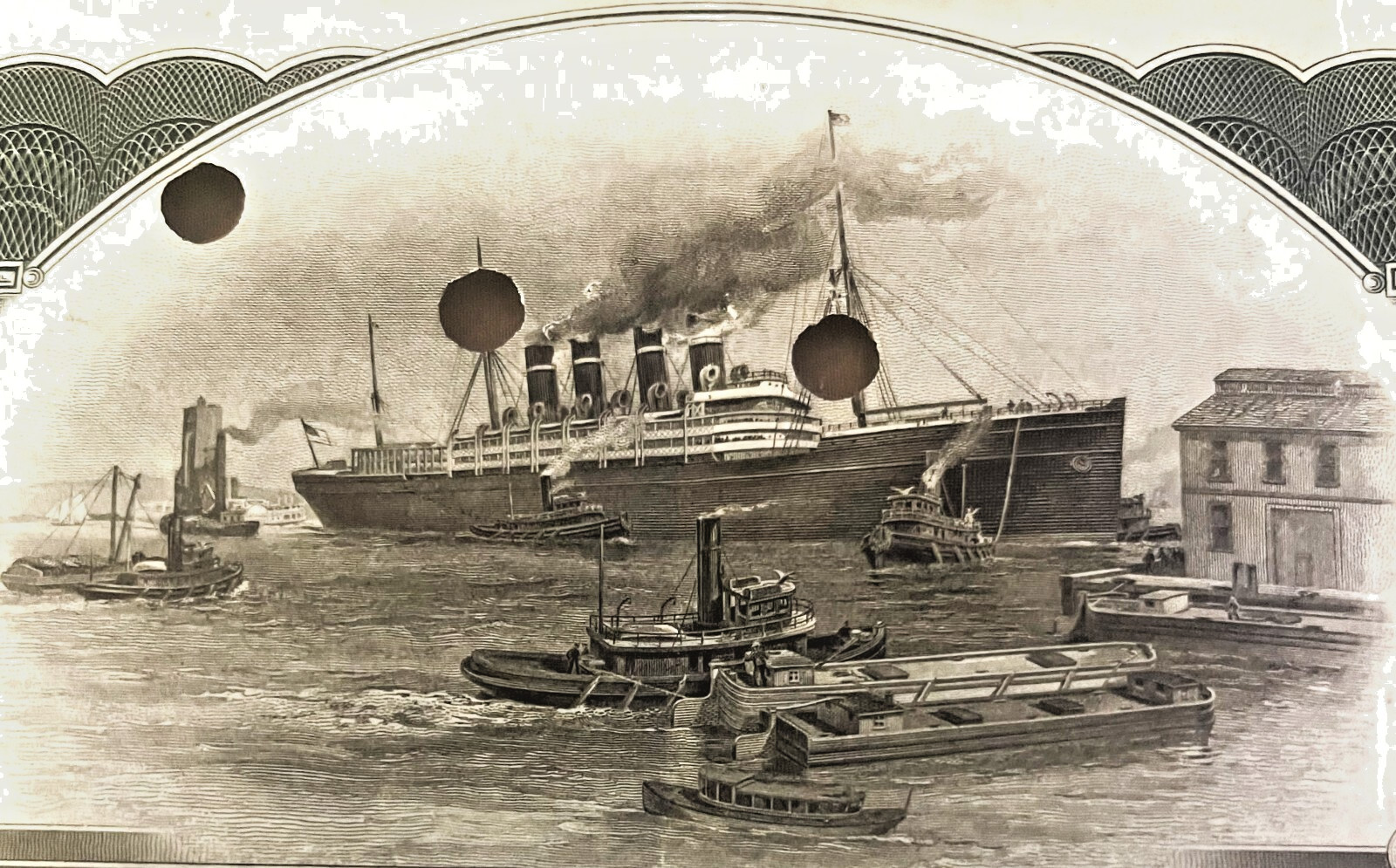
This listing is for an original, genuine International Mercantile Marine Company stock certificate — a green-tinted 100-share issue dating to the 1910s–1920s, the era directly bound up with the Titanic story. It is engraved and printed by the American Bank Note Company of New York, one of the premier security printers in the country, and the artistry shows it. Across the top of the certificate runs a wide vignette of a four-stack ocean liner steaming through a busy harbor, tugboats and barges crowding the water around her, smoke pouring from her funnels — a scene scripophily specialists identify as depicting the great Olympic-class sisters, the same class of ship that included Titanic herself. Below, bold ornamental lettering spells out INTERNATIONAL MERCANTILE MARINE COMPANY across a black banner, framed in the scrollwork, guilloché border-engraving, and fine geometric lathe-work that made American Bank Note certificates so difficult to forge and so beautiful to look at. A second vignette lower on the certificate depicts a classically-draped woman seated beside nautical instruments and rigging — an allegorical figure of maritime commerce, a favorite device of the era's bank note engravers. The piece is offered as New Old Stock (NOS) — genuine unissued/uncancelled financial paper surviving from this remarkable company, never put to use, preserved as a piece of history rather than a transaction record.
🏦 J.P. Morgan's Gamble: Building an Ocean Monopoly
To understand this certificate, you have to understand what J.P. Morgan was trying to do. By the turn of the 20th century, Morgan was arguably the single most powerful private financier in the world — a man who had already reorganized American railroads and helped bail out the U.S. Treasury during the Panic of 1893. His next target was the North Atlantic passenger trade. Morgan's plan was to buy up and consolidate the major transatlantic steamship lines into one giant holding company, creating a shipping trust so large it could dictate fares, schedules, and terms across the ocean crossing business.
The formation of the combine was announced in London in April 1902, and the company was incorporated in New Jersey that October. Within months it had absorbed the White Star Line, the American Line, the Dominion Line, the Atlantic Transport Line, the Leyland Line, and the Red Star Line — swallowing whole fleets under one corporate umbrella — and it struck trade agreements with the two German giants, Hamburg-Amerika and Norddeutscher Lloyd, effectively bringing much of the North Atlantic passenger trade under its influence. Old-timers in the shipping trade came to know it simply as "The Shipping Trust." It was one of the boldest attempts at industrial consolidation of the Gilded Age — finance capital reaching out to control not railroads or steel this time, but the ocean crossing itself.
It never quite delivered on Morgan's ambitions. A hoped-for federal subsidy bill failed in Congress in 1902, and the trust struggled financially almost from the start — collectors and historians alike note that Morgan, having committed so much capital and prestige to the venture, found himself unable to simply walk away from it. The company limped through the 1900s and into the 1910s carrying heavy debt, and in 1914 it defaulted on its bond payments outright, entering a "friendly" receivership the following spring. It took the outbreak of the First World War — and the sudden, desperate demand for ocean shipping capacity — to save the company's finances and see it reorganized and stabilized by 1916.
🛳️ White Star, Titanic, and the Olympic Trio
Among IMM's holdings, none mattered more to history than the White Star Line, purchased into the trust in 1902 after long negotiation. It was White Star that laid down the three great Olympic-class liners — Olympic, Titanic, and Britannic — intended to be the largest, most luxurious ships afloat, built to outclass the rival Cunard Line's speed queens with sheer scale and opulence instead. Titanic sailed on her maiden voyage in April 1912 and never completed it, striking an iceberg and sinking with tremendous loss of life — a disaster that reverberated through the shipping world, through Congress, through the press, and through the reputation of International Mercantile Marine itself. Though Titanic sailed under the British flag and White Star colors, she was, through IMM, ultimately an American-owned vessel — a detail that surprises many people encountering this history for the first time, and one that gives this certificate its particular resonance: it is not merely "shipping company paper," it is paper from the actual ownership structure behind the Titanic.
👤 The Men Behind the Trust
The names attached to IMM read like a who's-who of the era's shipping and finance world. J. Pierpont Morgan himself stood behind the venture as its financial architect, and remained tied to it until his death in 1913. Clement Griscom served as the company's first president before J. Bruce Ismay took the role in 1904. Ismay — who also headed White Star Line — was aboard Titanic on her maiden voyage and survived the sinking, a fact that shadowed him for the rest of his life and made him one of the most controversial figures connected to the disaster; he retired from the IMM presidency in 1913, succeeded by Harold Sanderson. Perhaps the most consequential figure in IMM's corporate history, though, is Philip A. S. Franklin, the company's vice president, who became the public face of IMM in New York during the agonizing days of the Titanic disaster as the company struggled to confirm and communicate the fate of the ship and her passengers. Franklin went on to serve as receiver during the company's 1915 reorganization, headed the U.S. Shipping Control Commission during the First World War, and rose to the IMM presidency itself in 1921, steering the company for another fifteen years. Certificates of this era frequently carry the signatures — printed or hand-signed — of these very officers, a direct paper link to the men who ran the company through its most historic and most difficult hours.
⚓ The Long Goodbye — and a Legacy That Outlived the Trust
IMM sold the White Star Line in 1927 to the Royal Mail Steam Packet Company under Lord Kylsant, for a reported £7 million — closing the chapter on the Morgan trust's direct connection to the ship line that made it famous. IMM itself continued on through further mergers and reorganizations across the following decades, ultimately evolving into the United States Lines, a name that endured in American shipping until its own bankruptcy in 1986. It is a genuine rise-and-fall arc: a Gilded Age monopoly dream, a world-altering maritime disaster, a wartime rescue, a slow corporate transformation, and a final dissolution three-quarters of a century later — all traceable, in outline, through the surviving paper the company once issued to its shareholders.
🖼️ Display Ideas
- 🚢 Framed beside a model ship or maritime print for a den, office, or library wall
- ⚓ Paired with other Titanic-era ephemera in a shadow box for a themed collection display
- 📚 Matted and hung in a home library or study as a conversation-starting piece of finance history
- 🏛️ Displayed alongside other Gilded Age industrial and banking artifacts
- 🎓 Given as a gift to a history buff, maritime enthusiast, or finance professional who will recognize the name instantly
- 💼 Kept in an archival sleeve as part of a growing scripophily or Americana collection
🎁 Who Collects These
This certificate sits at the crossroads of several serious collecting worlds — scripophily collectors chasing "story stocks" with real historical narrative behind them, Titanic history enthusiasts and researchers building out their archives, maritime historians and model-ship builders wanting authentic period ephemera, and collectors of Gilded Age American finance and J.P. Morgan-related material. It also draws in gift-givers looking for something with genuine weight and story behind it — a keepsake for a history-loving father, grandfather, sailor, or finance professional that isn't just decorative but carries an actual documented company history worth telling at the dinner table.
❓ FAQIs this connected to the actual Titanic?
Yes, through corporate ownership — International Mercantile Marine was the parent company that owned the White Star Line, which built and operated RMS Titanic. This certificate is IMM company stock, not a White Star or Titanic-specific certificate, but it represents the ownership entity behind the ship.
What does "New Old Stock" mean here?
It means this is a genuine, unused certificate surviving from the original printing — never issued and cancelled through a real stock transaction, preserved instead as an intact piece of period financial ephemera.
Who printed the certificate?
The American Bank Note Company of New York, one of the most respected security printers of the era, known for their fine steel-engraved vignettes and elaborate guilloché borderwork.
What does the imagery on the certificate depict?
The top vignette shows a large four-stack ocean liner in a busy harbor scene, identified by scripophily specialists as representing the Olympic-class ships — the same class that included Titanic. A second vignette features a classical allegorical female figure with nautical instruments, a common decorative motif on bank note-engraved stock certificates of the period.
How old is this certificate exactly?
It dates to the broad 1910s–1920s window associated with this green 100-share IMM issue — the exact date, signatures, and serial details vary certificate to certificate since each was individually issued and hand-signed by company officers at the time.
Was International Mercantile Marine a successful company?
It had a turbulent history — financial strain from its founding, a 1914 bond default and 1915 receivership, a wartime financial recovery, the 1927 sale of White Star Line, and an eventual evolution into United States Lines, which operated for decades afterward before its own 1986 bankruptcy.
Does the certificate come matted or framed?
It is offered as the certificate itself, ready for you to frame, mat, or archive as you prefer for display.