When you click on links to various merchants on this site and make a purchase, this can result in this site earning a commission. Affiliate programs and affiliations include, but are not limited to, the eBay Partner Network.
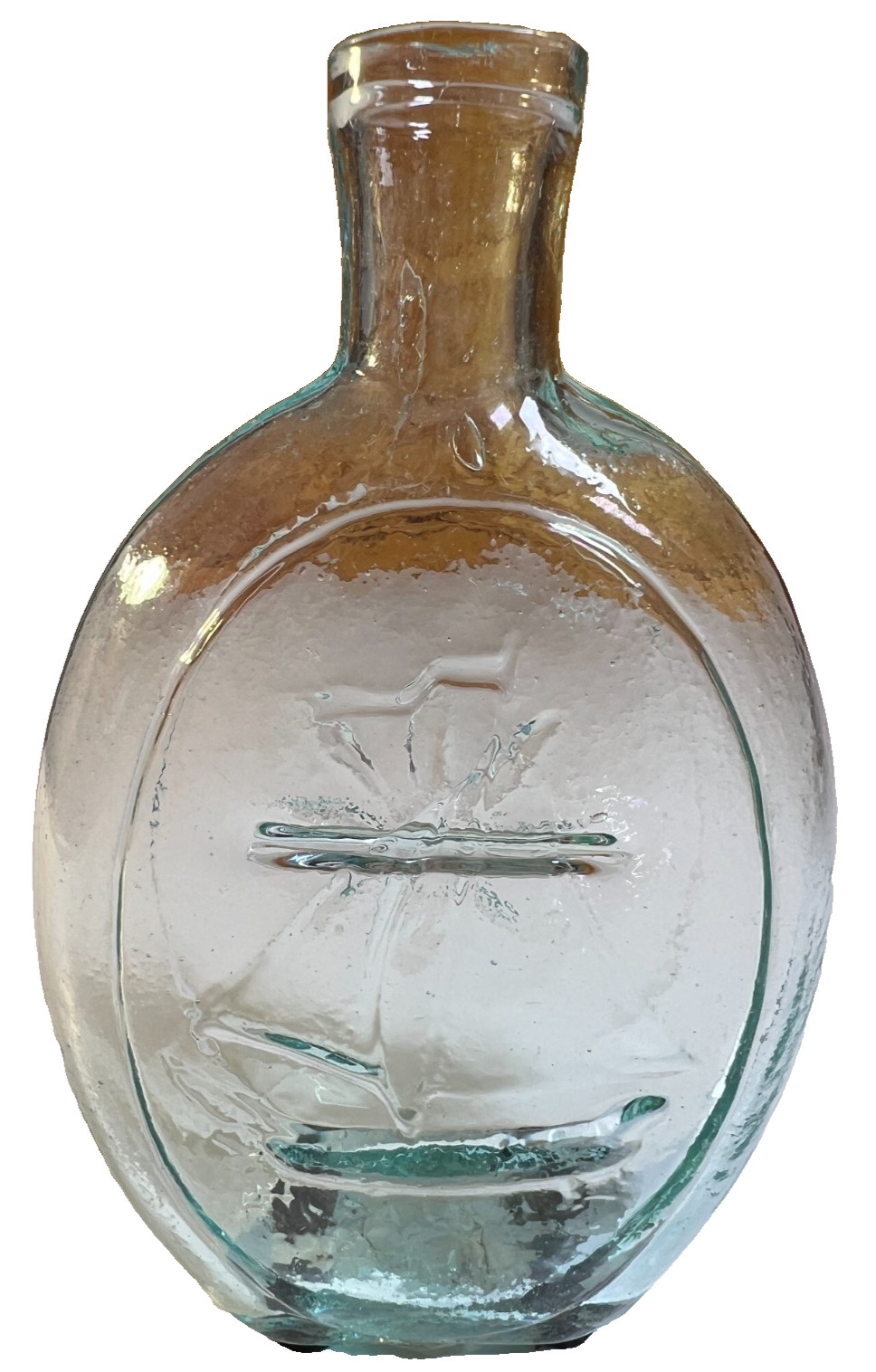
Offered here is a wonderful circa 1845–1855 American pictorial pocket flask, generally classified in the McKearin GX-8 / GX-8A Sloop & 8-Pointed Star family and attributed to the historic glassmaking industry of Bridgeton, Cumberland County, New Jersey.
At only about 6" tall, this is a fantastic little piece of pre-Civil War American glass—crude, bubbly, whittled and absolutely loaded with handmade character.
One face is boldly embossed with a sailing sloop, while the reverse carries the distinctive 8-pointed star / flower device. These Sloop-Star flasks are traditionally rated "Comparatively Scarce" in collector literature.
Details
- Type: Early American pictorial / historical pocket flask
- McKearin Classification: GX-8 / GX-8A Sloop-Star family
- Attribution: Bridgeton, New Jersey glassmaking tradition
- Probable Works: Bridgeton / Cohansey Glass Works
- Period associated with: Joel Bodine-era Bridgeton production
- Date: Circa 1845–1855
- Best single-date estimate: Circa 1850
- Height: Approximately 6"
- Color: Beautiful pale aqua / aquamarine
- Front: Embossed sailing sloop
- Reverse: Embossed 8-pointed star / flower
- Mouth: Early sheared/finished lip
- Base: Large open blowpipe pontil
- Construction: Hand blown into a two-sided pictorial mold
- Rarity: Traditionally considered Comparatively Scarce
- Probable original use: Whiskey, brandy, rum or other distilled spirits
The Sloop & Star Design
The little sailing vessel isn't merely generic decoration.
Bridgeton sits in Cumberland County in southern New Jersey, an area historically tied to rivers, Delaware Bay commerce, fishing and small working sailing vessels. Historical discussion of this flask family has connected its sloop or shallop motif with the small craft that were once an everyday part of southern New Jersey's waterways.
That gives the flask a particularly appealing regional identity: a South Jersey bottle carrying South Jersey maritime imagery.
The reverse is decorated with the bold 8-pointed star / flower, creating the classic Sloop-Star combination by which collectors recognize this mold family.
What Did It Originally Hold?
This was most likely a spirits flask, intended for whiskey, brandy, rum or another distilled liquor.
Unlike a proprietary medicine bottle bearing the name of a druggist or patent remedy, these early pictorial flasks were essentially decorative commercial containers. The glasshouse produced the flask; it could then be sold, filled and reused.
Its compact flattened form made it a genuine pocket flask, probably in the roughly half-pint class. The mouth would originally have been closed simply with a cork.
So while we can't tell you whether the first contents were whiskey, brandy or rum, this was very much the mid-19th-century ancestor of the familiar pocket liquor flask.
Beautiful Early American Glass
The glass itself may be the best part of this particular example.
This bottle has gorgeous pale aqua coloration and is positively alive with the irregularities collectors seek in genuinely early handmade glass.
Look closely and you'll find:
Whittle, waves, tiny seed bubbles, larger bubbles, uneven glass distribution, flow lines, folds and wonderfully crude manufacturing character.
This was made decades before automatic bottle machines transformed the industry.
A glassworker gathered molten glass on a blowpipe, inflated the gather inside an engraved mold, removed the bottle from the mold and transferred it to a pontil so that the mouth could be finished.
Each step depended on the hands and experience of the glassworkers.
Consequently, two bottles blown from the same mold could have remarkably different personalities.
This one has personality to spare.
That Magnificent Open Pontil
Turn the flask over and there's no mistaking its age.
The underside retains an enormous, thick open/blowpipe pontil scar and glass remnant from the manufacturing process.
The pontil is so pronounced that the flask is naturally somewhat tippy. It will stand on its own, but small removable felt pads have been placed beneath it simply to make display more stable and protect the glass.
The pads are modern and removable.
The wonderfully crude pontil itself is absolutely original and has not been ground, polished or "corrected."
We wouldn't dream of doing so.
For an early bottle collector, that crude base is part of the fun.
An Extraordinary In-the-Making Glass Feature
This flask also has one particularly fascinating manufacturing characteristic.
Across the sloop is a thin exterior glass crease/fold, associated with a substantial ribbon/stringer of glass on the interior.
Close examination shows this as part of the bottle's wonderfully crude manufacture rather than ordinary later impact damage. Molten glass folded, flowed and stretched in an unusual manner while the bottle was being formed, leaving a dramatic internal ribbon of glass.
It is an especially neat illustration of how imperfect—and wonderfully individual—early hand production could be.
Please examine the close-up photographs, as we've gone out of our way to show this unusual feature from multiple angles.
Condition
Displays Excellent.
The glass is bright, clean and shiny, with excellent clarity and beautiful aqua color.
The pictorial mold impression is very good, and importantly there is no significant high-point wear obscuring the Sloop-Star design.
No chips. No post-manufacture cracks noted. No dings. No haze.
There are numerous tiny seed bubbles, larger bubbles, whittle, folds, flow marks and other irregularities created during manufacture—all exactly the sort of handmade character collectors hope to find in early American glass.
Please specifically note the previously described in-the-making crease/fold and interior glass ribbon crossing the sloop area. It is shown extensively in the photographs.
There are also old collection/inventory numbers on the underside. We have intentionally left these alone rather than attempting to remove part of the flask's collecting history.
The small felt display pads on the base are modern and removable.
Please review all photographs carefully, as they form an important part of the description and do an excellent job of showing the condition, mold impression, bubbles, whittle, unusual glass formation and tremendous open pontil.
Bridgeton & Early New Jersey Glassmaking
This flask comes from one of America's great early glassmaking regions.
Bridgeton, New Jersey developed an important glass industry during the first half of the 19th century. The area's resources made southern New Jersey particularly well suited to glassmaking: abundant sand provided an essential raw material, vast forests supplied tremendous quantities of fuel, and waterways provided transportation for materials and finished goods.
The Bridgeton/Cohansey works passed through different operators during their history, with the Joel Bodine era particularly associated with mid-19th-century production.
Specialist bottle-sale references have attributed Sloop-Star examples to Joel Bodine & Sons / Bridgeton, New Jersey, with examples generally placed in the 1846–1855/1860 period.
Taking the published attribution together with this flask's construction—the crude aqua glass, hand-finished mouth, mold-blown body and heavy open pontil—we feel comfortable describing this particular example as:
Circa 1845–1855, probably around 1850.
That places it roughly a decade before the American Civil War.
America When This Flask Was Made
Imagine America around 1850.
The country's population was only about 23 million people.
There were no automobiles, airplanes, electric power grids or telephones. Railroads were rapidly spreading but horses, wagons, canals, sailing vessels and steamships still carried much of America's people and commerce.
The electric telegraph was cutting-edge technology.
The California Gold Rush was underway.
The nation was expanding westward while becoming increasingly divided over slavery. The Compromise of 1850 and Fugitive Slave Act belong to precisely this period.
Zachary Taylor died in office in 1850 and Millard Fillmore became President.
And in southern New Jersey, glassworkers were standing beside ferociously hot furnaces, gathering molten glass onto iron blowpipes and creating bottles like this one one at a time.
Before Bottles Came From Machines
This flask predates fully automatic bottle production by roughly half a century.
Every stage required skilled human labor: preparing the batch, maintaining the furnace, gathering molten glass, blowing the gather into the mold, manipulating the bottle with hand tools, transferring it to the pontil, finishing the mouth and annealing the finished vessel.
That's why this flask isn't perfectly symmetrical.
That's why it contains bubbles.
That's why the surface ripples and whittles.
That's why there's a ribbon of glass inside it.
And that's why the bottom has a giant rough pontil scar.
Those aren't the sterile characteristics of a machine-made container—they're fingerprints left by its manufacture approximately 175 years ago.
Scarcity & Collector Appeal
The Sloop-Star flask is known to collectors, but it isn't an everyday flask. The type has traditionally been described as "Comparatively Scarce."
Examples exist in different colors and degrees of crudity, with spectacular deep colors becoming considerably rarer and more valuable.
This example is the classic aqua / aquamarine, but what elevates it is its overall presentation:
Excellent clarity + strong embossing + very little high-point wear + abundant seed bubbles + whittle + huge open pontil + wonderfully crude glass + dramatic in-the-making glass ribbon.
It's exactly the sort of little flask that rewards being picked up and studied under different lighting.
At approximately 6 inches tall, it also displays beautifully without taking over the cabinet.
A terrific example for a collection of early American bottles, historical flasks, pictorial flasks, New Jersey glass, pontiled bottles, pre-Civil War Americana, maritime antiques or early American glassmaking.
Circa 1845–1855. Approximately 175 years old. Comparatively scarce. Bright, crude, bubbly and unmistakably handmade.
A fantastic little survivor from the era when every bottle was still made by human hands.