When you click on links to various merchants on this site and make a purchase, this can result in this site earning a commission. Affiliate programs and affiliations include, but are not limited to, the eBay Partner Network.
STORAGE METHOD : Please do not clean under any circumstances with water or a dampcloth (there is a risk of damaging the patina). Store in a dry place and in aroom free from moisture. Protect from impacts with hard objects to avoiddamaging the surfaces and patina. Clean and polish with a soft DRY cottoncloth.
Gladiator: A gladiator (Latin: gladiator 'swordsman', from Latin gladius 'sword') was an armed combatant who entertained audiences in the Roman Republic and Roman Empire in violent confrontations with other gladiators, wild animals, and condemned criminals. Some gladiators were volunteers who risked their lives and their legal and social standing by appearing in the arena. Most were despised as slaves, schooled under harsh conditions, socially marginalized, and segregated even in death. Irrespective of their origin, gladiators offered spectators an example of Rome's martial ethics and, in fighting or dying well, they could inspire admiration and popular acclaim. They were celebrated in high and low art, and their value as entertainers was commemorated in precious and commonplace objects throughout the Roman world. The origin of gladiatorial combat is open to debate. There is evidence of it in funeral rites during the Punic Wars of the 3rd century BC, and thereafter it rapidly became an essential feature of politics and social life in the Roman world. Its popularity led to its use in ever more lavish and costly games. The gladiator games lasted for nearly a thousand years, reaching their peak between the 1st century BC and the 2nd century AD.The earliest types of gladiator were named after Rome's enemies of that time: the Samnite, Thracian and Gaul. The Samnite, heavily armed, elegantly helmed and probably the most popular type, was renamed secutor and the Gaul renamed murmillo, once these former enemies had been conquered then absorbed into Rome's Empire. In the mid-republican munus, each type seems to have fought against a similar or identical type. In the later Republic and early Empire, various "fantasy" types were introduced, and were set against dissimilar but complementary types. For example, the bareheaded, nimble retiarius ("net-man"), armoured only at the left arm and shoulder, pitted his net, trident and dagger against the more heavily armoured, helmeted Secutor. Most depictions of gladiators show the most common and popular types. Passing literary references to others has allowed their tentative reconstruction. Other novelties introduced around this time included gladiators who fought from chariots or carts, or from horseback. At an unknown date, cestus fighters were introduced to Roman arenas, probably from Greece, armed with potentially lethal boxing gloves.The trade in gladiators was empire-wide, and subject to official supervision. Rome's military success produced a supply of soldier-prisoners who were redistributed for use in State mines or amphitheatres and for sale on the open market. For example, in the aftermath of the Jewish Revolt, the gladiator schools received an influx of Jews—those rejected for training were sent straight to the arenas as noxii (lit. "hurtful ones"). The best—the most robust—were sent to Rome. In Rome's military ethos, enemy soldiers who had surrendered or allowed their own capture and enslavement had been granted an unmerited gift of life. Their training as gladiators gave them the opportunity to redeem their honour in the munus. Two other sources of gladiators, found increasingly during the Principate and the relatively low military activity of the Pax Romana, were slaves condemned to the arena (damnati), to gladiator schools or games (ad ludum gladiatorium) as punishment for crimes, and the paid volunteers (auctorati) who by the late Republic may have comprised approximately half—and possibly the most capable half—of all gladiators. The use of volunteers had a precedent in the Iberian munus of Scipio Africanus; but none of those had been paid. For the poor, and for non-citizens, enrollment in a gladiator school offered a trade, regular food, housing of sorts and a fighting chance of fame and fortune. Mark Antony chose a troupe of gladiators to be his personal bodyguard.[68] Gladiators customarily kept their prize money and any gifts they received, and these could be substantial. Tiberius offered several retired gladiators 100,000 sesterces each to return to the arena. Nero gave the gladiator Spiculus property and residence "equal to those of men who had celebrated triumphs.Gladiator games were advertised well beforehand, on billboards that gave the reason for the game, its editor, venue, date and the number of paired gladiators (ordinarii) to be used. Other highlighted features could include details of venationes, executions, music and any luxuries to be provided for the spectators, such as an awning against the sun, water sprinklers, food, drink, sweets and occasionally "door prizes". For enthusiasts and gamblers, a more detailed program (libellus) was distributed on the day of the munus, showing the names, types and match records of gladiator pairs, and their order of appearance. Left-handed gladiators were advertised as a rarity; they were trained to fight right-handers, which gave them an advantage over most opponents and produced an interestingly unorthodox combination. The night before the munus, the gladiators were given a banquet and opportunity to order their personal and private affairs; Futrell notes its similarity to a ritualistic or sacramental "last meal". These were probably both family and public events which included even the noxii, sentenced to die in the arena the following day; and the damnati, who would have at least a slender chance of survival. The event may also have been used to drum up more publicity for the imminent game.
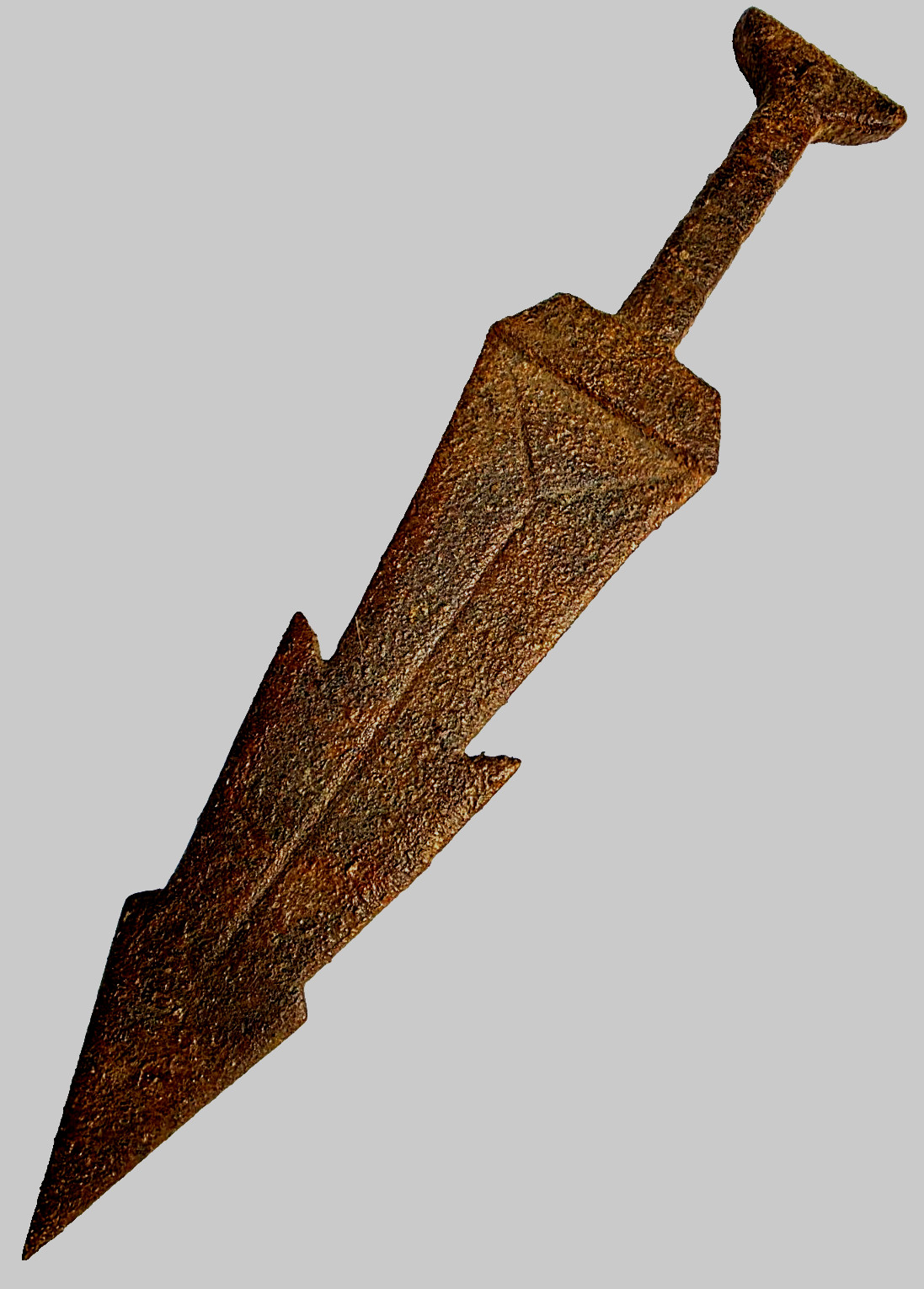
This 200 BC Ancient Roman Fight Weapon Gladiator Battle Dagger is a unique and authentic artifact crafted from wrought iron. With a certificate of authenticity available, this original piece from Italy guarantees its uniqueness with a 100% lifetime warranty. The multi-color metal dagger, designed in the Italian style, is a true representation of ancient Roman craftsmanship. Perfect for collectors or history enthusiasts, this artifact is a genuine piece of history from the Roman era that would make a striking addition to any collection.
Expertise ofthe material :WROUGHT IRONwith authentic GENUINE OLD PATINA
EXPERTEVALUATIONCONTROL NUMBER:3785003
MUSEUM GRADE RESTORED
CERTIFICATEOF AUTHENTICITY (COA) : Below in the listing description,for your convenience and security, is a CERTIFICATE OF AUTHENTICITY (COA) AVAILABLE.
How to obtaina COA - Please print the description and photos ( Photos of your choice ),from the listing if desired (laminate) and apply the printed documents andPhotos to the item.
The Authenticity of our items is guaranteed and protected by our 100% buyer satisfactionguarantee as well as a guaranteed one hundred percent opportunity to return theitem and receive a full refund of the amount you purchased it for, according to policies.
CERTIFICATE OF AUTHENTICITY (COA)NUMBER :3785003
1. Expertise of the material :WROUGHTironwith authentic GENUINE OLD PATINA
2. MEASUREMENTS & WEIGHT :605grams :Total length including handle365millimeters :Blade width in the widest part70millimeters
3. Condition : Extremely Fine -Museum grade restored
4. GUARANTEES : We give for buyer a 100% lifetime warranty for the uniqueness of this artifact ONE OF A KIND EXTREMELY UNIQUE.
The daggeris presented in its unaltered condition, with detailing of the featuresclearly visible, a relatively smooth surface, and a naturally aged patina, deepcovered in molted variations of hues and colours as maintained. If you examinethe enlarged photos of thisdagger, you'll see that it has been meticulouslycrafted with stunning details. I'm confident that you'll be 100% satisfied with thisdagger, which is not only a beautiful work ofart but also great antiquities. Thank you for considering our offerings, and welook forward to serving you !!! At our shop, we take pride in offering a uniquecollection of Ancient Artifacts of diverse cultures from different eras thatare truly one-of-a-kind. Many of these items are quite old and rare, and once they are sold, wemay not be able to find another one to replace it. That's why we believe thatwhoever possesses one of these special daggerscan be considered to have true pride. We understand that our customersare discerning collectors who appreciate the value and significance of theserare artifacts. That's why we make every effort to ensure that our collectionis authentic and of the highest quality. We believe that owning one of these daggersis not just a matter of acquiring abeautiful object, but also of connecting with a rich cultural tradition thatspans centuries. So if you're looking for a truly uniquedaggerto add to your collection - you are inthe right place ! Our inventory represents time-tested investment quality itemswith everlasting decorative beauty. We look forward to your business andappreciate any reasonable offers. All of our curated items are vetted andguaranteed authentic and as described. We only deals in original antiques andnever reproductions. 100% Customer Satisfaction Guaranteed - We are extremelyconfident that all items presented from our collection are genuine antiques.
Dear buyers, please keep in mind that we are dealing with ancient and antiqueitems. You should not expect ancient and antique items to be as brand new ones.They always have some degree of wearing. Please, take care to examine thephotos and read descriptions. Thank you.
The photosare part of the description in this Listing !!!Dear Customers, you will receive exactly the same item which you see on the pictures,not similar or other. Please read the description carefully and review thephotos. All items, which I sell, are captured with high - photographicequipment and the photos, which I insert in my sales, are with highresolution. The photos are absolutely clear and the potential buyer can trulyidentify the item, which purchased. Photos are not further processed byspecialized software! Upon purchase my item, you will receive exactly the sameitem which you saw on the photo !!! The pictures in listing are CLEAR with opportunities ZOOM for expansion + VIDEO sothat you can perfectly identify all the details of item !
RETURNS : IF YOU HAVE ANY REASON TO DOUBT AITEM THAT YOU HAVE PURCHASED, YOU MAY RETURN IT WITHIN 14 DAYS !!!
Thank you for your time, I wish yousuccessful and happy days.