When you click on links to various merchants on this site and make a purchase, this can result in this site earning a commission. Affiliate programs and affiliations include, but are not limited to, the eBay Partner Network.
Title roughly translates to: "How to feed your Baby Properly to Raise Him Healthy and Strong"
Blurb oppostive of reverse title page roughly translates to "We must teach children to adopt subtle and monotype tastes. We should not spoil them with food. This only limits their adaptations to changing life conditions in the future"
- Iv Pavlovg
Issued by Institute of Nutrition, Academies of Medical Sciences, CCCP.
Illustrated throughout by A. Bray, G. Valk, I. Ganf, F. Glebov, N. Zhukov, and B. Fridkin. Includes poems by N. Konchalovskaya and S. Mikhalkov
Page 65/66 missing.
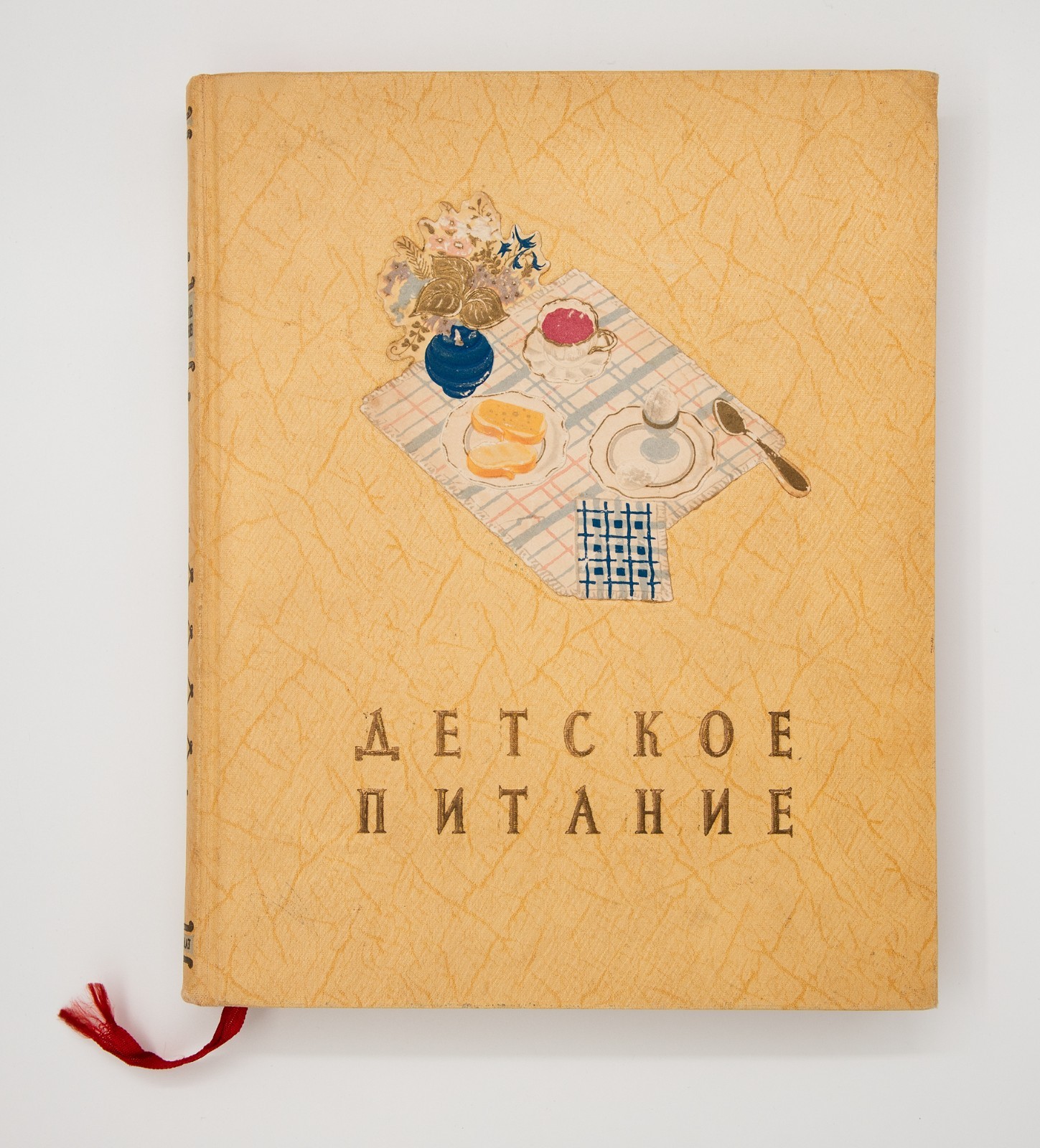
This 1958 Soviet manual on infant and child feeding, Детское питание (Children's Nutrition), exemplifies the domestic reach of state ideology in the post-Stalinist USSR. Published by GosTorgIzdat, the official outlet for trade and food literature, the book combined nutritional guidance with the cultural project of Soviet social engineering. Ostensibly a handbook for mothers, it also served as a tool for shaping future citizens according to the principles of state-directed health, discipline, and collectivism.
Structured around age-specific stages, the book offers meal schedules, caloric guidelines, and over 100 recipes for cereals, vegetable purées, broths, and egg-based dishes. But its deeper function was ideological: it cast the Soviet mother not merely as a caretaker, but as a rational, scientifically equipped agent responsible for producing the ideal socialist subject. This vision of "scientific motherhood" merged domestic labor with civic responsibility, positioning everyday child-rearing as a form of service to the nation.
The idealized domestic environment presented in the book was reinforced through a warm visual language. Illustrations by prominent Soviet artists—including N. Zhukov, I. Ganf, and F. Glebov—portrayed cheerful, well-fed children and attentive mothers in bright, orderly settings. These images were not simply decorative; they helped naturalize a vision of maternal competence and nutritional abundance as hallmarks of a functioning socialist state. In this way, the book functioned unmistakably as propaganda, embedding the state's ideological demands into the rhythms and aesthetics of daily family life.
Yet this idealized vision was sharply at odds with the material conditions experienced by most Soviet households. While postwar rationing had officially ended, the country remained plagued by chronic food shortages and systemic failures in agricultural planning and distribution. Khrushchev's Virgin Lands campaign, launched to dramatically increase grain output, was already showing signs of ecological strain and logistical failure by the time this book was issued. Meat, dairy, fresh vegetables, and infant formula were often in short supply, particularly outside urban centers.
The book's detailed menus and confident tone were not aspirational fantasies, but didactic mandates—a projection of how the state believed Soviet families should function, regardless of material feasibility. Most readers would have recognized this dissonance; the gap between prescriptive norms and lived reality was a familiar one. Mothers were expected to fulfill state-defined roles in shaping the health of future workers, often with little more than ingenuity, substitution, and informal networks of exchange to support them.
Today, Children's Nutrition is both a utilitarian artifact and a revealing ideological instrument. It illustrates how even the most private acts—feeding, nurturing, scheduling—were incorporated into the Soviet state's broader program of political education and cultural control. Through its combination of policy, visual design, and poetic instruction, the book offers a vivid case study of how propaganda functioned not only in public spectacles, but in the ordinary texture of Soviet domestic life.