When you click on links to various merchants on this site and make a purchase, this can result in this site earning a commission. Affiliate programs and affiliations include, but are not limited to, the eBay Partner Network.
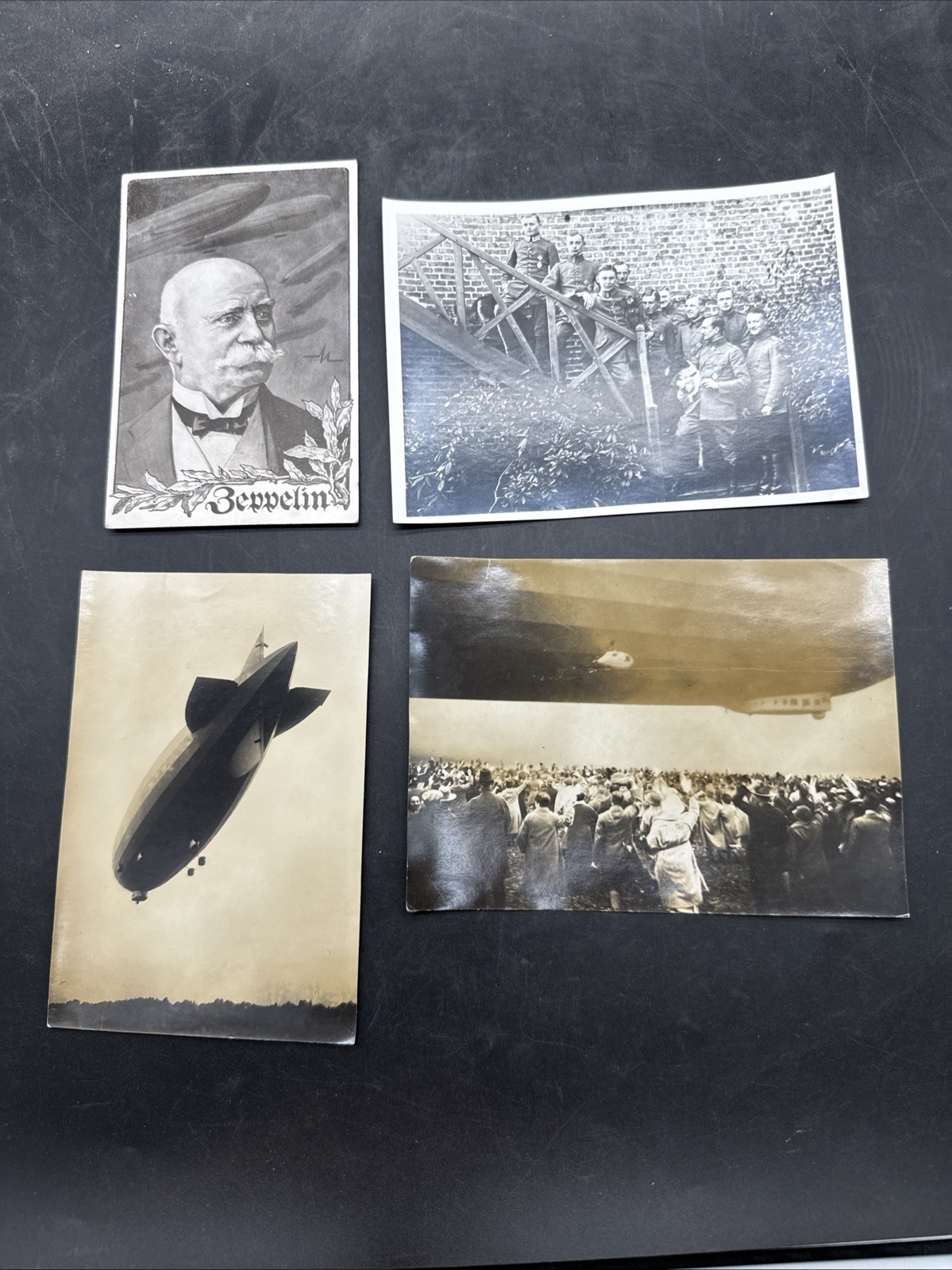
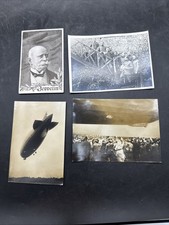
This is a spectacular lot of 3 photographs and 1 postcard all related to the famous Zeppelin LZ 126, also known at the time as ZR-3.The LZ 126 departedFriedrichshafen, Germany, on the morning of October 12, 1924, commanded by the famous German Zeppelin captainDr. Hugo Eckener. It crossed the Atlantic and arrived atNaval Air Station Lakehurst, New Jersey, on October 15after roughly81 hours in the airand a journey of about5,000 miles (8,050 km).This was an extraordinary achievement at the time. Only one airship—the BritishR34 in 1919—had previously crossed the Atlantic. The Zeppelin Museum notes that the LZ 126 crossing was considered risky enough that Eckener was unable to obtain conventional insurance for the undertaking.Interestingly, this wasn't primarily a passenger flight.
The LZ 126 wasbuilt specifically for the United States as part of Germany's World War I reparations obligations. The Zeppelin Company at Friedrichshafen constructed it to replace airships that the United States was supposed to receive after WWI but did not ultimately obtain.
There was also an important political dimension. The Treaty of Versailles severely restricted German airship construction. Building LZ 126 for the United States provided the Zeppelin company with an opportunity to continue operating and preserve its expertise. The Zeppelin Museum says the construction contract was worth about3.2 million Reichsmarksand helped ensure the survival of the Friedrichshafen Zeppelin works
The airship itself
LZ 126 was enormous—approximately200 meters (656 feet) long. It had a gas volume of roughly70,000 cubic metersand was powered byfive Maybach engines.
Unlike later American rigid airships, it originally crossed the Atlantic usinghydrogenfor lift. Once it entered American service, it was converted to use the much saferheliumavailable to the United States.
Its first test flight had occurred only a few weeks earlier, onAugust 27, 1924.
Arrival in America
The arrival became a huge public spectacle.
Before landing at Lakehurst, the Zeppelin flew over the New York area. Thousands gathered to see it, and ships and fire stations reportedly sounded their whistles and sirens as it appeared overhead. Thousands more waited at Lakehurst.
The German crew received a hero's welcome. Eckener and several members of his crew were subsequently honored in New York, andPresident Calvin Coolidge received them at the White House. The flight came to be regarded as a symbol of improving German-American relations only six years after the end of WWI.
It became the USSLos Angeles
After delivery, the airship was formally incorporated into the U.S. Navy as:
USS Los Angeles (ZR-3)
formerlyLZ 126
It became arguably themost successful American rigid airship ever operated. Unlike theShenandoah,Akron, andMacon, which were all lost in accidents, theLos Angelessurvived its operational career. The Navy used it extensively for training and experiments with airship operations and mooring systems.
It remained intact until it was finally dismantled in1939. The Smithsonian actually has surviving pieces of its outer envelope in its collection today.
The photos are original press photos from the time. Photos measure 4 5/8" x 6 1/2", 4" x 6", 4 3/4" x 6 1/2"