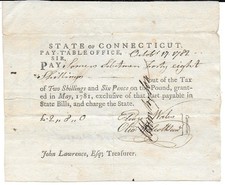
When you click on links to various merchants on this site and make a purchase, this can result in this site earning a commission. Affiliate programs and affiliations include, but are not limited to, the eBay Partner Network.
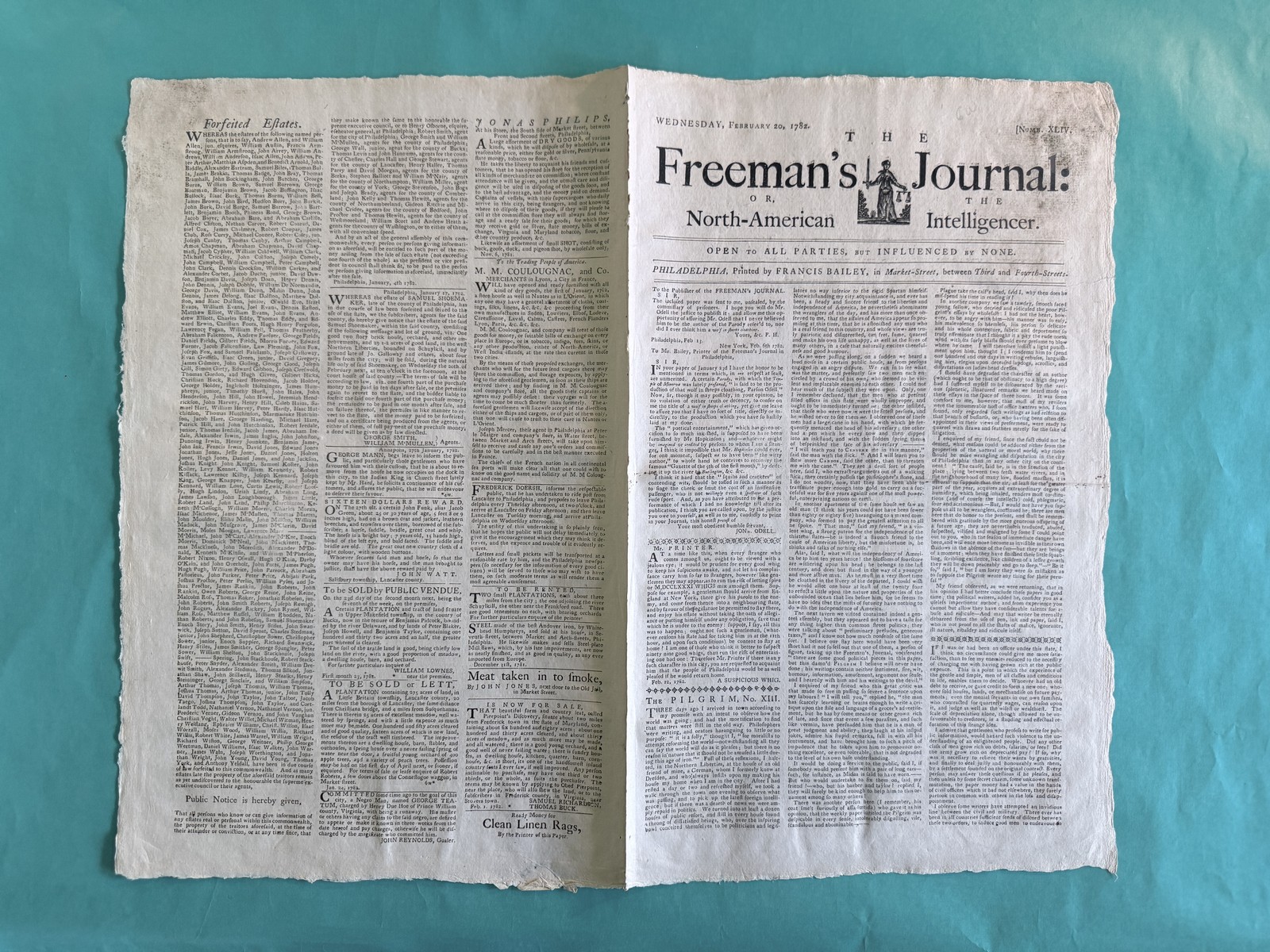
Original Freeman\'s Journal; OR, The North-American Intelligencer from Philadelphia, Wednesday, February 20, 1782 — printed during the final year of the American Revolutionary War, by Francis Bailey on Market Street, Philadelphia.Contains extraordinary historical content:• GEORGE WASHINGTON\'S Proclamation offering pardons to Continental Army deserters who return by June 1, 1782
• Forfeited Estates list naming Loyalists whose property was seized — including BENEDICT ARNOLD as a traitor
• King George III\'s speech to Parliament discussing the war in America
• Reports on the Dutch Republic recognizing American independence
• Local Philadelphia advertisements.
*The Pilgrim, No. XIII:Philip Freneau, the Poet of the American revolution, is the authorwriting under the pseudonym\"The Pilgrim.\"During his time working with Francis Bailey onThe Freeman’s Journalbetween 1781 and 1782, Freneau published a series of 19 satirical, philosophical, and political essays under this exact pen name.
The article begins at the bottom left of the front page under the bold headerTHE PILGRIM, No. XIII.
1. The Premise: A Traveler\'s ObservationsFreneau opens the essay in his characteristic persona—an observant traveler (the Pilgrim) who has arrived in Philadelphia after walking through the countryside. He reflects on how different the real world is from what people read or imagine, noting that \"three days ago I arrived in town according to custom\" to observe human nature and urban society.2. The Satire on Tavern Philosophers & Politicians
The core of the essay is a humorous, sharp critique of self-important city dwellers—specifically those who gather in local taverns, coffee houses, and public spaces to loudly debate politics, trade, and the war without actually understanding them.
He describes encountering a variety of eccentric characters, including a \"suspicious wheel-wright\" and various self-proclaimed political experts who pretend to have deep insight into international affairs.
He mocks how these \"coffee-house politicians\" confidently predict the movements of fleets or the decisions of European courts based on mere rumors, treating local gossip as absolute truth.
3. The Underlying Moral
Through the satire, Freneau delivers a broader philosophical message about human vanity and the nature of public discourse in the young American republic. He critiques how quickly people form aggressive, unyielding opinions on public matters based on superficial information, suggesting a need for greater humility, genuine wisdom, and focused civic responsibility as the new nation takes shape.
*Philip Freneau is the also author ofthe poem (Pages 2 & 3)The poem spanning the bottom of the second column on page 2 and carrying over to page 3 is titled\"A SPEECH that should have been spoken by the king to both houses of parliament...\"This is a famous piece of political satire written by Freneau (often anthologized as\"George the Third\'s Soliloquy\"or a variation thereof), mocking King George III’s despair, stubbornness, and impending defeat following the British disaster at Yorktown.
A CITIZEN\" vs. \"CENSOR Debate
The Content:These columns represent a fierce, classic Revolutionary-era war of words (pamphleteering/editorial combat). \"A CITIZEN\" directly attacks \"CENSOR,\" accusing them of spreading falsehoods, attempting to revive bitter political controversies, and actively working to fracture the fragile unity of Pennsylvania\'s citizens.
Condition: Complete 4-page issue. Ink remains dark and legible. Slight discoloration top right corner of first and third page, and on left top corner of second and fourth page. Expected age wear: frayed edges, typical mailing center fold, foxing, yellowing.Measurements (approximate, packed): 20\" x 14\"