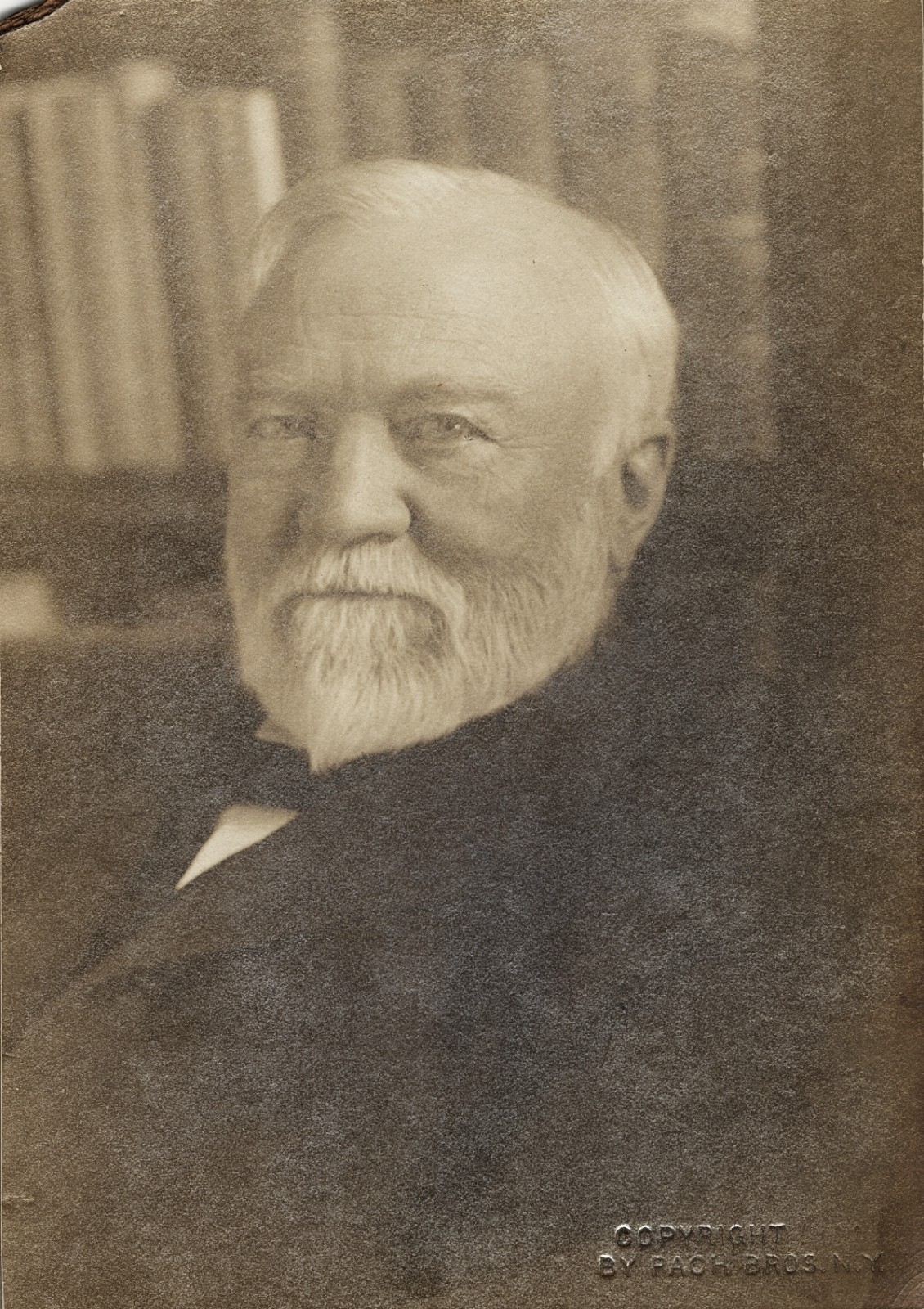
 c. 1910's Andrew Carnegie Portrait Cabinet Photograph by Pach Bros. US STEEL For Sale
When you click on links to various merchants on this site and make a purchase, this can result in this site earning a commission. Affiliate programs and affiliations include, but are not limited to, the eBay Partner Network.

c. 1910's Andrew Carnegie Portrait Cabinet Photograph by Pach Bros. US STEEL:
$250.00
DATE: c. 1910'sPHOTOGRAPHER: Pach Brothers (see bio below)SUBJECT: Andrew Carnegie (see bio below)PROCESS: Gelatin silverSIZE: Board measures4.25" x 6.5" and mounted photo measures 4" x 5.75"CONDITION: Board cracked across the middle, not affecting the photo. Corners damaged. See photosSHIPPING: Shipping cost is non-negotiable, please consider it when offerding/buying.COMBINED SHIPPING: Yes, I do combine shipping. Additional shipping per item is 20% of the lower shipping cost [For example, if 2 items are purchased that have a $30 and $10 shipping cost each, the combined shipping cost becomes $32 for the 2 items]. If offerding/buying more than 1 item, please wait for an invoice with combined shipping before Pach Brotherswas established in 1867 by German-born siblings Gustavus W. Pach (1848–1904), Gotthelf Pach (1852–1925), and Morris Pach (1837–1914). The family immigrated to the United States as children and began their photographic careers in New York City. Gustavus, having worked as a printer for Turner & Co., a leading commercial photographer, honed his skills during the photographic boom of the Civil War era. In 1865, due to health issues, he relocated to Toms River, New Jersey, and later to Long Branch, where he established a studio. The brothers gained recognition by photographing prominent families, including those of George W. Childs, Anthony J. Drexel, and Ulysses S. Grant.Expansion and Notable AchievementsBy the 1870s, the Pach Brothers had expanded their operations, establishing studios in various locations, including Broadway in New York City. They became renowned for their portrait photography, capturing images of notable figures such as Ulysses S. Grant, Benjamin Harrison, Theodore Roosevelt, and Woodrow Wilson. Their clientele included individuals from business, politics, education, and the arts, as well as thousands of students and families.In the 1880s, the firm began operating seasonal studios in college towns, photographing graduating classes and athletic teams at institutions like Yale, Harvard, Princeton, and Vassar. They also became the official photographers for the United States Military Academy at West Point, a position they held for several decades.Challenges and ResilienceIn 1895, a devastating fire destroyed their New York studio and processing rooms, along with their entire negative archive. Despite this setback, the Pach Brothers rebuilt and continued their operations, maintaining their reputation for high-quality portraiture. They also contributed to the art community by documenting artworks for the Metropolitan Museum of Art.Later Years and LegacyThe Pach Brothers' firm continued to operate under the leadership of subsequent generations, expanding to over 17 locations across the United States. Their work is preserved in various collections, including the New-York Historical Society, which holds a significant archive of their portraits from 1867 to 1947.In 1933, *The New Yorker* magazine highlighted the firm's legacy, noting their extensive portfolio that included portraits of every U.S. president from Ulysses S. Grant to Herbert Hoover, as well as other prominent figures like Henry Wadsworth Longfellow and J.P. Carnegie’s life was a journey of immense transformation, beginning in a small weaver's cottage in Dunfermline, Scotland. Born in 1835, his early childhood was defined by the collapse of his father's handloom trade due to the rise of industrial steam power. This poverty forced the family to seek a new life in the United States in 1848. Settling in Pennsylvania, the thirteen-year-old Carnegie immediately entered the workforce as a bobbin boy in a cotton mill, earning little more than a dollar a week. His trajectory changed when he became a telegraph messenger. His ability to decode messages by ear caught the attention of Thomas A. Scott of the Pennsylvania Railroad, who hired Carnegie as a personal secretary and mentored him in the complexities of American business and strategic investment.By the time the Civil War ended, Carnegie had turned his focus toward the iron and steel industries. He adopted the Bessemer process after seeing it in England, which allowed for the mass production of steel at a fraction of the previous cost. He pioneered a business model known as vertical integration, where he controlled every aspect of production, from the iron ore mines and the ships that transported the raw materials to the railroads that delivered the final product. This efficiency allowed Carnegie Steel to dominate the global market, making him one of the wealthiest individuals in human history. However, his success was not without controversy. The 1892 Homestead Strike remains a dark chapter in his legacy, as the violent confrontation between striking workers and armed Pinkerton guards resulted in multiple deaths and cast a shadow over Carnegie’s reputation as a man of the people.In 1901, Carnegie reached the pinnacle of his financial power and sold his company to J.P. Morgan for $480 million, a move that led to the creation of U.S. Steel. He spent the remainder of his life putting into practice the philosophy he outlined in his essay, The Gospel of Wealth. He believed that the wealthy had a moral obligation to distribute their riches for the betterment of society during their lifetime. He focused his giving on education and world peace, famously funding the construction of over 2,500 public libraries. By the time of his death in 1919, he had given away approximately 90% of his fortune to various causes, including the establishment of Carnegie Hall and Carnegie Mellon University, leaving behind a philanthropic blueprint that continues to influence modern giving.
|
|
Other Related Items:
Related Items:
c1910's View Atkinson Corner Maine ME RPPC Photo Postcard COPY $4.95
c. 1910's René Frilson Imitating a "Highland Lassie" RPPC by Carles EARLY DRAG $150.00
2 Antique Golf Postcards Children Golfer Humor Edition Francaise c1910s-1920s $39.00
|
