When you click on links to various merchants on this site and make a purchase, this can result in this site earning a commission. Affiliate programs and affiliations include, but are not limited to, the eBay Partner Network.
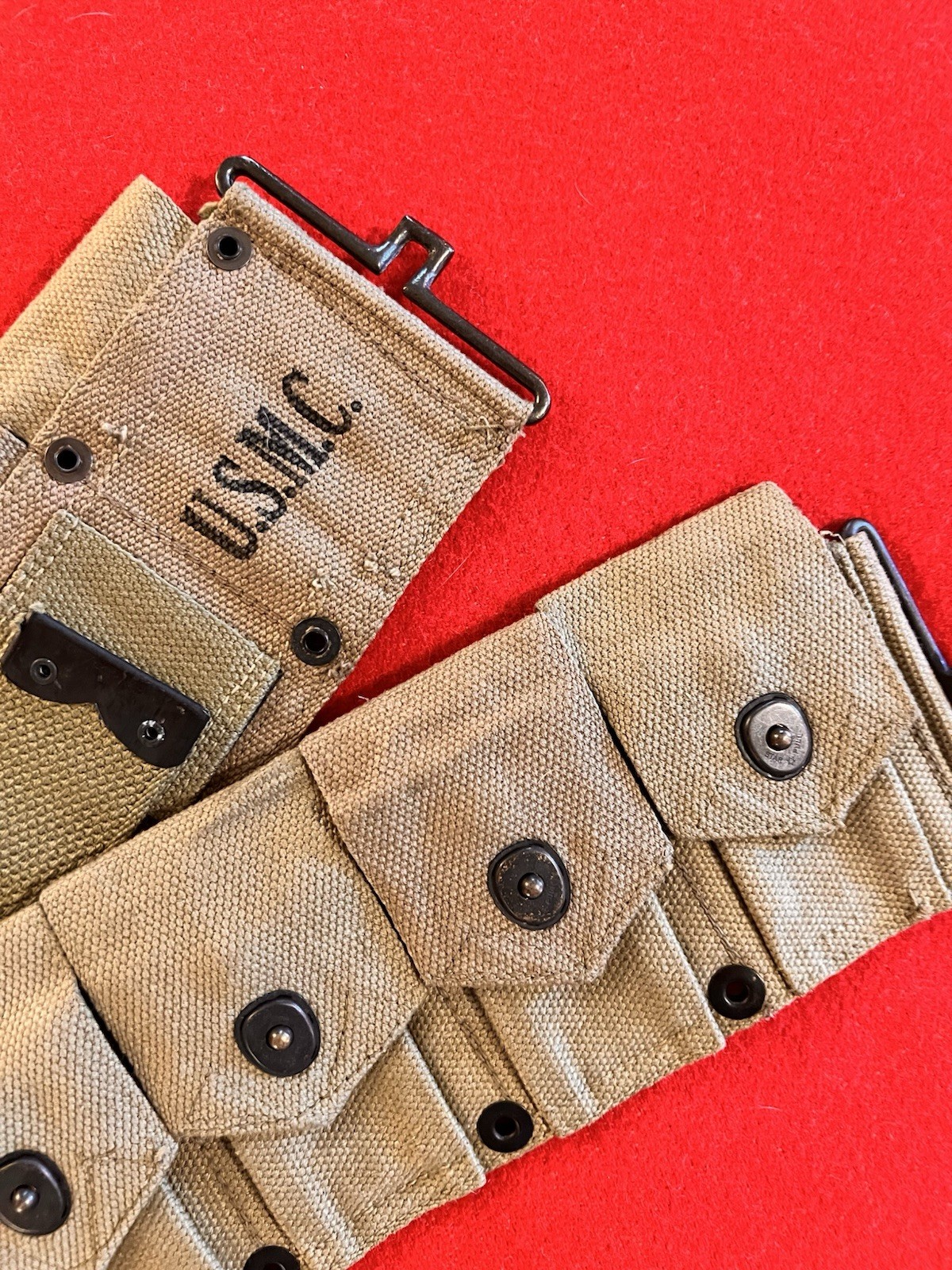
WWIIM1923 Cartridge Belt, 10-Pocket, Light Shade, OD#3
U.S.M.C.contract!
BOYTHARNESS CO.
1943
(forthe M1 Garand and M1903 Springfield .30 cal. Service Rifles)
UnissuedNOS Superiorcondition!
SCARCE!
+ This scarcemid-war example of the U.S.M.C. contract M1923Cartridge Belt came off the factory's assembly line priorto, contemporary with ALL of the Marine Corps' bittercampaigns in the Pacific beginning in 1943:
The end of theGuadalcanal Campaign (through Feb. '43), New Guinea andSolomon Islands Campaigns ('43), the Battles of Tarawa andMakin (Nov. '43) the Marshall Islands (Feb. '44),Bougainville Japanese counter-offensive (Mar. '44), Hollandia,New Guinea (Apr. '44), Biak (May '44), Saipan in the Marianas(June '44), Guam and Tinian in the Marianas (Jul. '44),Peleliu (Sept. '44), Ryukyus (Oct. '44), andOkinawa (Apr. - Jun. '45).
+ This is lastof the Light Shade OD#3 Cartridge Beltsbefore Dark Shade OD#7 was authorized andintroduced at the close of the 1943 production year.
+ This piece of gearwas the mainstay of a combat infantryman's gear. He might shed hisHaversack, but he would retain ammunition, water,and a wound dressing!
+ This Belt isin Unisssued NOS condition.
+ZERO cuts, frays, creases, loose stitching, or mildewstains, sun fading, or signs of wear! The ONLY blemishes areseveral minute, almost microscopic, ink or greasemarks on the very TOP edge of the first Pockets on the Rand L sides...that’s it...otherwise this Belt is in MINTcondition!
+ It is boldly andlegibly stamped on the interior of the left section pocketwith "U.S.M.C." surchargein SERIF FONT and on the interior of the right section withthe iconic name of the famous contractor of USMC gear and thelast two digits of the year (1943) of manufacture:
U.S.M.C.
---
BOYT
-43 -
+ NOTE:Post-war "U.S.M.C." markedBelts were stamped with the Corps' initials in a NARROW SANSERIF FONT!
+ This M1923Cartridge Belt may never been issued, judging from(1) the PERFECT finish on the blackened brassBuckle, (2) the absence of a Marine's stamped or stenciled name,(3) the absence of wear to the Studs of the "STAR* PULL" Fastenersandblackened brassEyelets, and(4) the absence of any evidence that the ConnectorStrap hasever been adjusted!
+ This is the10-Pocket Cartridge Belt for the two .30cal. Army Service Rifles issued during the war. The 10pockets could accommodate twenty of the 5-round clipsfor the M1903 Springfield...or ten of the8-round "en bloc" magazines for the M1Garand. Occasionally a Marine or soldier would dedicate oneof the pockets to carry a small can of Bore Cleaner.
+This example hasall ten of the narrow 3/4" web tape RetentionStraps, secured by a blackened brass Glove Snap forsecuring the individual 5-round clips for thosetroops armed with the M1903 Springfield servicerifle. These narrow Retention Straps were laterdiscontinued by most contractors later in the war. ZEROwear to the Retention Straps with the GloveSnaps.
+ ZEROcorrosion or wear to the ten blackened brass"STAR*PULL" Fasteners.
+ Each of theblackened brass Eyelets is still securely anchoredin the canvas wet and show ZERO wear to theirfinish.
+ This Belt as thecorrect USMC-specific blackenedbrass "closed" Guide Loops forthe Connector Strap.
+ ZEROcorrosion to the two blackened brass AdjustableLadder Buckles for the Connector Strap.
+ The blackenedbrass End Tips on the Connector Strapare free of corrosion.
+ The largeblackened brass Buckle is the early design withthe un-reinforced 'female' piece.
*****
HERELATIVE SCARCITY OF USMC GEAR:
Only 4% of allwho served during WWII were MARINES!
During World War IIabout 16,000,000 personnel served in the U.S. military. Approximately11,200,000 or 70% served in the U.S. Army; 4,200,000 served in theNavy; but ONLY660,000 served in the U.S. Marine Corps. Six-hundred THOUSANDout of sixteen MILLION...but only a fraction of a fraction of a percent of those few Marines were issued these USMC-contract M1923Cartridge Belts.
Not many of thesethese U.S. Marine Corpsmarked M1923 Cartridge Belts weremade in the first place,relative to the enormous number of U.S.Army contract Belts.
Solid NearMint examples ofearly-war dated U.S.Marine Corps M1923 Cartridge Belts arenow extremely SCARCE.
*****
HistoryofBoytHarness Company
by JenniferWatson
"110Years of Sporting Tradition"
Boyt Harness Company,the hunting industry standard for gun cases and firearm storage andtransport, traces their beginnings to a family owned regional harnessshop in turn of the century Iowa. These kinds of firearms storagefacilities have gained approval from the safe experts whospecialize in firearm storage.
In 1885 a young Englishmannamed Walter Boyt set sail to America to find his calling in life.Meeting up with his brother John in Des Moines, the pair settled intothe well-worn workbenches of DesMoines Saddlery Company,learning the time-honored trade as saddle makers and leather workers.
Started in 1881, DesMoines Saddlery sat at theconfluence of two major rivers and 13 rail lines giving the company acompetitive transportation edge over competitors. The ideal locationwas not lost on the aspiring Boyt brothers.
Between long days ofsorting hides, making patterns, tooling leather and then sewing it onmassive belt driven machines, the Boyt brothers found time to travelback to England, enjoy the Iowa rural lifestyle and socialize in themany gathering places along Des Moines Court Avenue district. Waltermarried and started a family that would eventually include sixdaughters, known throughout Des Moines as the "Beautiful BoytSisters"!
After twenty years inbusiness, Des Moines Saddleryclosed their doors and the industrious Boytbrothers decided to continue building saddles and harness asproprietors rather than employees with the founding of WalterBoyt Saddlery in 1901.Thebusiness was moved just a few blocks east, still close to both therivers and the rail yards. With his business savvy wife Mary as vicepresident and brother, John, as book keeper and trusted advisor,Walter’s burgeoning enterprise primarily manufactured fine drivingharness for buggies, however, the GreatWar in Europe took the companyin a direction that would frame it for the next 100 years. The adventof World War I foundthe company building the first of many firearm accessories such asmilitary pistol holsters for the then new Colt1911 .45 Pistol along withcavalry saddle bags and harness for artillery and transport horses.
n 1925, Walter Boyt decidedto sell the company to John Boyt and his three sons, Joseph Walter,Arthur John, and Paul Alfred Boyt. The name was changed from TheWalter Boyt Saddlery Company toThe Boyt Harness Company anda new generation of Boyt brothers continued the tradition of makingharness, saddles, bridles and tack for farmers and stockmen acrossthe Midwest.
Struggling through theGreat Depression andthe dust bowl years, Boyt HarnessCompany developed a reputationfor quality and delivery second to none and farmers across thecountry proudly tacked their draft teams in well oiled Boytharness and collars each morningbut the Japanese attack on Pearl Harbor begin another shift toproduction for the war effort. From 1941 through 1945, TheBoyt Harness Company producedmillions of pieces of equipment destined for American offensives inboth the European and Pacific theaters as tens of thousands ofteachers, farmers, office workers and tradesmen were transformed intothe largest standing fighting force in the nation's history. Some ofthose soldiers were local kids from the neighborhoods to the southand east of the factory, including the large Italian Americancommunity of Des Moines south side, directly across the river fromBoyt.
'My uncles, whoserved with the First Marine Division and the 3rd and 4th RaiderBattalions, were combat marines who made the landings at Pelelieu,Guadalcanal, Bougainville and Okinawa," saidTony Caligiuri, president of BoytHarness.
"On theirtransport ships to the Solomon's, they were pleasantly surprised tofind much of the gear they were issued had been made at the bustlingharness factory just a few blocks from their house. I still have myUncle Frank's theater modified Marine bolo in a BOYT sheath that hewore next to his Raider stiletto," recalledCaligiuri.
In fact, combatMarines generally were issued more than a dozen pieces of gear thatwas produced by Boyt including their backpacks, web belts, cartridgepouches and M-1 Garand slings. There was a saying in the factory thatJapanese soldiers had never seen a BOYT backpack because UnitedStates Marines never retreated. At one point, war production required2800 workers and BOYT became one of the largest manufacturingoperations in Iowa."
After the war, Boytshifted production back to saddles andharness, but the mechanization of America had put most of the workhorses out to pasture. For the first time, sporting goods became apriority and gun cases, hunting vests and cartridge bags begin tomake up the majority of production. The "BoytFive Star" canvas case,named for the five award stars that the company had been presentedfor their production efforts during the war years, was quicklyheralded as the premier method of firearm storage of the times, aposition that Boyt hasmaintained for almost 70 years. Sadly, this period also marked thepassing of the founders, both John and Walter Boyt.
Though gun cases and othersporting products were the main production focus, the companycontinued to make saddle and tack into the late 1950s, eventuallyselling the business to WelshSporting Goods in 1963. The1960s saw the company move their headquarters and production from DesMoines to Iowa Falls, Iowa along with the creation of BoytLuggage Company and an expansioninto the growing soft sided luggage market.
*****
NOTE: The Rifleand the M1905 Bayonets are NOTa part of this sale, but are displayed for scale.