When you click on links to various merchants on this site and make a purchase, this can result in this site earning a commission. Affiliate programs and affiliations include, but are not limited to, the eBay Partner Network.
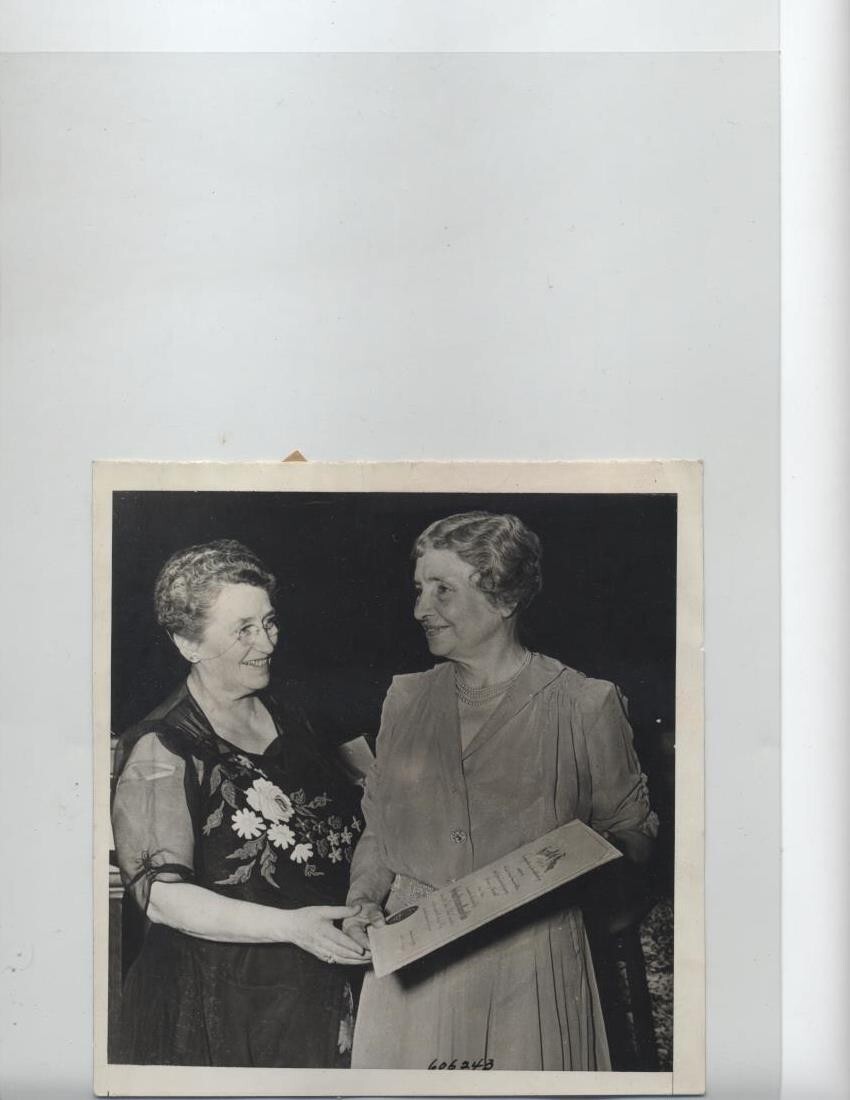
Helen Keller vintage original photo 6 1/4 x 6 1/4 inches from 1941
When Anne Sullivan (whose eyesight began to significantly fail near the end of her life) was no longer able to travel with Helen Keller, Polly Thomson filled the role. After Annie died (in 1936), Polly became Helen\'s constant companion and the verbal communicator between Helen and the public - until Polly also died, in 1957.Helen Adams Keller (June 27, 1880 – June 1, 1968) was an American author, political activist, and lecturer. She was the first deaf-blind person to earn a bachelor of arts degree. The story of how Keller\'s teacher, Anne Sullivan, broke through the isolation imposed by a near complete lack of language, allowing the girl to blossom as she learned to communicate, has become widely known through the dramatic depictions of the play and film The Miracle Worker. Her birthplace in West Tuscumbia, Alabama, is now a museum[1] and sponsors an annual \"Helen Keller Day\". Her birthday on June 27 is commemorated as Helen Keller Day in the U.S. state of Pennsylvania and was authorized at the federal level by presidential proclamation by President Jimmy Carter in 1980, the 100th anniversary of her birth.A prolific author, Keller was well-traveled and outspoken in her convictions. A member of the Socialist Party of America and the Industrial Workers of the World, she campaigned for women\'s suffrage, labor rights, socialism, antimilitarism, and other similar causes. She was inducted into the Alabama Women\'s Hall of Fame in 1971[2] and was one of twelve inaugural inductees to the Alabama Writers Hall of Fame on June 8, 2015.[3] Keller proved to the world that deaf people could all learn to communicate and that they could survive in the hearing world. She also taught that deaf people are capable of doing things that hearing people can do. One of the most famous deaf people in history, she is an idol to many deaf people in the world.[4]Contents 1 Early childhood and illness
2 Formal education
3 Example of her lectures
4 Companions
5 Political activities
6 Writings
7 Later life
8 Portrayals
9 Posthumous honors
10 Archival material
11 See also
12 References
13 Further reading
13.1 Primary sources
13.2 Historiography
14 External linksEarly childhood and illness
Keller with Anne Sullivan vacationing on Cape Cod in July 1888Helen Adams Keller was born on June 27, 1880, in Tuscumbia, Alabama.[5] Her family lived on a homestead, Ivy Green,[1] that Helen\'s grandfather had built decades earlier.[6] She had two siblings, Mildred Campbell and Phillip Brooks Keller, and two older half-brothers from her father\'s prior marriage, James and William Simpson Keller.[7][8]Her father, Arthur H. Keller,[9] spent many years as an editor for the Tuscumbia North Alabamian, and had served as a captain for the Confederate Army.[5][6] Her paternal grandmother was second cousins with Robert E. Lee.[10] Her mother, Kate Adams,[11] was the daughter of Charles W. Adams, a Confederate general.[12] Though originally from Massachusetts, Charles Adams also fought for the Confederate Army during the American Civil War, earning the rank of colonel (and acting brigadier-general). Her paternal lineage was traced to Casper Keller, a native of Switzerland.[10][13] One of Helen\'s Swiss ancestors was the first teacher for the deaf in Zurich. Keller reflected on this coincidence in her first autobiography, stating \"that there is no king who has not had a slave among his ancestors, and no slave who has not had a king among his.\"[10]Helen Keller was born with the ability to see and hear. At 19 months old, she contracted an unknown illness described by doctors as \"an acute congestion of the stomach and the brain\",[14] which might have been scarlet fever or meningitis.[5][15] The illness left her both deaf and blind. At that time, she was able to communicate somewhat with Martha Washington, the six-year-old daughter of the family cook, who understood her signs;[16]:11 by the age of seven, Keller had more than 60 home signs to communicate with her family. Even though blind and deaf, Helen Keller had passed through many obstacles and she learned to live with her disabilities. She learned how to tell which person was walking by from the vibrations their footsteps would make. The sex and age of the person could be identified by how strong and continuous the steps were.[17]In 1886, Keller\'s mother, inspired by an account in Charles Dickens\' American Notes of the successful education of another deaf and blind woman, Laura Bridgman, dispatched the young Keller, accompanied by her father, to seek out physician J. Julian Chisolm, an eye, ear, nose, and throat specialist in Baltimore, for advice.[18] Chisholm referred the Kellers to Alexander Graham Bell, who was working with deaf children at the time. Bell advised them to contact the Perkins Institute for the Blind, the school where Bridgman had been educated, which was then located in South Boston. Michael Anagnos, the school\'s director, asked 20-year-old former student Anne Sullivan, herself visually impaired, to become Keller\'s instructor. It was the beginning of a 49-year-long relationship during which Sullivan evolved into Keller\'s governess and eventually her companion.[16]:Introduction, Key FiguresSullivan arrived at Keller\'s house in March 1887, and immediately began to teach Helen to communicate by spelling words into her hand, beginning with \"d-o-l-l\" for the doll that she had brought Keller as a present. Keller was frustrated, at first, because she did not understand that every object had a word uniquely identifying it. In fact, when Sullivan was trying to teach Keller the word for \"mug\", Keller became so frustrated she broke the mug.[19] Keller\'s breakthrough in communication came the next month, when she realized that the motions her teacher was making on the palm of her hand, while running cool water over her other hand, symbolized the idea of \"water\"; she then nearly exhausted Sullivan demanding the names of all the other familiar objects in her world.Helen Keller was viewed as isolated, but was very in touch with the outside world. She was able to enjoy music by feeling the beat and she was able to have a strong connection with animals through touch. She was delayed at picking up language, but that did not stop her from having a voice.[20]
Formal educationIn May 1888, Keller started attending the Perkins Institute for the Blind. In 1894, Keller and Sullivan moved to New York to attend the Wright-Humason School for the Deaf, and to learn from Sarah Fuller at the Horace Mann School for the Deaf. In 1896, they returned to Massachusetts, and Keller entered The Cambridge School for Young Ladies before gaining admittance, in 1900, to Radcliffe College,[21] where she lived in Briggs Hall, South House. Her admirer, Mark Twain, had introduced her to Standard Oil magnate Henry Huttleston Rogers, who, with his wife Abbie, paid for her education. In 1904, at the age of 24, Keller graduated from Radcliffe, becoming the first deaf blind person to earn a Bachelor of Arts degree. She maintained a correspondence with the Austrian philosopher and pedagogue Wilhelm Jerusalem, who was one of the first to discover her literary talent.[22]Determined to communicate with others as conventionally as possible, Keller learned to speak, and spent much of her life giving speeches and lectures on aspects of her life. She learned to \"hear\" people\'s speech by reading their lips with her hands—her sense of touch had heightened. She became proficient at using braille[23] and reading sign language with her hands as well. Shortly before World War I, with the assistance of the Zoellner Quartet, she determined that by placing her fingertips on a resonant tabletop she could experience music played close by.[24]
Example of her lecturesOn January 22, 1916, Keller and Sullivan traveled to the small town of Menomonie in western Wisconsin to deliver a lecture at the Mabel Tainter Memorial Building. Details of her talk were provided in the weekly Dunn County News on January 22, 1916: A message of optimism, of hope, of good cheer, and of loving service was brought to Menomonie Saturday—a message that will linger long with those fortunate enough to have received it. This message came with the visit of Helen Keller and her teacher, Mrs. John Macy, and both had a hand in imparting it Saturday evening to a splendid audience that filled The Memorial. The wonderful girl who has so brilliantly triumphed over the triple afflictions of blindness, dumbness and deafness, gave a talk with her own lips on \"Happiness,\" and it will be remembered always as a piece of inspired teaching by those who heard it.When part of the account was reprinted in the January 20, 2016, edition of the paper under the heading \"From the Files\", the column compiler added According to those who attended, Helen Keller spoke of the joy that life gave her. She was thankful for the faculties and abilities that she did possess and stated that the most productive pleasures she had were curiosity and imagination. Keller also spoke of the joy of service and the happiness that came from doing things for others ... Keller imparted that \"helping your fellow men were one\'s only excuse for being in this world and in the doing of things to help one\'s fellows lay the secret of lasting happiness.\" She also told of the joys of loving work and accomplishment and the happiness of achievement. Although the entire lecture lasted only a little over an hour, the lecture had a profound impact on the audience.[25]Companions
Helen Keller in 1899 with lifelong companion and teacher Anne Sullivan. Photo taken by Alexander Graham Bell at his School of Vocal Physiology and Mechanics of Speech.Anne Sullivan stayed as a companion to Helen Keller long after she taught her. Sullivan married John Macy in 1905, and her health started failing around 1914. Polly Thomson was hired to keep house. She was a young woman from Scotland who had no experience with deaf or blind people. She progressed to working as a secretary as well, and eventually became a constant companion to Keller.[26]Keller moved to Forest Hills, Queens, together with Sullivan and Macy, and used the house as a base for her efforts on behalf of the American Foundation for the Blind.[27] \"While in her thirties Helen had a love affair, became secretly engaged, and defied her teacher and family by attempting an elopement with the man she loved.\"[28] He was \"Peter Fagan, a young Boston Herald reporter who was sent to Helen\'s home to act as her private secretary when lifelong companion, Anne, fell ill.\"[29]Anne Sullivan died in 1936 after a coma as a result of coronary thrombosis,[30]:266 with Keller holding her hand.[31]:255 Keller and Thomson moved to Connecticut. They traveled worldwide and raised funds for the blind. Thomson had a stroke in 1957 from which she never fully recovered, and died in 1960. Winnie Corbally, a nurse whom they originally hired to care for Thomson in 1957, stayed on after her death and was Keller\'s companion for the rest of her life.[27]
Political activities
Helen Keller portrait, 1904. Due to a protruding left eye, Keller was usually photographed in profile. Both her eyes were replaced in adulthood with glass replicas for \"medical and cosmetic reasons\".[31]
\"The few own the many because they possess the means of livelihood of all ... The country is governed for the richest, for the corporations, the bankers, the land speculators, and for the exploiters of labor. The majority of mankind are working people. So long as their fair demands—the ownership and control of their livelihoods—are set at naught, we can have neither men\'s rights nor women\'s rights. The majority of mankind is ground down by industrial oppression in order that the small remnant may live in ease.\"
—Helen Keller, 1911[32]Keller went on to become a world-famous speaker and author. She is remembered as an advocate for people with disabilities, amid numerous other causes. The Deaf community was widely impacted by her. She traveled to twenty-five different countries giving motivational speeches about Deaf people\'s conditions.[33] She was a suffragette, pacifist, radical socialist, birth control supporter, and opponent of Woodrow Wilson. In 1915 she and George A. Kessler founded the Helen Keller International (HKI) organization. This organization is devoted to research in vision, health and nutrition. In 1920, she helped to found the American Civil Liberties Union (ACLU). Keller traveled to over 40 countries with Sullivan, making several trips to Japan and becoming a favorite of the Japanese people. Keller met every U.S. President from Grover Cleveland to Lyndon B. Johnson and was friends with many famous figures, including Alexander Graham Bell, Charlie Chaplin and Mark Twain. Keller and Twain were both considered radicals at the beginning of the 20th century, and as a consequence, their political views have been forgotten or glossed over in the popular mind.[34]Keller was a member of the Socialist Party and actively campaigned and wrote in support of the working class from 1909 to 1921. Many of her speeches and writings were about women\'s right to vote and the impacts of war. She had speech therapy in order to have her voice heard better by the public. When the Rockefeller-owned press refused to print her articles, she protested until her work was finally published.[30] She supported Socialist Party candidate Eugene V. Debs in each of his campaigns for the presidency. Before reading Progress and Poverty, Helen Keller was already a socialist who believed that Georgism was a good step in the right direction.[35] She later wrote of finding \"in Henry George\'s philosophy a rare beauty and power of inspiration, and a splendid faith in the essential nobility of human nature.\"[36]Keller claimed that newspaper columnists who had praised her courage and intelligence before she expressed her socialist views now called attention to her disabilities. The editor of the Brooklyn Eagle wrote that her \"mistakes sprung out of the manifest limitations of her development.\" Keller responded to that editor, referring to having met him before he knew of her political views: At that time the compliments he paid me were so generous that I blush to remember them. But now that I have come out for socialism he reminds me and the public that I am blind and deaf and especially liable to error. I must have shrunk in intelligence during the years since I met him. ... Oh, ridiculous Brooklyn Eagle! Socially blind and deaf, it defends an intolerable system, a system that is the cause of much of the physical blindness and deafness which we are trying to prevent.[37]Keller joined the Industrial Workers of the World (the IWW, known as the Wobblies) in 1912,[34] saying that parliamentary socialism was \"sinking in the political bog\". She wrote for the IWW between 1916 and 1918. In Why I Became an IWW,[38] Keller explained that her motivation for activism came in part from her concern about blindness and other disabilities: I was appointed on a commission to investigate the conditions of the blind. For the first time I, who had thought blindness a misfortune beyond human control, found that too much of it was traceable to wrong industrial conditions, often caused by the selfishness and greed of employers. And the social evil contributed its share. I found that poverty drove women to a life of shame that ended in blindness.The last sentence refers to prostitution and syphilis, the former a frequent cause of the latter, and the latter a leading cause of blindness. In the same interview, Keller also cited the 1912 strike of textile workers in Lawrence, Massachusetts for instigating her support of socialism.Like Alexander Graham Bell and others, Keller supported eugenics. In 1915 she wrote in favor of refusing life-saving medical procedures to infants with severe mental impairments or physical deformities, stating that their lives were not worthwhile and they would likely become criminals.[39][40] Keller also expressed concerns about human Keller, circa 1912Keller wrote a total of 12 published books and several articles.One of her earliest pieces of writing, at age 11, was The Frost King (1891). There were allegations that this story had been plagiarized from The Frost Fairies by Margaret Canby. An investigation into the matter revealed that Keller may have experienced a case of cryptomnesia, which was that she had Canby\'s story read to her but forgot about it, while the memory remained in her subconscious.[27]At age 22, Keller published her autobiography, The Story of My Life (1903), with help from Sullivan and Sullivan\'s husband, John Macy. It recounts the story of her life up to age 21 and was written during her time in college.Keller wrote The World I Live In in 1908, giving readers an insight into how she felt about the world.[43] Out of the Dark, a series of essays on socialism, was published in 1913.When Keller was young, Anne Sullivan introduced her to Phillips Brooks, who introduced her to Christianity, Keller famously saying: \"I always knew He was there, but I didn\'t know His name!\"[44][45][46]Her spiritual autobiography, My Religion,[47] was published in 1927 and then in 1994 extensively revised and re-issued under the title Light in My Darkness. It advocates the teachings of Emanuel Swedenborg, the Christian revelator and theologian who gives a spiritual interpretation of the teachings of the Bible and who claims that the second coming of Jesus Christ has already taken place. Adherents use several names to describe themselves, including Second Advent Christian, Swedenborgian, and New Church.Keller described the progressive views of her belief in these words: But in Swedenborg\'s teaching it [Divine Providence] is shown to be the government of God\'s Love and Wisdom and the creation of uses. Since His Life cannot be less in one being than another, or His Love manifested less fully in one thing than another, His Providence must needs be universal ... He has provided religion of some kind everywhere, and it does not matter to what race or creed anyone belongs if he is faithful to his ideals of right living.[47]Later lifeKeller suffered a series of strokes in 1961 and spent the last years of her life at her home.[27]On September 14, 1964, President Lyndon B. Johnson awarded her the Presidential Medal of Freedom, one of the United States\' two highest civilian honors. In 1965 she was elected to the National Women\'s Hall of Fame at the New York World\'s Fair.[27]Keller devoted much of her later life to raising funds for the American Foundation for the Blind. She died in her sleep on June 1, 1968, at her home, Arcan Ridge, located in Easton, Connecticut, a few weeks short of her eighty-eighth birthday. A service was held in her honor at the National Cathedral in Washington, D.C., her body was cremated and her ashes were placed there next to her constant companions, Anne Sullivan and Polly Thomson. She was buried at the Washington National Cathedral.[48]
Portrayals
\"Anne Sullivan – Helen Keller Memorial\"—a bronze sculpture in Tewksbury, MassachusettsKeller\'s life has been interpreted many times. She appeared in a silent film, Deliverance (1919), which told her story in a melodramatic, allegorical style.[49]She was also the subject of the documentaries Helen Keller in Her Story, narrated by Katharine Cornell, and The Story of Helen Keller, part of the Famous Americans series produced by Hearst Entertainment.The Miracle Worker is a cycle of dramatic works ultimately derived from her autobiography, The Story of My Life. The various dramas each describe the relationship between Keller and Sullivan, depicting how the teacher led her from a state of almost feral wildness into education, activism, and intellectual celebrity. The common title of the cycle echoes Mark Twain\'s description of Sullivan as a \"miracle worker.\" Its first realization was the 1957 Playhouse 90 teleplay of that title by William Gibson. He adapted it for a Broadway production in 1959 and an Oscar-winning feature film in 1962, starring Anne Bancroft and Patty Duke. It was remade for television in 1979 and 2000.In 1984, Keller\'s life story was made into a TV movie called The Miracle Continues.[50] This film that entailed the semi-sequel to The Miracle Worker recounts her college years and her early adult life. None of the early movies hint at the social activism that would become the hallmark of Keller\'s later life, although a Disney version produced in 2000 states in the credits that she became an activist for social equality.The Bollywood movie Black (2005) was largely based on Keller\'s story, from her childhood to her graduation.[51]A documentary called Shining Soul: Helen Keller\'s Spiritual Life and Legacy was produced by the Swedenborg Foundation in the same year. The film focuses on the role played by Emanuel Swedenborg\'s spiritual theology in her life and how it inspired Keller\'s triumph over her triple disabilities of blindness, deafness and a severe speech impediment.[citation needed]On March 6, 2008, the New England Historic Genealogical Society announced that a staff member had discovered a rare 1888 photograph showing Helen and Anne, which, although previously published, had escaped widespread attention.[52] Depicting Helen holding one of her many dolls, it is believed to be the earliest surviving photograph of Anne Sullivan Macy.[53]Video footage showing Helen Keller learning to mimic speech sounds also exists.[54]A biography of Helen Keller was written by the German Jewish author H.J.Kaeser.A 10-by-7-foot painting titled The Advocate: Tribute to Helen Keller was created by three artists from Kerala as a tribute to Helen Keller. The Painting was created in association with a non-profit organization Art d\'Hope Foundation, artists groups Palette People and XakBoX Design & Art Studio.[55] This painting was created for a fundraising event to help blind students in India [56] and was inaugurated by M. G. Rajamanikyam, IAS (District Collector Ernakulam) on Helen Keller day (June 27, 2016).[57] The painting depicts the major events of Helen Keller\'s life and is one of the biggest paintings done based on Helen Keller\'s life.
Posthumous honors
Helen Keller as depicted on the Alabama state quarterA preschool for the deaf and hard of hearing in Mysore, India, was originally named after Helen Keller by its founder, K. K. Srinivasan. In 1999, Keller was listed in Gallup\'s Most Widely Admired People of the 20th century.In 2003, Alabama honored its native daughter on its state quarter.[58] The Alabama state quarter is the only circulating US coin to feature braille.[59]The Helen Keller Hospital in Sheffield, Alabama, is dedicated to her.[60]Streets are named after Helen Keller in Zürich, Switzerland, in the USA, in Getafe, Spain, in Lod, Israel,[61] in Lisbon, Portugal[62] and in Caen, France.A stamp was issued in 1980 by the United States Postal Service depicting Keller and Sullivan, to mark the centennial of Keller\'s birth.On October 7, 2009, a bronze statue of Helen Keller was added to the National Statuary Hall Collection, as a replacement for the State of Alabama\'s former 1908 statue of the education reformer Jabez Lamar Monroe Curry. It is displayed in the United States Capitol Visitor Center and depicts Keller as a seven-year-old child standing at a water pump. The statue represents the seminal moment in Keller\'s life when she understood her first word: W-A-T-E-R, as signed into her hand by teacher Anne Sullivan. The pedestal base bears a quotation in raised Latin and braille letters: \"The best and most beautiful things in the world cannot be seen or even touched, they must be felt with the heart.\"[63] The statue is the first one of a person with a disability and of a child to be permanently displayed at the U.S. Capitol.[64][65][66]
Archival materialArchival material of Helen Keller stored in New York was lost when the Twin Towers were destroyed in the September 11 attacks.[67][68][69]The Helen Keller Archives are owned by the American Foundation for the Blind.[70]Distributed by Universal Press Syndicate© 2004 The Mini Page Publishing Company Inc.release dates: March 6-12 11-1 (04)from The Mini Page by Betty Debnam © 2004 The Mini Page Publishing Company Inc.By BETTY DEBNAMTM TMImagine what life would be like ifyou could not see or hear. Imagine youdid not know any way to communicatewith other people. Imagine being shutinside a confusing world with no wayto ask for help.Helen Keller lived in such a world.When she was 19 months old, shebecame very ill. The disease left herblind and deaf.No one knows what illness struckher, although some believe it mayhave been scarlet fever.And yet, in spite of these problems,she grew up to graduate from collegewith high honors. She wrote 14 books,had a vaudeville act, met sevenpresidents, and traveled to 39 countriesgiving speeches on good causes.Her story was made famous by theBroadway play and movie “TheMiracle Worker.”Helen Keller visits a wounded soldier at aNorth Carolina hospital in 1945. DuringWorld War II she traveled throughout thecountry giving support to blinded andwounded veterans.Helen as a childHelen Keller grew up in the countrynear Tuscumbia, Ala. She was asmart, loving child. But she alsomisbehaved a lot. Her parents felt sobad that she couldn’t see or hear thatthey didn’t teach her proper behavior.Helen also acted naughty becauseshe was upset when she couldn’tcommunicate with others.She wandered around the table,grabbing food from other people’s plates.One time she locked her mother in acupboard. She bit and scratched people.Some members of her family thoughtshe would always be impossible tohandle at home.TeacherWhen Helen was about 7, inventorAlexander Graham Bell helpedHelen’s worried parents find aremarkable teacher, Anne Sullivan.Anne Sullivan knew she had to bestrict with her naughty student. Forexample, she would not let Helen eatuntil Helen sat properly, with hernapkin on her lap. At first Helenrebelled, fighting her teacher for hours.Anne Sullivan took Helen to a littlecottage on the family’s property so shecould teach her without the family’sinterference. In just two weeks, AnneSullivan taught her much about howto behave.However, when they returned to thefamily house, Helen continued tothrow tantrums occasionally.The miracleOne day, during one such tantrum,Anne Sullivan made Helencome out to the yard.While she pumped waterinto Helen’s hand, shespelled out “w-a-t-e-r”using a special handalphabet.And then the miracle happened.Suddenly Helen understood. Sheunderstood that what her teacher wasspelling stood for actual water. Sherealized words had meaning.From then on, everything changed.That day alone she learned about 30words.An Amazing WomanThe Story of Helen KellerPlease include all of the appropriate registered trademark symbols and copyright lines in any publication of The Mini Page®. photos courtesy American Foundation for the BlindHelen Keller (1880-1968) is about 7 in thispicture. She loved dogs her whole life, andalways had at least one. (This is a blackand-white photo colored in by an artist.)The Mini Page celebratesWomen’s History Month with astory about a woman who led anincredible life, Helen Keller.Mini Spy . . .from The Mini Page by Betty Debnam © 2004 The Mini Page Publishing Company Inc.Mini Spy’s class is learning braille. See if you can find:• number 7 • feather • pencil • toothbrush • letter D• umbrella • cat• ruler • carrot• man in moon• donkey head• elephant head• key • muffin• number 2• letter A • bell• number 8• football • sock• letter CWords and names that remind us of Helen Keller are hidden in theblocks below. Some words are hidden backward or diagonally. Seeif you can find: DEAF, BLIND, MEDALS, VAUDEVILLE, MIRACLE,TEACHER, ANNE, SULLIVAN, DOGS, SENSES, WATER, SPELL,AMAZING, READ, BRAILLE, NATURE, INSPIRING, TRANSLATING.Helen Keller TRY ’NFINDS T E L L I ARBB LL EPSU E DWAMA Z I NGR I V LL AQ E AV S E S N E S EMDL CC K AT S L AD EMUADI HHMNF EHE RUT ANDV EB L I NDRE LCAR IMA RR V EL L I V EDUAVVN RE NNAGN I R I PSN IG N I T AL SNAR TDOGSfrom The Mini Page by Betty Debnam © 2004 The Mini Page Publishing Company Inc.from The Mini Page by Betty Debnam © 2004 The Mini Page Publishing Company Inc.Basset BrownThe NewsHound’sDistributed by Universal Press Syndicate 11-2 (04); release dates: March 6-12 ®TM TMThe Hand AlphabetPlease include all of the appropriate registered trademark symbols and copyright lines in any publication of The Mini Page®.Manual alphabetAnne Sullivan opened up HelenKeller’s world when she taught Helen tocommunicate through the hand, ormanual, alphabet.A blind or deaf person can “read”words by feeling thehand of the otherperson. The personspells out words inthe palm of the blindor deaf person’s hand.It is very close to the sign-languagealphabet that deaf people use tocommunicate by sight.Experts believe the manual alphabetwas invented by medieval Spanishmonks who had made a vow of silence.In the 1700s the Frenchbegan using it to teachpeople with hearing andspeech problems. Later,British and Americaneducators changed it some so it could befelt by deaf-blind persons.These photos from theAmerican Foundation forthe Blind are of HelenKeller’s hands as she formsthe letters of the manualalphabet.HELEN KELLERIS INSPIRING!Distributed by Universal Press Syndicate®11-3 (04); release dates: March 6-12Rookie Cookie’s RecipeCrunchy Cinnamon Pecansfrom The Mini Page by Betty Debnam © 2004 The Mini Page Publishing Company Inc.Meet Amber TamblynAmber Tamblyn, 20, is the star ofthe television show “Joan of Arcadia.”She was born in Los Angeles andgrew up in a family of artists. Herfather was an actor, and her motherwas a singer and artist. When Amberwas 10 years old, an agent saw herstarring in the show “PippiLongstocking,” and her televisionand movie career began.She has guest-starred on television shows such as“Buffy the Vampire Slayer.”Amber likes to write poetry and enjoys singing,dancing and theater. She currently lives in Los Angeles.You’ll need:• 1/4 cup butter• 3 tablespoons light brown sugar• 1 tablespoon white sugar• 1/2 teaspoon ground cinnamon• 2 cups pecans, shelledWhat to do:1. Melt butter in a microwave oven on high for 25 seconds.2. Remove butter from microwave and mix in sugars andcinnamon.3. Add the pecans and toss until well-coated.4. Spread pecans on an ungreased cookie sheet.5. Bake in a preheated 250-degree oven for 30 minutes.6. Remove from oven and let cool on wax paper.Makes 4 half-cup servings.Note: You will need an adult to help you with this recipe.from The Mini Page by Betty Debnam © 2004 The Mini Page Publishing Company Inc.from The Mini Page by Betty Debnam © 2004 The Mini Page Publishing Company Inc.All the following jokes have something in common. Canyou guess the common theme or category?John: Do you believe in free speech?Mike: Of course.John: Then may I use your telephone?Charlene: What number does a pig dialwhen it needs help?Ned: Swine-one-one!Adele: What type of phone doimposters use?Victor: Phoneys!from The Mini Page by Betty Debnam © 2004 The Mini Page Publishing Company Inc.TMTMGo dot to dot and color.• Full-page pictures• Signatures• Biographical information• Dates of presidential terms• Important achievements• Stories about the many rolesof the president, the electoralvote process, political terms,and a visit to the White House!George W. Bush 86Please include all of the appropriate registered trademark symbols and copyright lines in any publication of The Mini Page®.Distributed by Universal Press Syndicate 11-4 (04); release dates: March 6-12 ®from The Mini Page by Betty Debnam © 2004 The Mini Page Publishing Company Inc.The Mini Page is created and edited byBetty DebnamStaff ArtistWendy DaleyAssociate EditorsTali DentonLucy LienPlease include all of the appropriate registered trademark symbols and copyright lines in any publication of The Mini Page®.The excitement of learningHelen learned to speak by feelinghow Anne Sullivan’s mouth movedwhen she spoke.She learned to read and writeFrench, German, Greek and Latin inbraille.* She even learned to play chess.*Braille is a form of writing where lettersare formed by raised dots.Amazing abilitiesHelen was able to do wonderfulthings sighted people could not do.She could remember people’shandshakes years after last meetingthem. She couldidentify hundredsof plants by theirsmell.Once, at a competition held by agroup of rug experts, all the judgeswere blindfolded. Each judge hadabout an hour to feel many differentrugs. Then they had to identify eachone by touch. Only Helen was able toidentify all the rugs.On stageWhen Helen was in her 40s, sheand Anne Sullivan went on avaudeville* tour to talk about herlife. People were curious about whatit was like to be deaf and blind, andyet still be in control of your life.*Vaudeville shows had many differentacts, including comedy, music anddancing.Helen Keller was presented withan Academy Award in 1955 becauseof how inspiring her life was. It wasa duplicate of an award that wasgiven to the movie maker of thedocumentary, “Helen Keller in HerStory.”More About Helen KellerAnne Sullivan MacyAnne Sullivan (1866-1936) had adifficult childhood. Her parents werepoor Irish immigrants. Her motherdied when she was very young.When she was 5 years old, adisease damaged her sight. Then herfather took 10-year-old Anne and heryounger brother Jimmy to anorphanage and abandoned them.Her brother died there. Anne stayeduntil she was about 14.She was sent to a famous school,the Perkins School for the Blind,where she got top grades.When she was 21, she beganteaching Helen Keller. Not only didshe change Helen’s life, but themethods she invented to teach thedeaf and blind are still used today.When she was older, she married.She, her husband, John, and Helenlived in the same house for manyyears.Until Anne Sullivan died, shestayed with Helen, helping her.photos courtesy American Foundation for the BlindHelen Keller loved outdoor activities.Here the 38-year-old Helen is riding ahorse in Beverly Hills, Calif.Amazing achievementsHelen wrote her autobiography,“The Story of My Life,” when shewas just 23, and it waslater translated into 50languages. To write,Helen wrote on a brailletypewriter and then retypedher work on a regular typewriter.Throughout her life she traveled,speaking and raising money for goodcauses such as the American Foundationfor the Blind, women’s right to vote,peace and ending poverty.Anne Sullivan taught Helen to experiencenature by touch and smell. They hadmany of their classes outdoors. All of herlife, Helen loved nature.Look through your newspaper for storiesabout people who are achieving greatthings.The writer Mark TwRead the storyof Helen Kellerby Betty DebnamAppearing in yournewspaper on ____________.from The Mini Page by Betty Debnam© 2004 The Mini Page Publishing Company Inc.inDistributed by Universal Press Syndicate®release dates: March 6-12 11-5 (04)used in place of ad if desired.)Please include all of the appropriate registered trademark symbols and copyright lines in any publication of The Mini Page®.from The Mini Page by Betty Debnam © 2004 The Mini Page Publishing Company Inc.Supersport: Sanya RichardsHeight: 5-8 Weight: 120Hometown: Pembroke Pines, Fla.The “S” in Sanya Richards’ name could standfor “speed.” The University of Texas sophomorelooks like a blur on a track. She won the 400-meter gold medal in the U.S. championships in2003 and anchored a gold-medal-winning 400-meter relay team at the world championships.In 2002, Richards was named Verizon Youth Athlete of theYear.Richards, who was born in Jamaica, also played basketballin high school and had a perfect 4.0 grade-point average. AtTexas, the “Gold Girl” is majoring in engineering – andwinning races.TMpromoting Issue 11.)Distributed by Universal Press SyndicateStandards Spotlight:The Story of Helen KellerMini Page activities meet many state and national educational standards. Eachweek we identify standards that relate to The Mini Page’s content and offeractivities that will help your students reach them.This week’s standards:• Students use biographies and stories to understand the individuals who are honored bythe nation. (Social Studies: History)• Students explore factors that contribute to one’s personal identify, such as interests,capabilities and perceptions. (Social Studies: Individual development)Activities:1. Divide a piece of paper into four sections. At the top of one section write “Friends.” Atthe top of the other sections, write the words “Travel,” “Fun” and “Studies.” Write asentence about Helen Keller in each of the sections. For example, in the “Travel” section,write something about her travels. In the “Studies” section, write a sentence about whatshe studied and learned.2. Talk to several friends or family members. Ask them to tell you something they like tolook at in nature. Ask them to name a sound they like to hear. (Ask them not to namepictures and sounds from television or recordings.)3. List three qualities you admire in Anne Sullivan. Write a sentence for each oneexplaining how you think that quality helped her.4. Look in the newspaper to find people who share some of Helen Keller’s interests andabilities. Find someone who (a) travels a lot, (b) is a writer, (c) loves nature, (d) helpsothers and (e) knows the president.5. Think about a special teacher you’ve had. Write a paragraph describing that teacher andexplaining why you think he/she deserves special recognition.(standards by Dr. Sherrye D. Garrett, Texas A&M University-Corpus Christi)®(Note to Editor: Above is the Standards for Issue 11.)More than thirty years after her death, Helen Keller is still known internationally asthe little deaf blind girl, the ‘miracle child’ who triumphed over adversity. Butbehind the image, hidden from the public gaze, was a flesh-and-blood woman,writer and radical activist, suffragette and Socialist. She was a woman who lived toold age, yet is fixed in the public imagination as an eternal child.This paper charts the creation of Keller’s popular image and enduring iconic status,analysing their purpose and the implications they hold for us as disabled people. Itthen examines the truth of her life, revealing how contemporary are the issueswhich determined it. Finally, it explores the value of retelling her biography and therelevance it holds in the building of disability culture.Biographical detailsHelen Keller: Rethinking the Problematic Icon 1Liz Crow is a writer, broadcaster and disability activist. She is co-producer/director,with Ann Pugh, of The Real Helen Keller for Channel Four Television.Helen Keller: Rethinking the Problematic Icon 2Helen Keller: Rethinking the Problematic IconHelen Keller was like a ‘kitchen word’. It was as if she were always in therealm of my consciousness. (Marcous, 1999a)I have a memory of school assembly, many years ago - the theme: heroes throughtime.We sat there, cross-legged, 150 children in the big school hall, everyone prayingfor Helen Keller and all the Helen Kellers of the world, and that we might live ourown lives with the same strength and fortitude. Perhaps we watched The MiracleWorker, because quarter of a century later there is still a scene from the filmetched in my mind: the child Helen with her teacher, high drama by the waterpump, that moment when deaf and blind Helen discovers language and a ‘miracle’occurs.I have a memory, too, of an instinctive resistance to what we were being told. Stilla non-disabled child, this was a figure outside my experience. Soon to become adisabled child, she was a figure beyond my grasp. Either way, she was set up assomething I should strive towards, however unwillingly, but at which I would mostcertainly fail. As I grew older, for the most part I could dismiss her from my mind.But, when others expected me to be inspired, I would decry her.Helen Keller: Rethinking the Problematic Icon 3And then, in adulthood, I read a book about women anti-militarists (Oldfield, 1989).I learned of Sophie Scholl’s resistance work in the Germany of World War II, of theessays of Simone Weil and the awakening of Christa Wolf to the Nazism of herchildhood. And amongst them I found the name of Helen Keller – so different fromthe Helen Keller of my school days that I took convincing that this was the sameperson. In place of some pale icon, here she was flesh-and-blood, a writer andradical activist, suffragette and Socialist. All those years before, I had been taught,not of Helen Keller, but of an image of Helen Keller. I began to read wider, trackingdown her own words, finding out what she was really like, trying to understand thisgulf between the fiction and fact of her life.What I have learned has left me wanting to tell the truth of her life. But I also wantto look at the origins and reasons for its fiction. It is not simply the events of her lifethat have kept me focused, it is that the issues which influenced and determinedthem are those which still occupy disability activists today. I am intrigued by theconnection that her life offers to our past, the lessons that we can learn fromlooking back and the assurance that, however tentatively, we are making progress.In this paper I will:• Describe the creation of her popular and enduring image – her elevation fromhuman being to icon• Analyse its purpose and the implications it holds for us as disabled peopleHelen Keller: Rethinking the Problematic Icon 4• Examine the ‘truth’ – and show how contemporary are the issues which shapedher life• Explore the idea of rethinking icons, bringing their stories into a culture ofdisability.Creating an Image“Most people know of Helen Keller as a disabled seven year old in the grips ofan oblivion of no sight, no sound, rescued by an incredible teacher at a well atthe age of seven, brought out of that oblivion through language …and then itdisappears from people’s minds.” (Bergmann, 1999)Helen Keller was born in 1880 in Tuscumbia, Alabama, the first child of CaptainArthur Keller and his second wife Kate. Theirs was a genteel Southern militaryfamily that had been made poor by the civil war of fifteen years before.At 19 months, after a brief illness, Helen became deaf and blind. The reactions ofher family were mixed. The family struggled to communicate with each other andHelen became increasingly “wild and destructive”. Her uncle wanted her shutaway in an institution for being “defective and not very pleasant to see” (Keller,1903). In the late nineteenth century, this was the fate of many disabled children,most of whom subsequently died.Helen Keller: Rethinking the Problematic Icon 5However, her aunt was convinced that “this child has more sense than all theKellers - if there is any way to reach her mind”. That Helen was already exercisingfreewill is absent from the popular image, yet she had by now begun to devise herown basic signs, permitting the family rudimentary communication.Her family’s desire to find a way at least to discipline Helen and control hertantrums led them to Alexander Graham Bell, the great inventor, who was also wellknown for his work with deaf people. The controversial nature of this work neverappears in the fiction of Helen Keller, although it would soon exert a fundamentalinfluence on the course of her life. At their first meeting, Bell suggested theyapproach Perkins School for the Blind in Boston to find a teacher. It was there thatAnne Sullivan, a recent graduate of the school, was recommended for the job.Annie travelled down to Alabama to work with Helen. She believed intuitively thata child would learn best when the process was enjoyable and, set against theVictorian education system, her teaching was progressive and inspired. She usedthe deaf blind manual alphabet and spelt words constantly into the palm of Helen’shand. For several months this was a game to Helen, with no inherent meaning,until one day, at the water pump, a single event occurred which would instantly beturned into mythical status:As the cool stream gushed over one hand she spelled into the other the wordwater, first slowly, then rapidly. I stood still, my whole attention fixed upon themotions of her fingers. Suddenly I felt a misty consciousness as of somethingHelen Keller: Rethinking the Problematic Icon 6forgotten – a thrill of returning thought; and somehow the mystery of languagewas revealed to me. (Keller, 1903)This was the ‘miracle’ that would for ever after define the image of Helen Keller.“She was transformed from this semi-wild child into this saint-like child, thisangel child. She was groomed to play a part.” (Herrmann, 1999)Once she had discovered language and learning, Helen revelled in it. She wasvery bright and learned at a phenomenal pace. Annie recorded her learning indetailed letters to Michael Anagnos, the director of Perkins School. At a time whenrelatively few deaf blind children even survived, the fact that a deaf blind childcould be educable was a revelation. Anagnos alerted the press and the story ofthe ‘miracle child’ was born. Within weeks Helen was world famous.Throughout her childhood, the desire of the press and public to follow her everymove was feverish. Wild stories were spread about her amazing achievements:her ability to identify colours by touch, her fluency in seven languages by the age often, her singing and her brilliant piano playing. The language used wasextravagant:“She was a miracle child, she had sprung fully grown from the forehead likeAthena, she was brilliant, she was innocent, she was a natural wonder, shewas a genius – the word miracle occurs again and again.” (Klages, 1999)Helen Keller: Rethinking the Problematic Icon 7Helen was visited by famous people, written about by the literati and examined byphilosophers and scientists (who found, her mind and her senses to be remarkablylike those of other people). Her likes, her sayings and her foibles, her kindnessesto others were all catalogued in detail and read voraciously.Financed by philanthropists, Helen’s education continued. Soon she had learnedto write using a stylus and, by the age of eleven, to lip read and speak. The imageof Helen Keller does not question her means of communication, although manydeaf people have done so ever since.Although at the time of Helen’s birth, sign language was well established in theUnited States, her education coincided with the new oralism movement (Baynton,1996). This argued that deaf children should be taught to lip read and speak.Helen had met Alexander Graham Bell, who was a leading figure for the oralismcampaign, before she had acquired language and at a time when her family wasdesperate for answers. His advice was trusted and unquestioned.When Helen was introduced to communication and language through the deafblind manual alphabet, it was used as a tool by which to ‘break through’ to her.The intention was never to facilitate her connection with other deaf people. WhenBell referred her to Perkins School for the Blind, she was presented with lipreadingand speech as the only valid means of communication. The manual alphabetbecame a secondary communication method, a back up to speech and lipreading,Helen Keller: Rethinking the Problematic Icon 8and her segregation from other deaf people was reinforced. Her early schoolingset her firmly on the path of oralism so that even when she later attended a schoolfor deaf children, the Wright-Humason School in New York was selectedspecifically for its innovations in oralism.From early childhood, Helen knew that she wanted to spend her life working toimprove social conditions. To do so, she must be able to communicate effectively.Sign language, a predominantly visual (as opposed to tactile) language, was notreadily available to her and the deaf blind manual alphabet ( which entails spellingeach word letter-by-letter) made communication very slow. The most effectiveroute that Helen knew for her ideas to reach people was speaking. She “laborednight and day” and was delighted in her achievement, but “discouragement andweariness cast me down frequently” (Keller, 1903). Helen could never speakclearly enough to be understood by strangers and, in life-long regret, believedherself to have failed.At eighteen, she passed her entrance exams to Radcliffe, the leading women’scollege of the time. Radcliffe admitted Helen, but grudgingly:When the word became public there was much talk – ‘Why don’t they sayoutright that Miss Sullivan is entering Radcliffe instead of Helen Keller a blind,deaf and dumb girl?’ (Lash, 1980)Helen Keller: Rethinking the Problematic Icon 9Very few staff or students made real effort to communicate with her. Books wererarely provided in Braille, classes were laboriously finger-spelled by Annie andHelen spent each night typing up the day’s lectures from memory. Helen was thefirst deaf blind college student in the United States – and the last for half a century.In the public image, her education was a triumph; in reality she struggledthroughout, remembering her college years as times of deep loneliness andexclusion.In adulthood, the child of purity became the woman of virtue. In her middle years,Helen worked as fundraiser and ambassador with the newly established AmericanFoundation for the Blind (AFB). She still attracted the press who cast her as aninternational figurehead for blind people. But the public image omits her scepticismabout charity and her loathing of asking for money:“She didn’t like doing it, she felt like she was begging. I think she felt it was astep backwards in the evolution of being a blind person, to find herself there ona stage asking for money, even though she was not asking for money forherself. I think she perceived it as something that was needed and she waswilling to do it because she believed in the cause.” (Kleege, 1999)She conceded to working within the AFB and the system with great reluctance,believing it was the best means for her to be effective. However, the image doesnot record her growing frustration and increasingly volatile relationship with anHelen Keller: Rethinking the Problematic Icon 10organisation which, initially at the vanguard, became increasingly establishmentover time.The biggest omissions, however, from the popular image of Helen Keller concernher political activism and her personal life.During her college days, Helen was introduced to socialism by the lecturer andjournalist John Macy (who later married Annie). She recognised “a struggle whichresembles my own” and rapidly moved from an intellectual commitment intolifelong and revolutionary activism.The saint was in actuality a spitfire, and her rhetoric was forceful and furious.(Fillippeli, 1985)Helen joined the Socialist Party, subsequently leaving it for the more radicalIndustrial Workers of the World. Her political involvements were many and varied,carried out with resoluteness. She campaigned for birth control, supported civilrights for black people, defended militant women’s suffrage, campaigned withleading pacifists against the United States’ preparations for war, protested at thedeportation of immigrants for their political beliefs, co-founded the American CivilLiberties Union. For Helen, the root of all these campaigns lay in a fundamentaldrive for justice and social equality and she exhorted others to join the struggle.Helen Keller: Rethinking the Problematic Icon 11Many young women full of devotion and good-will have been engaged insuperficial charities. They have tried to feed the hungry without knowing thecauses of poverty. They have tried to minister to the sick withoutunderstanding the cause of disease. They have tried to raise up fallen sisterswithout understanding the brutal arm of necessity that struck them down… Weattempt social reforms where we need social transformations. We mend smallthings and leave the great things untouched. (Keller, 1913)No one has given me a good reason why we should obey unjust laws. But thereason why we should resist them is obvious… The dignity of human naturecompels us to resist what we believe to be wrong. (Keller, 1914)In 1933, her book of political essays was burned by the Nazis. From the 1930sand throughout the tide of anti-Communism into the 1950s, to the great dismay ofthe American Foundation for the Blind, she was kept under surveillance by the FBIfor her far-left politics and support of Communism. She took risks that saw otherpeople jailed or socially dispossessed and, particularly during her early civil rightswork, “her politics for anyone else might have gotten her lynched” (Fillippeli, 1999).Early on, she publicly linked her work on women’s suffrage and anti-poverty withthe rights of blind people.The way to help the blind or any other defective class is to understand, correct,remove the incapacities and inequalities of our entire civilization. (Keller, 1913)Helen Keller: Rethinking the Problematic Icon 12A class of college girls…asked me to initiate them into philanthropic endeavorfor the sightless. I told them to study the life that swarms at their very doors…that the best educated human is the one who understands most about the lifein which he is placed… They asked me how to help the blind… I gravelyrecommended that they study Industrial Economics. (Keller, 1913)To most people, her disability rights work appeared to be in keeping with the saintlypublic image, so that they were open to her ideas without realising how radical theycould be. In Israel, when her hosts showed her with great pride a village for blindpeople, Helen argued vehemently against segregation and convinced them tobreak up the village. Long before the social model of disability had a name, shepublicised the link between social and economic conditions and impairment, aswell as grasping the impact of multiple oppression. Within the AmericanFoundation for the Blind and the legislature, she lobbied continuously to include theparticular needs of deaf blind people and of black disabled people.As part of her offer to bring her political beliefs to a wider audience, Helen(misguidedly) took up an offer from Hollywood in 1920 to star in Deliverance, asilent movie of her life. The producer realised early on that the saccharine imagealone would not hold audiences. To sell the film, he spiced it up with a lover. Forthe public image of Helen Keller, this was the sole admission of Helen as sexual,but the concession was only partial. In the film, her love is unrequited and so purethat the idol has fallen for Ulysses, a mythical being like herself.Helen Keller: Rethinking the Problematic Icon 13The public image does not permit her a real personal life. Yet just two years beforeHollywood’s fiction, she had fallen in love with her secretary Peter Fagan and thetwo had taken out a marriage licence in secret. The press broke the news andHelen’s family whisked her back to Alabama, banishing her lover at gunpoint. Herfamily could not countenance the reality of Helen’s adulthood and nor could theimage incorporate her as sexual: “for anyone as pure as Helen is, she would be sosullied by actual sexuality that it could just never happen” (Finger, 1999).The public image cannot incorporate a Helen Keller that is human and so thelargest part of her life - her greatest accomplishments and her great tragedy – ismissing from the public account.The final event associated with Helen Keller was her funeral, held in 1968. Shehad left instructions for a simple, intimate funeral, in keeping with her chosenSwedenborgian religion. However, her wishes did not fit the image of Helen Kellerand so they were ignored by her family and her trustees at the AmericanFoundation for the Blind. Instead, these keepers of the image conducted a largepublic service, with full honours and interment at the National Cathedral inWashington DC, so that “even in death, she wasn’t free, her image wasn’t free”(Fillippeli, 1999).The aoffering image of Helen Keller is reinforced in the last major public document ofher life. The Unconquered is a film biography made in 1953 towards the end of herpublic life. It recounts the water pump story, the charity work, the great achiever,Helen Keller: Rethinking the Problematic Icon 14the icon, and shows scenes of domesticity – flower arranging and washing up. Itomits all departures from the image and leaves the audience with a picture ofHelen now, a mild, docile old lady who once inspired the world.But in the popular imagination, it is the childhood image that persists. On theinternet, a school project posted recently by an eleven year old charts the events ofHelen Keller’s life. A timeline begins with her birth, notes her illness in 1882, tellsus “Annie came to teach Helen how to behave”. In 1890, she learns to speak,followed by her school days and on to 1900: “Helen’s first day at college”. Achronological gap gives way to the next event, in 1968: “Helen died”.Helen Keller is ‘the little blind girl who overcame adversity to symbolize the triumphof the individual’ (Fillippeli, 1999). She was a woman who lived to old age, yet isfixed in the public imagination as an eternal child. Situated alongside Heidi’s LittleClara and Beth in Little Women, she enjoins us to be better than ourselves andrivals the very essence of fiction.
Helen Adams Keller (June 27, 1880 – June 1, 1968) was an American author, disability rights advocate, political activist and lecturer. Born in West Tuscumbia, Alabama, she lost her sight and her hearing after a bout of illness when she was 19 months old. She then communicated primarily using home signs until the age of seven, when she met her first teacher and life-long companion Anne Sullivan. Sullivan taught Keller language, including reading and writing. After an education at both specialist and mainstream schools, Keller attended Radcliffe College of Harvard University and became the first deafblind person in the United States to earn a college diploma.[1]
Keller was also a prolific author, writing 14 books and hundreds of speeches and essays on topics ranging from animals to Mahatma Gandhi.[2] Keller campaigned for those with disabilities and for women\'s suffrage, labor rights, and world peace. In 1909, she joined the Socialist Party of America (SPA). She was a founding member of the American Civil Liberties Union (ACLU).[3]
Keller\'s autobiography, The Story of My Life (1903), publicized her education and life with Sullivan. The playwright William Gibson wrote a theatrical adaptation, The Miracle Worker, in 1959, which he adapted as a film under the same title in 1962. Her birthplace has been designated and preserved as a National Historic Landmark. Since 1954, it has been operated as a house museum[4] and sponsors an annual \"Helen Keller Day\".[5]
Early childhood and illness
Keller\'s birthplace in Tuscumbia, Alabama
Keller (left) with Anne Sullivan vacationing on Cape Cod in July 1888Keller was born Helen Adams Keller on June 27, 1880, in Tuscumbia, Alabama, the daughter of Arthur Henley Keller (1836–1896),[6] and Catherine Everett (née Adams) Keller (1856–1921), known as \"Kate\".[7][8] The Keller family lived on a homestead, Ivy Green,[4] which her paternal grandfather had built decades earlier.[9] She had four siblings: two full siblings, Mildred Campbell (née Keller) Tyson and Phillip Brooks Keller; and two older half-brothers from her father\'s first marriage, James McDonald Keller and William Simpson Keller.[10][11]
Keller\'s father worked for many years as an editor of the Tuscumbia North Alabamian. He had served as a captain in the Confederate Army.[8][9] The family was part of the slaveholding elite before the American Civil War, but lost status later.[9] Her mother was the daughter of Charles W. Adams, a Confederate general.[12] Keller\'s paternal lineage was traced to Casper Keller, a native of Switzerland.[13][14] One of Helen\'s Swiss ancestors was the first teacher for the deaf in Zürich. Keller reflected on this fact in her first autobiography, asserting that \"there is no king who has not had a slave among his ancestors, and no slave who has not had a king among his\".[13]
At 19 months old, Keller contracted an unknown illness described by doctors as \"an acute congestion of the stomach and the brain\".[15] Contemporary doctors believe it may have been meningitis, caused by the bacterium Neisseria meningitidis (meningococcus),[16] by rubella or scarlet fever,[8][17] (or by Haemophilus influenzae, which can cause the same symptoms but is less likely because of its 97% juvenile mortality rate at that time).
Keller was able to recover from her illness, but was left permanently blind and deaf, as she recalled in her autobiography, \"at sea in a dense fog\".[18] At that time, Keller was able to communicate somewhat with Martha Washington, who was two years older and the daughter of the family cook, and understood the girl\'s signs;[19]: 11 by the age of seven, Keller had more than 60 home signs to communicate with her family, and could distinguish people by the vibration of their footsteps.[20]
In 1886, Keller\'s mother, inspired by an account in Charles Dickens\' American Notes of the successful education of Laura Bridgman, a deaf and blind woman, dispatched the young Keller and her father to consult physician J. Julian Chisholm, an eye, ear, nose and throat specialist in Baltimore, for advice.[21][9] Chisholm referred the Kellers to Alexander Graham Bell, who was working with deaf children at the time. Bell advised them to contact the Perkins Institute for the Blind, the school where Bridgman had been educated. It was then located in South Boston. Michael Anagnos, the school\'s director, asked Anne Sullivan, a 20-year-old alumna of the school who was visually impaired, to become Keller\'s instructor. It was the beginning of a nearly 50-year-long relationship Sullivan developed with Keller as her governess and later her companion.[19]
Sullivan arrived at Keller\'s house on March 5, 1887, a day Keller would forever remember as \"my soul\'s birthday\".[18] Sullivan immediately began to teach Helen to communicate by spelling words into her hand, beginning with \"d-o-l-l\" for the doll that she had brought Keller as a present. Keller initially struggled with lessons since she could not comprehend that every object had a word identifying it. When Sullivan was trying to teach Keller the word for \"mug\", Keller became so frustrated she broke the mug.[22] Keller remembered how she soon began imitating Sullivan\'s hand gestures: \"I did not know that I was spelling a word or even that words existed. I was simply making my fingers go in monkey-like imitation.\"[23]
The next month, Keller made a breakthrough, when she realized that the motions her teacher was making on the palm of her hand, while running cool water over her other hand, symbolized the idea of \"water\". Writing in her autobiography, The Story of My Life, Keller recalled the moment:
I stood still, my whole attention fixed upon the motions of her fingers. Suddenly I felt a misty consciousness as of something forgotten—a thrill of returning thought; and somehow the mystery of language was revealed to me. I knew then that w-a-t-e-r meant the wonderful cool something that was flowing over my hand. The living word awakened my soul, gave it light, hope, set it free![18]
Keller quickly demanded that Sullivan sign the names of all the other familiar objects in her world.[24]
Formal educationIn May 1888, Keller started attending the Perkins Institute for the Blind. In 1893, Keller, along with Sullivan, attended William Wade House and Finishing School.[25] In 1894, Keller and Sullivan moved to New York to attend the Wright-Humason School for the Deaf, and to learn from Sarah Fuller at the Horace Mann School for the Deaf. In 1896, they returned to Massachusetts, and Keller entered The Cambridge School for Young Ladies before gaining admittance, in 1900, to Radcliffe College of Harvard University,[26] where she lived in Briggs Hall, South House. Her admirer, Mark Twain, had introduced her to Standard Oil magnate Henry Huttleston Rogers, who, with his wife Abbie, paid for her education. In 1904, at the age of 24, Keller graduated from Radcliffe as a member of Phi Beta Kappa,[27] becoming the first deafblind person to earn a Bachelor of Arts degree[28]. She maintained a correspondence with the Austrian pedagogue and philosopher Wilhelm Jerusalem, who was one of the first to discover her literary talent.[29]
Determined to communicate with others as conventionally as possible, Keller learned to speak and spent much of her life giving speeches and lectures on aspects of her life. She learned to \"hear\" people\'s speech using the Tadoma method, which means using her fingers to feel the lips and throat of the speaker.[30] She became proficient at using braille,[31] and also used fingerspelling to communicate.[32] Shortly before World War I, with the assistance of the Zoellner Quartet, she determined that by placing her fingertips on a resonant tabletop she could experience music played close by.[33]
Companions
Helen Keller in 1899 with lifelong companion and teacher Anne Sullivan. Photo taken by Alexander Graham Bell at his School of Vocal Physiology and Mechanics of Speech.Anne Sullivan stayed as a companion to Keller long after she taught her. Sullivan married John Macy in 1905, and her health started failing around 1914. Polly Thomson (February 20, 1885[34] – March 21, 1960) was hired to keep house. She was a young woman from Scotland who had no experience with deaf or blind people. She progressed to working as a secretary as well, and eventually became a constant companion to Keller.[35]
Keller moved to Forest Hills, Queens, together with Sullivan and Macy, and used the house as a base for her efforts on behalf of the American Foundation for the Blind.[36] While in her 30s, Keller had a love affair and became secretly engaged; she also defied her teacher and family by attempting an elopement with the man she loved,[37] Peter Fagan, who was known as \"the fingerspelling socialist\",[9] and was a young Boston Herald reporter sent to Keller\'s home to act as her private secretary when Sullivan fell ill. At the time, her father had died and Sullivan was recovering in Lake Placid and Puerto Rico. Keller had moved with her mother to Montgomery, Alabama.[9]
Sullivan died in 1936, with Keller holding her hand,[38] after falling into a coma as a result of coronary thrombosis.[39]: 266 Keller and Thomson moved to Connecticut. They traveled worldwide and raised funds for the blind. Thomson had a stroke in 1957 from which she never fully recovered and died in 1960. Winnie Corbally, a nurse originally hired to care for Thomson in 1957, stayed on after Thomson\'s death and was Keller\'s companion for the rest of her life.[36]
Akita dogs
Helen Keller with her second Akita Kenzan-GoKeller was very fond of Akita dogs. She visited Akita Prefecture in June 1937 and asked about Hachikō, a loyal dog who searched for his deceased master for about 10 years. She began keeping Akitas as pets and introduced them to America. In 1948, she touched the re-made statue of Hachikō at Shibuya Station.[40] The first Akita given to her was Kamikaze-Go, who was the first Akita to travel overseas from Japan and the first Akita in America. He died of an infection two months after arriving in America and Keller was given Kamikaze-Go\'s brother, Kenzan-Go.[41][42][43] Keller nicknamed the dog Go-Go and they were great companions from day one. Go-Go even spent his first night at Keller\'s home sleeping at the foot of her bed.[44]
Career, writing and political activities
Helen Keller portrait, 1904. Due to a protruding left eye, Keller was usually photographed in profile until she had her eyes replaced, c. 1911, with glass replicas for \"medical and cosmetic reasons\".[45][46]The few own the many because they possess the means of livelihood of all ... The country is governed for the richest, for the corporations, the bankers, the land speculators, and for the exploiters of labor. The majority of mankind are working people. So long as their fair demands—the ownership and control of their livelihoods—are set at naught, we can have neither men\'s rights nor women\'s rights. The majority of mankind is ground down by industrial oppression in order that the small remnant may live in ease.
— Helen Keller, 1911[47]On January 22, 1916, Keller and Sullivan traveled to the small town of Menomonie in western Wisconsin to deliver a lecture at the Mabel Tainter Memorial Building. Details of her talk were provided in the weekly Dunn County News on January 22, 1916:
A message of optimism, of hope, of good cheer, and of loving service was brought to Menomonie Saturday—a message that will linger long with those fortunate enough to have received it. This message came with the visit of Helen Keller and her teacher, Mrs. John Macy, and both had a hand in imparting it Saturday evening to a splendid audience that filled The Memorial. The wonderful girl who has so brilliantly triumphed over the triple afflictions of blindness, dumbness and deafness, gave a talk with her own lips on \"Happiness\", and it will be remembered always as a piece of inspired teaching by those who heard it.[48]
Keller became a world-famous speaker and author. She was an advocate for people with disabilities, amid numerous other causes. She traveled to twenty-five different countries giving motivational speeches about deaf people\'s conditions.[49] She was a suffragist, pacifist, Christian socialist, birth control supporter, and opponent of Woodrow Wilson. In 1915, she and George A. Kessler founded the Helen Keller International (HKI) organization. This organization is devoted to research in vision, health, and nutrition. In 1916, she sent money to the NAACP, as she was ashamed of the Southern un-Christian treatment of \"colored people\".[9]
In 1920, Keller helped to found the American Civil Liberties Union (ACLU). She traveled to over 40 countries with Sullivan, making several trips to Japan and becoming a favorite of the Japanese people. Keller met every U.S. president from Grover Cleveland to Lyndon B. Johnson and was friends with many famous figures, including Alexander Graham Bell, Charlie Chaplin, and Mark Twain. Keller and Twain were both considered political radicals allied with leftist politics.[50]
Keller, who believed that the poor were \"ground down by industrial oppression\",[47] wanted children born into poor families to have the same opportunities to succeed that she had enjoyed. She wrote, \"I owed my success partly to the advantages of my birth and environment. I have learned that the power to rise is not within the reach of everyone.\"[51]
In 1909, Keller became a member of the Socialist Party of America (SPA); she actively campaigned and wrote in support of the working class from 1909 to 1921. Many of her speeches and writings were about women\'s right to vote and the effects of war; in addition, she supported causes that opposed military intervention.[52] She had speech therapy to have her voice understood better by the public. When the Rockefeller-owned press refused to print her articles, she protested until her work was finally published.[39]
Keller supported the SPA candidate Eugene V. Debs in each of his campaigns for the presidency. Before reading Progress and Poverty by Henry George, she was already a socialist who believed that Georgism was a good step in the right direction.[53] She later wrote of finding \"in Henry George\'s philosophy a rare beauty and power of inspiration, and a splendid faith in the essential nobility of human nature\".[54] Keller stated that newspaper columnists who had praised her courage and intelligence before she expressed her socialist views now called attention to her disabilities. The editor of the Brooklyn Eagle wrote that her \"mistakes sprung out of the manifest limitations of her development\". Keller responded to that editor, referring to having met him before he knew of her political views:
At that time the compliments he paid me were so generous that I blush to remember them. But now that I have come out for socialism he reminds me and the public that I am blind and deaf and especially liable to error. I must have shrunk in intelligence during the years since I met him. ... Oh, ridiculous Brooklyn Eagle! Socially blind and deaf, it defends an intolerable system, a system that is the cause of much of the physical blindness and deafness which we are trying to prevent.[55]
In 1912, Keller joined the Industrial Workers of the World (the IWW, known as the Wobblies),[50] saying that parliamentary socialism was \"sinking in the political bog\". She wrote for the IWW between 1916 and 1918. In Why I Became an IWW, Keller explained that her motivation for activism came in part from her concern about blindness and other disabilities:[56]
I was appointed on a commission to investigate the conditions of the blind. For the first time I, who had thought blindness a misfortune beyond human control, found that too much of it was traceable to wrong industrial conditions, often caused by the selfishness and greed of employers. And the social evil contributed its share. I found that poverty drove women to a life of shame that ended in blindness.[56]
The last sentence refers to prostitution and syphilis, the former a \"life of shame\" that women used to support themselves, which contributed to their contracting syphilis. Untreated, it was a leading cause of blindness. In the same interview, Keller also cited the 1912 strike of textile workers in Lawrence, Massachusetts, for instigating her support of socialism.[56] As a result of her advocacy, she was placed on the FBI\'s watchlist;[57] the FBI wrote on July 1, 1953, that although they have not \"conducted an investigation with regard to Helen Adams Keller\", their files of Keller \"reflect the following pertinent information concerning this individual\".[58]
Keller supported eugenics, which had become popular with both new understandings and misapprehensions of principles of biological inheritance. In 1915, she wrote in favor of refusing life-saving medical procedures to infants with severe mental impairments or physical deformities, saying that their lives were not worthwhile and they would likely become criminals.[39]: pp. 36–37 [59] From 1946 to 1957, Keller visited 35 countries.[60] In 1948, she went to New Zealand and visited deaf schools in Christchurch and Auckland. She met Deaf Society of Canterbury Life Member Patty Still in Christchurch.[61]
Works
Helen Keller, c. November 1912Keller wrote a total of 12 published books and several articles. One of her earliest pieces of writing, at age 11, was The Frost King (1891). There were allegations that this story had been plagiarized from The Frost Fairies by Margaret Canby. An investigation into the matter revealed that the allegations were correct. However, it was felt by the Perkins schoolmaster Michael Anagnos that Keller may have experienced a case of cryptomnesia, which was that she had Canby\'s story read to her but forgot about it, while the memory remained in her subconscious.[36][62]: 141
At age 22, with help from Sullivan and Sullivan\'s husband John Macy, Keller published her autobiography, The Story of My Life (1903).[63] It recounts the story of her life up to age 21 and was written during her time in college. In an article Keller wrote in 1907, she brought to public attention the fact that many cases of childhood blindness could be prevented by washing the eyes of every newborn baby with a disinfectant solution. At the time, only a fraction of doctors and midwives were doing this. Thanks to Keller\'s advocacy, this commonsense public health measure was swiftly and widely adopted.[51][64]Keller holding a magnolia, c. 1920In 1908, Keller wrote The World I Live In, giving readers an insight into how she felt about the world.[65] Out of the Dark, a series of essays on socialism, was published in 1913.
Keller, along with her friend Mark Twain, also became involved in the dispute about the authorship of the Shakespeare plays, which they discussed extensively during Keller\'s, Sullivan\'s and Macy\'s visit to Twain\'s home in 1909. In a review Keller published of George Greenwood\'s book The Shakespeare Problem Restated, she wrote that \"Shakespeare of Stratford is not to be even thought of as a possible author of the most wonderful plays in the world.\"[66] She soon became convinced by the claims of William Stone Booth that the works\' true author was Francis Bacon and that Bacon had hidden an acrostic in every one of the plays contained in the First Folio. She asked Richard Watson Gilder, the editor of The Century Magazine, if he\'d be willing to publish an article by her advocating for Booth\'s hypothesis, but he declined.[67]
When Keller was young, Anne Sullivan introduced her to Phillips Brooks, who introduced her to Christianity, Keller famously saying: \"I always knew He was there, but I didn\'t know His name!\"[68][69][70] Her spiritual autobiography, My Religion,[71] was published in 1927 and then in 1994 extensively revised by Ray Silverman,[72] and re-issued under the title Light in My Darkness. It advocates the teachings of Emanuel Swedenborg, the Christian theologian and mystic who gave a spiritual interpretation of the teachings of the Bible and who claimed that the Second Coming of Jesus Christ had already taken place. Keller described the core of her belief in these words:
But in Swedenborg\'s teaching it [Divine Providence] is shown to be the government of God\'s Love and Wisdom and the creation of uses. Since His Life cannot be less in one being than another, or His Love manifested less fully in one thing than another, His Providence must needs be universal ... He has provided religion of some kind everywhere, and it does not matter to what race or creed anyone belongs if he is faithful to his ideals of right living.[71]
\"The Frost King\" (1891)The Story of My Life (1903)Optimism: an essay (1903) T. Y. Crowell and companyMy Key of Life: Optimism (1904), IsbisterThe World I Live In (1908)The miracle of life (1909) Hodder and StoughtonThe song of the stone wall (1910) The Century co.Out of the Dark, a series of essays on socialism (1913)Uncle Sam Is Calling (set to music by Pauline B. Story) (1917)[73]My Religion (1927; also called Light in My Darkness)Midstream: my later life (1929) Doubleday, Doran & companyWe bereaved.(1929) L. Fulenwider, IncPeace at eventide (1932) Methuen & co. ltdHelen Keller in Scotland: a personal record written by herself (1933) Methuen, 212ppHelen Keller\'s journal (1938) M. Joseph, 296ppLet us have faith (1940), Doubleday, & Doran & co., inc.Teacher: Anne Sullivan Macy: a tribute by the foster-child of her mind. (1955), Doubleday (publisher)The open door (1957), Doubleday, 140ppThe faith of Helen Keller (1967)Helen Keller: her socialist years, writings and speeches (1967)Archival materialThe Helen Keller Archives in New York are owned by the American Foundation for the Blind.[74] Archival material of Keller stored in New York was lost when the Twin Towers were destroyed in the September 11 attacks.[75][76][77]
Later life and deathKeller had a series of strokes in 1961 and spent the last years of her life at her home.[36] On September 14, 1964, President Lyndon B. Johnson awarded her the Presidential Medal of Freedom, one of the United States\' two highest civilian honors. In 1965, she was elected to the National Women\'s Hall of Fame at the New York World\'s Fair.[36] Keller devoted much of her later life to raising funds for the American Foundation for the Blind. She died in her sleep on June 1, 1968, at her home, Arcan Ridge, located in Easton, Connecticut, at the age of 87. A service was held at the Washington National Cathedral in Washington, D.C., and her body was cremated in Bridgeport, Connecticut. Her ashes were buried at the Washington National Cathedral next to her constant companions, Anne Sullivan and Polly Thomson.[78][79]
Portrayals
Anne Sullivan – Helen Keller Memorial, bronze sculpture in Tewksbury, MassachusettsKeller\'s life has been interpreted many times. She and her companion Anne Sullivan appeared in a silent film, Deliverance (1919), which told her story in a melodramatic, allegorical style.[80] She was also the subject of the Academy Award-winning 1954 documentary Helen Keller in Her Story, narrated by her friend and noted theatrical actress Katharine Cornell;[81][82] in 2023, the film was added to the National Film Registry by the Library of Congress for being deemed \"culturally, historically, or aesthetically significant\".[83] She was also profiled in The Story of Helen Keller, part of the Famous Americans series produced by Hearst Entertainment. In the 1950s, when she was considered by many worldwide the greatest woman alive, Hearst reporter Adela Rogers St. Johns told friends that she did not plan to include Keller in the book she was writing about the most famous women of the United States.[81]
The Miracle Worker is a literature cycle of dramatic works ultimately derived from her autobiography, The Story of My Life. The various dramas each describe the relationship between Keller and Sullivan, depicting how the teacher led her from a state of almost feral wildness into education, activism, and intellectual celebrity. The common title of the cycle echoes Mark Twain\'s description of Sullivan as a \"miracle worker\".[84] Its first realization, starring Patty McCormack as Keller and Teresa Wright as Sullivan, was the 1957 Playhouse 90 teleplay of that title by William Gibson. When Keller heard about it, she was enthusiastic, saying: \"Never did I dream a drama could be devised out of the story of my life.\"[85] Within the cultural context of the early civil rights movement,[86] Gibson adapted it for a Broadway production in 1959, which was praised by critics as a contemporary classic,[87] and an Oscar-winning feature film in 1962, starring Anne Bancroft and Patty Duke.[87] It was remade for television in 1979,[87] and then again in 2000.[88][89]Helen Keller with Patty Duke, who portrayed Keller in both the play and film The Miracle Worker (1962). In a 1979 remake, Patty Duke played Anne Sullivan.An anime movie called The Story of Helen Keller: Angel of Love and Light was made in 1981.[90] In 1984, Keller\'s life story was made into a TV movie called The Miracle Continues.[91] This film, a semi-sequel to The Miracle Worker, recounts her college years and her early adult life. None of the early movies hint at the social activism that would become the hallmark of Keller\'s later life, although a Disney version produced in 2000 states in the credits that she became an activist for social equality. The Bollywood movie Black (2005) was largely based on Keller\'s story from her childhood to her graduation.[92]
A documentary called Shining Soul: Helen Keller\'s Spiritual Life and Legacy was produced by the Swedenborg Foundation in 2005. The film focuses on the role played by Emanuel Swedenborg\'s spiritual theology in her life and how it inspired Keller\'s triumph over her triple disabilities of blindness, deafness, and a severe speech impediment.[93] On March 6, 2008, the New England Historic Genealogical Society announced that a staff member had discovered a rare 1888 photograph showing Helen and Anne, which, although previously published, had escaped widespread attention.[94] Depicting Helen holding one of her many dolls, it is believed to be the earliest surviving photograph of Anne Sullivan Macy.[95] Video footage showing Keller speaking also exists.[96]
A biography of Keller was written by the German Jewish author H. J. Kaeser.[97]
In 2020, the documentary essay Her Socialist Smile by John Gianvito evolves around Keller\'s first public talk in 1913 before a general audience, when she started speaking out on behalf of progressive causes.[98]
Posthumous honorsIn 1999, Keller was listed fifth (at 30 percent) in Gallup\'s List of Most Widely Admired People of the 20th Century.[99][100] That same year, Keller was also named one of Time magazine\'s 100 Most Important People of the 20th Century.[101] In 2003, Alabama honored its native daughter on its state quarter.[102] The Alabama state quarter is the only circulating U.S. coin to feature braille.[103] The Helen Keller Hospital in Sheffield, Alabama, is dedicated to her.[104] Streets are named after Keller in Zurich, Switzerland; in Alabama and New York in the United States; in Getafe, Spain; in Vienna, Austria; in Lod, Israel;[105] in Lisbon, Portugal;[106] in Caen, France; and in São Paulo, Brazil. A preschool for the deaf and hard of hearing in Mysore, India, was originally named after Keller by its founder, K. K. Srinivasan.[107] In 1973, Keller was inducted into the National Women\'s Hall of Fame.[108]
A commemorative stamp was issued in 1980 (pictured) by the United States Postal Service, depicting Keller and Sullivan, to mark the centennial of Keller\'s birth.[109][110] That year, her birth was also recognized by a presidential proclamation from U.S. President Jimmy Carter.[111][112] Pennsylvania annually commemorates her June 27 birthday as Helen Keller Day.[113][114] On October 7, 2009, the State of Alabama donated a bronze statue of Keller to the National Statuary Hall Collection, as a replacement for its 1908 statue of education reformer Jabez Lamar Monroe Curry.[115] Keller was posthumously inducted into the Alabama Women\'s Hall of Fame in 1971.[116] She was one of twelve inaugural inductees to the Alabama Writers Hall of Fame on June 8, 2015.[117]
Helen Keller as depicted on the Alabama state quarter. The braille on the coin is English Braille for \"HELEN KELLER\".Helen Keller as depicted on the Alabama state quarter. The braille on the coin is English Braille for \"HELEN KELLER\".Helen Keller (left) and Anne Sullivan on a U.S.commemorative postage stamp, 1980 issue.Helen Keller (left) and Anne Sullivan on a U.S.commemorative postage stamp, 1980 issue.See also Biography portal History portalicon Politics portalicon Socialism portalflag Alabama portalflag Massachusetts portalflag United States portalHelen Keller International – U.S. nonprofit organizationHelen Keller Services for the Blind – American organizationLaura Bridgman – American deaf-blind woman (1829–1889)List of peace activistsPerkins School for the BlindRagnhild Kåta – Norwegian deafblind girl who inspired Helen KellerReferences
Anne Sullivan Macy (born as Johanna Mansfield Sullivan; April 14, 1866 – October 20, 1936) was an American teacher best known for being the instructor and lifelong companion of Helen Keller.[1] At age five, Sullivan contracted trachoma which left her partially blind and without reading or writing skills.[2] Sullivan received her education as a student of the Perkins School for the Blind. Soon after graduation at age 20, she became a teacher to Keller.[2]
ChildhoodSign in a park that says \"Anne Sullivan Memorial, Feeding Hills, Massachusetts, Funded by the Community Preservation Act Committee\" under the Town of Agawam seal.Anne Sullivan Memorial in Feeding Hills, MassachusettsSullivan was born on April 14, 1866, in Feeding Hills, Agawam, Massachusetts, United States. The name on her baptismal certificate was Johanna Mansfield Sullivan, but she was called \"Anne\" or \"Annie\" from birth.[3] She was the eldest child of Thomas and Alice (née Cloesy) Sullivan, who had emigrated from Ireland to the United States during the Great Famine.[4]
At age five, Sullivan contracted the bacterial eye disease trachoma, which caused many painful infections and, over time, made her nearly blind.[2] Growing up, Sullivan suffered poverty and physical abuse at the hands of her alcoholic father.[5] When she was eight, her mother died from tuberculosis, and her father abandoned the children two years later for fear that he could not raise them on his own.[2] Sullivan and her younger brother, James (Jimmie), were sent to the run-down and overcrowded almshouse in Tewksbury, Massachusetts, today part of Tewksbury Hospital, and their younger sister, Mary, was left to an aunt. Jimmie had a weak hip condition and then died from tuberculosis four months into their stay. Anne remained at Tewksbury after his death and endured two unsuccessful eye operations.[citation needed]
In 1875, as a result of reports of cruelty to inmates at Tewksbury, including sexually perverted practices and cannibalism, the Massachusetts Board of State Charities launched an investigation into the institution.[6][7] The investigation was led by Franklin Benjamin Sanborn, then chairman of the board, and Samuel Gridley Howe, founder of the Perkins School for the Blind in Boston.[citation needed]
In February 1877, Sullivan was sent to the Soeurs de la Charité hospital in Lowell, Massachusetts, where she had another unsuccessful operation. While there, she helped the nuns in the wards and went on errands in the community until July of that year, when she was sent to the city infirmary, where she had one more unsuccessful operation. She was then transferred back to Tewksbury under duress.[6] Instead of returning to the facility for predominantly ill and insane patients, she was housed with single mothers and unmarried pregnant women.[citation needed]
In 1880, during a subsequent inspection of Tewksbury by Franklin Benjamin Sanborn, now State Inspector of Charities, Sullivan implored of him to allow her to be admitted to the Perkins School for the Blind, in Watertown, Massachusetts, when she threw herself in front of him, pleading, “Mr. Sanborn, I want to go to school!” Within a matter of months, that plea was granted.[6]
Education
Howe Building, Perkins School for the Blind (1912).On October 7, 1880, Sullivan began her studies at the Perkins School.[2] Although her first years at Perkins were humiliating because of her rough manners, Sullivan managed to connect with a few teachers and made progress with her learning.[2]
While at Perkins, Sullivan befriended Laura Bridgman, a graduate of Perkins and the first blind and deaf person to have been educated there; Sullivan learned the manual alphabet from Laura. During her time there, Sullivan had a series of eye operations that significantly improved her vision.[8] In June 1886, graduating at age 20 as the valedictorian of her class, Sullivan stated:
Fellow-graduates: Duty offers us go forth into active life. Let us go cheerfully, hopefully, and earnestly, and set ourselves to find our especial part. When we have found it, willingly and faithfully perform it; for every obstacle we overcome, every success we achieve tends to bring man closer to God and make life more as He would have it.[2]
Career
Helen Keller (left) in 1899 with lifelong companion and teacher Anne Sullivan (right). Photo taken by Alexander Graham Bell at his School of Vocal Physiology and Mechanics of Speech.The summer after Sullivan had graduated, the director of Perkins School for the Blind, Michael Anagnos, was contacted by Arthur Keller, Helen Keller\'s father, who was in search of a teacher for his seven-year-old blind and deaf daughter.[2] Anagnos immediately recommended Sullivan for this position and she began her work on March 3, 1887, at the Kellers\' home located in Alabama.[2] As soon as she arrived, Sullivan argued with Helen\'s parents about the Civil War and over the fact that they had owned slaves.[9] At the same time, she quickly connected with Helen. It was the beginning of a 49-year relationship: Sullivan evolved from teacher to governess and finally to companion and friend.[10]Anne Sullivan (standing) with Helen Keller, c. 1909Sullivan\'s curriculum involved a strict schedule, with constant introduction of new vocabulary; however, she quickly changed her teaching method after seeing it did not suit Keller.[2] Instead, Sullivan began to teach her vocabulary based on her own interests, by spelling each word out into Keller\'s palm;[11] within six months, this method proved to be working as Keller had learned 575 words, some multiplication tables, and the Braille system.[2]
Sullivan strongly encouraged Helen\'s parents to send her to the Perkins School, where she could have an appropriate education. Once they had agreed, Sullivan took Keller to Boston in 1888 and stayed with her there. Sullivan continued to teach her bright protégée, who soon became famous for her remarkable progress.[12] With the help of the school\'s director, Anagnos, Keller became a public symbol for the school, helping to increase its funding and donations and making it the most famous and sought-after school for the blind in the country. An accusation of plagiarism against Keller greatly upset Sullivan; she left and never returned but remained influential to the school.[2]
Sullivan remained a close companion to Keller and continued to assist in her education, which ultimately included a degree from Radcliffe College (now part of Harvard University). In 1916, Sullivan and Keller went on a lecture tour under the auspices of the Y.W.C.A. that brought them to the stage at the Mabel Tainter Memorial Building in Menomonie, Wisconsin, on January 22, 1916. During the hour-long presentation, Sullivan, identified as Mrs. Macy in the newspaper account, described her work with Keller, followed by Keller\'s talk on \"Happiness\".[13]
Personal life
Helen Keller and Anne Sullivan vacationing at Cape Cod in July 1888On May 3, 1905, Sullivan married Harvard University instructor and literary critic John Albert Macy (1877–1932), who had helped Keller with her publications.[14] When she married, Sullivan was already living with Keller as her personal teacher, so Macy moved into the household of both women. However, within a few years, the marriage began to disintegrate. By 1914, they separated, though Macy is listed as living as a \"lodger\" with them in the 1920 U.S. Census.[15] As the years progressed after their separation, Macy appears to have faded from her life, and the two never officially divorced. Macy died of a heart attack in 1932.[16] Sullivan never remarried.
AwardsIn 1932, Sullivan and Keller were each awarded honorary fellowships from the Educational Institute of Scotland. They were also awarded honorary degrees from Temple University.[17] In 1955, Keller was awarded an honorary degree from Harvard University,[14] and the following year, the director\'s cottage at the Perkins School was named the Keller-Macy Cottage.[2] In 2003, Sullivan was inducted into the National Women\'s Hall of Fame.[18]
DeathSullivan had been seriously visually impaired for almost all of her life, but by 1935, she became completely blind. On October 16, 1936, Sullivan had a coronary thrombosis, fell into a coma, and died four days later[19] at age 70 in the Forest Hills neighborhood of Queens, New York, with Keller holding her hand.[20] Keller described Sullivan as being very agitated during her last month of life, but during the last week, Sullivan was said to return to her normal generous self.[21] Sullivan was cremated and her ashes interred in a memorial at the National Cathedral in Washington, D.C.[22] She was the first woman to be recognized for her achievements in this way. When Keller died in 1968, she was cremated as well and her ashes were interred alongside those of Sullivan.[23]
Media representationIn the 1919 film Deliverance, Sullivan is played by Edith Lyle. Sullivan is the main character in The Miracle Worker by William Gibson, originally produced for television in 1957, in which she was portrayed by Teresa Wright.[24] The Miracle Worker then moved to Broadway and later was produced as a 1962 feature film. Both the play and the film featured Anne Bancroft as Sullivan.[25] Patty Duke, who played Keller on Broadway and in the 1962 film, later played Sullivan in a 1979 television remake.[26] Blythe Danner portrayed her in The Miracle Continues and Roma Downey portrayed her in the TV movie Monday After the Miracle (1998).[27] Alison Elliott portrayed her in a 2000 television movie.[28] Alison Pill played her on Broadway in the short-lived 2010 revival, with Abigail Breslin as Keller. In 1980, the United States Postal Service issued a commemorative stamp, honoring Sullivan and Keller.[29][30]
Helen Adams Keller was born a healthy child on June 27, 1880, to Captain Arthur H. and Kate Adams Keller of Tuscumbia. Her father, Arthur H. Keller, was a retired Confederate Army captain and editor of the local newspaper. Her mother, Kate Keller, was an educated young woman from Memphis.
When Helen Keller was 19 months old, she was afflicted by an unknown illness, possibly scarlet fever or meningitis, which left her deaf and blind.
Helen was quite intelligent and tried to learn in her own way with taste, feel and smell. She developed a rudimentary sign language with which to communicate, but soon she realized that her family members could communicate with their mouths instead of signing. This left her isolated, unruly and prone to wild tantrums. Some members of her family considered institutionalizing her.
Keller would later write in her autobiography, “the need of some means of communication became so urgent that these outbursts occurred daily, sometimes hourly.”
Seeking to improve her condition, in 1886 Helen and her parents traveled from their Alabama home to Baltimore, Maryland, to see an oculist who had had some success in dealing with conditions of the eye. After examining Keller, he told her parents that he could not restore her sight, but suggested that she could still be educated, referring them to Alexander Graham Bell, who despite having achieved worldwide fame with the invention of the telephone, was working with deaf children in Washington, D.C.
After the visit Bell connected the Kellers to The Perkins Institute and by March 3, 1887 Anne Sullivan came to Ivy Green to be Helen’s teacher. The strong willed Sullivan, a recent graduate of the Perkins school, met her match in Helen. The two worked together even though Helen pinched, hit, kicked and even knocked out one of Anne’s teeth. Once she had gained Helen’s trust, the real work could begin.
Anne began teaching Helen using finger spelling into the child’s hand. Although Helen enjoyed this, she didn’t understand it truly until Sullivan was steadily pumping cool water into one of the girl’s hands while repeatedly tapping out the five letters in W-A-T-E-R. She continued finger spelling while pumping the water again and again as young Helen painstakingly struggled to break her world of silence.
Suddenly the signals crossed Helen’s consciousness with a meaning. By nightfall, Helen had learned 30 words using this process.
After Helen’s miraculous break-through at the simple well-pump, she proved so gifted that she soon learned the fingertip alphabet and shortly afterward to write. By the end of August, in six short months, she knew 625 words.
By age 10, Helen had mastered Braille as well as the manual alphabet and even learned to use the typewriter. By the time she was 16, Helen could speak well enough to go to preparatory school and to college. Sullivan interpreted lectures and class discussions to Helen. In 1904 she became the first deaf-blind person to graduate cum laude from Radcliffe College.
Helen became one of history’s most remarkable women. She dedicated her life to improving the conditions of the visually impaired and the hearing impaired around the world, lecturing in more than 25 countries. She helped to create the American Civil Liberties Union advocating for the rights of women and of those with disabilities.
During her life she performed on the Vaudeville circuit, earned an Oscar, was nominated for the Nobel Peace Prize, traveled to 25 countries and met every President from Grover Cleveland to John F. Kennedy, 12 to be exact.
Who Was Helen Keller?Helen Keller was an American educator, advocate for the blind and deaf and co-founder of the ACLU. Stricken by an illness at the age of 2, Keller was left blind and deaf. Beginning in 1887, Keller\'s teacher, Anne Sullivan, helped her make tremendous progress with her ability to communicate, and Keller went on to college, graduating in 1904. During her lifetime, she received many honors in recognition of her accomplishments.
Early Life and FamilyKeller was born on June 27, 1880, in Tuscumbia, Alabama. Keller was the first of two daughters born to Arthur H. Keller and Katherine Adams Keller. Keller\'s father had served as an officer in the Confederate Army during the Civil War. She also had two older stepbrothers.
More From BiographyThe Truth Behind The Gloriavale CultUnmuteWatch: The Truth Behind The Gloriavale CultThe family was not particularly wealthy and earned income from their cotton plantation. Later, Arthur became the editor of a weekly local newspaper, the North Alabamian.
Keller was born with her senses of sight and hearing, and started speaking when she was just 6 months old. She started walking at the age of 1.
Loss of Sight and HearingKeller lost both her sight and hearing at just 19 months old. In 1882, she contracted an illness — called \"brain fever\" by the family doctor — that produced a high body temperature. The true nature of the illness remains a mystery today, though some experts believe it might have been scarlet fever or meningitis.
Within a few days after the fever broke, Keller\'s mother noticed that her daughter didn\'t show any reaction when the dinner bell was rung, or when a hand was waved in front of her face.
As Keller grew into childhood, she developed a limited method of communication with her companion, Martha Washington, the young daughter of the family cook. The two had created a type of sign language. By the time Keller was 7, they had invented more than 60 signs to communicate with each other.
During this time, Keller had also become very wild and unruly. She would kick and scream when angry, and giggle uncontrollably when happy. She tormented Martha and inflicted raging tantrums on her parents. Many family relatives felt she should be institutionalized.
Keller\'s Teacher, Anne SullivanKeller worked with her teacher Anne Sullivan for 49 years, from 1887 until Sullivan\'s death in 1936. In 1932, Sullivan experienced health problems and lost her eyesight completely. A young woman named Polly Thomson, who had begun working as a secretary for Keller and Sullivan in 1914, became Keller\'s constant companion upon Sullivan\'s death.
Looking for answers and inspiration, Keller\'s mother came across a travelogue by Charles Dickens, American Notes, in 1886. She read of the successful education of another deaf and blind child, Laura Bridgman, and soon dispatched Keller and her father to Baltimore, Maryland to see specialist Dr. J. Julian Chisolm.
After examining Keller, Chisolm recommended that she see Alexander Graham Bell, the inventor of the telephone, who was working with deaf children at the time. Bell met with Keller and her parents, and suggested that they travel to the Perkins Institute for the Blind in Boston, Massachusetts.
Photo: Thaxter P. Spencer Family, New England Historic Genealogical Society [Public domain], via Wikimedia CommonsHelen Keller and Anne Sullivan in 1888There, the family met with the school\'s director, Michael Anaganos. He suggested Keller work with one of the institute\'s most recent graduates, Sullivan.
On March 3, 1887, Sullivan went to Keller\'s home in Alabama and immediately went to work. She began by teaching six-year-old Keller finger spelling, starting with the word \"doll,\" to help Keller understand the gift of a doll she had brought along. Other words would follow.
At first, Keller was curious, then defiant, refusing to cooperate with Sullivan\'s instruction. When Keller did cooperate, Sullivan could tell that she wasn\'t making the connection between the objects and the letters spelled out in her hand. Sullivan kept working at it, forcing Keller to go through the regimen.
As Keller\'s frustration grew, the tantrums increased. Finally, Sullivan demanded that she and Keller be isolated from the rest of the family for a time, so that Keller could concentrate only on Sullivan\'s instruction. They moved to a cottage on the plantation.
In a dramatic struggle, Sullivan taught Keller the word \"water\"; she helped her make the connection between the object and the letters by taking Keller out to the water pump, and placing Keller\'s hand under the spout. While Sullivan moved the lever to flush cool water over Keller\'s hand, she spelled out the word w-a-t-e-r on Keller\'s other hand. Keller understood and repeated the word in Sullivan\'s hand. She then pounded the ground, demanding to know its \"letter name.\" Sullivan followed her, spelling out the word into her hand. Keller moved to other objects with Sullivan in tow. By nightfall, she had learned 30 words.
In 1905, Sullivan married John Macy, an instructor at Harvard University, a social critic and a prominent socialist. After the marriage, Sullivan continued to be Keller\'s guide and mentor. When Keller went to live with the Macys, they both initially gave Keller their undivided attention. Gradually, however, Anne and John became distant to each other, as Anne\'s devotion to Keller continued unabated. After several years, the couple separated, though were never divorced.
EducationIn 1890, Keller began speech classes at the Horace Mann School for the Deaf in Boston. She would toil for 25 years to learn to speak so that others could understand her.
From 1894 to 1896, Keller attended the Wright-Humason School for the Deaf in New York City. There, she worked on improving her communication skills and studied regular academic subjects.
Around this time, Keller became determined to attend college. In 1896, she attended the Cambridge School for Young Ladies, a preparatory school for women.
As her story became known to the general public, Keller began to meet famous and influential people. One of them was the writer Mark Twain, who was very impressed with her. They became friends. Twain introduced her to his friend Henry H. Rogers, a Standard Oil executive.
Rogers was so impressed with Keller\'s talent, drive and determination that he agreed to pay for her to attend Radcliffe College. There, she was accompanied by Sullivan, who sat by her side to interpret lectures and texts. By this time, Keller had mastered several methods of communication, including touch-lip reading, Braille, speech, typing and finger-spelling.
Keller graduated, cum laude, from Radcliffe College in 1904, at the age of 24.
DOWNLOAD BIOGRAPHY\'S HELEN KELLER FACT CARD
\'The Story of My Life\'With the help of Sullivan and Macy, Sullivan\'s future husband, Keller wrote her first book, The Story of My Life. Published in 1905, the memoirs covered Keller\'s transformation from childhood to 21-year-old college student.
\'The Story of My Life\' by Helen Keller\'The Story of My Life\' by Helen Keller$9 at AmazonSocial ActivismThroughout the first half of the 20th century, Keller tackled social and political issues, including women\'s suffrage, pacifism, birth control and socialism.
After college, Keller set out to learn more about the world and how she could help improve the lives of others. News of her story spread beyond Massachusetts and New England. Keller became a well-known celebrity and lecturer by sharing her experiences with audiences, and working on behalf of others living with disabilities. She testified before Congress, strongly advocating to improve the welfare of blind people.
In 1915, along with renowned city planner George Kessler, she co-founded Helen Keller International to combat the causes and consequences of blindness and malnutrition. In 1920, she helped found the American Civil Liberties Union.
When the American Federation for the Blind was established in 1921, Keller had an effective national outlet for her efforts. She became a member in 1924, and participated in many campaigns to raise awareness, money and support for the blind. She also joined other organizations dedicated to helping those less fortunate, including the Permanent Blind War Relief Fund (later called the American Braille Press).
Soon after she graduated from college, Keller became a member of the Socialist Party, most likely due in part to her friendship with John Macy. Between 1909 and 1921, she wrote several articles about socialism and supported Eugene Debs, a Socialist Party presidential candidate. Her series of essays on socialism, entitled \"Out of the Dark,\" described her views on socialism and world affairs.
It was during this time that Keller first experienced public prejudice about her disabilities. For most of her life, the press had been overwhelmingly supportive of her, praising her courage and intelligence. But after she expressed her socialist views, some criticized her by calling attention to her disabilities. One newspaper, the Brooklyn Eagle, wrote that her \"mistakes sprung out of the manifest limitations of her development.\"
In 1946, Keller was appointed counselor of international relations for the American Foundation of Overseas Blind. Between 1946 and 1957, she traveled to 35 countries on five continents.
In 1955, at age 75, Keller embarked on the longest and most grueling trip of her life: a 40,000-mile, five-month trek across Asia. Through her many speeches and appearances, she brought inspiration and encouragement to millions of people.
\'The Miracle Worker\' MovieKeller\'s autobiography, The Story of My Life, was used as the basis for 1957 television drama The Miracle Worker.
In 1959, the story was developed into a Broadway play of the same title, starring Patty Duke as Keller and Anne Bancroft as Sullivan. The two actresses also performed those roles in the 1962 award-winning film version of the play.
Awards and HonorsDuring her lifetime, she received many honors in recognition of her accomplishments, including the Theodore Roosevelt Distinguished Service Medal in 1936, the Presidential Medal of Freedom in 1964, and election to the Women\'s Hall of Fame in 1965.
Keller also received honorary doctoral degrees from Temple University and Harvard University and from the universities of Glasgow, Scotland; Berlin, Germany; Delhi, India; and Witwatersrand in Johannesburg, South Africa. She was named an Honorary Fellow of the Educational Institute of Scotland.
DeathKeller died in her sleep on June 1, 1968, just a few weeks before her 88th birthday. Keller suffered a series of strokes in 1961 and spent the remaining years of her life at her home in Connecticut.
During her remarkable life, Keller stood as a powerful example of how determination, hard work, and imagination can allow an individual to triumph over adversity. By overcoming difficult conditions with a great deal of persistence, she grew into a respected and world-renowned activist who labored for the betterment of others.
Quick Facts:FULL NAME: Helen Adams KellerBORN: June 27, 1880BIRTHPLACE: Tuscumbia, ALDIED: June 1, 1968ASTROLOGICAL SIGN: Cancer
Fact CheckWe strive for accuracy and fairness. If you see something that doesn\'t look right, contact us!QUOTESKeep your face to the sunshine and you cannot see the shadow.One can never consent to creep when one feels an impulse to soar.Remember, no effort that we make to attain something beautiful is ever lost. Sometime, somewhere, somehow we shall find that which we seek.Gradually from naming an object we advance step by step until we have traversed the vast distance between our first stammered syllable and the sweep of thought in a line of Shakespeare.If it is true that the violin is the most perfect of musical instruments, then Greek is the violin of human thought.A happy life consists not in the absence, but in the mastery of hardships.The two greatest characters in the 19th century are Napoleon and Helen Keller. Napoleon tried to conquer the world by physical force and failed. Helen tried to conquer the world by power of mind — and succeeded!” (Mark Twain)The bulk of the world’s knowledge is an imaginary construction.We differ, blind and seeing, one from another, not in our senses, but in the use we make of them, in the imagination and courage with which we seek wisdom beyond the senses.[T]he mystery of language was revealed to me. I knew then that \"w-a-t-e-r\" meant the wonderful cool something that was flowing over my hand. That living word awakened my soul, gave it light, hope, joy, set it free!It is more difficult to teach ignorance to think than to teach an intelligent blind man to see the grandeur of Niagara.Everything has its wonders, even darkness and silence, and I learn, whatever state I may be in, therein to be content.
Helen Adams Keller was born June 27, 1880, in the northwest Alabama city of Tuscumbia. Her father, Arthur H. Keller, was a retired Confederate Army captain and editor of the local newspaper. Her mother, Kate Keller, was an educated young woman from Memphis. When Helen Keller was 19 months old, she was afflicted by an unknown illness, possibly scarlet fever or meningitis, which left her deaf and blind.
Keller was extremely intelligent and tried to understand her surroundings through touch, smell and taste. However, she began to realize that her family members spoke to one another with their mouths instead of using signs as she did. Feeling their moving lips, she flew into a rage when she was unable to join in the conversation. By the age of six, Keller later wrote in her autobiography, “the need of some means of communication became so urgent that these outbursts occurred daily, sometimes hourly.”
The birthday of Helen Keller’s soulAnne Sullivan came to Tuscumbia to be Helen Keller’s teacher on March 3, 1887. Later Keller would call this day her “soul’s birthday.” Perkins Director Michael Anagnos had been wise to choose the strong-willed Sullivan, for few young women would have persevered through the tempestuous first weeks of the relationship. Keller hit, pinched, and kicked her teacher, knocking out one of her teeth. Sullivan finally gained control by moving with the girl into a small cottage on the Kellers’ property. Through patience and firm consistency, she finally won the child’s heart and trust, a necessary step before Keller’s education could proceed.
Sullivan started with the techniques developed by Perkins’ first director, Samuel Gridley Howe, when he worked with Laura Bridgman 50 years earlier. She fingerspelled the names of familiar objects into her student’s hand. She also innovated by incorporating Keller’s favorite activities and her love of the natural world into the lessons. Keller enjoyed this “finger play,” but she didn’t understand until the famous moment when Sullivan spelled “w-a-t-e-r” while pumping water over her hand. Keller later wrote:
Suddenly I felt a misty consciousness as of something forgotten—a thrill of returning thought; and somehow the mystery of language was revealed to me. I knew then that “w-a-t-e-r” meant the wonderful cool something that was flowing over my hand. That living word awakened my soul, gave it light, hope, joy, set it free! …Everything had a name, and each name gave birth to a new thought. As we returned to the house every object which I touched seemed to quiver with life.
Keller wrote of the days that followed, “I did nothing but explore with my hands and learn the name of every object that I touched; and the more I handled things and learned their names and uses, the more joyous and confident grew my sense of kinship with the rest of the world.” Sullivan finger-spelled to her constantly and coached her in the give-and-take of conversation. Many people believe that Keller’s love of language, her great articulation and grace as a writer and public speaker were built upon this foundation.
Exploring a new worldIn May of 1888, Sullivan brought Keller to Perkins School for the Blind in Boston, where a new world of friendship began. “I joined the little blind children in their work and play, and talked continually. I was delighted to find that nearly all of my new friends could spell with their fingers. Oh, what happiness! To talk freely with other children! To feel at home in the great world!”
A young Helen Keller with Anne Sullivan.After that visit, Keller spent nearly every winter studying at Perkins: “In the school where Laura Bridgman was taught I was in my own country.” Keller studied French, arithmetic, geography, and other subjects. She especially enjoyed the library of embossed books and the tactile museum’s collection of bird and animal specimens.
In the fall of 1891, Keller wrote a story she called “The Frost King” as a birthday gift for Anagnos. Delighted, he published it in the Perkins alumni magazine. Soon Anagnos was informed that Keller’s tale was very similar to a previously published story. It appears that Keller had read the original many months earlier and recreated the story from her memory, believing it was her own creation.
The accusation of plagiarism was extremely wounding to the 11-year-old girl and her teacher. In 1892, Keller and Sullivan left Perkins and did not return. Fortunately, Keller later forgave Perkins for her unhappy experience. In 1909, she donated many braille books to the Perkins library. In 1956, she officiated at the dedication of the Keller-Sullivan building when it became the home of the school’s Deafblind Program.
Throughout her life, Keller devoted her energies to humanitarian pursuits, advocating for economic justice, and the rights of women and of people with disabilities. She asserted her right “to feel at home in the great world.” Through her eloquence and tireless activism, she fought for the same right on behalf of all people.\\Helen Keller (born June 27, 1880, Tuscumbia, Alabama, U.S.—died June 1, 1968, Westport, Connecticut) was an American author and educator who was blind and deaf. Her education and training represent an extraordinary accomplishment in the education of persons with these disabilities.
Deafblind activist Helen Keller touches a plane labeled \"The Helen Keller\" with a graphic overlay of a plane and dashed travel path.How Did Helen Keller Fly a Plane?Contrary to online rumors, Keller really did take to the sky.See all videos for this articleHelen Keller\'s birthplace1 of 2Helen Keller\'s birthplaceHelen Keller\'s birthplace, Tuscumbia, Alabama.Helen Keller and Anne Sullivan2 of 2Helen Keller and Anne SullivanHelen Keller (left) with her teacher, Anne Sullivan.Keller was afflicted at the age of 19 months with an illness (possibly scarlet fever) that left her blind and deaf. She was examined by Alexander Graham Bell at the age of 6. As a result, he sent to her a 20-year-old teacher, Anne Sullivan (Macy) from the Perkins Institution for the Blind in Boston, which Bell’s son-in-law directed. Sullivan, a remarkable teacher, remained with Keller from March 1887 until her own death in October 1936.
Within months Keller had learned to feel objects and associate them with words spelled out by finger signals on her palm, to read sentences by feeling raised words on cardboard, and to make her own sentences by arranging words in a frame. During 1888–90 she spent winters at the Perkins Institution learning Braille. Then she began a slow process of learning to speak under Sarah Fuller of the Horace Mann School for the Deaf, also in Boston. She also learned to lip-read by placing her fingers on the lips and throat of the speaker while the words were simultaneously spelled out for her. At age 14 she enrolled in the Wright-Humason School for the Deaf in New York City, and at 16 she entered the Cambridge School for Young Ladies in Massachusetts. She won admission to Radcliffe College in 1900 and graduated cum laude in 1904.
Helen Keller1 of 2Helen KellerHelen Keller, c. 1904.How did Helen Keller learn to communicate?2 of 2How did Helen Keller learn to communicate?Learn more about the life and accomplishments of Helen Keller.See all videos for this articleHaving developed skills never approached by any similarly disabled person, Keller began to write of blindness, a subject then taboo in women’s magazines because of the relationship of many cases to venereal disease. Edward W. Bok accepted her articles for the Ladies’ Home Journal, and other major magazines—The Century, McClure’s, and The Atlantic Monthly—followed suit.
Helen KellerHelen KellerHelen Keller with a Braille book, c. 1904.She wrote of her life in several books, including The Story of My Life (1903), Optimism (1903), The World I Live In (1908), Light in My Darkness and My Religion (1927), Helen Keller’s Journal (1938), and The Open Door (1957). In 1913 she began lecturing (with the aid of an interpreter), primarily on behalf of the American Foundation for the Blind, for which she later established a $2 million endowment fund, and her lecture tours took her several times around the world. She cofounded the American Civil Liberties Union with American civil rights activist Roger Nash Baldwin and others in 1920. Her efforts to improve treatment of the deaf and the blind were influential in removing the disabled from asylums. She also prompted the organization of commissions for the blind in 30 states by 1937.
Quick FactsIn full: Helen Adams KellerBorn: June 27, 1880, Tuscumbia, Alabama, U.S.Died: June 1, 1968, Westport, Connecticut (aged 87)Keller’s childhood training with Sullivan was depicted in William Gibson’s play The Miracle Worker (1959), which won the Pulitzer Prize in 1960 and was subsequently made into a motion picture (1962), starring Anne Bancroft as Sullivan and Patty Duke as Keller, that won two Academy Awards.
The Editors of Encyclopaedia BritannicaThis article was most recently revised and updated by Meg Matthias.Britannica AI IconAsk AnythingPolitics, Law & GovernmentLaw, Crime & PunishmentCITE
Americans with Disabilities Act (1990)Americans with Disabilities Act (1990) Pres. George H.W. Bush signing the Americans with Disabilities Act, on the South Lawn of the White House, July 26, 1990.Americans with Disabilities ActUnited States [1990]Also known as: ADAChelsey Parrott-ShefferBritannica Editors May 15, 2026 •HistoryBritannica AI IconBritannica AIAsk AnythingAmericans with Disabilities Act (ADA), U.S. legislation that provided civil rights protections to individuals with physical and mental disabilities and guaranteed them equal opportunity in public accommodations, employment, transportation, state and local government services, and telecommunications. The act, which defined disability as a “physical or mental impairment that substantially limits one or more of the major life activities,” was signed into law by Pres. George H.W. Bush on July 26, 1990, with widespread bipartisan support.
The ADA’s employment provisions applied to all employers with 15 or more employees; those with 25 or more were given until the middle of 1992 to comply, while those with 15–24 employees had until mid-1994 to come into compliance. The public-accommodations provisions—which required that necessary changes be made to afford access by persons with disabilities to all public facilities, including restaurants, theatres, day-care centres, parks, institutional buildings, and hotels—generally went into effect early in 1992.
The passage of the ADA resulted in myriad discrimination lawsuits, many of which went before the U.S. Supreme Court. For resolution of these cases, the court was required to interpret the broad antidiscrimination provisions of the law in a variety of specific contexts while at the same time balancing such questions as states’ rights and the definition of disability. In Olmstead v. L.C. (1999), the court ruled that two developmentally disabled women being held in a large psychiatric institution run by the state of Georgia should be allowed to relocate to smaller group homes and that prohibiting them from doing so constituted segregation and discrimination. In Sutton v. United Airlines, Inc. (1999), the Supreme Court ruled that two women who had sued the airline for not hiring them as pilots because they did not meet vision standards could not claim discrimination under the ADA because their correctable vision impairments did not constitute a disability. The court further limited the definition of who is disabled in Vaughn L. Murphy v. United Parcel Service, Inc., which was decided later in 1999. In that case the majority argued that a medically treatable condition (in this instance hypertension) cannot be considered a disability. In a unanimous decision the court also ruled against an autoworker who claimed her carpal tunnel syndrome should have qualified her as disabled and afforded her different treatment by her employer in Toyota Motor Mfg. v. Williams (2001). The decision, written by Justice Sandra Day O’Connor, noted that “given large potential differences in the severity and duration of the effects of carpal tunnel syndrome, an individual’s carpal tunnel syndrome diagnosis, on its own, does not indicate whether the individual has a disability within the meaning of the ADA.”How Everything Works LogoDiscover how ordinary objects work, and expand your understanding of the familiar.Email AddressSIGN UPHow Everything Works ImageBy clicking \"Sign Up\", you consent to the Britannica Privacy Policy and Terms of Use.The Supreme Court grappled with issues of states’ rights in two notable ADA-related cases. In Alabama v. Garrett (2001), the majority ruled that state workers cannot sue a state for damages if that state violates the provisions of the ADA, but three years later, in Tennessee v. Lane (2004), the court decided in favour of two people with physical disabilities who alleged that the state of Tennessee did not provide accessible courtrooms for the use of both private citizens and state employees.
Quick FactsDate: July 26, 1990Location: United StatesKey People: Justin Dart, Jr. Ronald L. MaceAmericans with Disabilities Amendments Act (2008)Americans with Disabilities Amendments Act (2008)Pres. George W. Bush (seated middle) signing the Americans with Disabilities Amendments Act, in the Oval Office of the White House, Sept. 25, 2008.The ADA Amendments Act (ADAAA), which clarified and expanded several measures of the original law, was signed into law by Pres. George W. Bush in 2008 and went into effect at the beginning of 2009. The act rejected certain Supreme Court decisions that had altered the original intent of the law. For instance, the ADAAA went against the spirit of the court’s decision in Vaughn L. Murphy v. United Parcel Service, Inc. by declaring that mitigating measures such as medication cannot be taken into account when considering whether someone should be classified as disabled; the amendment, however, made corrective eyewear an exception to that ruling, thereby reaffirming the Sutton decision. In response to the Williams ruling, the ADAAA also made clearer the law’s stance on what it means for a disability to limit a “major life activity” by defining that term more broadly to include such basic functions as eating, sleeping, seeing, and learning.
Chelsey Parrott-ShefferBritannica AI IconAsk AnythingSociety & Social IssuesEducationCITE
Anne Sullivan and Helen KellerAnne Sullivan and Helen Keller Anne Sullivan (right) and Helen Keller, c. 1920s.Anne SullivanAmerican educatorAlso known as: Anne Sullivan Macy, Joanna SullivanBritannica Editors HistoryBritannica AI IconBritannica AIAsk AnythingTop QuestionsWho was Anne Sullivan?Why is Anne Sullivan famous in American history?Who was Anne Sullivan’s most well-known student?How did Anne Sullivan help Helen Keller learn to communicate?Anne Sullivan (born April 14, 1866, Feeding Hills, near Springfield, Massachusetts, U.S.—died October 20, 1936, Forest Hills, New York) was an American teacher of Helen Keller, widely recognized for her achievement in educating to a high level a person without sight, hearing, or normal speech.
Joanna Sullivan, known throughout her life as Anne or Annie, was eight when her mother died, and two years later her father deserted the three children. Sullivan, whom an earlier illness had left nearly blind, entered the Perkins Institution for the Blind in 1880. Surgery the next year restored some sight, and she graduated from Perkins at the head of her class in 1886.
Helen Keller and Anne SullivanHelen Keller and Anne SullivanHelen Keller (seated) holding the hand of her teacher, Anne Sullivan, c. 1909.In March 1887, after several months of studying the records of Samuel Gridley Howe’s work with Laura Bridgman, Sullivan arrived in Tuscumbia, Alabama, to become governess to six-year-old Helen Keller, who had been left blind and deaf by an illness contracted at the age of 19 months. Keller had grown into an undisciplined, willful, and ill-tempered child with no means of contact with the outer world but touch. With patience and creativity, Sullivan within a month succeeded in teaching Keller, by means of a manual alphabet, that things had names. Her progress was rapid thereafter. Keller and Sullivan gained a national reputation as Keller mastered a full vocabulary and displayed a gifted intelligence. In 1888 the two began spending periods at the Perkins Institution, and Sullivan subsequently accompanied Keller to the Wright-Humason School in New York City, the Cambridge School for Young Ladies, and finally Radcliffe College, where Sullivan painstakingly spelled out the lectures to Keller and read to her for hours each day. After Keller’s graduation in 1904, they settled on a farm given by a benefactor in Wrentham, Massachusetts.
In 1905 Sullivan married John A. Macy, a Harvard instructor who had worked with Keller on her autobiography. The marriage ultimately proved unhappy, and from 1913 they were separated. Anne continued as Keller’s constant companion at home and on national and later worldwide lecture tours on the chautauqua and vaudeville circuits and later for the American Foundation for the Blind. Anne’s frequent overexertions taxed her strength, however, and as her health declined, so did her always delicate spirits. By 1935 she was completely blind.
Quick FactsByname of: Joanna SullivanMarried name: Anne Sullivan MacyBorn: April 14, 1866, Feeding Hills, near Springfield, Massachusetts, U.S.Died: October 20, 1936, Forest Hills, New York (aged 70)Deafblind activist Helen Keller touches a plane labeled \"The Helen Keller\" with a graphic overlay of a plane and dashed travel path.How Did Helen Keller Fly a Plane?Contrary to online rumors, Keller really did take to the sky.See all videos for this articleSullivan was portrayed by Anne Bancroft, and Helen Keller by Patty Duke, in the acclaimed 1962 film about their lives, The Miracle Worker. The film earned Bancroft and Duke Academy Awards for best actress and supporting actress, respectively.