When you click on links to various merchants on this site and make a purchase, this can result in this site earning a commission. Affiliate programs and affiliations include, but are not limited to, the eBay Partner Network.
🧡 Remember When A&P Was the Corner Grocery Store in Every American Town?
Ask anyone who grew up shopping before the shopping-mall era and they'll tell you the same thing: A&P wasn't just a grocery store, it was the grocery store. The coffee-roasting smell drifting out the door, the red-and-gold signage on Main Street, the Eight O'Clock Coffee tins stacked by the register — for the better part of a century, A&P was as familiar to American shoppers as any brand alive today. Holding one of the company's original stock certificates puts a piece of that everyday American history right in your hands, engraved the old way, on paper meant to outlast the transaction it represented.
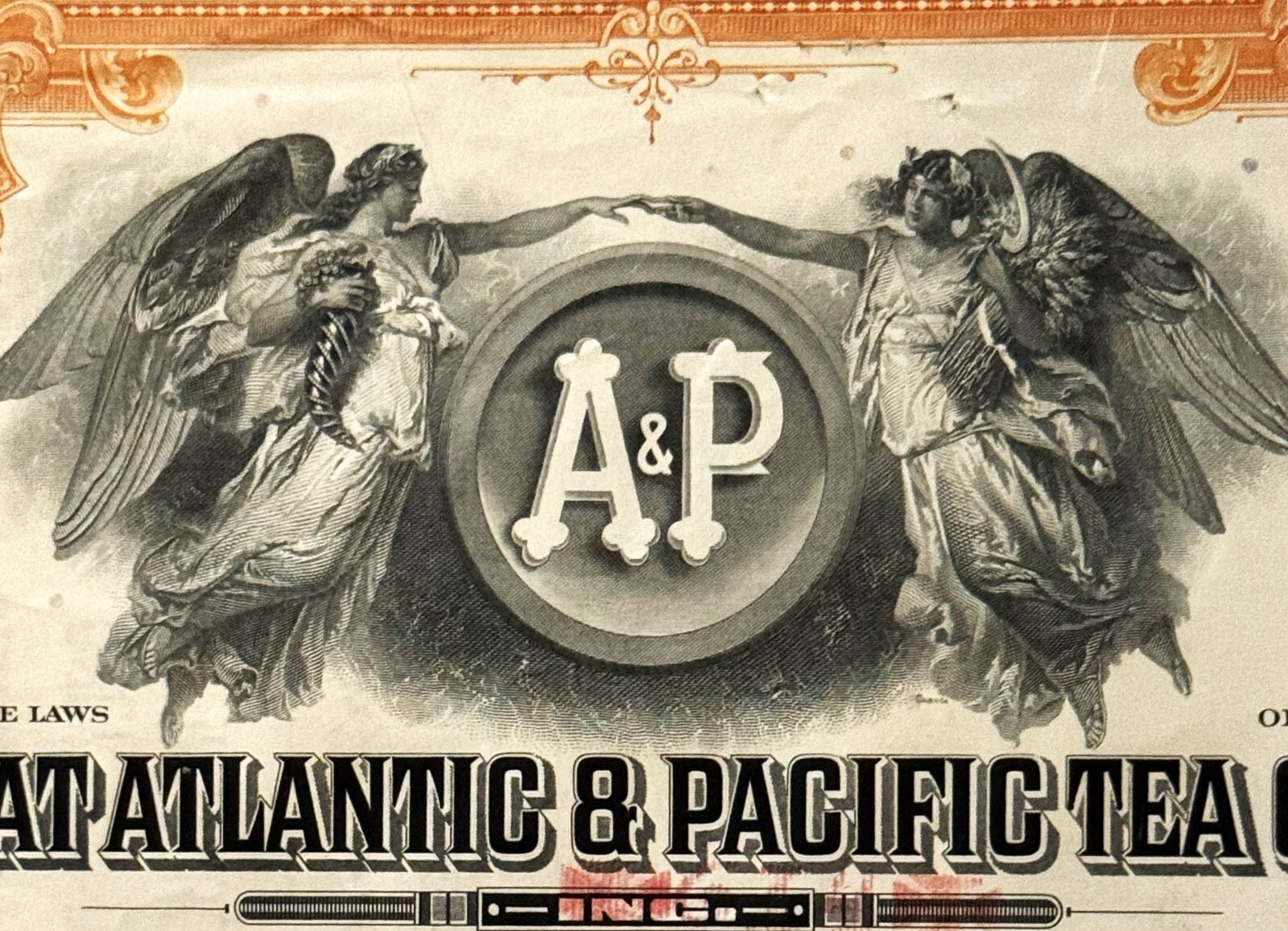
This is an original stock certificate issued by The Great Atlantic & Pacific Tea Company — universally known as A&P — incorporated under the laws of the State of Maryland, representing full-paid, non-assessable shares of common stock at a par value of $1 each. The certificate is engraved in a bold orange and cream color scheme measuring 13.5 x 9.5 inches, anchored by the company's circular A&P monogram flanked by two allegorical winged figures, with the company name set in dramatic shadowed lettering across the center. It's presented here as an original issued certificate from A&P's own share issue — countersigned, registered and punch-cancelled — never a reprint or reproduction.
🛒 A&P: From Tea Peddlers to America's Largest Retailer
The company's roots go back to 1859, when George Huntington Hartford and George Gilman began selling tea and coffee directly to consumers in New York, cutting out the wholesale middlemen who normally set the price. It was a radical idea at the time — buy direct, sell cheap, move volume — and it worked. In 1869, with the golden spike freshly driven and the transcontinental railroad connecting the nation coast to coast, the founders renamed their growing company The Great Atlantic & Pacific Tea Company, a name meant to capture the sweep of a country now linked rail to rail — and the name stuck for the next century and a half.
Under the leadership of Hartford's sons, John A. and George L. Hartford, A&P transformed from a tea-and-coffee retailer into the template for the modern American supermarket. The brothers pioneered the "economy store" model — small, no-frills, cash-and-carry locations that undercut full-service grocers on price — and expanded at a pace that's hard to overstate: from roughly 400 stores in 1912 to well over 16,000 by 1930. From 1915 through 1975, A&P was the largest grocery retailer in the United States, and until 1965 it was the largest retailer of any kind in the country — bigger than Sears, bigger than Woolworth's. At its peak in the 1940s, A&P rang up roughly one out of every ten dollars Americans spent on groceries. The Wall Street Journal later put it plainly: A&P was, in its day, as recognizable a name as McDonald's or Google is now — the Walmart of its era.
Much of that dominance came from vertical integration long before the term was fashionable. A&P ran its own bakeries, dairy processing plants, and coffee-roasting facilities, producing house brands like Eight O'Clock Coffee and Ann Page foods that stocked its own shelves at prices competitors struggled to match.
🏛️ Maryland, New York, and the Business of Being Incorporated
Like many major American corporations of the twentieth century, A&P chose to incorporate under Maryland's business-friendly statutes even though its stores, warehouses, and executive offices were rooted in New York and later New Jersey. This split between "incorporated in" and "headquartered in" was standard practice for large national chains of the era, and this certificate's printed language — "Incorporated under the laws of the State of Maryland" — reflects exactly that corporate structuring.
The financial machinery behind the certificate tells its own dating story. The certificate names The First National City Bank of New York as registrar and Guaranty Trust Company of New York as transfer agent — both real, storied Wall Street institutions. First National City Bank carried that exact name only from 1955 until its 1976 rebrand as Citibank, and Guaranty Trust Company of New York merged into J.P. Morgan & Co. in 1959 to form Morgan Guaranty Trust. Taken together, these two named institutions place certificates of this design squarely in the mid-twentieth century — a window collectors of scripophily lean on heavily, since stock issues of this era rarely carry a printed calendar date beyond the corporate seal.
That corporate seal, stamped in orange at the base of the certificate, reads "1925" — the year The Great Atlantic & Pacific Tea Company, Inc. was formally chartered in Maryland, not the year this particular certificate was printed or issued. It's a detail worth knowing, because collectors sometimes mistake a corporate seal's founding year for the certificate's print date; here, the seal commemorates the corporation's legal birth, while the certificate itself belongs to that later mid-century run of shares traded actively on the New York Stock Exchange.
🖋️ The Hartfords and the Men Behind the Monogram
George Gilman put up the capital and George Huntington Hartford ran the operation in those early tea-and-coffee days, but it was Hartford's sons — John A. Hartford and George L. Hartford — who built A&P into the retail giant this certificate represents. The brothers split duties for decades: George handled finance and real estate, John ran merchandising and stores, and together they were considered visionaries of American retail, credited with helping invent the modern chain-store supermarket model that Kroger, Safeway, and eventually Walmart would all follow.
That scale came with scrutiny. In the late 1940s, the federal government pursued an antitrust case against A&P, treating the grocer's size and buying power with the same suspicion later generations would reserve for the biggest tech and retail names of their own day — a piece of lore worth remembering when you consider just how dominant a single grocery chain once was in American commerce.
📉 The Long Goodbye — and What's Left Today
A&P's decline unfolded slowly over decades, as suburban supermarkets, regional chains, and eventually big-box retailers chipped away at the dominance the Hartford brothers had built. Ownership changed hands, banners were folded together, and after a string of reorganizations and two separate bankruptcy filings, A&P closed its remaining stores in 2015 — bringing a retail run of more than 150 years to its end. For collectors and old-timers alike, that closure turned everyday paperwork like this stock certificate into something more: a tangible, engraved artifact of a company that once shaped how an entire nation bought its groceries.
🎨 The Engraving: Angels, a Cornucopia, and the A&P Monogram
The artwork itself is classic Gilded Age-to-mid-century corporate engraving. Two winged, classically draped female figures face one another across the top of the certificate, clasping hands over a circular medallion — one figure cradles a cornucopia spilling grain, a fitting emblem of abundance for a company built on feeding the nation. Between them sits the company's monogram, "A&P," rendered in bold Gothic-style block lettering raised against a shaded medallion background. Below, the company name runs in dramatic dimensional lettering, and the whole certificate is framed in a dense orange border of scrollwork, cartouches, and fine guilloche patterning typical of the security printing craft of its day. The engraving carries the hallmark of the American Bank Note Company, one of the preeminent security printers in American history, whose engravers produced currency, bonds, and certificates for many of the nation's largest corporations and institutions.
🖼️ Display Ideas
- 🖼️ Framed on its own as a bold piece of orange-toned graphic art for a kitchen or dining room wall
- 🏪 Paired with vintage grocery advertising, produce crate labels, or old A&P packaging for a themed retail-history wall
- 🏢 Displayed in a home office or den alongside other scripophily as a study in mid-century American corporate design
- 🎓 Used as a teaching piece for anyone interested in retail history, antitrust history, or the story of the American supermarket
- 🎁 Given as a milestone or retirement gift to a grocery industry veteran, finance professional, or collector of Americana
🎁 Who Collects These
Scripophily collectors — those who collect antique stock and bond certificates for their engraving, history, and provenance — actively seek out A&P certificates as blue-chip pieces of American retail and financial history. Because A&P was, for decades, one of the largest and most recognizable companies in the country, its certificates draw interest well beyond dedicated scripophilists: collectors of grocery and supermarket memorabilia, Americana and advertising art enthusiasts, and anyone with a personal or family connection to the old A&P stores all gravitate toward these pieces as an affordable, display-worthy way to own a slice of that history.
❓ FAQ
Is this an original certificate or a reproduction?
This is an original, genuine issued A&P stock certificate from the company's own share issue, not a reprint.
What size is the certificate?
It measures 13.5 x 9.5 inches (approximately 34.3 x 24.1 cm).
Was this certificate ever registered to a shareholder or does it still have value as stock?
A&P ceased operations in 2015 and its shares no longer trade; certificates like this one are collected today purely for their historical and decorative value, not as active securities.
How old is this certificate exactly?
The certificate itself carries no single printed calendar date, but the named registrar and transfer agent tie its design to the mid-twentieth century — roughly the mid-1950s through the mid-1970s, based on the documented naming history of those institutions.
What does the "1925" on the seal mean?
That's the year The Great Atlantic & Pacific Tea Company, Inc. was formally incorporated in Maryland — the corporate seal commemorates the company's legal charter date, not the year this certificate was printed.
Who printed the certificate?
The engraving bears the hallmark of the American Bank Note Company, a leading American security printer of currency, bonds, and stock certificates for major corporations of the era.
Does the certificate come framed?
It's offered as the certificate itself, ready for you to frame and display however suits your space.
These are issued instruments rather than blanks. Certificates of this type were filled in for a holder in ink, countersigned by the transfer agent and registered by the registrar, then punch- or cut-cancelled when they were redeemed and retired. Expect financial writings, markings, stamps, hole punches and staple holes as part of the life of the instrument: endorsements and signatures, transfer-agent and registrar stamps, revenue or documentary tax stamps, cancellation punches, staple holes from being bound into a transfer book, pencil ledger notations. That is the paper trail of a security that actually did its job, and it is what separates a document that lived from a blank that never did. No two are alike: holder details, serial numbers, dates, signatures, stamps and punch patterns vary from example to example, so the photographs show the type rather than the exact sheet that ships.