When you click on links to various merchants on this site and make a purchase, this can result in this site earning a commission. Affiliate programs and affiliations include, but are not limited to, the eBay Partner Network.
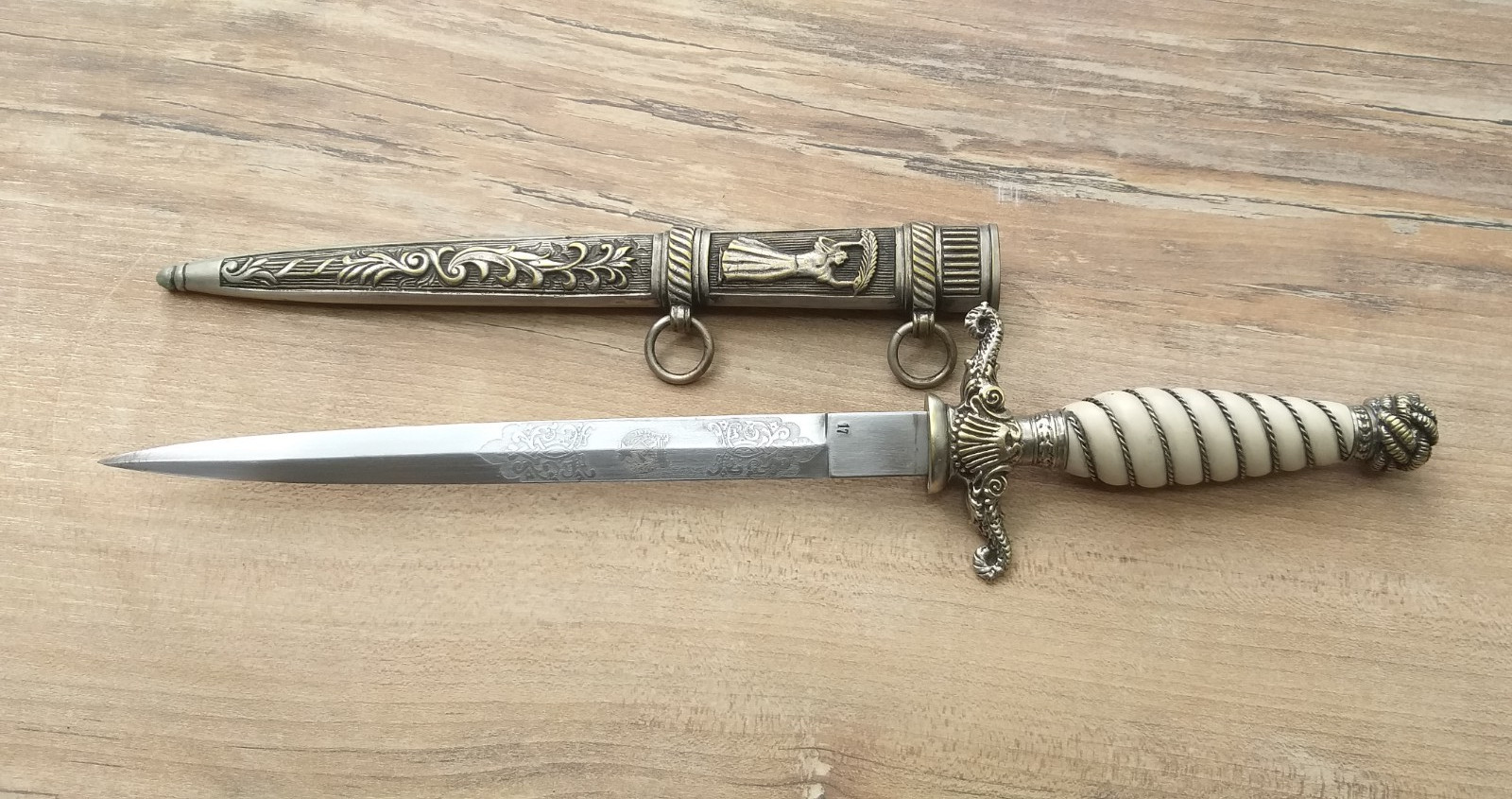
Rare and interesting "Liberation of Hungary" political presentation dagger, Soviet expansion era.
Awarded to Hungarian minister József Révai shortly after Stalin’sdeath in 1953.
Révai (1898–1959) was a prominent Jewish-Hungarian communistleader, writer, and cultural ideologue, best known for shaping Hungary’scultural and intellectual life during the Stalinist period under Mátyás Rákosi.
Born into a Jewish family, Révai became involved inleft-wing politics early in life and participated in the short-lived HungarianSoviet Republic. After its collapse, he spent years in exile, during which hedeepened his commitment to Marxist ideology and developed his skills as awriter and theorist.
Following World War II, Révai returned to Hungary with thecommunists’ rise to power. As a leading member of the Hungarian CommunistParty, he became the chief architect of cultural policy during the late 1940sand early 1950s. In this role, he enforced strict ideological control overliterature, arts, and education, promoting socialist realism and suppressingdissenting or non-conforming voices. His influence made him one of the mostpowerful cultural figures of the so-called Rákosi era, arguably the darkestperiod in modern Hungarian history.
Révai’s policies contributed to the broader system ofpolitical repression characteristic of the time, aligning Hungary closely withSoviet models under Joseph Stalin.
In the early 1950s, József Révai reached the height of hispower and influence, becoming one of the central figures shaping Hungary’sintellectual and cultural life under the Stalinist system of Mátyás Rákosi.
As Minister of People’s Education (from 1949) and a leadingideologue of the party, Révai exercised tight control over cultural production.He was the principal enforcer of socialist realism in Hungary, insisting thatliterature, art, and scholarship serve political and ideological goals.Writers, artists, and academics were expected to depict reality through aMarxist-Leninist lens, emphasizing class struggle, the heroism of workers, andloyalty to the party. Any deviation from this line—whether “bourgeois,”“formalistic,” or insufficiently ideological—was harshly criticized or outrightbanned.
Révai played a direct role in orchestrating cultural purges.Publishing houses, theaters, universities, and research institutions wereplaced under strict supervision. Intellectuals who failed to conform weremarginalized, silenced, or removed from their positions. He also influenced therewriting of school curricula and textbooks to align with party doctrine,ensuring that education became a key tool of ideological indoctrination.
A defining feature of his activity in this period was hisinvolvement in show trials and political campaigns against “deviation.” Whilehe was not a judicial figure, his ideological authority helped justifycampaigns targeting perceived enemies within the party and society, such asduring the climate surrounding the László Rajk trial. Révai’s rhetoricreinforced the idea that ideological purity was essential, contributing to abroader atmosphere of fear and conformity.
He also engaged in literary criticism and public debates,often attacking prominent Hungarian writers and thinkers for insufficientideological commitment. His speeches and essays set the tone for cultural life,effectively determining what was acceptable and what was not. In this sense, hefunctioned not only as a policymaker but as a gatekeeper of intellectuallegitimacy.
By the early 1950s, Révai was widely seen as the chiefcultural authority of the regime—sometimes described as its “culturalcommissar.” However, after the death of Joseph Stalin in 1953 and thesubsequent shift toward a more moderate line, his rigid Stalinist approach cameunder criticism. Reformist tendencies within the party, associated with figureslike Imre Nagy, led to a gradual erosion of his influence, marking thebeginning of his political decline.
Overall, Révai’s activities were defined by systematicideological control, institutional restructuring, and the suppression of independentcultural expression—making him one of the key architects of Hungary’s Stalinistcultural system.
However, after Stalin’s death and the subsequent politicalthaw, Révai’s influence declined. He was gradually sidelined from power asreforms began to challenge the rigid Stalinist framework he had helpedestablish.
In 1953, József Révai was still formally one of the leadingcultural and ideological figures in Hungary, but this year marked a clearturning point in his career.
Up to that point, he had been serving as Minister ofPeople’s Education and as the chief architect of Stalinist cultural policyunder Mátyás Rákosi. However, the death of Joseph Stalin in March 1953triggered major political shifts across the Eastern Bloc, including in Hungary.
Under pressure from Moscow, the Hungarian leadership wasforced to adopt a “New Course,” which aimed to soften the harshest aspects ofStalinist rule. In July 1953, Imre Nagy became prime minister and beganimplementing reforms—reducing repression, easing economic pressures, andallowing somewhat greater intellectual flexibility.
This shift directly undermined Révai’s position. His rigid,dogmatic approach to culture and education—centered on strict ideologicalcontrol and socialist realism—was increasingly seen as excessive andpolitically damaging. As a result:
He lost his ministerial post in 1953, stepping down asMinister of People’s Education.
It is believed that this honor dagger was his farewellpresent from the prime minister.
Although he remained a member of the party leadership (thePolitical Committee), his influence declined sharply.
His role as the regime’s chief cultural authority waseffectively weakened, as the new leadership sought a less repressive culturalclimate.
Révai did not disappear from politics immediately; hecontinued to defend orthodox Stalinist positions and remained aligned withRákosi’s hardline faction. However, 1953 marked the beginning of hismarginalization, as the political climate moved—at least temporarily—away fromthe strict ideological control he had championed.
In short, during 1953 Révai transitioned from being thedominant cultural policymaker of the regime to a figure whose authority wasincreasingly questioned and curtailed amid broader post-Stalin reforms.
He died in 1959, leaving behind a controversial legacy asboth an influential intellectual and a central figure in one of the mostrepressive periods of modern Hungarian history.
The dagger:
The main motive on the dagger is the Hungarian LibertyStatue or Freedom Statue, which is a monument standing on the Gellért Hill inBudapest, Hungary.
It commemorates “those who sacrificed their lives for theindependence, freedom, and prosperity of Hungary”.
The statue was erected in 1947 in remembrance of what wasthen referred to as the Soviet liberation of Hungary during World War II, whichended the occupation by Nazi Germany. Its location upon Gellért Hill makes it aprominent feature of Budapest's cityscape.
The 14 m tall bronze statue stands atop a 26 m pedestal andholds a palm leaf.
At the time of the monument's construction, the defeat ofAxis forces by the Red Army was officially proclaimed “liberation” – a jumpfrom the pan into the fire.
The original inscription upon the memorial can be translatedto read, "To the memory of the liberating Soviet heroes [erected by] thegrateful Hungarian people [in] 1945".
During the Rákosi era this model of dress dagger was awarded mainly to political ormilitary figures who contributed either to the Soviet occupation of Hungary in1945 or to the establishment of the subsequent communist regime during the 1950’s. That’smost cynical. In reality the people who received these daggers were actually tearing down liberty and democracy in Hungary. The newly established bolshevik and communist regime brought a total lack of liberty to the people of Hungary.