When you click on links to various merchants on this site and make a purchase, this can result in this site earning a commission. Affiliate programs and affiliations include, but are not limited to, the eBay Partner Network.
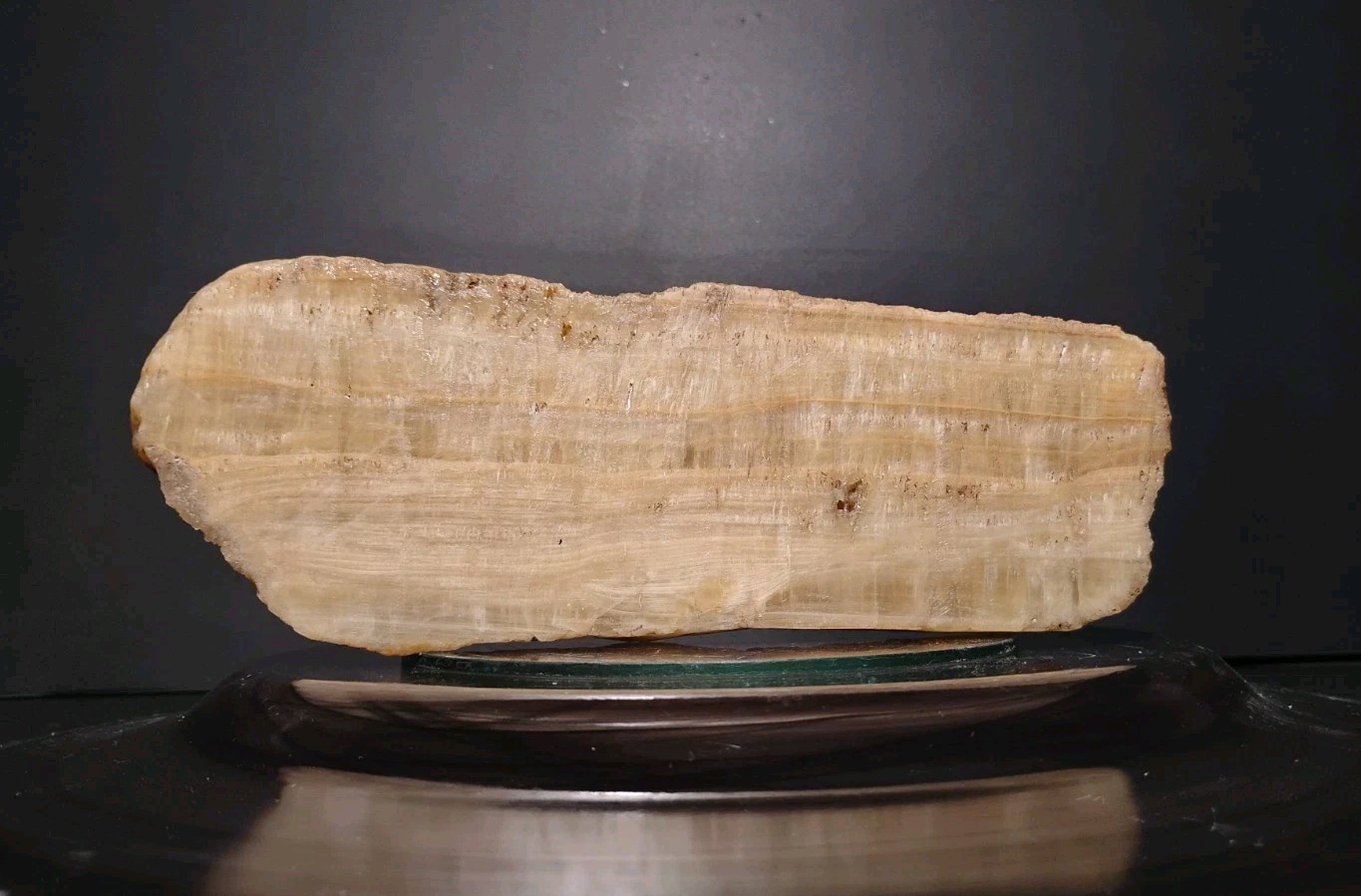
Dimensions:
Weight: 1 lb 10.8 oz
Travertine is a form of limestone composed primarily of
calcium carbonate
minerals, specifically calcite and aragonite.
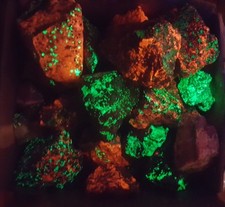
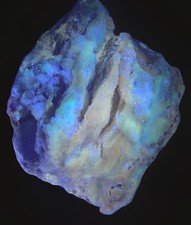
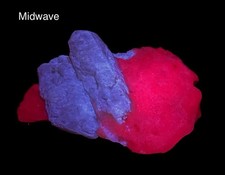
It \"glows\" (fluoresces) under ultraviolet (UV) light due to the presence of trace impurities known as \"activators\" within its crystal structure.
Travertine is a chemical sedimentary rock formed by the rapid precipitation of calcium carbonate from the water of natural mineral springs, particularly hot springs. While pure travertine would be white, it often contains various impurities, such as iron oxides, manganese, and organic compounds, which give it a range of natural earthy colors like beige, tan, cream, yellow, brown, or rust tones.
The \"Glow\" (Fluorescence)
The glowing phenomenon, known as fluorescence, occurs when the mineral is exposed to UV light:
Excitation: The UV light is absorbed by the \"activator\" impurities in the travertine\'s atomic structure, exciting their electrons to a higher energy orbit.Emission: When these electrons fall back to their original, lower energy level, they release energy as a different wavelength of light, which is in the visible spectrum. This is the \"glow\" we see.
- The specific color of the glow (which can range from pink, red, or orange to blue, green, or white) depends on the specific type of activator impurity present and its concentration. Common activators include certain metal cations or rare earth elements; conversely, impurities like iron can sometimes dampen or eliminate the fluorescence. Travertine may also exhibit phosphorescence, which means it continues to glow for a short time after the UV light source is removed, like glow-in-the-dark materials.