When you click on links to various merchants on this site and make a purchase, this can result in this site earning a commission. Affiliate programs and affiliations include, but are not limited to, the eBay Partner Network.
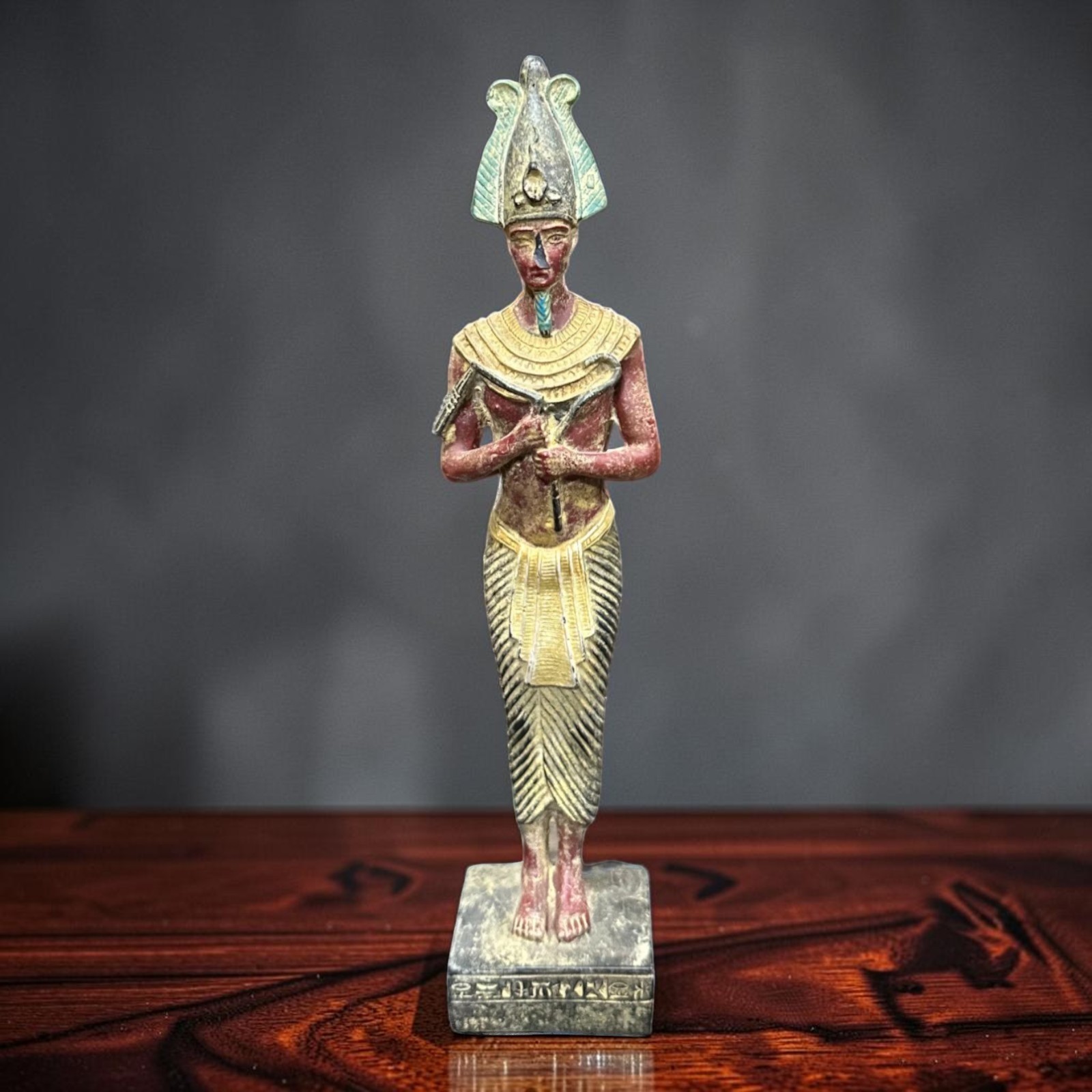
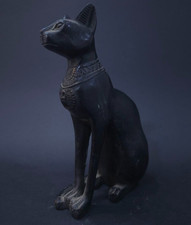
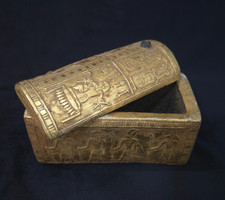
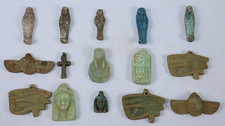
Ancient Egyptian Statue God Osiris Rare Antique Pharaonic Mythology Unique BCDescription
Osiris is one of ancient Egypt’s most important and enduring gods — ruler of the afterlife, judge of the dead, and symbol of fertility, resurrection, and the cycle of life. The myths about him evolved over centuries and vary by region, but below is the classic, widely attested version of the Osiris story and its religious meaning.
Who is Osiris?
Role: God of the dead and king of the underworld (the Duat); also associated with vegetation, fertility, and renewal. He represents the promise of rebirth after death.Family: Son of the sky goddess Nut and the earth god Geb (in many versions). Brother and husband of Isis; brother of Set (Seth), Nephthys, and sometimes Horus is portrayed as his son.The basic myth (damnation, murder, resurrection)
Osiris as kingOsiris was a wise and just king who brought civilization, law, agriculture, and prosperity to Egypt. Under his rule crops grew, people prospered, and order prevailed.Jealousy and betrayal by SetSet, the god of chaos, desert, and violence, envied Osiris’s power and popularity. Seeking to overthrow him, Set plotted murder.In the familiar account, Set made a beautiful, ornamented wooden chest (or a golden sarcophagus) and announced that he would give it to anyone who fit it perfectly. Osiris lay down in the chest to demonstrate, and Set’s conspirators slammed the lid, sealed it (often with molten lead), and threw it into the Nile. The chest carried Osiris away downriver and out to sea.Isis’s search and griefIsis, Osiris’s devoted wife and sister, searched tirelessly for his body. She traveled across Egypt and beyond, gathering clues and overcoming obstacles. Her sister Nephthys often assists.The chest eventually washed ashore and became embedded or entombed in a tree (often a tamarisk or sycamore) that grew around it. In some versions the tree is cut down and used as a pillar in the palace of the foreign king (sometimes identified as Byblos). When the chest was discovered by the foreign king, he refused to return it; the chest remained in the palace.Recovery and a new betrayalIsis used magic and cunning to recover Osiris’s body (sometimes with the help of her son Horus or the god Thoth). She brought the body back to Egypt and hid it.In some tellings, Set discovered the hidden body, dismembered it into pieces, and scattered the pieces across the land to prevent resurrection. Isis then again searched for and gathered the dispersed parts, reassembling him. In other versions the first murder already included dismemberment.Resurrection by Isis and ThothIsis, using powerful magic and with help from Thoth (and sometimes Anubis), reassembled and magically restored Osiris. This restoration was not complete in the mortal world: Osiris became ruler of the afterlife rather than returning to rule the living kingdom. In many versions Isis conceived a son, Horus, through divine means after reanimating Osiris.Osiris as king of the deadOsiris’s resurrection made him the archetypal dead king and lord of the Duat. He presides over the judgment of the deceased: in funerary texts and tomb scenes, the hearts of the dead are weighed against the feather of Maat (order/truth) before Osiris and a panel of gods.Osiris’s role became central to Egyptian funerary religion because his victory over death provided hope that the deceased could be reborn and enjoy eternal life.Horus and the vengeance / kingship struggle
Horus, son of Isis and Osiris, grows to challenge Set for the kingship of Egypt. Their long struggle — involving battles, trials before the gods, and magical contests — ends (in many versions) with Horus victorious and recognized as rightful king.This struggle symbolizes the restoration of order (Maat) over chaos (Set), continuity of kingship, and legitimate succession. Egyptian pharaohs identified with Horus in life and were associated with Osiris in death.Religious practice and symbolism
Osiris cult: Widespread in Egypt from the Middle Kingdom onward. Abydos (the cult center) became a major pilgrimage site; many Egyptians sought to be buried near Abydos to be close to Osiris and share in his resurrection.Festivals: The Osiris Mysteries (often staged at Abydos) reenacted his death and resurrection, allowing participants to ritually identify with Osiris’s death and hope for rebirth.Funerary texts and imagery: Coffins, mortuary spells, and temple reliefs frequently depict Osiris and scenes of his resurrection. The funerary “Book of the Dead” and earlier Pyramid and Coffin Texts elaborate his role in the afterlife.Iconography: Osiris is usually shown as a mummified king — wrapped from head to toe, holding the crook and flail (symbols of kingship), wearing the Atef crown (white crown with ostrich feathers), and sometimes green- or black-skinned (colors symbolizing rebirth, vegetation, or fertility).Meanings and themes
Death and rebirth: Osiris personifies death that leads to regeneration; agricultural cycles (seed dying in the ground and sprouting) were linked to his myth.Legitimate kingship: His story underpins the idea that kingship is divine and that order must be restored after chaos.Magic and devotion: Isis’s devotion and magical skill emphasize the power of loyalty, love, and ritual to overcome death.Moral and cosmic order: The triumph of Horus (and the judgment under Osiris) reassert the importance of Maat — cosmic truth, balance, and justice.Variations and later developments
Different temples and local traditions offered variations in detail (how Osiris died, how he was recovered, and how the afterlife court functioned).In Late Period and Greco-Roman times, Osiris’s worship continued and syncretized with Greek beliefs; Osiris was sometimes linked with Dionysus and other Hellenistic deities, and his mysteries influenced Mediterranean religious thought.Legacy
Osiris is one of the best-known Egyptian gods in modern culture, appearing in literature, film, art, and New Age thought. Scholarly study emphasizes his central religious role in giving ancient Egyptians a coherent vision of death, judgment, and hope for rebirth.Size : Height: 22 cm.Our Guarantee 👌
That the Item Will Delivered to You As Shown in Pictures Therefore we recommend that you see the picture well and then take your decision and take your responsibility.
Shipment ✈️ :
DHL Fast Shipping 4-12 Days with track number - We Offer Combine Shipping 📦
Returns : 🔁I check myself each product and sell only the best quality products. In any case, if you are not satisfied with the product, first, please contact me and I will do everything to your 💯 satisfaction.