When you click on links to various merchants on this site and make a purchase, this can result in this site earning a commission. Affiliate programs and affiliations include, but are not limited to, the eBay Partner Network.
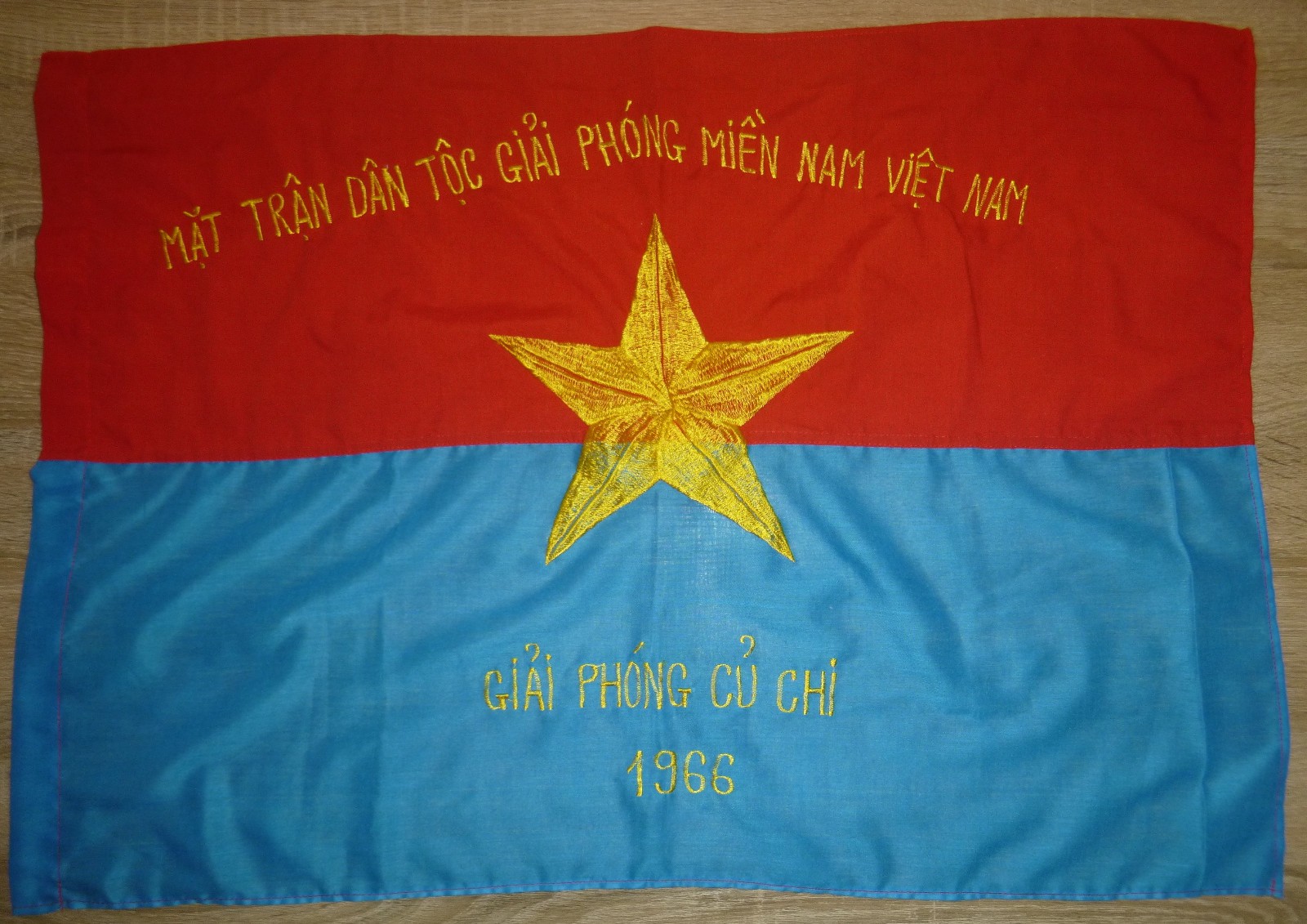
Measures - 29 x21 inches (75 x 54 cms) Excellent PieceNLF, NVA, VC - Viet Cong / National Liberation FrontCu Chi 1966
In 1966, Củ Chi District, northwest of Saigon in Bình Dương Province, was one of the most heavily contested areas of South Vietnam and a major Viet Cong base complex. It lay within Military Region 4 and formed part of the Iron Triangle–Củ Chi operational zone, used by communist forces to threaten Saigon directly.
Viet Cong forces in the area were primarily from the VC 272nd and 273rd Regiments of the VC 9th Division, supported by the Củ Chi District Battalion, local-force companies, and extensive guerrilla and political cadre networks. These units operated from a dense system of underground tunnels, bunkers, and base camps extending across Củ Chi, Hóc Môn, and Trảng Bàng. Strength in the wider area was several thousand VC personnel, though rarely concentrated above battalion level.
VC activity in 1966 focused on ambushes, mining, sniper attacks, and mortar fire against U.S. and ARVN units, particularly along Route 1, Route 15, and approaches to Saigon. The tunnel system allowed forces to survive heavy bombardment, store weapons, move unseen, and conduct repeated attacks close to major allied bases.
U.S. forces operating in Củ Chi included the 25th Infantry Division, which established its division headquarters at Củ Chi Base Camp in early 1966. Major operations during the year included Operation Crimp in January 1966, which exposed the scale of the tunnel system, and Operation Cedar Falls in early 1967, which was prepared by sustained 1966 pressure operations.
Despite large-scale sweeps, artillery, airstrikes, and defoliation, VC forces avoided decisive engagement and continued to operate.
By the end of 1966, Củ Chi remained an active Viet Cong base area.
Although VC units suffered losses, their infrastructure survived, and the district continued to serve as a key staging area for attacks against Saigon, including preparations for the Tet Offensive in 1968 and beyond.
NLF - National Liberation Front
The Việt Cộng, also known as the NationalLiberation Front (NLF), was a communist political organization with its ownarmy – the People's Liberation Armed Forces of South Vietnam (PLAF) – in SouthVietnam and Cambodia that fought the United States and South Vietnamesegovernments, eventually emerging on the winning side
It had both guerrilla and regular army units,as well as a network of cadres who organized peasants in the territory itcontrolled. Many soldiers were recruited in South Vietnam, but others wereattached to the People's Army of Vietnam (PAVN), the regular North Vietnamesearmy.
During the war, communists and anti-waractivists insisted the Việt Cộng was an insurgency indigenous to the South,while the U.S. and South Vietnamese governments portrayed the group as a toolof Hanoi. Although the terminology distinguishes northerners from thesoutherners, communist forces were under a single command structure set up in1958.
North Vietnam established the NationalLiberation Front on December 20, 1960, to grow insurgency in the South. Many ofthe Việt Cộng's core members were volunteer "regroupees", southern ViệtMinh who had resettled in the North after the Geneva Accord (1954).
Hanoi gave the regroupees military training andsent them back to the South along the Ho Chi Minh trail in the early 1960s.
The NLF called for southern Vietnamese to"overthrow the camouflaged colonial regime of the Americanimperialists" and to make "efforts toward the peacefulunification".
The People's Liberation Armed Forces of SouthVietnam (PLAF)'s best-known action was the Tet Offensive, a massive assault onmore than 100 South Vietnamese urban centers in 1968, including an attack onthe U.S. embassy in Saigon.
The offensive riveted the attention of theworld's media for weeks, but also overextended the Việt Cộng. Later communistoffensives were conducted predominantly by the North Vietnamese. Theorganization was dissolved in 1976 when North and South Vietnam were officiallyunified under a communist government.
For your kindConsideration.