 1965 THE TYMES Soul Group Concert Contract Signed Club A Go-Go Pennsylvania R&B For Sale
When you click on links to various merchants on this site and make a purchase, this can result in this site earning a commission. Affiliate programs and affiliations include, but are not limited to, the eBay Partner Network.

1965 THE TYMES Soul Group Concert Contract Signed Club A Go-Go Pennsylvania R&B:
$400.00
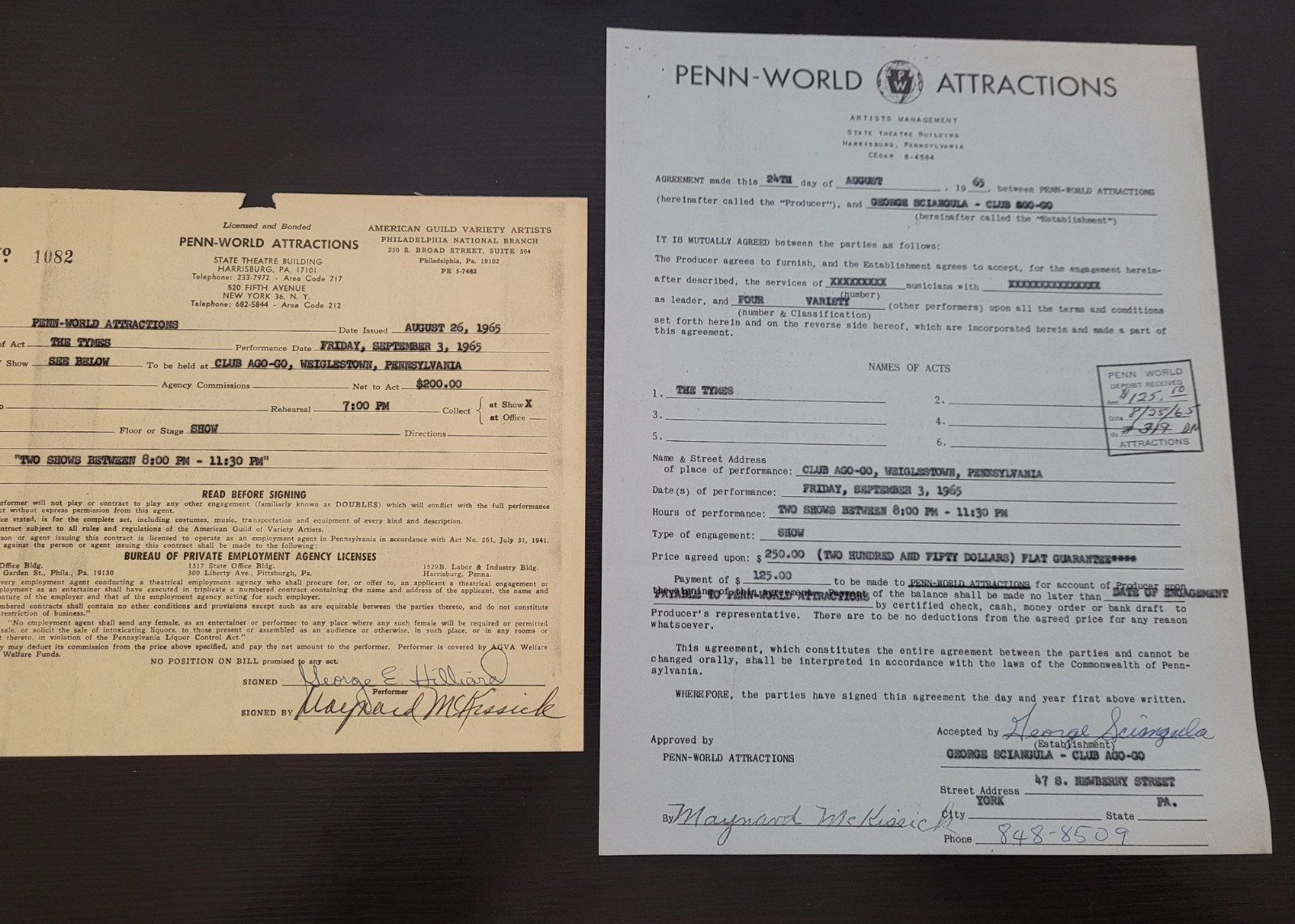
This is an incredible piece of music history involving The Tymes, a prominent Philadelphia soul/doo-wop group famous for their 1963 #1 hit \"So Much in Love.\" Authentic 1965 Concert Performance Contract – The Tymes at Club A Go-Go Up for sale is a rare, original two-page booking contract and agreement for the legendary soul group The Tymes. Dated August 24 & 26, 1965, this document captures a moment in the mid-60s R&B circuit in Pennsylvania. The contract is issued by Penn-World Attractions and features original signatures. Historical Context & Bios The Tymes: A quintessential \"Philly Soul\" group. By the time of this 1965 contract, they were international stars following their 1963 chart-topper \"So Much in Love\" and their hit cover of \"Wonderful! Wonderful!\". This contract represents their active touring period during the height of the Motown and British Invasion era. Club A Go-Go: Located in Weiglestown, PA (near York), this was a notable regional venue during the \"Go-Go\" craze of the 1960s. Maynard McKissick: A prominent regional booking agent and manager who headed Penn-World Attractions. George Sciangula: The proprietor of Club A Go-Go and a local figure in the Pennsylvania entertainment scene.
Full Transcription: Page 1 (Front) Document A: Penn-World Attractions Letterhead (Left) Agency: Penn-World Attractions, State Theatre Building, Harrisburg, PA. Branch: American Guild Variety Artists, Philadelphia National Branch. Date Issued: August 26, 1965 Name of Act: THE TYMES Place: Club A Go-Go, Weiglestown, Pennsylvania Net to Act: $200.00 Rehearsal: 7:00 PM Show Time: \"Two Shows Between 8:00 PM - 11:30 PM\" Signed: George E. Hilliard (Performer) & Maynard McKissick (Agent)
Document B: Formal Agreement (Right) Agreement Date: 24th day of August, 1965. Parties: Penn-World Attractions (Producer) and George Sciangula - Club A Go-Go (Establishment). Price Agreed Upon: $250.00 (Two Hundred and Fifty Dollars) Flat Guarantee. Payment: $125.00 deposit / $125.00 balance due date of engagement. Signed: Maynard McKissick (Approved) & George Sciangula (Accepted). Address: 47 S. Newberry Street, York, PA. Phone: 848-8509.
Full Transcription: Page 2 (Reverse) Heading: The Laws of the Commonwealth of Pennsylvania Provide as follows... Includes sections from the Division of Private Employment Agency Licenses, Act No. 261, July 31, 1941. Key Clauses: Terms and Provisions: The establishment shall not record, reproduce, or transmit performances without written consent. Philly Soul, Doo-Wop, 1960s Music Memorabilia, Original Contract, Autograph, The Tymes Band, Rhythm and Blues, Pennsylvania History, Music Business Ephemera, Vintage Concert Poster Era, Motown Era.
The Tymes are an American soul vocal group who enjoyed equal success in the United Kingdom and in their homeland. They are one of the few acts to have one chart-topper in both the US and UK with different songs.[1]
Early careerThe group was formed in Philadelphia, Pennsylvania, in 1956 as the Latineers, by Donald Banks (bass), Albert Berry (first tenor), Norman Burnett (baritone), and George Hilliard (second tenor).[2] After a four-year stint on Philadelphia\'s club circuit, they recruited a new lead vocalist, George Williams in 1960, and changed their name to the Tymes.[2]The Tymes had hits in the UK in the 1960s with songs such as \"So Much in Love\", a US chart-topper and million-seller in 1963,[3] \"Wonderful! Wonderful!\" (a remake of the Johnny Mathis hit from 1957), \"Somewhere\", then in the 1970s with \"You Little Trustmaker\" and \"Ms Grace\". The last of these became the group\'s biggest UK hit, reaching number one on the UK Singles Chart in 1975,[3] but barely dented the Billboard Hot 100, long after the success of \"So Much in Love\".[4] \"Ms Grace\", while only charting modestly in the US, was and remains a regional hit with the Carolina Beach Music scene. By 1976, Albert Berry and George Hilliard had been replaced with female singers Terri Gonzales and Melanie Moore. Gonzales later recorded a solo album with Nile Rodgers while Moore worked as session vocalist with Kleeer and artists such as Chaka Khan.The Tymes were also the Jewels (obviously not to be confused with the R&B girl group the Jewels), as in Billy Abbott and the Jewels, whose only Hot 100 and Cashbox Top 100 entry was \"Groovy Baby\" in July 1963.[5][6]In 1963, American Bandstand signed the Tymes to Dick Clark\'s Caravan of Stars national US tour.[7]
Later careerIn 1980, a single, \"Brothers And Sisters\" bw \"Louise\" was released in the UK on Hammer HS 311. It was credited to The Tymes Featuring George Williams. The A side was very much in the Drifters\' UK period vein.[8]Their song \"So Much in Love\" was elected to the Songs of the Century in 2001. In 2005, the Tymes were inducted into the Vocal Group Hall of Fame.[9] The Tymes continue to perform with surviving original members Berry and Burnett. The group appeared on the 2003 PBS special My Music: Love Songs of the 50s and 60s, one of the last times all five original members performed live.
Deceased members George Williams - born George Reginald Williams Jr, December 6, 1935, Philadelphia — died July 28, 2004, Maple Shade, New Jersey - lead vocals[9]
Donald Banks - died October 7, 2011, aged 72 - bass[10][11]
George Hilliard - died September 24, 2014, age 73 - second tenor[12]Discography
Studio albums
Year Album Chart positions
US 200
[4] US R&B
[4]
1963 So Much in Love 15 —
1964 The Sound of the Wonderful Tymes 117 —
Somewhere 122 —
1969 People — —
1974 Trustmaker — 46
1976 Turning Point — —
Tymes Up — 40
1977 Diggin\' Their Roots — —
\"—\" denotes releases that did not chart.
1960s singles
Year Single (A-side, B-side)
Both sides from same album except where indicated Chart positions Album
US Hot 100
[4] US R&B
[4] US Adult
[4] UK
[3][13]
1963 \"So Much in Love\"
b/w \"Roscoe James McClain\" (Non-album track) 1 4 — 21 So Much in Love
\"Wonderful! Wonderful!\"
b/w \"Come With Me to the Sea\" (from The Sound of the Wonderful Tymes and Somewhere) 7 23 2 —
\"Somewhere\"
b/w \"View from My Window\" (from Tymes Biggest Hits) 19 — — — Somewhere
\"Isle of Love\"
b/w \"I\'m Always Chasing Rainbows\" — — — —
1964 \"To Each His Own\"
b/w \"Wonderland of Love\" 78 — — — Non-album tracks
\"The Magic of Our Summer Love\"
b/w \"With All My Heart\" 99 — — —
\"Here She Comes\"
b/w \"Malibu\" 92 — — —
\"The Twelfth of Never\"
b/w \"Here She Comes\" (Non-album track) — — — — So Much in Love
1966 \"Pretend\"
b/w \"Street Talk\" — — — — Non-album tracks
\"A Touch of Baby\"
b/w \"What Would I Do\" — — — —
1967 \"This Time It\'s Love\"
b/w \"These Foolish Things (Remind Me of You)\" — — — —
1968 \"People\"
b/w \"For Love of Ivy\" 39 33 — 16 People
1969 \"God Bless the Child\"
b/w \"The Love That You\'re Looking For\"
(Ain\'t Gonna Find It Here) — — — —
\"If You Love Me Baby\"
b/w \"Find My Way\" — — — — Non-album track
\"—\" denotes releases that did not chart or were not released in that territory.
1970s singles
Year Single (A-side, B-side)
Both sides from same album except where indicated Chart positions Certifications Album
US Hot 100
[4] US R&B
[4] AUS
[14] UK
[3][13]
1970 \"Most Beautiful Married Lady\"
b/w \"Love Child\" — — — — Non-album tracks
1971 \"She\'s Gone\"
b/w \"Someone to Watch Over Me\" — — — —
1974 \"You Little Trustmaker\"
b/w \"The North Hills\" 12 20 57 18 Trustmaker
\"Ms Grace\"
b/w \"The Crutch\" 91 75 59 1 BPI: Silver[15]1975 \"Someway, Somehow I\'m Keepin\' You\"
b/w \"Interloop!\" — — — —
\"God\'s Gonna Punish You\"
b/w \"If I Can\'t Make You Smile\" — — — 41 Tymes Up
1976 \"It\'s Cool\"
b/w \"Good Morning Dear Lord\" 68 3 — —
\"Only Your Love\"
b/w \"Goin\' Through the Motions\" — — — —
\"Savannah Sunny Sunday\"
b/w \"Love\'s Illusion\" — — — — Turning Point
1977 \"How Am I to Know (The Things a Girl in Love Should Know)\"
b/w \"I\'ll Take You There\" — — — — Diggin\' Their Roots
\"—\" denotes releases that did not chart or were not released in that territory.
See also List of artists who reached number one in the United States
List of artists who reached number one in Ireland
List of artists who reached number one on the UK Singles Chart
List of performers on Top of the PopsSoul music is a popular music genre that originated in African-American communities throughout the United States in the late 1950s and early 1960s.[2] Catchy rhythms, stressed by handclaps and extemporaneous body movements, are an important hallmark of soul. Other characteristics are a call and response between the lead and backing vocalists, an especially tense vocal sound, and occasional improvisational additions, twirls, and auxiliary sounds.[3] Soul music is known for reflecting African-American identity and stressing the importance of African-American culture.Soul has its roots in African-American gospel music and rhythm and blues,[4] and primarily combines elements of gospel, R&B and jazz.[5] The genre emerged from the power struggle to increase black Americans\' awareness of their African ancestry, as a newfound consciousness led to the creation of music that boasted pride in being black.[6][7] Soul music became popular for dancing and listening, and American record labels such as Motown, Atlantic and Stax were influential in its proliferation during the civil rights movement. Soul also became popular worldwide, directly influencing rock music and the music of Africa.[8] It had a resurgence in the mid-to late 1990s with the subgenre neo soul,[9] which incorporated modern production elements and hip-hop influences.Soul music dominated the U.S. R&B charts in the 1960s, and many recordings crossed over into the pop charts in the United States, United Kingdom, and elsewhere. Many prominent soul artists, including Ray Charles, Sam Cooke, Otis Redding, James Brown, Aretha Franklin, and various acts under the Motown label, such as the Supremes and the Temptations, were highly influential in the genre\'s development and all gained widespread popularity during this time.[10] By 1968, the soul music genre had begun to splinter. Some soul artists moved to funk music, while other singers and groups developed slicker, more sophisticated, and in some cases more socially conscious varieties.[11] By the early 1970s, soul music had begun to absorb influences from psychedelic rock and progressive rock, among other genres, leading to the creation of psychedelic soul and progressive soul. Prominent soul artists of this era include Marvin Gaye, Jackson 5, Stevie Wonder, Curtis Mayfield, Isaac Hayes, Al Green, and Bill Withers. Neo soul, which adopted hip-hop influences, developed around 1994.Other subgenres of soul include the \"Motown sound\", a more rhythmic and pop-friendly style that originated from the eponymous label; Southern soul, a driving, energetic variety combining R&B with southern gospel music influences;[12] Memphis soul, a shimmering, sultry style; New Orleans soul, which emerged from the rhythm and blues style; Chicago soul, a lighter gospel-influenced sound; and Philadelphia soul, a lush orchestral variety with doo-wop-inspired vocals.
History
Origins
Ray Charles pioneered the soul music genre during the 1950s by combining blues, rhythm and blues, and gospel styles.Soul music has its roots in traditional African-American gospel music and rhythm and blues and as the hybridization of their respective religious and secular styles – in both lyrical content and instrumentation – that began in the 1950s. The term \"soul\" had been used among African-American musicians to emphasize the feeling of being an African American in the United States.[13] According to musicologist Barry Hansen,[14] Though this hybrid produced a clutch of hits in the R&B market in the early 1950s, only the most adventurous white fans felt its impact at the time; the rest had to wait for the coming of soul music in the 1960s to feel the rush of rock and roll sung gospel-style.James Brown was known as the \"Godfather of Soul\".[15]According to AllMusic, \"Soul music was the result of the urbanization and commercialization of rhythm and blues in the \'60s.\"[16] The phrase \"soul music\" itself, referring to gospel-style music with secular lyrics, was first attested in 1961.[17] The term \"soul\" in African-American parlance has connotations of African-American pride and culture. Gospel groups in the 1940s and \'50s occasionally used the term as part of their names. The jazz style that originated from gospel became known as soul jazz. As singers and arrangers began using techniques from both gospel and soul jazz in African-American popular music during the 1960s, soul music gradually functioned as an umbrella term for African-American popular music at the time.[18][19]
Sam Cooke is regarded as one of soul music\'s \"forefathers\".According to the Acoustic Music Organization, the \"first clear evidence of soul music shows up with the \"5\" Royales, an ex-gospel group that turned to R&B and in Faye Adams, whose \"Shake A Hand\" becomes an R&B standard\".[20]Important innovators whose recordings in the 1950s contributed to the emergence of soul music included Clyde McPhatter, Hank Ballard, and Etta James.[14] Ray Charles is often cited as popularizing the soul music genre with his series of hits, starting with 1954\'s \"I Got a Woman\".[21] Singer Bobby Womack said, \"Ray was the genius. He turned the world onto soul music.\"[11] Charles was open in acknowledging the influence of Pilgrim Travelers vocalist Jesse Whitaker on his singing style.Little Richard, who inspired Otis Redding,[22] and James Brown both were equally influential. Brown was nicknamed the \"Godfather of Soul Music\",[15] and Richard proclaimed himself as the \"King of Rockin\' and Rollin\', Rhythm and Blues Soulin\'\", because his music embodied elements of all three, and since he inspired artists in all three genres.[23]Sam Cooke and Jackie Wilson also are often acknowledged as soul forefathers.[11][24] Cooke became popular as the lead singer of the gospel group the Soul Stirrers, before controversially moving into secular music. His recording of \"You Send Me\" in 1957 launched a successful pop music career. Furthermore, his 1962 recording of \"Bring It On Home to Me\" has been described as \"perhaps the first record to define the soul experience\".[25] Jackie Wilson, a contemporary of both Cooke and James Brown, also achieved crossover success, especially with his 1957 hit \"Reet Petite\".[26] He even was particularly influential for his dramatic delivery and performances.[27]
1960s
Solomon Burke recorded for Atlantic Records in the 1960s.Husband-wife duo Ike & Tina Turner emerged as \"leading exponents\" of soul music in the 1960s.[28][29] Their debut single \"A Fool in Love\" crossed over to the pop charts in 1960. They earned a Grammy nomination for their song \"It\'s Gonna Work Out Fine\" in 1962.[30] Along with the Kings of Rhythm and the Ikettes, they toured the Chitlin’ Circuit as the Ike & Tina Turner Revue.[31]Writer Peter Guralnick is among those to identify Solomon Burke as a key figure in the emergence of soul music, and Atlantic Records as the key record label. Burke\'s early 1960s songs, including \"Cry to Me\", \"Just Out of Reach (of My Two Open Arms)\" and \"Down in the Valley\" are considered classics of the genre. Guralnick wrote: Soul started, in a sense, with the 1961 success of Solomon Burke\'s \"Just Out of Reach\". Ray Charles, of course, had already enjoyed enormous success (also on Atlantic), as had James Brown and Sam Cooke — primarily in a pop vein. Each of these singers, though, could be looked upon as an isolated phenomenon; it was only with the coming together of Burke and Atlantic Records that you could begin to see anything even resembling a movement.[32]Aretha Franklin is widely known as the \"Queen of Soul\".Ben E. King also achieved success in 1961 with \"Stand by Me\", a song directly based on a gospel hymn.[11] By the mid-1960s, the initial successes of Burke, King, and others had been surpassed by new soul singers, including Stax artists such as Otis Redding and Wilson Pickett, who mainly recorded in Memphis, Tennessee, and Muscle Shoals, Alabama. According to Jon Landau: Between 1962 and 1964 Redding recorded a series of soul ballads characterized by unabashedly sentimental lyrics usually begging forgiveness or asking a girlfriend to come home... He soon became known as \"Mr. Pitiful\" and earned a reputation as the leading performer of soul ballads.[33]The most important female soul singer to emerge was Aretha Franklin, originally a gospel singer who began to make secular recordings in 1960 but whose career was later revitalized by her recordings for Atlantic. Her 1967 recordings, such as \"I Never Loved a Man (The Way I Love You)\", \"Respect\" (written and originally recorded by Otis Redding), and \"Do Right Woman, Do Right Man\" (written by Chips Moman and Dan Penn), were significant and commercially successful recordings.[34][35][36][37]Soul music dominated the U.S. African-American music charts in the 1960s, and many recordings crossed over into the pop charts in the U.S. Otis Redding was a huge success at the Monterey International Pop Festival in 1967.[11] The genre also became highly popular in the UK, where many leading acts toured in the late 1960s. \"Soul\" became an umbrella term for an increasingly wide variety of R&B-based music styles – from the dance and pop-oriented acts at Motown Records in Detroit, such as the Temptations, Marvin Gaye and Stevie Wonder, to \"deep soul\" performers such as Percy Sledge and James Carr.[38][39][40] Different regions and cities within the U.S., including New York City, Detroit, Chicago, Memphis, New Orleans, Philadelphia, and Muscle Shoals, Alabama (the home of FAME Studios and Muscle Shoals Sound Studios) became noted for different subgenres of the music and recording styles.[16][41]By 1968, while at its peak of popularity, soul began to fragment into different subgenres. Artists such as James Brown and Sly and the Family Stone evolved into funk music, while other singers such as Marvin Gaye, Stevie Wonder, Curtis Mayfield and Al Green developed slicker, more sophisticated and in some cases more politically conscious varieties of the genre.[11] However, soul music continued to evolve, informing most subsequent forms of R&B from the 1970s-onward, with pockets of musicians continuing to perform in traditional soul style.[16]
1970s and 1980s
Marvin Gaye shifted to a socially conscious sound with his 1971 hit \"What\'s Going On\".Mitchell\'s Hi Records continued in the Stax tradition of the previous decade, releasing a string of hits by Green, Ann Peebles, Otis Clay, O. V. Wright and Syl Johnson.[42] Bobby Womack, who recorded with Chips Moman in the late 1960s, continued to produce soul recordings in the 1970s and 1980s.[43][44]In Detroit, producer Don Davis worked with Stax artists such as Johnnie Taylor and the Dramatics.[45] Early 1970s recordings by the Detroit Emeralds, such as Do Me Right, are a link between soul and the later disco style.[46] Motown Records artists such as Marvin Gaye, Michael Jackson, Stevie Wonder and Smokey Robinson contributed to the evolution of soul music, although their recordings were considered more in a pop music vein than those of Redding, Franklin and Carr.[38] Although stylistically different from classic soul music, recordings by Chicago-based artists are often considered part of the genre.[47]By the early 1970s, soul music had been influenced by psychedelic rock and other genres.[48] Artists like James Brown led soul towards funk music, which became typified by 1970s bands like Parliament-Funkadelic and the Meters.[49] More versatile groups such as War, the Commodores, and Earth, Wind and Fire became popular around this time.[50] During the 1970s, some slick and commercial blue-eyed soul acts like Philadelphia\'s Hall & Oates and Oakland\'s Tower of Power achieved mainstream success, as did a new generation of street-corner harmony or \"city-soul\" groups such as the Delfonics and the historically black Howard University\'s Unifics.[51][52]The syndicated music/dance variety television series Soul Train, hosted by Chicago native Don Cornelius, debuted in 1971.[53] The show provided an outlet for soul music for several decades, also spawning a franchise that saw the creation of a record label (Soul Train Records) that distributed music by the Whispers, Carrie Lucas, and an up-and-coming group known as Shalamar.[54] Numerous disputes led to Cornelius spinning off the record label to his talent booker, Dick Griffey, who transformed the label into Solar Records, itself a prominent soul music label throughout the 1980s.[54] The TV series continued to air until 2006, although other predominantly African-American music genres such as hip-hop began overshadowing soul on the show beginning in the 1980s.[55]
BeyondAs disco and funk musicians had hits in the late 1970s and early 1980s, soul went in the direction of quiet storm. With its relaxed tempos and soft melodies, quiet storm soul took influences from fusion and adult contemporary. Some funk bands, such as EW&F, the Commodores and Con Funk Shun would have a few quiet storm tracks on their albums. Among the most successful acts in this era include Smokey Robinson, Jeffry Osbourne, Peabo Bryson, Chaka Khan, and Larry Graham.After the decline of disco and funk in the early 1980s, soul music became influenced by electro music. It became less raw and more slickly produced, resulting in a style that is known as contemporary R&B, which sounded very different from the original rhythm and blues style. The United States saw the development of neo-soul around 1994.
Notable labels and producers
Motown Records
Levi Stubbs singing lead with the Four Tops in 1966.
icon
This section needs additional citations for verification. Please help improve this article by adding citations to reliable sources in this section. Unsourced material may be challenged and removed. (May 2014) (Learn how and when to remove this message)
Main article: Motown RecordsBerry Gordy\'s successful Tamla/Motown group of labels was notable for being African American owned, unlike most of the earlier independent R&B labels. Notable artists under this label were Gladys Knight & the Pips, the Supremes, the Temptations, the Miracles, the Four Tops, the Marvelettes, Mary Wells, Jr. Walker & the All-Stars, Stevie Wonder, Marvin Gaye, Tammi Terrell, Martha and the Vandellas,[56] and the Jackson 5.Hits were made using a quasi-industrial \"assembly line\" approach. The producers and songwriters brought artistic sensitivity to the three-minute tunes. Brian Holland, Lamont Dozier and Eddie Holland were rarely out of the charts for their work as songwriters and record producers for the Supremes, the Four Tops and Martha and the Vandellas.[56] They allowed important elements to shine through the dense musical texture. The rhythm was emphasized by handclaps or tambourine. Smokey Robinson was another writer and record producer who added lyrics to \"The Tracks of My Tears\" by his group the Miracles, which was one of the most important songs of the decade.
Stax Records and Atlantic Records
Main articles: Stax Records and Atlantic RecordsStax Records and Atlantic Records were independent labels that produced high-quality dance records featuring many well-known singers of the day.[57] They tended to have smaller ensembles marked by expressive gospel-tinged vocals. Brass and saxophones were also used extensively.[58][page needed] Stax Records, founded by siblings Estelle and James Stewart, was the second most successful record label behind Motown Records. They were responsible for releasing hits by Otis Redding, Wilson Pickett, the Staple Singers, and many more.[59] Ahmet Ertegun, who had anticipated being a diplomat until 1944 when his father died, founded Atlantic Records in 1947 with his friend Herb Abramson. Ertegun wrote many songs for Ray Charles and the Clovers. He even sang backup vocals for his artist Big Joe Turner on the song \"Shake, Rattle and Roll\".[60]
Subgenres
Detroit (Motown)
Further information: MotownDominated by Berry Gordy\'s Motown Records empire, Detroit\'s soul is strongly rhythmic and influenced by gospel music. The Motown sound often includes hand clapping, a powerful bassline, strings, brass and vibraphone. Motown Records\' house band was the Funk Brothers. AllMusic cites Motown as the pioneering label of pop-soul, a style of soul music with raw vocals, but polished production and toned-down subject matter intended for pop radio and crossover success.[61] Artists of this style included Diana Ross, the Jackson 5, Stevie Wonder, and Billy Preston.[61] Popular during the 1960s, the style became glossier during the 1970s and led to disco.[61] In the late 2000s, the style was revisited by contemporary soul singers such as Amy Winehouse,[62] Raphael Saadiq (specifically his 2008 album The Way I See It) and Solange Knowles (her 2008 album Sol-Angel and the Hadley St. Dreams).[63]
Deep and Southern
Soul singer Otis Redding was known to be an electrifying stage presence.
Further information: Southern soulThe terms \"deep soul\" and \"Southern soul\" generally refer to a driving, energetic soul style combining R&B\'s energy with pulsating southern United States gospel music sounds. Memphis, Tennessee, label Stax Records nurtured a distinctive sound, which included putting vocals further back in the mix than most contemporary R&B records, using vibrant horn parts in place of background vocals, and a focus on the low end of the frequency spectrum. The vast majority of Stax releases were backed by house bands Booker T. & the M.G.\'s (with Booker T. Jones, Steve Cropper, Duck Dunn, and Al Jackson) and the Memphis Horns (the splinter horn section of the Mar-Keys, trumpeter Wayne Jackson and saxophonist Andrew Love).
Memphis
Further information: Memphis soulMemphis soul is a shimmering, sultry style of soul music produced in the 1960s and 1970s at Stax Records[57] and Hi Records in Memphis, Tennessee. It featured melancholic and melodic horns, Hammond organ, bass, and drums, as heard in recordings by Hi\'s Al Green and Stax\'s Booker T. & the M.G.\'s. The latter group also sometimes played in the harder-edged Southern soul style. The Hi Records house band (Hi Rhythm Section) and producer Willie Mitchell developed a surging soul style heard in the label\'s 1970s hit recordings. Some Stax recordings fit into this style but had their own unique sound.
New Orleans
icon
This section does not cite any sources. Please help improve this section by adding citations to reliable sources. Unsourced material may be challenged and removed. (January 2009) (Learn how and when to remove this message)
Further information: New Orleans soulThe New Orleans soul scene directly came out of the rhythm and blues era, when such artists as Little Richard, Fats Domino, and Huey \"Piano\" Smith made a huge impact on the pop and R&B charts and a huge direct influence on the birth of funk music. The principal architect of Crescent City\'s soul was songwriter, arranger, and producer Allen Toussaint. He worked with such artists as Irma Thomas (\"the Soul Queen of New Orleans\"), Jessie Hill, Chris Kenner, Benny Spellman, and Ernie K-Doe on the Minit/Instant label complex to produce a distinctive New Orleans soul sound that generated a passel of national hits. Other notable New Orleans hits came from Robert Parker, Betty Harris, and Aaron Neville. While record labels in New Orleans largely disappeared by the mid-1960s, producers in the city continued to record New Orleans soul artists for other mainly New York City and Los Angeles–based record labels—notably Lee Dorsey for New York-based Amy Records and the Meters for New York–based Josie Records and then LA-based Reprise Records.
Chicago
Further information: Chicago soulChicago soul generally had a light gospel-influenced sound, but the large number of record labels based in the city tended to produce a more diverse sound than other cities. Vee Jay Records, which lasted until 1966, produced recordings by Jerry Butler, Betty Everett, Dee Clark, and Gene Chandler. Chess Records, mainly a blues and rock and roll label, produced several major soul artists, including the Dells and Billy Stewart. Curtis Mayfield not only scored many hits with his group, the Impressions, but wrote many hit songs for Chicago artists and produced hits on his own labels for the Fascinations, Major Lance, and the Five Stairsteps.
Philadelphia
Further information: Philadelphia soulBased primarily in the Philadelphia International record label, Philadelphia soul (or Philly soul) had lush string and horn arrangements and doo-wop-inspired vocals. Thom Bell, and Kenneth Gamble & Leon Huff are considered the founders of Philadelphia soul, which produced hits for Patti LaBelle, the O\'Jays, the Intruders, the Three Degrees, the Delfonics, the Stylistics, Harold Melvin & the Blue Notes, and the Spinners.
Progressive
Isaac Hayes performing in 1973
Main article: Progressive soulBy the 1970s, African-American popular musicians had drawn from the conceptual album-oriented approach of the then-burgeoning progressive rock development. This progressive-soul development inspired a newfound sophisticated musicality and ambitious lyricism in black pop.[64] Among these musicians were Sly Stone, Stevie Wonder, Marvin Gaye, Curtis Mayfield, and George Clinton.[65] In discussing the progressive soul of the 1970s, Martin cites this period\'s albums from Wonder (Talking Book, Innervisions, Songs in the Key of Life), War (All Day Music, The World Is a Ghetto, War Live), and the Isley Brothers (3 + 3).[66] Isaac Hayes\'s 1969 recording of \"Walk On By\" is considered a \"classic\" of prog-soul, according to City Pages journalist Jay Boller.[67] Later prog-soul music includes recordings by Prince,[68] Peter Gabriel,[69] Meshell Ndegeocello, Joi,[70] Bilal, Dwele, Anthony David,[71] Janelle Monáe,[72] and the Soulquarians, an experimental black-music collective active during the late 1990s and early 2000s.[73]
Psychedelic
Main article: Psychedelic soulPsychedelic soul, sometimes known as \"black rock\", was a blend of psychedelic rock and soul music in the late 1960s, which paved the way for the mainstream emergence of funk music a few years later.[74] Early pioneers of this subgenre of soul music include Jimi Hendrix, Sly and the Family Stone, Norman Whitfield, and Isaac Hayes.[75] While psychedelic rock began its decline, the influence of psychedelic soul continued on and remained prevalent through the 1970s.[76][failed verification]
British
Adele performing in 2016
Main article: British soulIn the early 1960s, small soul scenes began popping up around the UK. Liverpool in particular had an established black community from which artists such as Chants and Steve Aldo emerged and go on to record within the British music industry. As a result, many recordings were commercially released by British soul acts during the 1960s which were unable to connect with the mainstream market.[77] Nevertheless, soul has been a major influence on British popular music since the 1960s including bands of the British Invasion, most significantly the Beatles.[78] There were a handful of significant British blue-eyed soul acts, including Dusty Springfield and Tom Jones.[79] In the 1970s Carl Douglas, the Real Thing and Delegation[80] had hits in the UK. American soul was extremely popular among some youth sub-cultures like the mod, Northern soul and modern soul movements, but a clear genre of British soul did not emerge until the 1980s when several artists including George Michael, Sade, Simply Red, Lisa Stansfield and Soul II Soul enjoyed commercial success.[81] The popularity of British soul artists in the U.S., most notably Amy Winehouse, Adele, Estelle, Duffy, Joss Stone and Leona Lewis, led to talk of a \"Third British Invasion\" or \"British Soul Invasion\" in the 2000s and 2010s.[82][83]
Neo
Further information: Neo soulNeo soul is a blend of 1970s soul-style vocals and instrumentation with contemporary R&B sounds, hip-hop beats, and poetic interludes. The style was developed in the early to mid-1990s, and the term was coined in the early 1990s by producer and record label executive Kedar Massenburg. A key element in neo-soul is a heavy dose of Fender Rhodes or Wurlitzer electronic piano \"pads\" over a mellow, grooving interplay between the drums (usually with a rim shot snare sound) and a muted, deep funky bass. The Fender Rhodes piano sound gives the music a warm, organic character.Notable artists include Jill Scott, Lauryn Hill, Aloe Blacc and Erykah Badu. Newer artists like H.E.R. and SZA are also influenced by neo soul.
Northern
Further information: Northern soulNorthern soul is a music and dance movement that emerged in the late 1960s out of the British mod subculture in Northern England and the English Midlands, based on a particular style of soul music with a heavy beat and fast tempo. The phrase northern soul was coined by a journalist Dave Godin and popularised through his column in Blues and Soul magazine.[84] The rare soul records were played by DJs at nightclubs, and included obscure 1960s and early 1970s American recordings with an uptempo beat, such as those on Motown and smaller labels, not necessarily from the Northern United States.
Nu jazz and other influenced electronica
Further information: Nu jazz and ElectronicaMany artists in various genres of electronic music (such as house, drum and bass, UK garage, and downtempo) are heavily influenced by soul, and have produced many soul-inspired compositions.
See also flagUnited States portalR&B and Soul Music portal Neo soul
List of soul musicians
Funk
Disco
African-American musicThe Tymes were a Philadelphia A cappella group who reached the height of their popularity in the 1960s. They included baritone Norman Burnett, born May 5, 1943, tenor Albert Alexander Berry III born March 17, 1941; bass Donald Banks, born October 29, 1939; tenor George Hilliard born 1941, and tenor George Reginald Williams Jr, born on December 6, 1935. They formed in 1956 as an ensemble called the Latineers as they believed they had a Latin sound. The Latineers started getting a local reputation after appearing on a talent contest hosted by Philadelphia radio station, WDAS called “The Tip Top Talent Hour” later in 1956.By 1960, the quintet added other members as some of the original members dropped away. By the point the members included baritone Russell Gore, Jr., baritone Lafayette Gamble, baritone Billy Jackson, baritone Dave James, principal tenor Charles Nixon, bass Ron Richardson, tenor Jimmy Wells, soprano Melanie Moore, contralto Terri Gonzalez, and soprano Isabelle Coles.In 1963, the president of Cameo-Parkway Records selected the name “The Tymes” and recorded the A cappella single, “So Much in Love.” The single went to no.1 on the pop charts and remained charted for 15 weeks. It also reached no. 4 on R&B and stayed up for 10 weeks indicating ironically that the group had more success with non-black audiences than with African Americans. It also peaked at no. 21 in the United Kingdom and eventually sold more than a million copies. They followed up with their debut album also called, So Much in Love, which reached no. 16 on Billboard 200 albums. A second album, Somewhere, Followed Quickly and peaked at no. 122 on the album chart. The group was sought after and performed on Dick Clark’s television show, American Bandstand.In 1964, their single, “Wonderful! Wonderful!” peaked at no.7 on the pop chart. It was included in their third album, The Sound of The Wonderful Tymes, which reached no.117. After going four years without a single or album, the Thymes in 1968 signed with Columbia Records. Their first release with Columbia was the hit, “People,” from the musical, Funny Girl, which peaked at no. 39.RCA Records signed The Tymes in 1974. During this period, the group released “You Little Trustmaker” (1974) which reached no. 12 on the Billboard pop charts and no. 18 in the United Kingdom. Also, in 1974 the single, “Ms. Grace” was released but peaked at no. 91 on the Billboard charts. While “Ms. Grace” did not fare well in the United States, it rose to no. 1 in the United Kingdom. Two years later, in 1976, “It’s Cool” reached no. 68 and “God’s Gonna Punish You” charted at no. 41 and was the last song by the group to hit the Billboard charts.In 2001, “So Much In Love” was elected to the Songs of the Century list and four years later the Tymes were inducted into the Vocal Group Hall of Fame in Sharon, Pennsylvania.Donald Banks died on October 7, 2011, at age 72. George Reginald Williams Jr died on July 28, 2004, at age 68 and lead vocalist George Hilliard died on September 24, 2014, age 73.Within two decades, The Tymes released eight albums, and their music continues to be played and performed globally especially the smooth Philadelphia A cappella sound.Philadelphia (/ˌfɪləˈdɛlfiə/ ⓘ FIL-ə-DEL-fee-ə), colloquially referred to as Philly, is the most populous city in the U.S. state of Pennsylvania.[11] It is the sixth-most populous city in the United States with a population of 1.6 million at the 2020 census, while the Philadelphia metropolitan area (sometimes called the Delaware Valley) with 6.33 million residents is the nation\'s ninth-largest metropolitan area.[12] Philadelphia is known for its culture, cuisine, and history, maintaining contemporary influence in business and technology, sports, and music.[13][14]Philadelphia was founded in 1682 by William Penn, an English Quaker and advocate of religious freedom, and served as the capital of the colonial era Province of Pennsylvania.[3][15] It then played a vital role during the American Revolution and Revolutionary War. It served as the central meeting place for the nation\'s Founding Fathers in hosting the First Continental Congress (1774) and the Second Continental Congress, during which the Founders formed the Continental Army, elected George Washington as its commander, and adopted the Declaration of Independence on July 4, 1776. During the Revolutionary War\'s Philadelphia campaign, the city fell to the British Army, which occupied Philadelphia for nine months from September 1777 to June 1778.[16] Following the end of the Revolutionary War, the U.S. Constitution was ratified at the Philadelphia Convention. Philadelphia remained the nation\'s largest city until 1790, and it served as the nation\'s first capital from May 10, 1775, until December 12, 1776, and on four subsequent occasions until 1800, when construction of the new national capital in Washington, D.C. was completed.[17]With 17 four-year universities and colleges in the city, Philadelphia is one of the nation\'s leading centers for higher education and academic research.[18][19] The city hosts more outdoor sculptures and murals than any other city in the nation.[20][21] Fairmount Park, when combined with adjacent Wissahickon Valley Park in the same watershed, has an area of 2,052 acres (830 ha), representing one of the nation\'s largest urban parks and the world\'s 55th largest.[22] With five professional sports teams and one of the nation\'s most loyal and passionate fan bases, Philadelphia is often ranked as the nation\'s best city for professional sports fans.[23][24][25][26] The city has a culturally and philanthropically active LGBTQ+ community. Philadelphia also has played an influential historic and ongoing role in the development and evolution of American music, especially R&B, soul, and rock.[27][28]As of 2023, the Philadelphia metropolitan area had a gross metropolitan product of US$557.6 billion[9] and is home to 13 Fortune 500 corporate headquarters.[29] Metropolitan Philadelphia ranks as one of the nation\'s Big Five venture capital hubs, facilitated by its proximity to both the financial ecosystems of New York City and the regulatory environment of Washington, D.C.[30] Metropolitan Philadelphia is also a biotechnology hub and has garnered the nickname \"Cellicon Valley\" for its central role in the development of immunotherapies to treat different cancers.[31] The Philadelphia Stock Exchange, owned by Nasdaq since 2008, is the nation\'s oldest stock exchange and a global leader in options trading.[32] 30th Street Station, the city\'s primary rail station, is the third-busiest Amtrak hub in the nation with over 4.1 million passengers in 2023. The city\'s multimodal transportation and logistics infrastructure includes Philadelphia International Airport,[33] the PhilaPort seaport,[34] and Interstate 95, a primary component of the north–south highway system along the U.S. East Coast.Philadelphia is a city of many firsts, including the nation\'s first library (1731),[35] hospital (1751),[35] medical school (1765),[36] national capital (1774),[37] university (by some accounts) (1779),[38] central bank (1781),[39] stock exchange (1790),[35] zoo (1874),[40] and business school (1881).[41] Philadelphia contains 67 National Historic Landmarks, including Independence Hall.[42][43][19] From the city\'s 17th century founding through the present, Philadelphia has been the birthplace of or home to many prominent and influential Americans.
History
Main article: History of Philadelphia
For a chronological guide, see Timeline of Philadelphia.
See also: List of National Historic Landmarks in Philadelphia and National Register of Historic Places listings in Philadelphia
Native peoplesPrior to the arrival of Europeans in the early 17th century, the Lenape, an Indian tribe also known as the Delaware Indians, lived in the village of Shackamaxon in present-day Philadelphia and the surrounding area.[44] The Lenape historically lived along the Delaware River watershed, western Long Island, and the Lower Hudson Valley.[a] Most Lenape were pushed out of the region during the 18th century as the original Thirteen Colonies expanded, which was further exacerbated by losses from intertribal conflicts.[44] Lenape communities were also weakened by newly introduced diseases, mainly smallpox, and conflicts with Europeans. The Iroquois occasionally fought the Lenape. Surviving Lenape moved west into the upper Ohio River basin. Following the American Revolutionary War and the subsequent establishment of the United States, the Lenape began moving further west. In the 1860s, the U.S. federal government sent most remaining Lenape in the eastern United States to the Indian Territory in present-day Oklahoma and surrounding territories as part of the Indian removal policy.
Colonial era
William Penn (holding paper) and King Charles II depicted in The Birth of Pennsylvania 1680, a portrait by Jean Leon Gerome Ferris
William Penn\'s 1682 Treaty of Shackamaxon with the Lenape tribe depicted in Penn\'s Treaty with the Indians, a 1772 portrait by Benjamin West
A Portraiture of the City of Philadelphia, by Thomas Holme
A 1683 portrait of Philadelphia by Thomas Holme, believed to be the city\'s first mapEuropeans first entered Philadelphia and the surrounding Delaware Valley in the early 17th century. The first settlements were founded by Dutch colonists, who built Fort Nassau on the Delaware River in 1623 in what is now Brooklawn, New Jersey. The Dutch considered the entire Delaware River valley to be part of their New Netherland colony. In 1638, Swedish settlers led by renegade Dutch established the colony of New Sweden at Fort Christina, located in present-day Wilmington, Delaware, and quickly spread out in the valley. In 1644, New Sweden supported the Susquehannocks in their war against Maryland colonists.[45] In 1648, the Dutch built Fort Beversreede on the west bank of the Delaware, south of the Schuylkill River near the present-day Eastwick section of Philadelphia, to reassert their dominion over the area. The Swedes responded by building Fort Nya Korsholm, or New Korsholm, named after a town in Finland with a Swedish majority.In 1655, a Dutch military campaign led by New Netherland Director-General Peter Stuyvesant took control of the Swedish colony, ending its claim to independence. The Swedish and Finnish settlers continued to have their own militia, religion, and court, and to enjoy substantial autonomy under the Dutch. An English fleet captured the New Netherland colony in 1664, though the situation did not change substantially until 1682, when the area was included in William Penn\'s charter for Pennsylvania.[46]In 1681, in partial repayment of a debt, Charles II of England granted Penn a charter for what would become the Pennsylvania colony. Despite the royal charter, Penn bought the land from the local Lenape in an effort to establish good terms with the Native Americans and ensure peace for the colony.[47] Penn made a treaty of friendship with Lenape chief Tammany under an elm tree at Shackamaxon, in what is now the city\'s Fishtown neighborhood.[3] Penn named the city Philadelphia, which is Greek for \'brotherly love\', derived from the Ancient Greek terms φίλος phílos (\'beloved, dear\') and ἀδελφός adelphós (\'brother, brotherly\'). There were a number of cities named Philadelphia (Φιλαδέλφεια) in the Eastern Mediterranean during the Greek and Roman periods, including modern Alaşehir, mentioned as the site of an early Christian congregation in the Book of Revelation. As a Quaker, Penn had experienced religious persecution and wanted his colony to be a place where anyone could worship freely. This tolerance, which exceeded that of other colonies, led to better relations with the local native tribes and fostered Philadelphia\'s rapid growth into America\'s most important city.[48]Penn planned a city on the Delaware River to serve as a port and place for government. Hoping that Philadelphia would become more like an English rural town instead of a city, Penn laid out roads on a grid plan to keep houses and businesses spread far apart with areas for gardens and orchards.The city\'s inhabitants did not follow Penn\'s plans, however, and instead crowded the present-day Port of Philadelphia on the Delaware River and subdivided and resold their lots.[49] Before Penn left Philadelphia for the final time, he issued the Charter of 1701 establishing it as a city. Though poor at first, Philadelphia became an important trading center with tolerable living conditions by the 1750s. Benjamin Franklin, a leading citizen, helped improve city services and founded new ones that were among the first in the nation, including a fire company, library, and hospital.A number of philosophical societies were formed, which were centers of the city\'s intellectual life, including the Philadelphia Society for Promoting Agriculture (1785), the Pennsylvania Society for the Encouragement of Manufactures and the Useful Arts (1787), the Academy of Natural Sciences (1812), and the Franklin Institute (1824).[50] These societies developed and financed new industries that attracted skilled and knowledgeable immigrants from Europe.
American Revolution
See also: Pennsylvania in the American Revolution and Philadelphia campaign
The Committee of Five presenting their draft of the Declaration of Independence in Independence Hall on June 28, 1776, depicted in an 1818 painting by John Trumbull; historian Joseph Ellis called the Declaration \"the most potent and consequential words in American history.\"[51]
President\'s House on Market Street served as the presidential mansion for the nation\'s first two presidents, George Washington and John Adams, from 1790 to 1800 prior to the completion of the White House and the development of Washington, D.C. as the nation\'s new capital.
Independence Hall on Chestnut Street between 5th and 6th streets, where the Declaration of Independence was signed and the Constitution was ratified, on July 4, 1776, and June 21, 1788, respectivelyPhiladelphia\'s importance and central location in the colonies made it a natural center for America\'s revolutionaries. By the 1750s, Philadelphia surpassed Boston as the largest city and busiest port in British America, and the second-largest city in the entire British Empire after London.[52][53] In 1774, as resentment of the British government\'s policies towards the colonies and support for independence began burgeoning in the colonies, Philadelphia hosted the First Continental Congress at Carpenters\' Hall, and 12 of the original 13 colonies sent delegates to the Congress.From 1775 to 1781, Philadelphia hosted the Second Continental Congress,[54] whose 56 delegates unanimously adopted the Declaration of Independence inside what was then called Pennsylvania State House and was later renamed Independence Hall. Written predominantly by Thomas Jefferson from his second-floor apartment on Market Street within walking distance of Independence Hall, the Declaration has been described by Pulitzer Prize-winning historian Joseph Ellis as \"the most potent and consequential words in American history,\"[16] and its adoption represented a declaration of war against Great Britain. Since the Declaration\'s July 4, 1776, adoption, its signing has been cited globally and repeatedly by various peoples of the world seeking independence and liberty. It also has been, since its adoption, the basis for annual celebration by Americans; in 1938, this celebration of the Declaration was formalized as Independence Day, one of only eleven designated U.S. federal holidays.After George Washington\'s defeat at the Battle of Brandywine in Chadds Ford Township, on September 11, 1777, during the Philadelphia campaign, the revolutionary capital of Philadelphia was defenseless, and the city prepared for what was perceived to be an inevitable British attack. Because bells could easily be recast into munitions, the Liberty Bell, then known as the Pennsylvania State Bell, and bells from two Philadelphia churches, Christ Church and St. Peter\'s Church, were hastily taken down and transported by heavily guarded wagon train out of the city. The Liberty Bell was taken to Zion German Reformed Church in Northampton Town, which is present-day Allentown, where it was hidden under the church\'s floor boards for nine months from September 1777 until departure of British forces from Philadelphia in June 1778.[55] Two Revolutionary War battles, the Siege of Fort Mifflin, fought between September 26 and November 16, 1777, and the Battle of Germantown, fought on October 4, 1777, took place within Philadelphia\'s city limits.In Philadelphia, the Second Continental Congress adopted the Articles of Confederation on November 15, 1777. Independence Hall in Philadelphia was the meeting place for the Constitutional Convention, which ratified the Constitution on September 17, 1787, which is now the longest-standing codified national constitution.Philadelphia served as capital of the United States for most of the colonial and early post-colonial period, including for a decade, from 1790 to 1800, while Washington, D.C. was being constructed and prepared to serve as the new national capital, and on five prior occasions between 1776 and 1790.[56] In 1793, the largest yellow fever epidemic in U.S. history killed approximately 4,000 to 5,000 people in Philadelphia, or about ten percent of the city\'s population at the time.[57][58] The capital of the United States was moved to Washington, D.C. in 1800 upon completion of the White House and U.S. Capitol buildings.The state capital was moved from Philadelphia to Lancaster in 1799, then ultimately to Harrisburg in 1812. Philadelphia remained the nation\'s largest city until the late 18th century. It also was the nation\'s financial and cultural center until ultimately being eclipsed in total population by New York City in 1790. In 1816, the city\'s free Black community founded the African Methodist Episcopal Church, the first independent Black denomination in the country, and the first Black Episcopal Church. The free Black community also established many schools for its children with the help of Quakers. Large-scale construction projects for new roads, canals, and railroads made Philadelphia the first major industrial city in the United States.
19th century
Further information: Pennsylvania in the American Civil War
Opening day ceremonies at the Centennial Exposition at Memorial Hall in Fairmount Park in 1876, the first world fair held in the U.S. on the centennial anniversary of the nation\'s foundingThroughout the 19th century, Philadelphia hosted a variety of industries and businesses; the largest was the textile industry. Major corporations in the 19th and early 20th centuries included the Baldwin Locomotive Works, William Cramp & Sons Shipbuilding Company, and the Pennsylvania Railroad.[59] Established in 1870, the Philadelphia Conveyancers\' Association was chartered by the state in 1871. Along with the U.S. Centennial in 1876, the city\'s industry was celebrated in the Centennial Exposition, the first official World\'s fair in the U.S.Immigrants, mostly from Ireland and Germany, settled in Philadelphia and the surrounding districts. These immigrants were largely responsible for the first general strike in North America in 1835, in which workers in the city won the ten-hour workday. The city was a destination for thousands of Irish immigrants fleeing the Great Famine in the 1840s; housing for them was developed south of South Street and later occupied by succeeding immigrants. They established a network of Catholic churches and schools and dominated the Catholic clergy for decades. Anti-Irish, anti-Catholic nativist riots erupted in Philadelphia in 1844. The rise in population of the surrounding districts helped lead to the Act of Consolidation of 1854, which extended the city limits from the 2 square miles (5.2 km2) of Center City to the roughly 134 square miles (350 km2) of Philadelphia County.[60][61] In the latter half of the 19th century and leading into the 20th century, immigrants from Russia, Eastern Europe, and Italy, and African Americans from the southern U.S. settled in the city.[62]Philadelphia was represented by the Washington Grays in the American Civil War. The African-American population of Philadelphia increased from 31,699 to 219,559 between 1880 and 1930, largely stemming from the Great Migration from the South.[63][64]
20th centuryBy the 20th century, Philadelphia had an entrenched Republican political machine and a complacent population.[clarification needed][65] In 1910, a general strike shut down the entire city.[66]In 1917, following outrage over the election-year murder of a Philadelphia police officer, the City Council shrank from two houses to just one.[67] In July 1919, Philadelphia was one of more than 36 industrial cities nationally to suffer a race riot during Red Summer in post-World War I unrest as recent immigrants competed with Black residents for jobs. In the 1920s, the public flouting of Prohibition laws, organized crime, mob violence, and corrupt police involvement in illegal activities led to the appointment of Brig. Gen. Smedley Butler of the U.S. Marine Corps as the city\'s director of public safety, but political pressure still prevented long-term success in fighting crime and corruption.[68]In 1940, non-Hispanic whites constituted 86.8% of the city\'s population.[69] In 1950, the population peaked at more than two million residents, then began to decline with the restructuring of industry that led to the loss of many middle-class union jobs. In addition, suburbanization enticed many affluent residents to depart the city for its outlying railroad commuting towns and newer housing. The resulting reduction in Philadelphia\'s tax base and the resources of local government caused the city to struggle through a long period of adjustment, and it approached bankruptcy by the late 1980s.[70][71]In 1985, the Philadelphia Police Department, utilizing a Pennsylvania State Police helicopter, bombed the Cobbs Creek neighborhood to execute arrest warrants on MOVE members, a Black liberation movement. The incident killed 11 people, destroyed 61 homes, and displaced 250 residents, marking one of the only times a US city intentionally bombed its own civilians.[72]Revitalization and gentrification of neighborhoods began in the late 1970s and continues into the 21st century with much of the development occurring in the Center City and University City neighborhoods. But this expanded a shortage of affordable housing in the city. After many manufacturers and businesses left Philadelphia or shut down, the city started attracting service businesses and began to market itself more aggressively as a tourist destination. Contemporary glass-and-granite skyscrapers were built in Center City beginning in the 1980s. Historic areas such as Old City and Society Hill were renovated during the reformist mayoral era of the 1950s through the 1980s, making both areas among the most desirable Center City neighborhoods. Immigrants from around the world began to enter the U.S. through Philadelphia as their gateway, leading to a reversal of the city\'s population decline between 1950 and 2000, during which it lost about 25 percent of its residents.[73][74]
21st centuryPhiladelphia eventually began experiencing a growth in its population in 2007, which continued with incremental annual increases through the present.[75][76] A migration pattern has been established from New York City to Philadelphia by residents opting for a large city with relative proximity and a lower cost of geographic center is about 40° 0′ 34″ north latitude and 75° 8′ 0″ west longitude. The 40th parallel north passes through neighborhoods in Northeast Philadelphia, North Philadelphia, and West Philadelphia including Fairmount Park. The city encompasses 142.71 square miles (369.62 km2), of which 134.18 square miles (347.52 km2) is land and 8.53 square miles (22.09 km2), or 6%, is water.[79] Natural bodies of water include the Delaware and Schuylkill rivers, lakes in Franklin Delano Roosevelt Park, and Cobbs, Wissahickon, and Pennypack creeks. The largest artificial body of water is East Park Reservoir in Fairmount Park.The lowest point is sea level and the highest point is in Chestnut Hill, about 446 feet (136 m) above sea level on Summit Street near the intersection of Germantown Avenue and Bethlehem Pike at: 40.07815 N, 75.20747 W.[80][81] Philadelphia is located on the Atlantic Seaboard Fall Line that separates the Atlantic Plain from the Piedmont.[82] The Schuylkill River\'s rapids at East Falls were inundated by completion of the dam at Fairmount Water Works.[83]The city is the seat of its own county. The city is bordered by six adjacent counties: Montgomery to the northwest; Bucks to the north and northeast; Burlington County, New Jersey to the east; Camden County, New Jersey to the southeast; Gloucester County, New Jersey to the south; and Delaware County to the southwest.
Cityscape
See also: Architecture of Philadelphia and List of tallest buildings in Philadelphia
City planning
See also: List of Philadelphia neighborhoods
The skyline of Philadelphia seen from the northwest on Spring Garden Street Bridge over the Schuylkill River in April 2018 (annotated version)
Philadelphia\'s skyline at twilight from the southwest on South Street Bridge with the Schuylkill River on the left in July 2016 (annotated version)Philadelphia was created in the 17th century, following the plan by William Penn\'s surveyor Thomas Holme. Center City is structured with long, straight streets running nearly due east–west and north–south, forming a grid pattern between the Delaware and Schuylkill rivers that is aligned with their courses. The original city plan was designed to allow for easy travel and to keep residences separated by open space that would help prevent the spread of fire.[84] In keeping with the idea of a \"Greene Countrie Towne\", and inspired by the many types of trees that grew in the region, Penn named many of the east–west streets for local trees.[85] Penn planned the creation of five public parks in the city which were renamed in 1824.[84] Centre Square was renamed Penn Square;[86] Northeast Square was renamed Franklin Square; Southeast Square was renamed Washington Square; Southwest Square was renamed Rittenhouse Square; and Northwest Square was renamed Logan Circle/Square.[87] Center City had an estimated 183,240 residents as of 2015, making it the second-most populated downtown area in the United States after Midtown Manhattan in New York City.[88]Philadelphia\'s neighborhoods are divided into six large sections that surround Center City: North Philadelphia, Northeast Philadelphia, South Philadelphia, Southwest Philadelphia, West Philadelphia, and Northwest Philadelphia. The city\'s geographic boundaries have been largely unchanged since these neighborhoods were consolidated in 1854. However, each of these large areas contains numerous neighborhoods, some of whose boundaries derive from the boroughs, townships, and other communities that constituted Pennsylvania County before their inclusion within the city.[89]The City Planning Commission, tasked with guiding growth and development of the city, has divided the city into 18 planning districts as part of the Philadelphia2035 physical development plan.[90][91] Much of the city\'s 1980 zoning code was overhauled from 2007 to 2012 as part of a joint effort between former mayors John F. Street and Michael Nutter. The zoning changes were intended to rectify incorrect zoning maps to facilitate future community development, as the city forecasts an additional 100,000 residents and 40,000 jobs will be added by 2035.The Philadelphia Housing Authority (PHA) is the largest landlord in Pennsylvania. Established in 1937, the PHA is the nation\'s fourth-largest housing authority, serving about 81,000 people with affordable housing, while employing 1,400 on a budget of $371 million.[92] The Philadelphia Parking Authority is responsible for ensuring adequate parking for city residents, businesses, and visitors.[93]
Architecture
Main articles: Architecture of Philadelphia and List of tallest buildings in Philadelphia
Chestnut Street in Center City at night in February 2016
Philadelphia City Hall at night in December 2012
Two of Center City Philadelphia\'s most prominent high-rise buildings, One Liberty Place, built between 1985 and 1987 (in background), and Philadelphia City Hall, built between 1871 and 1901 (in foreground)Philadelphia\'s architectural history dates back to colonial times and includes a wide range of styles. The earliest structures were constructed with logs, but brick structures were common by 1700. During the 18th century, the cityscape was dominated by Georgian architecture, including Independence Hall and Christ Church.In the first decades of the 19th century, Federal and Greek Revival architecture were the dominant styles produced by Philadelphia architects such as Benjamin Latrobe, William Strickland, John Haviland, John Notman, Thomas Walter, and Samuel Sloan.[94] Frank Furness is considered Philadelphia\'s greatest architect of the second half of the 19th century. His contemporaries included John McArthur Jr., Addison Hutton, Wilson Eyre, the Wilson Brothers, and Horace Trumbauer. In 1871, construction began on the Second Empire-style Philadelphia City Hall. The Philadelphia Historical Commission was created in 1955 to preserve the cultural and architectural history of the city. The commission maintains the Philadelphia Register of Historic Places, adding historic buildings, structures, sites, objects and districts as it sees fit.[95]In 1932, Philadelphia became home to the first modern International Style skyscraper in the United States, the PSFS Building, designed by George Howe and William Lescaze. The 548 ft (167 m) City Hall remained the tallest building in the city until 1987 when One Liberty Place was completed. Numerous glass and granite skyscrapers were built in Center City beginning in the late 1980s. In 2007, the Comcast Center surpassed One Liberty Place to become the city\'s tallest building. The Comcast Technology Center was completed in 2018, reaching a height of 1,121 ft (342 m), as the tallest building in the United States outside of Manhattan and Chicago.[96]For much of Philadelphia\'s history, the typical home has been the row house. The row house was introduced to the United States via Philadelphia in the early 19th century and, for a time, row houses built elsewhere in the United States were known as \"Philadelphia rows\".[94] A variety of row houses are found throughout the city, from Federal-style continuous blocks in Old City and Society Hill to Victorian-style homes in North Philadelphia to twin row houses in West Philadelphia. While newer homes have been built recently, much of the housing dates to the 18th, 19th, and early 20th centuries, which has created problems such as urban decay and vacant lots. Some neighborhoods, including Northern Liberties and Society Hill, have been rehabilitated through gentrification.[97][98] Elfreth\'s Alley, first developed in 1703, is the nation\'s oldest residential street.[99]
Elfreth\'s Alley, first developed in 1703, is the nation\'s oldest residential street.[99]
Carpenters\' Hall, built between 1770 and 1774 in Georgian architecture style
Carpenters\' Hall, built between 1770 and 1774 in Georgian architecture style
The Second Bank of the United States, built between 1818 and 1824, exhibiting Greek Revival architecture
The Second Bank of the United States, built between 1818 and 1824, exhibiting Greek Revival architecture
Second Empire-style Philadelphia City Hall, built between 1871 and 1901, on South Broad Street
Second Empire-style Philadelphia City Hall, built between 1871 and 1901, on South Broad StreetParks
See also: Drinking fountains in Philadelphia, Fairmount Park, and List of parks in Philadelphia
Philadelphia\'s Fairmount Park on the Schuylkill River, the city\'s largest and one of the world\'s largest public parksAs of 2014, the city\'s total park space, including municipal, state, and federal parks in the city, amounts to 11,211 acres (17.5 sq mi).[22] Philadelphia\'s largest park is Fairmount Park, which includes the Philadelphia Zoo and encompasses 2,052 acres (3.2 sq mi) of the total parkland. Fairmount Park\'s adjacent Wissahickon Valley Park contains 2,042 acres (3.2 sq mi).[100] Fairmount Park, when combined with Wissahickon Valley Park, is one of the largest contiguous urban park areas in the U.S.[22] The two parks, along with the Colonial Revival, Georgian and Federal-style mansions in them, have been listed as one entity on the National Register of Historic Places since 1972.[101]
Climate
Philadelphia, Pennsylvania
Climate chart (explanation)
J
F
M
A
M
J
J
A
S
O
N
2.8
44
28
4
53
34
3.5
65
44
3.3
74
54
4
83
64
4.4
88
70
4.3
86
68
4.4
79
61
3.5
67
49
2.9
56
39
Average max. and min. temperatures in °F
█ Precipitation totals in inches
Metric conversion
Within the Köppen climate classification, Philadelphia falls under the northern periphery of the humid subtropical climate zone (Köppen Cfa).[102] Within the Trewartha climate classification, Philadelphia has a temperate maritime climate (Do) limited to the north by the continental climate (Dc).[103] Summers are typically hot and muggy. Fall and spring are generally mild, and winter is moderately cold. The plant life hardiness zones are 7a and 7b, reflecting an average annual extreme minimum temperature between 0 and 10 °F (−18 and −12 °C).[104]Snowfall is highly variable. Some winters have only light snow while others include major snowstorms. The normal seasonal snowfall averages 22.4 in (57 cm), with rare snowfalls in November or April, and rarely any sustained snow cover.[105] Seasonal snowfall accumulation has ranged from trace amounts in 1972–73, to 78.7 inches (200 cm) in the winter of 2009–10.[105][b] The city\'s heaviest single-storm snowfall was 30.7 in (78 cm), which occurred in January 1996.[106]Precipitation is generally spread throughout the year, with eight to eleven wet days per month,[107] at an average annual rate of 44.1 inches (1,120 mm), but historically ranging from 29.31 in (744 mm) in 1922 to 64.33 in (1,634 mm) in 2011.[105] The most rain recorded in one day occurred on July 28, 2013, when 8.02 in (204 mm) fell at Philadelphia International Airport.[105] Philadelphia has a moderately sunny climate with an average of 2,498 hours of sunshine annually. The percentage of sunshine ranges from 47% in December to 61% in June, July, and August.[108]The January daily average temperature is 33.7 °F (0.9 °C). The temperature frequently rises to 50 °F (10 °C) during thaws. July averages 78.7 °F (25.9 °C). Heat waves accompanied by high humidity and heat indices are frequent, with highs reaching or exceeding 90 °F (32 °C) on 30 days of the year. The average window for freezing temperatures is November 6 to April 2,[105] allowing a growing season of 217 days. Early fall and late winter are generally dry, with February having the lowest average precipitation at 2.75 inches (70 mm). The dewpoint in the summer averages between 59.1 and 64.5 °F (15 and 18 °C).[105]The highest recorded temperature was 106 °F (41 °C) on August 7, 1918. Temperatures at or above 100 °F (38 °C) are not common, with the last occurrence of such a temperature being July 21, 2019.[109] The lowest officially recorded temperature was −11 °F (−24 °C) on February 9, 1934.[109] Temperatures at or below 0 °F (−18 °C) are rare, with the last such occurrence being January 19, 1994.[105] The record low maximum is 5 °F (−15 °C) on February 10, 1899, and December 30, 1880. The record high minimum is 83 °F (28 °C) on July 23, 2011, and July 24, 2010.[110] The record high dew point is 82 °F (28 °C) which occurred on July 15, 1995.[111] vteClimate data for Philadelphia (Philadelphia Airport), 1991–2020 normals,[c] extremes 1872–present[d]
Climate data for Philadelphia
Time Series
This graph was using the legacy Graph extension, which is no longer supported. It needs to be converted to the new Chart extension.See or edit raw graph data.
Air qualityPhiladelphia County received an ozone grade of F and a 24-hour particle pollution rating of D in the American Lung Association\'s 2017 State of the Air report, which analyzed data from 2013 to 2015.[116][117] The city was ranked 22nd for ozone, 20th for short-term particle pollution, and 11th for year-round particle pollution.[118] According to the same report, the city experienced a significant reduction in high ozone days since 2001—from nearly 50 days per year to fewer than 10—along with fewer days of high particle pollution since 2000—from about 19 days per year to about 3—and an approximate 30% reduction in annual levels of particle pollution since 2000.[117]Five of the ten largest combined statistical areas (CSAs) were ranked higher for ozone: Los Angeles (1st), New York City (9th), Houston (12th), Dallas (13th), and San Jose, California (18th). Many smaller CSAs were also ranked higher for ozone, including Sacramento (8th), Las Vegas (10th), Denver (11th), El Paso (16th), and Salt Lake City (20th). Only two of those same ten CSAs, San Jose and Los Angeles, were ranked higher than Philadelphia for both year-round and short-term particle pollution.[118]
Demographics
Main article: Demographics of Philadelphia
See also: Chinese in Philadelphia; History of Irish Americans in Philadelphia; History of Italian Americans in Philadelphia; Koreans in Philadelphia; Little Saigon, Philadelphia; History of Jews in Philadelphia; LGBT culture in Philadelphia; and Puerto Ricans in Philadelphia
Historical populationYear Pop. ±%
1683 600 —
1731 12,000 +1900.0%
1790 28,522 +137.7%
1800 41,220 +44.5%
1810 53,722 +30.3%
1820 63,802 +18.8%
1830 80,462 +26.1%
1840 93,665 +16.4%
1850 121,376 +29.6%
1860 565,529 +365.9%
1870 674,022 +19.2%
1880 847,170 +25.7%
1890 1,046,964 +23.6%
1900 1,293,697 +23.6%
1910 1,549,008 +19.7%
1920 1,823,779 +17.7%
1930 1,950,961 +7.0%
1940 1,931,334 −1.0%
1950 2,071,605 +7.3%
1960 2,002,512 −3.3%
1970 1,948,609 −2.7%
1980 1,688,210 −13.4%
1990 1,585,577 −6.1%
2000 1,517,550 −4.3%
2010 1,526,006 +0.6%
2020 1,603,797 +5.1%
2024 (est.) 1,573,916 −1.9%
U.S. Decennial U.S. Decennial Census[120]As of the 2020 U.S. census, there were 1,603,797 people residing in Philadelphia, representing a 1.2% increase from the 2019 census estimate.[76] The racial composition of the city was 39.3% Black alone (42.0% Black alone or in combination), 36.3% White alone (41.9% White alone or in combination), 8.7% Asian alone, 0.4% American Indian and Alaska Native alone, 8.7% some other race, and 6.9% multiracial. 14.9% of residents were Hispanic or Latino.[121]34.8% had a bachelor\'s degree or higher. 23.9% spoke a language other than English at home, the most common of which was Spanish (10.8%). 15.0% of the population is foreign born, roughly half of whom are naturalized U.S. citizens. 3.7% of the population are veterans. The median household income was $52,889 and 22.8% of the population lived in poverty. 49.5% of the population drove alone to work, while 23.2% used public transit, 8.2% carpooled, 7.9% walked, and 7.0% worked from home. The average commute is 31 minutes.[121]After the 1950 census, when a record high of 2,071,605 was recorded, the city\'s population began a long decline. The population dropped to a low of 1,488,710 residents in 2006 before beginning to rise again. Between 2006 and 2017, Philadelphia added 92,153 residents. In 2017, the U.S. Census Bureau estimated that the racial composition of the city was 41.3% Black (non-Hispanic), 34.9% White (non-Hispanic), 14.1% Hispanic or Latino, 7.1% Asian, 0.4% Native American, 0.05% Pacific Islander, and 2.8% multiracial.[122]
Census racial composition 2020[121] 2010[123] 2000 1990[124] 1980[124] 1970[124]
Black or African American (non-Hispanic) 38.3% 42.2% 42.6% 39.3% 37.5% 33.3%[e]
White (non-Hispanic) 34.3% 36.9% 42.5% 52.1% 57.1% 63.8[e]
Hispanic or Latino (of any race) 14.9% 12.3% 8.5% 5.6% 3.8% 2.4%[e]
Asian 8.3% 6.3% 4.5% 2.7% 1.1% 0.3%
Pacific Islanders 0.1% <0.1% <0.1% <0.1%
Native Americans 0.4% 0.5% 0.3% 0.2% 0.1% 0.1%
Two or more races 6.9% 2.8% 2.2% n/a[125] n/a n/a
Ethnic origins in Philadelphia
Immigration and cultural diversity
Philadelphia\'s famed Italian Market in South Philadelphia
A Gayborhood street sign near Washington SquareIn addition to the city\'s economic growth, the city\'s population has been fueled by foreign immigration. According to The Pew Charitable Trusts, the city\'s foreign-born population increased by 69% between 2000 and 2016 to constitute nearly 20% of Philadelphia\'s workforce,[126] and it doubled between 1990 and 2017 to constitute 13.8% of the city\'s total population, with the top five countries of origin being China by a significant margin followed by the Dominican Republic, Jamaica, India, and Vietnam.[127]
Top 10 countries of origin for foreign-born Philadelphians, 2017[128] Country Population
China 22,140
Dominican Republic 13,792
Jamaica 13,500
India 11,382
Vietnam 10,132
Haiti 9,186
Mexico 7,823
Ukraine 6,898
Albania 5,258
Korea/ North Korea 4,385Irish, Italian, German, Polish, English, Russian, Ukrainian, and French ancestries constitute the largest European ethnic groups in the city.[129] Philadelphia has the second-largest Irish and Italian populations in the United States after New York City. South Philadelphia remains one of the largest Italian neighborhoods in the country and is home to the Italian Market.The Pennsport neighborhood and Gray\'s Ferry section of South Philadelphia, home to many Mummer clubs, are well known as Irish neighborhoods. The Kensington, Port Richmond, and Fishtown neighborhoods have historically been heavily Irish and Polish. Port Richmond is a center for the Polish-American community in Philadelphia, and it remains a common destination for Polish immigrants. Northeast Philadelphia, although known for its Irish and Irish-American population, is home to a Jewish and Russian population. Mount Airy in Northwest Philadelphia also contains a Jewish community. Nearby Chestnut Hill is historically known as an Anglo-Saxon Protestant community.Philadelphia\'s Black American population is the fourth-largest in the country after New York City, Chicago, and Houston. West Philadelphia and North Philadelphia are largely African-American neighborhoods, but many are leaving those areas in favor of the Northeast and Southwest sections of Philadelphia. A higher proportion of African-American Muslims reside in Philadelphia than most other major U.S. cities. West Philadelphia and Southwest Philadelphia are home to various Afro-Caribbean and African immigrant communities.[130]The Puerto Rican population in Philadelphia is the second-largest on the U.S. mainland after New York City, and the second-fastest growing after Orlando.[131] Eastern North Philadelphia, particularly Fairhill and surrounding areas to the north and east, has one of the highest concentrations of Puerto Ricans outside Puerto Rico, with many large swaths of blocks being close to 100% Puerto Rican.[132][133] Puerto Rican and Dominican populations reside in North Philadelphia and the Northeast, and Mexican and Central American populations exist in South Philadelphia.[134] South American migrants were being transported by bus from Texas to Philadelphia beginning in 2022.[135]Philadelphia\'s Asian American population includes those of Chinese, Indians, Vietnamese, South Koreans, Filipinos, Cambodians, and Indonesians. Over 35,000 Chinese Americans lived in the city in 2015,[136] including a Fuzhounese population. Center City hosts a Chinatown that is served by Chinatown bus lines with service to/from Chinatown, Manhattan.[137] Indians make up the second-largest Asian group in the city of Philadelphia,[138] while making up the largest foreign-born population in the Delaware Valley.[139] A Korean community initially settled in the North Philadelphia neighborhood of Olney; however, the primary Koreatown has subsequently shifted further north, straddling the city\'s border with adjacent Cheltenham in Montgomery County and Cherry Hill in South Jersey. South Philadelphia is home to Vietnamese-Americans in Little Saigon and Cambodian-Americans in Cambodia Town, as well as Thai-American, Indonesian-American, and Chinese-American communities.Philadelphia\'s Gay village near Washington Square is home to a concentration of gay and lesbian-friendly businesses, restaurants, and bars.[140][141]
Religion
Main article: Religion in PhiladelphiaIn a 2014 study by the Pew Research Center, 68% of the population of the city identified themselves as Christian.[142] Approximately 41% of Christians in the city and area professed attendance at a variety of churches that could be considered Protestant, while 26% professed Catholic beliefs.The Protestant Christian community in Philadelphia is dominated by mainline Protestant denominations including the Evangelical Lutheran Church in America, United Church of Christ, the Episcopal Church in the United States, Presbyterian Church (USA) and American Baptist Churches USA. One of the most prominent mainline Protestant jurisdictions is the Episcopal Diocese of Pennsylvania. The African Methodist Episcopal Church was established in Philadelphia. Historically, the city has strong connections to the Quakers, Unitarian Universalism, and the Ethical Culture movement, all of which continue to be represented in the city. The Quaker Friends General Conference is based in Philadelphia. Evangelical Protestants making up less than 15% of the population were also prevalent.Evangelical Protestant bodies included the Anglican Church in North America, Lutheran Church—Missouri Synod, Presbyterian Church in America, and National Baptist Convention of America. The Catholic community is primarily served by the Latin Catholic Archdiocese of Philadelphia, the Ukrainian Catholic Archeparchy of Philadelphia, and the Syro-Malankara Catholic Eparchy of the United States of America and Canada, though some independent Catholic churches exist throughout Philadelphia and its suburbs. The Latin Church-based jurisdiction is headquartered in the city, and its see is the Cathedral Basilica of Saints Peter and Paul. The Ukrainian Catholic jurisdiction is headquartered in Philadelphia, and is seated at the Cathedral of the Immaculate Conception.Less than 1% of Philadelphia\'s Christians were Mormons. The remainder of the Christian demographic is spread among smaller Protestant denominations and the Eastern and Oriental Orthodox among others. The Diocese of Eastern Pennsylvania (Orthodox Church in America) and Greek Orthodox Archdiocese of America (Ecumenical Patriarchate) divide the Eastern Orthodox in Philadelphia. The Russian Orthodox St. Andrew\'s Cathedral is in the city. The same study says that other religions collectively compose about 8% of the population, including Judaism, Hinduism, Islam, Buddhism, and Sikhism.[143] Philadelphia has the fifth-largest Muslim population among U.S. cities.[144] The remaining 24% claimed no religious affiliation.The Philadelphia metropolitan area\'s Jewish population was estimated at 206,000 in 2001, which was the sixth-largest in the U.S. at that time.[145] Jewish traders were operating in southeastern Pennsylvania long before William Penn. Jews in Philadelphia took a prominent part in the War of Independence. Although the majority of the early Jewish residents were of Portuguese or Spanish descent, some among them had emigrated from Germany and Poland. About the beginning of the 19th century, a number of Jews from the latter countries, finding the services of the Congregation Mickvé Israel unfamiliar to them, resolved to form a new congregation which would use the ritual to which they had been accustomed.African diasporic religions are practiced in some Latino and Hispanic and Caribbean communities in North and West Philadelphia.[146][147]
LanguagesAs of 2010, 79.12% (1,112,441) of Philadelphia residents age 5 and older spoke English at home as a primary language, while 9.72% (136,688) spoke Spanish, 1.64% (23,075) Chinese, 0.89% (12,499) Vietnamese, 0.77% (10,885) Russian, 0.66% (9,240) French, 0.61% (8,639) other Asian languages, 0.58% (8,217) African languages, 0.56% (7,933) Cambodian (Mon-Khmer), and Italian was spoken as a main language by 0.55% (7,773) of the population over the age of five. In total, 20.88% (293,544) of Philadelphia\'s population age 5 and older spoke a mother language other than English.[148]
PovertyPhiladelphia is home to many food poverty programs, of which two of the largest are Philabundance which claims to feed 90000 people per week.[149][150][151][152] and Share Food Program which claims to feed 1 million people per month.[153]
Economy
Main article: Economy of Philadelphia
Top publicly traded companies
headquartered in Philadelphia
Corporation 2019
rank Revenue
(billions)
Comcast 32 94.5
Aramark 198 15.8
FMC 556 4.7
Urban Outfitters 634 4.0
Carpenter Technology 940 2.2
Source: Fortune[154]Philadelphia\'s close geographical and transportation connections to other large metropolitan economies along the Eastern Seaboard of the United States have been cited as offering a significant competitive advantage for business creation and entrepreneurship.[155] The city is the center of economic activity in both Pennsylvania and the four-state Delaware Valley metropolitan region. Five Fortune 500 companies are based in the city. As of 2021, the Philadelphia metropolitan area is estimated to produce a gross metropolitan product (GMP) of US$479 billion,[156] an increase from the $445 billion calculated by the Bureau of Economic Analysis for 2017,[157] representing the ninth-largest U.S. metropolitan economy.Philadelphia\'s economic sectors include financial services, health care, biotechnology, information technology, trade and transportation, manufacturing, oil refining, food processing, and tourism. Metropolitan Philadelphia is one of the top five American venture capital hubs, credited to its proximity to New York City\'s financial and tech and biotechnology ecosystems.[30] Financial activities account for the largest economic sector of the metropolitan area, which is one of the largest health education and research centers in the United States. The city\'s two largest employers are the federal and city governments. Philadelphia\'s largest private employer is the University of Pennsylvania followed by Children\'s Hospital of Philadelphia.[158]
Finance and corporations
Main article: List of companies based in the Philadelphia area
The Philadelphia Stock Exchange building, the nation\'s first stock exchange, at 1411 Walnut StreetThe Philadelphia Stock Exchange, acquired by Nasdaq in 2007, is a global leader in options trading.[32] The city is home to the headquarters of Comcast, the nation\'s largest multinational telecommunications corporation; insurance conglomerates Cigna, Colonial Penn, and Independence Blue Cross; as well as food services company Aramark, chemical makers FMC Corporation and Rohm and Haas, pharmaceutical companies GlaxoSmithKline, Amicus Therapeutics, Spark Therapeutics, apparel retailers Five Below and Urban Outfitters and its subsidiary Anthropologie, automotive parts retailer Pep Boys, and stainless steel producer Carpenter Technology Corporation.Other corporate headquarters in the city include Crown Holdings, and Brandywine Realty Trust. The headquarters of Boeing Rotorcraft Systems and its main rotorcraft factory are in the Philadelphia suburb of Ridley Park; The Vanguard Group and the U.S. headquarters of Siemens Healthineers are headquartered in Malvern, Pennsylvania, a Philadelphia suburb. Healthcare conglomerate AmerisourceBergen and the North American headquarters of furniture retailer IKEA are located in suburban Conshohocken, Pennsylvania. Across the Delaware River in adjacent Camden County, New Jersey, Campbell Soup Company and Subaru USA are both headquartered in Camden, New Jersey, and TD Bank (USA) is headquartered in nearby suburban Cherry Hill, New Jersey.
Tech and biotech
Comcast Technology Center in Center CityPhiladelphia is a hub for information technology and biotechnology.[159] Philadelphia and Pennsylvania are attracting new life sciences ventures.[160] As of 2024, the Delaware Valley ranks as one of the Big Five U.S. venture capital hubs, enabled by its proximity to both the entrepreneurial and financial ecosystems of New York City and to the federal regulatory environment of Washington, D.C.[30][160]
Tourism
See also: List of tourist attractions in PhiladelphiaPhiladelphia\'s history attracts many tourists, with the Independence National Historical Park, which includes the Liberty Bell, Independence Hall, and other historic sites, received over 5 million visitors in 2016.[161] The city welcomed 42 million domestic tourists in 2016 who spent $6.8 billion, generating an estimated $11 billion in total economic impact in the city and surrounding four counties of Pennsylvania.[162] The annual Naked Bike Ride attracts participants from around the United States and internationally to Philadelphia.
Trade and transportation
Main article: Transportation in PhiladelphiaPhiladelphia International Airport, a major Transatlantic gateway and transcontinental hub, has undergone a $900 million infrastructural expansion to increase passenger capacity and augment passenger experience, and the airport continues an ongoing capital expenditure program to upgrade facilities and add further amenities.[163][164] The Port of Philadelphia, having experienced the highest percentage growth by tonnage loaded in 2017 among major U.S. seaports, has doubled its shipping capacity to accommodate super-sized post-Panamax shipping vessels since 2018.[165] Philadelphia\'s 30th Street Station is the third-busiest Amtrak rail hub, following Penn Station in Manhattan and Union Station in Washington, D.C., transporting over 4 million inter-city rail passengers annually.[166]
Culture
Main article: Culture of Philadelphia
See also: List of National Historic Landmarks in Philadelphia, List of sites of interest in Philadelphia, and List of tourist attractions in Philadelphia
The Kimmel Center for the Performing Arts at 300 Broad Street, home of the Philadelphia OrchestraPhiladelphia is home to many national historical sites that relate to the founding of the United States. Independence National Historical Park is the center of these historical landmarks and one of the country\'s 22 UNESCO World Heritage Sites. Independence Hall, where the Declaration of Independence was signed, and the Liberty Bell is housed, are among the city\'s most popular attractions. Other national historic sites include the homes of Edgar Allan Poe and Thaddeus Kosciuszko, and early government buildings, including the First and the Second Bank of the United States, Fort Mifflin, and the Gloria Dei (Old Swedes\') Church.[167] Philadelphia alone has 67 National Historic Landmarks, the third most of any city in the country.[167]Philadelphia\'s major science museums include the Franklin Institute, which contains the Benjamin Franklin National Memorial, the Academy of Natural Sciences, the Mütter Museum, and the University of Pennsylvania Museum of Archaeology and Anthropology. History museums include the National Constitution Center, the Museum of the American Revolution, the Philadelphia History Museum, the National Museum of American Jewish History, the African American Museum in Philadelphia, the Historical Society of Pennsylvania, the Masonic Library and Museum of Pennsylvania in the Masonic Temple, and the Eastern State Penitentiary. Philadelphia is home to the United States\'s first zoo[168] and hospital,[169] as well as Fairmount Park, one of America\'s oldest and largest urban parks,[22] founded in 1855.[170]The city is home to important archival repositories, including the Library Company of Philadelphia, established in 1731 by Benjamin Franklin at 1314 Locust Street,[171] and the Athenaeum of Philadelphia, founded in 1814.[172] The Presbyterian Historical Society is the country\'s oldest denominational historical society, organized in 1852.[173]
Arts
See also: List of museums in Philadelphia, List of public art in Philadelphia, and Mummers Parade
The Philadelphia Museum of Art
Keys to Community, a bust of Benjamin Franklin by James Peniston at 325 Arch Street in Center CityThe city is home to multiple art museums, including the Pennsylvania Academy of the Fine Arts and the Rodin Museum, which holds the largest collection of work by Auguste Rodin outside France. The city\'s largest art museum, the Philadelphia Museum of Art, is one of the largest art museums in the world. The long flight of steps to the Art Museum\'s main entrance became famous after the film Rocky (1976).[174]Annual events include the Philadelphia Film Festival, held annually each October, the 6abc Dunkin\' Donuts Thanksgiving Day Parade, the nation\'s longest-running continuously held Thanksgiving Day parade, and the Mummers Parade, the nation\'s longest continuously held folk parade, which is held every New Year\'s Day predominantly on Broad Street.Areas such as South Street and the Old City section of the city have a vibrant night life. The Avenue of the Arts in Center City contains many restaurants and theaters, such as the Kimmel Center for the Performing Arts, home of the Philadelphia Orchestra, and the Academy of Music, home of Opera Philadelphia and the Pennsylvania Ballet.[174] The Wilma Theatre and the Philadelphia Theatre Company at the Suzanne Roberts Theatre produce a variety of new plays.[175][176] Several blocks to the east are the Lantern Theater Company at St. Stephens Episcopal Church;[177] and the Walnut Street Theatre, a National Historic Landmark stated to be the oldest and most subscribed-to theatre in the English-speaking world, founded in 1809.[178] In May 2019, the Walnut Street Theatre announced a major expansion to begin in 2020.[179] New Freedom Theatre, Pennsylvania\'s oldest African-American theatre, is located on North Broad Street.Philadelphia has more public art than any other American city.[180] In 1872, the Association for Public Art, formerly the Fairmount Park Art Association, was created as the first private association in the United States dedicated to integrating public art and urban planning.[181] In 1959, lobbying by the Artists Equity Association helped create the Percent for Art ordinance, the first for a U.S. city.[182] The program, which has funded more than 200 pieces of public art, is administered by Creative Philadelphia,[f] the city\'s office of arts and culture.[184] The city has more murals than any other American city, due to the 1984 creation of the Department of Recreation\'s Mural Arts Program, which seeks to beautify neighborhoods and provide an outlet for graffiti artists. The program has funded more than 2,800 murals by professional, staff and volunteer artists and educated more than 20,000 youth in underserved neighborhoods throughout Philadelphia.[185]The city is home to a number of art organizations, including the regional art advocacy nonprofit Philadelphia Tri-State Artists Equity,[186] the Philadelphia Sketch Club, one of the country\'s oldest artists\' clubs,[187] and The Plastic Club, started by women excluded from the Sketch Club.[188] Many Old City art galleries stay open late on the First Friday event of each month.[189]
Cuisine
Main article: Cuisine of Philadelphia
Pat\'s Steaks (foreground) and Geno\'s Steaks (background) in South PhiladelphiaThe city is known for its hoagies, stromboli, roast pork sandwich, scrapple, soft pretzels, water ice, Irish potato candy, tastykakes, and the cheesesteak sandwich, which was developed by Italian immigrants.[190] The Philadelphia area has many establishments that serve cheesesteaks, including restaurants, taverns, delicatessens and pizza parlors.[191][192][193] The originator of the thinly sliced steak sandwich in the 1930s, initially without cheese, is Pat\'s King of Steaks, which faces its rival Geno\'s Steaks, founded in 1966,[194] across the intersection of 9th Street and Passyunk Avenue in the Italian Market of South Philadelphia.[195]McGillin\'s Olde Ale House, opened in 1860 on Drury Street in Center City, is the oldest continuously operated tavern in the city.[196] The City Tavern is a replica of a historic 18th-century building first opened in 1773, demolished in 1854 after a fire, and rebuilt in 1975 on the same site as part of Independence National Historical Park.[197] The tavern offers authentic 18th-century recipes, served in seven period dining rooms, three wine cellar rooms and an outdoor garden.[198]The Reading Terminal Market is a historic food market founded in 1893 in the Reading Terminal building, a designated National Historic Landmark. The enclosed market is one of the oldest and largest markets in the country, hosting over a hundred merchants offering Pennsylvania Dutch specialties, artisan cheese and meat, locally grown groceries, and specialty and ethnic foods.[199]
Dialect
Main article: Philadelphia EnglishThe traditional Philadelphia accent is considered by some linguists to be the most distinctive accent in North America.[200] The Philadelphia dialect, which is spread throughout the Delaware Valley and South Jersey, is part of a larger Mid-Atlantic American English family, a designation that also includes the Baltimore accent. Additionally, it shares many similarities with the New York accent. Owing to over a century of linguistic data collected by researchers at the University of Pennsylvania under sociolinguist William Labov, the Philadelphia dialect has been one of the best-studied forms of American English.[201][202][g] The accent is especially found within the Irish American and Italian American working-class neighborhoods.[203] Philadelphia also has its own unique collection of neologisms and slang terms.[204]
Music
Main article: Music of Philadelphia
The Curtis Institute of Music at 1726 Locust Street in Center City, one of the world\'s premier conservatoriesThe Philadelphia Orchestra is generally considered one of the top five orchestras in the United States. The orchestra performs at the Kimmel Center[205] and has a summer concert series at the Mann Center for the Performing Arts.[206] Opera Philadelphia performs at the nation\'s oldest continually operating opera house—the Academy of Music.[174] The Philadelphia Boys Choir & Chorale has performed its music all over the world.[207] The Philly Pops plays orchestral versions of popular jazz, swing, Broadway, and blues songs at the Kimmel Center and other venues within the mid-Atlantic region.[208] The Curtis Institute of Music is one of the world\'s premier conservatories and among the most selective institutes of higher education in the nation.[209]Philadelphia has played a prominent role in the music of the United States. The culture of American popular music has been influenced by significant contributions of Philadelphia area musicians and producers, in both the recording and broadcasting industries. In 1952, the teen dance party program called Bandstand premiered on local television, hosted by Bob Horn. The show was renamed American Bandstand in 1957, when it began national syndication on ABC, hosted by Dick Clark and produced in Philadelphia until 1964 when it moved to Los Angeles.[210] Promoters marketed youthful musical artists known as teen idols to appeal to the young audience. Philadelphia-born singers, including Frankie Avalon, James Darren, Eddie Fisher, Fabian Forte, Bobby Rydell, and South Philly-raised Chubby Checker, topped the music charts, establishing a clean-cut rock and roll image.Philly soul music of the late 1960s–1970s is a highly produced version of soul music which led to later forms of popular music such as disco and urban contemporary rhythm and blues.[211] On July 13, 1985, John F. Kennedy Stadium was the American venue for the Live Aid concert.[212] The city also hosted the Live 8 concert, which attracted about 700,000 people to the Benjamin Franklin Parkway on July 2, 2005.[213]Notable rock and pop musicians from Philadelphia and its suburbs include Bill Haley & His Comets, Nazz, Todd Rundgren, Hall & Oates, the Hooters, Cinderella, DJ Jazzy Jeff & the Fresh Prince, Ween, Schoolly D, Pink, the Roots, Beanie Sigel, State Property, Lisa \"Left Eye\" Lopes, Meek Mill, Lil Uzi Vert, and others.
Sports
Main article: Sports in Philadelphia
See also: Philadelphia 76ers, Philadelphia Flyers, Philadelphia Eagles, Philadelphia Phillies, and Philadelphia Union
Citizens Bank Park (left), home of the Phillies since 2004, and Lincoln Financial Field (right), home of the Eagles since 2003
The Philadelphia Eagles are awarded the Vince Lombardi Trophy after winning Super Bowl LII, on February 4, 2018.
Xfinity Mobile Arena in South Philadelphia, home of the two-time Stanley Cup champion Philadelphia Flyers of the National Hockey League (NHL) and three-time champion Philadelphia 76ers of the National Basketball Association (NBA)
Historic Boathouse Row at night on the Schuylkill River, a symbol of the city\'s rich history in competitive rowingPhiladelphia has one of the nation\'s richest histories in professional sports, dating back to the mid-19th century. Its first professional sports team, the Philadelphia Athletics, a professional baseball team, was founded in 1860.[214] The Athletics were initially an amateur league team that turned professional in 1871. In 1876, the Athletics joined with seven other teams in founding the National League, now the longest continuously operating league in world sports.[215]Philadelphia is one of 12 U.S. cities to have teams in all four major league sports: the Philadelphia Phillies of Major League Baseball (MLB), the Philadelphia Eagles of the National Football League (NFL), the Philadelphia Flyers of the National Hockey League (NHL), and the Philadelphia 76ers of the National Basketball Association (NBA).[216] The Phillies, formed in 1883 as the Quakers and renamed in 1884,[217] are the oldest team continuously playing under the same name in the same city in the history of American professional sports.[218]The Philadelphia metro area is also home to the Philadelphia Union of Major League Soccer (MLS), plays their home games at Subaru Park, a soccer-specific stadium in Chester, was the second of eight U.S. cities to win titles in all four major leagues, the MLB, NFL, NHL, and NBA. It won a title in soccer in the now-defunct North American Soccer League in 1973. Following the 76ers\' victory over the Los Angeles Lakers in the 1983 NBA Finals, however, the city\'s professional teams and their fans endured 25 years without a championship in any professional sport[222] until the Phillies won the 2008 World Series, defeating the Tampa Bay Rays.[223][224] This quarter century without a championship for any Philadelphia sports team is sometimes described as the Curse of Billy Penn, a reference to a 1987 decision that permitted One Liberty Place to become the first building in city history to surpass the height of William Penn, a statue installed in 1894 atop City Hall.[225] In 2004, during the city\'s championship drought, ESPN placed Philadelphia second on its list of \"The Fifteen Most Tortured Sports Cities\".[226][227] The city\'s sports fans are often both praised and sometimes derided. In 2011, for instance, GQ magazine named Eagles and Phillies fans the nation\'s worst professional sports fans, describing them as the \"Meanest Fans in America\" in summarizing repeated incidents of their drunken behavior and long history of booing.[228][229]After the Phillies won the 2008 World Series, nine years passed without a championship until the Eagles won their first Super Bowl following the 2017 season, defeating the New England Patriots in Super Bowl LII. Seven seasons later, following the 2024 season, the Eagles won their second Super Bowl, defeating the Kansas City Chiefs in Super Bowl LIX.[230]Major professional sports teams that originated in Philadelphia, which later moved to other cities, include the Golden State Warriors basketball team, which played in Philadelphia from 1946 to 1962[231] and the Oakland Athletics baseball team, which was originally the Philadelphia Athletics and played in Philadelphia from 1901 to 1954.[232]Philadelphia is home to professional, semi-professional, and elite amateur teams in multiple other sports, including cricket, rugby league, and rugby union. Major running events in the city include the Penn Relays, the Philadelphia Marathon, and the Broad Street Run. The Collegiate Rugby Championship is played annually each June at Talen Energy Stadium in Chester.[233]The city also has a rich history in rowing, which has been popular in Philadelphia since the 18th century.[234] On Boathouse Row, a symbol of Philadelphia\'s rich rowing history, each Big Five member has its own boathouse.[235] Philadelphia hosts numerous local and collegiate rowing clubs and competitions, including the annual Dad Vail Regatta, the largest intercollegiate rowing event in North America with more than 100 participating U.S. and Canadian colleges and universities;[236] the annual Stotesbury Cup Regatta, which is billed as the world\'s oldest and largest rowing event for high school students;[237][238] and the Head of the Schuylkill Regatta.[239] The regattas are held on the Schuylkill River and organized by Schuylkill Navy, an association of area rowing clubs that has produced numerous Olympic rowers.[240]The Philadelphia Spinners were a professional ultimate team in Major League Ultimate (MLU) until 2016. The Spinners were one of the original eight teams of the American Ultimate Disc League (AUDL), which was founded in 2012. They played at Franklin Field and won the inaugural AUDL championship and the final MLU championship in 2016.[241] The MLU was suspended indefinitely by its investors in December 2016.[242] As of 2018, the Philadelphia Phoenix continue to play in the AUDL.[243]Philadelphia is home to the Philadelphia Big 5, a group of five NCAA Division I college basketball programs, including La Salle, Penn, Saint Joseph\'s, Temple, and Villanova universities.[244] The sixth NCAA Division I school in Philadelphia is Drexel University. La Salle won the 1954 championship of the NCAA Division I men\'s basketball tournament.[245] Villanova won the 1985,[246] 2016,[247] and 2018[248] NCAA Division I men\'s basketball tournaments. Philadelphia will be one of the eleven US host cities for the 2026 FIFA World Cup.[249]
Team League Sport Venue Capacity Founded Championships
Philadelphia Phillies MLB Baseball Citizens Bank Park 46,528 1883 1980, 2008
Philadelphia Eagles NFL American football Lincoln Financial Field 69,176 1933 1948, 1949, 1960, 2017, 2024
Philadelphia 76ers NBA Basketball Xfinity Mobile Arena 21,600 1963 1966–67, 1982–83
Philadelphia Flyers NHL Ice hockey Xfinity Mobile Arena 19,786 1967 1973–74, 1974–75
Philadelphia Union MLS Soccer Subaru Park 18,500 2010 none
Philadelphia Wings NLL Lacrosse Xfinity Mobile Arena 19,786 2018 none
Philadelphia WNBA team WNBA Basketball Xfinity Mobile Arena 21,600 2030
Law and government
See also: Philadelphia City Hall
Old City Hall at 5th and Chestnut Street, Philadelphia\'s town hall from 1800 to 1854
Flag of Philadelphia in front of the Philadelphia Museum of ArtPhiladelphia County is a legal nullity. All county functions were assumed by the city in 1952.[250] The city has been coterminous with the county since 1854.[61]Philadelphia\'s 1952 Home Rule Charter was written by the City Charter Commission, which was created by the Pennsylvania General Assembly in an act of April 1949, and a city ordinance of June 1949. The existing city council received a proposed draft in February 1951, and the electors approved it in an election held in April 1951.[251] The first elections under the new Home Rule Charter were held in November 1951, and the newly elected officials took office in January 1952.[250]The city uses the strong-mayor version of the mayor–council form of government, which is led by one mayor in whom executive authority is vested. The mayor has the authority to appoint and dismiss members of all boards and commissions without the approval of the city council. Elected at-large, the mayor is limited to two consecutive four-year terms, but can run for the position again after an intervening term.[251]
Courts
See also: District Attorney of Philadelphia, United States Court of Appeals for the Third Circuit, and United States District Court for the Eastern District of PennsylvaniaPhiladelphia County is coterminous with the First Judicial District of Pennsylvania. The Philadelphia County Court of Common Pleas is the trial court of general jurisdiction for the city, hearing felony-level criminal cases and civil suits above the minimum jurisdictional limit of $10,000. The court has appellate jurisdiction over rulings from the Municipal and Traffic Courts, and some administrative agencies and boards. The trial division has 70 commissioned judges elected by the voters, along with about one thousand other employees.[252] The court has a family division with 25 judges[253] and an orphans\' court with three judges.[254]As of 2018, the city\'s District Attorney is Larry Krasner, a Democrat.[255] The last Republican to hold the office is Ronald D. Castille, who left in 1991 and later served as the Chief Justice of the Pennsylvania Supreme Court from 2008 to 2014.[256]The Philadelphia Municipal Court handles traffic cases, misdemeanor and felony criminal cases with maximum incarceration of five years, and civil cases involving $12,000 or less ($15,000 in real estate and school tax cases), and all landlord-tenant disputes. The municipal court has 27 judges elected by the voters.[257]Pennsylvania\'s three appellate courts also have sittings in Philadelphia. The Supreme Court of Pennsylvania, the court of last resort in the state, regularly hears arguments in Philadelphia City Hall.[258] The Superior Court of Pennsylvania and the Commonwealth Court of Pennsylvania also sit in Philadelphia several times a year.[259][260] Judges for these courts are elected at large.[261] The state Supreme Court and Superior Court have deputy prothonotary offices in Philadelphia.[262][263]Philadelphia is home to the federal United States District Court for the Eastern District of Pennsylvania and the Court of Appeals for the Third Circuit, both of which are housed in the James A. Byrne United States also: List of mayors of Philadelphia; Philadelphia City Council; and Philadelphia County, Pennsylvania § Politics
Musical Fund Hall at 808 Locust Street hosted the first nominating Republican National Convention in 1856
Cherelle Parker, (D), the 100th and current Mayor of PhiladelphiaThe current mayor is Cherelle Parker who won the election in November 2023.[266] Parker\'s predecessor, Jim Kenney, served two terms from 2016 to January 2024.[267] Parker is a member of the Democratic Party. For over seven decades, since 1952, every Philadelphia mayor has been a Democrat.Philadelphia City Council is the legislative branch which consists of ten council members representing individual districts and seven members elected at-large, all of whom are elected to four-year terms.[268] Democrats are currently the majority and hold 14 seats including nine of the ten districts and five at-large seats. Republicans hold one seat: the Northeast-based Tenth District. The Working Families Party holds two at-large seats making them the council\'s minority party. The current council president is Kenyatta Johnson.[269]Philadelphia\'s political structure consists of a system of wards and divisions. There are 66 wards with 11 to 51 divisions each for a total of 1703 divisions. Each division elects two committee people who are supposed to live within the division boundaries, and committee people select a leader for their ward.[270] Democrats and Republicans elect their own committee people every four years. The committee person\'s role is to serve as a point of contact between voters and party officials and help get out the vote.[271] Most wards are closed which means the ward leader makes sole endorsement decisions; open wards allow committee people to weigh in on these decisions.[272] There are groups such as Open Wards Philadelphia Archived April 2, 2024, at the Wayback Machine and individuals who are working to elect ward leaders who promote an open ward system.[273]
Chart of voter registration Democratic (75.2%)
Republican (11.3%)
Independent (11.0%)
Other Parties (2.50%)Philadelphia County voter registration statistics as of March 4, 2024[274]
Political Party Total Voters Percentage
Democratic 775,851 75.00%
Republican 117,639 11.37%
No Party Affiliation 114,990 11.11%
Minor parties 25,924 2.50%
Total 1,034,404 100.00%Philadelphia had historically been a bastion of the Republican Party from the American Civil War until the mid-1930s.[275][276] In 1856, the first Republican National Convention was held at Musical Fund Hall at 808 Locust Street in Philadelphia.[277]Democratic registrations increased after the Great Depression; however, the city was not carried by Democrat Franklin D. Roosevelt in his landslide victory of 1932, as Pennsylvania was one of only six states won by Republican Herbert Hoover. Voter turnout surged from 600,000 in 1932 to nearly 900,000 in 1936 and Roosevelt carried Philadelphia with over 60% of the vote. Philadelphia has voted Democratic in every presidential election since 1936. In 2008, Democrat Barack Obama drew 83% of the city\'s vote. Obama\'s win was even larger in 2012, capturing 85% of the vote. In 2016, Democrat Hillary Clinton won 82% of the vote.[278]As a result of the previously declining population in the city and state,[279] Philadelphia has only three congressional districts of the 18 districts in Pennsylvania, based on the 2010 census apportionment:[280] the 2nd district, represented by Brendan Boyle; the 3rd, represented by Dwight Evans; and the 5th, represented by Mary Gay Scanlon.[281] All three representatives are Democrats, though Republicans still have some support in the city, primarily in the Northeast.[282] Sam Katz ran competitive mayoral races as the Republican nominee in 1999 and 2003, losing to Democrat John Street both times.[283][284]Pennsylvania\'s longest-serving Senator, Arlen Specter,[285] was an alumnus of the University of Pennsylvania who opened his first law practice in Philadelphia.[286] Specter served as a Republican from 1981 and as a Democrat from 2009, losing that party\'s primary in 2010 and leaving office in January 2011.[287] He was assistant counsel on the Warren Commission in 1964 and the city\'s district attorney from 1966 to 1974.[286]Philadelphia has hosted various national conventions, including in 1848 (Whig), 1856 (Republican), 1872 (Republican), 1900 (Republican), 1936 (Democratic), 1940 (Republican), 1948 (Republican), 1948 (Progressive), 2000 (Republican), and 2016 (Democratic).[288] Philadelphia has been home to one vice president, George M. Dallas,[289] and one general of the American Civil War, George B. McClellan, who won his party\'s nomination for president but lost in the general election to Abraham Lincoln in 1864.[290] In May 2019, former U.S. Vice President Joe offeren chose Philadelphia to be his 2020 U.S. presidential campaign headquarters.[291]
Environmental policy\"Green Cities, Clean Water\" is an environmental policy initiative based in Philadelphia that has shown promising results in mitigating the effects of climate change.[292] The researchers on the policy have stated that despite such promising plans of green infrastructure building, \"the city is forecasted to grow warmer, wetter, and more urbanized over the century, runoff and local temperatures will increase on average throughout the city\".[292] Even though landcover predictive models on the effects of the policy initiative have indicated that green infrastructure could be useful at decreasing the amount of runoff in the city over time, the city government would have to expand its current plans and \"consider the cobenefit of climate change adaptation when planning new projects\" in limiting the scope of city-wide temperature increase.[292]
Public safety
Further information: Crime in Philadelphia and Philadelphia crime family
Police and law enforcement
Main article: Philadelphia Police Department
The Philadelphia Police Department administration building, known as the Roundhouse, in Center City east of Chinatown
A Philadelphia police cruiser on Benjamin Franklin ParkwayIn a 2015 report by Pew Charitable Trusts, the police districts with the highest rates of violent crime were Frankford (15th district) and Kensington (24th district) in the Near Northeast, and districts to the North (22nd, 25th, and 35th districts), West (19th district) and Southwest (12th district) of Center City. Each of those seven districts recorded more than a thousand violent crimes in 2014. The lowest rates of violent crime occurred in Center City, South Philadelphia, the Far Northeast, and Roxborough districts, the latter of which includes Manayunk.[158]Philadelphia had 500, 503 according to some sources, murders in 1990, a rate of 31.5 per 100,000. An average of about 400 murders occurred each year for most of the 1990s. The murder count dropped in 2002 to 288, then rose to 406 by 2006, before dropping slightly to 392 in 2007.[293][294] A few years later, Philadelphia began to see a rapid decline in homicides and violent crime. In 2013, the city had 246 murders, which is a decrease of nearly 40% since 2006.[295]In 2014, 248 homicides were committed. The homicide rate rose to 280 in 2015, then fell slightly to 277 in 2016, before rising again to 317 in 2017.[296] Homicides increased dramatically in the late 2010s/early 2020s, reaching 499 homicides in 2020[293] and surpassing the 1990 \"record\" in 2021, with 501st murder on November 27 and 510 by the end of the month.[297] Phillie ended the year with 562 murders, an all-time record. It dropped in 2022 to 514, and significantly further again in 2023, to 410. [298] In 2006, Philadelphia\'s homicide rate of 27.7 per 100,000 people was the highest of the country\'s 10 most populous cities.[299] In 2012, Philadelphia had the fourth-highest homicide rate among the country\'s most populous cities. The rate dropped to 16 homicides per 100,000 residents by 2014 placing Philadelphia as the sixth-highest city in the country.[158]The number of shootings in the city has declined significantly since the early years of the 21st century. Shooting incidents peaked at 1,857 in 2006 before declining nearly 44 percent to 1,047 shootings in 2014.[158] Major crimes have decreased gradually since a peak in 2006 when 85,498 major crimes were reported. The number of reported major crimes fell 11 percent in three years to 68,815 occurrences in 2014. Violent crimes, which include homicide, rape, aggravated assault, and robbery, decreased 14 percent in three years to 15,771 occurrences in 2014.[158]In 2014, Philadelphia enacted an ordinance decriminalizing the possession of less than 30 grams of marijuana or eight grams of hashish; the ordinance gave police officers the discretion to treat possession of these amounts as a civil infraction punishable by a $25 ticket, rather than a crime.[300][301] At the time, Philadelphia was at the largest city in the nation to decriminalize the possession of marijuana.[301] From 2013 to 2018, marijuana arrests in the city dropped by more than 85%.[300] The purchase or sale of marijuana remains a criminal offense in article: Philadelphia Fire DepartmentThe Philadelphia Fire Department provides fire protection and emergency medical services (EMS). The department\'s official mission is to protect public safety by quick and professional response to emergencies and the promotion of sound emergency prevention measures. This mandate encompasses all traditional firefighting functions, including fire suppression, with 60 engine companies and 30 ladder companies[302] as well as specialty and support units deployed throughout the city; specialized firefighting units for Philadelphia International Airport and the Port of Philadelphia; investigations conducted by the fire marshal\'s office to determine the origins of fires and develop preventive strategies; prevention programs to educate the public; and support services including research and planning, management of the fire communications center within the city\'s 911 system, and operation of the Philadelphia Fire Academy.
Education
Main article: Education in Philadelphia
See also: Free Library of Philadelphia
Primary and secondary education
See also: School District of Philadelphia
William Penn Charter School, established in 1689, the nation\'s oldest Quaker schoolEducation in Philadelphia is provided by many private and public institutions. The School District of Philadelphia is the local school district, operating public schools, in all of the city.[303] The Philadelphia School District is the eighth-largest school district in the nation[304] with 142,266 students in 218 traditional public schools and 86 charter schools as of 2014.[305]The city\'s K-12 enrollment in district–run schools dropped from 156,211 students in 2010 to 130,104 students in 2015. During the same time period, the enrollment in charter schools increased from 33,995 students in 2010 to 62,358 students in 2015.[158] This consistent drop in enrollment led the city to close 24 of its public schools in 2013.[306] During the 2014 school year, the city spent an average of $12,570 per pupil, below the average among comparable urban school districts.[158]Graduation rates among district-run schools, meanwhile, steadily increased in the ten years from 2005. In 2005, Philadelphia had a district graduation rate of 52%. This number increased to 65% in 2014, still below the national and state averages. Scores on the state\'s standardized test, the Pennsylvania System of School Assessment (PSSA) trended upward from 2005 to 2011 but subsequently decreased. In 2005, the district-run schools scored an average of 37.4% on math and 35.5% on reading. The city\'s schools reached their peak scores in 2011 with 59.0% on math and 52.3% on reading. In 2014, the scores dropped significantly to 45.2% on math and 42.0% on reading.[158]Of the city\'s public high schools, including charter schools, only four performed above the national average on the SAT (1497 out of 2400[307]) in 2014: Masterman, Central, Girard Academic Music Program, and MaST Community Charter School. All other district-run schools were below average.[158]
Higher education
See also: List of colleges and universities in Philadelphia
The University of Pennsylvania is an Ivy League university founded in 1749 by Benjamin Franklin.
Temple University is the city\'s largest university by enrollment.Medical and research facilities of the University of Pennsylvania School of Medicine and the Children\'s Hospital of Philadelphia. Philadelphia has the third-largest student concentration on the East Coast, with more than 120,000 college and university students enrolled within the city and nearly 300,000 in the metropolitan area.[308] More than 80 colleges, universities, trade, and specialty schools are in the Philadelphia region. One of the founding members of the Association of American Universities is in the city, the University of Pennsylvania, an Ivy League institution with claims to be the first university in the United States.[309]The city\'s largest university by student enrollment is Temple University, followed by Drexel University.[310] The city\'s nationally ranked research universities comprise the University of Pennsylvania, Temple University, Drexel University, and Thomas Jefferson University. Philadelphia is also home to five schools of medicine: Drexel University College of Medicine, Perelman School of Medicine at the University of Pennsylvania, Philadelphia College of Osteopathic Medicine, Temple University School of Medicine, and Thomas Jefferson University\'s Sidney Kimmel Medical College. Hospitals, universities, and higher education research institutions in Philadelphia\'s four congressional districts received more than $252 million in National Institutes of Health grants in 2015.[311]Other institutions of higher learning within the city\'s borders include: Chestnut Hill College
Community College of Philadelphia
Curtis Institute of Music
Holy Family University
La Salle University
Moore College of Art and Design
Peirce College
Saint Joseph\'s University
The Restaurant School at Walnut Hill CollegeMedia
See also: Media in two major daily newspapers are The Philadelphia Inquirer, first published in 1829—the third-oldest surviving daily newspaper in the country—and the Philadelphia Daily News, first published in 1925.[312] The Daily News has been published as an edition of the Inquirer since 2009.[313] Recent owners of the Inquirer and Daily News have included Knight Ridder, The McClatchy Company, and Philadelphia Media Holdings, with the latter organization declaring bankruptcy in 2010.[314] After two years of financial struggle, the newspapers were sold to Interstate General Media in 2012.[314] The two newspapers had a combined daily circulation of 306,831 and a Sunday circulation of 477,313 in 2013, the 18th-largest circulation in the country, and their collective website, Philly.com,[315] was ranked 13th in popularity among online U.S. newspapers by Alexa Internet the same year.[316]Smaller publications include the Philadelphia Tribune published five days each week for the African-American community;[317] Philadelphia magazine, a monthly regional magazine;[318] Philadelphia Weekly, a weekly alternative newspaper;[319] Philadelphia Gay News, a weekly newspaper for the LGBT community;[320] The Jewish Exponent, a weekly newspaper for the Jewish community;[321] Al Día, a weekly newspaper for the Latino community;[322] and Philadelphia Metro, a free daily newspaper.[323]Student-run newspapers include the University of Pennsylvania\'s The Daily Pennsylvanian,[324] Temple University\'s The Temple News,[325] and Drexel University\'s The Triangle.[326]
RadioThe first experimental radio license was issued in Philadelphia in August 1912 to St. Joseph\'s College. The first commercial AM radio stations began broadcasting in 1922: first WIP, then owned by Gimbels department store, followed by WFIL, then owned by Strawbridge & Clothier department store, and WOO, a defunct station owned by Wanamaker\'s department store, as well as WCAU and WDAS.[327]As of 2018, the FCC lists 28 FM and 11 AM stations for Philadelphia.[328][329] As of December 2017, the ten highest-rated stations in Philadelphia were adult contemporary WBEB-FM (101.1), sports talk WIP-FM (94.1), classic rock WMGK-FM (102.9), urban adult contemporary WDAS-FM (105.3), classic hits WOGL-FM (98.1), album-oriented rock WMMR-FM (93.3), country music WXTU-FM (92.5), all-news KYW-AM (1060), talk radio WHYY-FM (90.9), and urban adult contemporary WRNB-FM (100.3).[330][331] Philadelphia is served by three non-commercial public radio stations: WHYY-FM (NPR),[332] WRTI-FM (classical and jazz),[333] and WXPN-FM (adult alternative music).[334] vteRadio stations in the Philadelphia metropolitan area
TelevisionIn the 1930s, W3XE, an experimental station owned by Philco, was the Delaware Valley\'s first television station. In 1939, the station became the nation\'s first NBC affiliate, and later became KYW-TV. In 1952, WFIL, later renamed WPVI, premiered the television show Bandstand, which later became the nationally broadcast American Bandstand hosted by Dick Clark.[335] In the 1960s, WCAU, WFIL-TV, and WHYY-TV were founded.[327]Each of the nation\'s commercial networks has an owned-and operated station in Philadelphia: WDPN-TV 2 (MeTV and its sister networks), KYW-TV 3 (CBS), WPVI-TV 6 (ABC), WCAU 10 (NBC), WPHL-TV 17 (The CW with MyNetworkTV on a second subchannel), WFPA-CD 28 (UniMás), WTXF-TV 29 (Fox), WPSG 57 (a CBS-owned independent station), WPPX-TV 61 (Ion), WWSI 62 (Telemundo), and WUVP-DT 65 (Univision). The region is served also by public broadcasting stations WPPT-TV in Philadelphia, WHYY-TV (licensed to Wilmington, Delaware with facilities in Philadelphia and a repeater station in Seaford, Delaware), WLVT-TV in the Lehigh Valley, and NJ PBS station WNJS, licensed across the Delaware to Camden, New Jersey .[336]Philadelphia is also the headquarters city for Comcast, the owner of NBC and Telemundo, along with WCAU and WWSI and the area\'s regional sports network NBC Sports Philadelphia, with those stations and NBCSP based out of the city\'s tallest building, the Comcast Technology Center, and more Comcast operations in the Comcast Center. Additionally, sister company Comcast Spectacor owns the Xfinity Mobile Arena, Stateside Live! and the Philadelphia Flyers, and will own the replacement arena currently scheduled for a 2031 completion.As of 2023, the Philadelphia media market is the fifth-largest in North America with over 7.8 million viewers[337] vteBroadcast television in the Philadelphia metropolitan area and Lehigh Valley
article: Transportation in Philadelphia
See also: 30th Street Station, List of SEPTA Metro stations, and Philadelphia International Airport
Philadelphia\'s 30th Street Station serves both SEPTA regional and Amtrak national trains and is Amtrak\'s third-busiest train station in the nation.
The Art Deco-style grand concourse at 30th Street Station, one of the nation\'s busiest passenger train stations, built between 1927 and 1933
A Market–Frankford Line train departing 52nd Street stationPhiladelphia is served by SEPTA, which operates buses, trains, rapid transit (as both subways and elevated trains), trolleys, and trackless trolleys (electric buses) throughout Philadelphia, the four Pennsylvania suburban counties of Bucks, Chester, Delaware, and Montgomery, in addition to service to Mercer County, New Jersey (Trenton) and New Castle County, Delaware (Wilmington and Newark, Delaware).[338] The city\'s subway system consists of two routes: the subway section of the Market–Frankford Line running east–west under Market Street which opened in 1905 to the west and 1908 to the east of City Hall,[339] and the Broad Street Line running north–south beneath Broad Street which opened in stages from 1928 to 1938.[340]Beginning in the 1980s, large sections of the SEPTA Regional Rail service to the far suburbs of Philadelphia were discontinued due to a lack of funding for equipment and infrastructure 30th Street Station is a major railroad station on Amtrak\'s Northeast Corridor with 4.4 million passengers in 2017 making it the third-busiest station in the country after New York City\'s Pennsylvania Station and Washington\'s Union Station.[344] 30th Street Station offers access to Amtrak,[345] SEPTA,[346] and NJ Transit lines.[347] Over 12 million SEPTA and NJ Transit rail commuters use the station each year, and more than 100,000 people on an average weekday.[344]The PATCO Speedline provides rapid transit service to Camden, Collingswood, Westmont, Haddonfield, Woodcrest (Cherry Hill), Ashland (Voorhees), and Lindenwold, New Jersey, from stations on Locust Street between 16th and 15th, 13th and 12th, and 10th and 9th streets, on Market Street at 8th Street, and at 7th and Race at Franklin Square.[348]
Airports
See also: Philadelphia International Airport
An aerial view of Philadelphia International Airport, the busiest airport in Pennsylvania and 21st-busiest in the nation with over 13.6 million passengers in 2023Philadelphia is served by two airports. Philadelphia International Airport (PHL), the larger of the two, is 7 mi (11 km) south-southwest of Center City on the boundary with Delaware County, and provides scheduled domestic and international air service.[349] As of 2023, Philadelphia International Airport is the 21st-busiest airport in the nation with over 13.6 million passengers. It is also among the world\'s busiest airports measured by traffic movements, including takeoffs and landings.[350] Over 30 million passengers pass through the airport annually on 25 airlines, including all major domestic carriers. The airport has nearly 500 daily departures to over 120 destinations worldwide.[349] SEPTA\'s Airport Line provides direct service between Center City railroad stations and Philadelphia International Airport.[351]Philadelphia\'s second major airport, Northeast Philadelphia Airport (PNE), is a general aviation relief airport in Northeast Philadelphia, which provides general and corporate aviation.[352]
Roads
The 9,650-foot (2,940 m) long Benjamin Franklin Bridge spans the Delaware River, connecting Philadelphia and South Jersey.
The Schuylkill Expressway (I-76) eastbound at I-676 and US 30, also known as the Vine Street Expressway, in Center CityWilliam Penn planned Philadelphia with numbered streets traversing north and south, and streets named for trees, including Chestnut, Walnut, and Mulberry (since renamed Arch) Streets, traversing east and west. The two main streets were named Broad Street, the north–south artery, later designated Pennsylvania Route 611, and High Street, the east–west artery, which was later renamed Market Street, converging at Centre Square which later became the site of City Hall.[353]Interstate 95, also known as the Delaware Expressway, traverses the southern and eastern edges of the city along the Delaware River as the main north–south controlled-access highway, and connects Philadelphia with Newark, New Jersey and New York City to the north and Baltimore and Washington, D.C. to the south. The city is served by Interstate 76, also known as the Schuylkill Expressway, which runs along the Schuylkill River, intersecting the Pennsylvania Turnpike at King of Prussia and providing access to Harrisburg and points west. Interstate 676, also known as Vine Street Expressway, links I-95 and I-76 through Center City, running below street level between the eastbound and westbound lanes of Vine Street. Entrance and exit ramps for the Benjamin Franklin Bridge are near the eastern end of the expressway just west of the I-95 interchange.[354]Roosevelt Boulevard and Expressway, also known as U.S. 1, connects Northeast Philadelphia with Center City via I-76 through Fairmount Park. Woodhaven Road, also known as Route 63, and Cottman Avenue, also known as Route 73, serve the neighborhoods of Northeast Philadelphia, running between I-95 and the Roosevelt Boulevard. Fort Washington Expressway, also known as Route 309, extends north from the city\'s northern border, serving Montgomery and Bucks Counties. U.S. Route 30, also known as Lancaster Avenue, extends west from West Philadelphia to Lancaster.[354]Interstate 476, locally called the Blue Route,[355] traverses Delaware County, bypassing the city to the west and serving the city\'s western suburbs, providing a direct route to Allentown, the Poconos, and points north. Interstate 276, the Pennsylvania Turnpike\'s Delaware River Extension, is a bypass and commuter route north of the city, which links to the New Jersey Turnpike and New York City.[354]Delaware River Port Authority operates four bridges in the Philadelphia area, each of which crosses the Delaware River to South Jersey: Walt Whitman Bridge (I-76), the Benjamin Franklin Bridge (I-676 and U.S. 30), Betsy Ross Bridge (New Jersey Route 90), and Commodore Barry Bridge (U.S. 322 in Delaware County, south of the city.[356] The Burlington County Bridge Commission maintains two additional bridges that cross the Delaware River. Tacony–Palmyra Bridge connects PA Route 73 in the Tacony section of Northeast Philadelphia with New Jersey Route 73 in Palmyra in Burlington County. Burlington–Bristol Bridge connects NJ Route 413/U.S. Route 130 in Burlington, New Jersey with PA Route 413/U.S. 13 in Bristol Township, north of Philadelphia.[357]
Bus service
Further information: Philadelphia Greyhound TerminalThe Greyhound terminal is at 1001 Filbert Street (at 10th Street) in Center City, southeast of the Pennsylvania Convention Center and south of Chinatown.[358] Several other bus operators provide service at the Greyhound terminal including Fullington Trailways,[359] Martz Trailways,[360] Peter Pan Bus Lines,[361] and NJ Transit buses.[362]Other intercity bus services include Megabus with stops at 30th Street Station and the visitor center for Independence Hall,[363] BoltBus (operated by Greyhound) at 30th Street Station,[364] OurBus at various stops in the city.
Rail
Further information: History of rail transport in Philadelphia
Suburban Station with art deco architecture at 16th Street and JFK BoulevardSince the early days of rail transportation in the United States, Philadelphia has served as a hub for several major rail companies, particularly the Pennsylvania Railroad and the Reading Railroad. The Pennsylvania Railroad first operated Broad Street Station, then 30th Street Station and Suburban Station, and the Reading Railroad operated Reading Terminal, now part of the Pennsylvania Convention Center. The two companies also operated competing commuter rail systems in the area. The two systems now operate as a single system under the control of SEPTA, the regional transit authority. Additionally, the PATCO Speedline subway system and NJ Transit\'s Atlantic City Line operate successor services to South Jersey.[365]In 1911, Philadelphia had nearly 4,000 electric trolleys running on 86 lines.[366] In 2005, SEPTA reintroduced trolley service to the Girard Avenue Line, Route 15.[367] SEPTA operates six subway-surface trolleys that run on street-level tracks in West Philadelphia and subway tunnels in Center City, along with two surface trolleys in adjacent suburbs.[368]Philadelphia is a regional hub of the federally-owned Amtrak system, with 30th Street Station being a primary stop on the Washington-Boston Northeast Corridor and the Keystone Corridor to Harrisburg and Pittsburgh. 30th Street also serves as a major station for services via the Pennsylvania Railroad\'s former Pennsylvania Main Line to Chicago. As of 2018, 30th Street is Amtrak\'s third-busiest station in the country, after New York City and Washington.[166]
Utilities
Water purity and availability
Further information: Philadelphia Water Department
Fairmount Water Works, Philadelphia\'s second municipal waterworks, in December 1984In 1815, Philadelphia began sourcing its water via the Fairmount Water Works on the Schuylkill River, the nation\'s first major urban water supply system. In 1909, the Water Works was decommissioned as the city transitioned to modern sand filtration methods.[369] Philadelphia Water Department (PWD) provides drinking water, wastewater collection, and stormwater services for Philadelphia, as well as surrounding counties. PWD draws about 57 percent of its drinking water from the Delaware River and the balance from the Schuylkill River.[370] The city has two filtration plants on the Schuylkill River and one on the Delaware River. The three plants can treat up to 546 million gallons of water per day, while the total storage capacity of the combined plant and distribution system exceeds one billion gallons. The wastewater system consists of three water pollution control plants, 21 pumping stations, and about 3,657 miles (5,885 km) of sewers.[370]
Electricity
Further information: PECO Energy CompanyExelon subsidiary PECO Energy Company, founded as the Brush Electric Light Company of Philadelphia in 1881 and renamed Philadelphia Electric Company (PECO) in 1902, provides electricity to about 1.6 million customers and more than 500,000 natural gas customers in the southeastern Pennsylvania area including the city of Philadelphia and most of its suburbs.[371] PECO is the largest electric and natural gas utility in the state with 472 power substations and nearly 23,000 miles (37,000 km) of electric transmission and distribution lines and 12,000 miles (19,000 km) of natural gas transmission, distribution, and service lines.[372]
Natural gas
Further information: Philadelphia Gas WorksPhiladelphia Gas Works (PGW), overseen by the Pennsylvania Public Utility Commission, is the nation\'s largest municipally owned natural gas utility. PGW serves over 500,000 homes and businesses in the Philadelphia area.[373] Founded in 1836, the company came under city ownership in 1987 and has been providing the majority of gas distributed within city limits. In 2014, the City Council refused to conduct hearings on a $1.86 billion sale of PGW, part of a two-year effort that was proposed by the mayor. The refusal led to the prospective buyer terminating its also: Area codes 215, 267, and 445Southeastern Pennsylvania was assigned the 215 area code in 1947 when the North American Numbering Plan of the Bell System went into effect. The geographic area covered by the code was split nearly in half in 1994 when area code 610 was created, with the city and its northern suburbs retaining 215. Overlay area code 267 was added to the 215 service area in 1997, and 484 was added to the 610 area in 1999. A plan in 2001 to introduce a third overlay code to both service areas, area code 445 to 215 and area code 835 to 610, was delayed and later rescinded.[376] Area code 445 was implemented as an overlay for area codes 215 and 267 starting on February 3, 2018.[377]
Notable people
Main article: List of people from Philadelphia
Sister cities
|
|
Other Related Items:
Related Items:
Lobo #1 CGC 5.0 1st African-American Solo Title, 1965 Dell Comic $395.00
1965 The National Insider Newspaper, Topless Go-Go Dancer Carol Doda (VRN10L) $47.49
1965 The National Insider Newspaper, White Supremacy KKK Calvin Craig (VRN10L) $85.49
|
